How to Read a Tire Sidewall: Every Marking Decoded
A sidewall carries about six independent specifications plus manufacturing data. Here is what each marking governs, in the order you meet it.

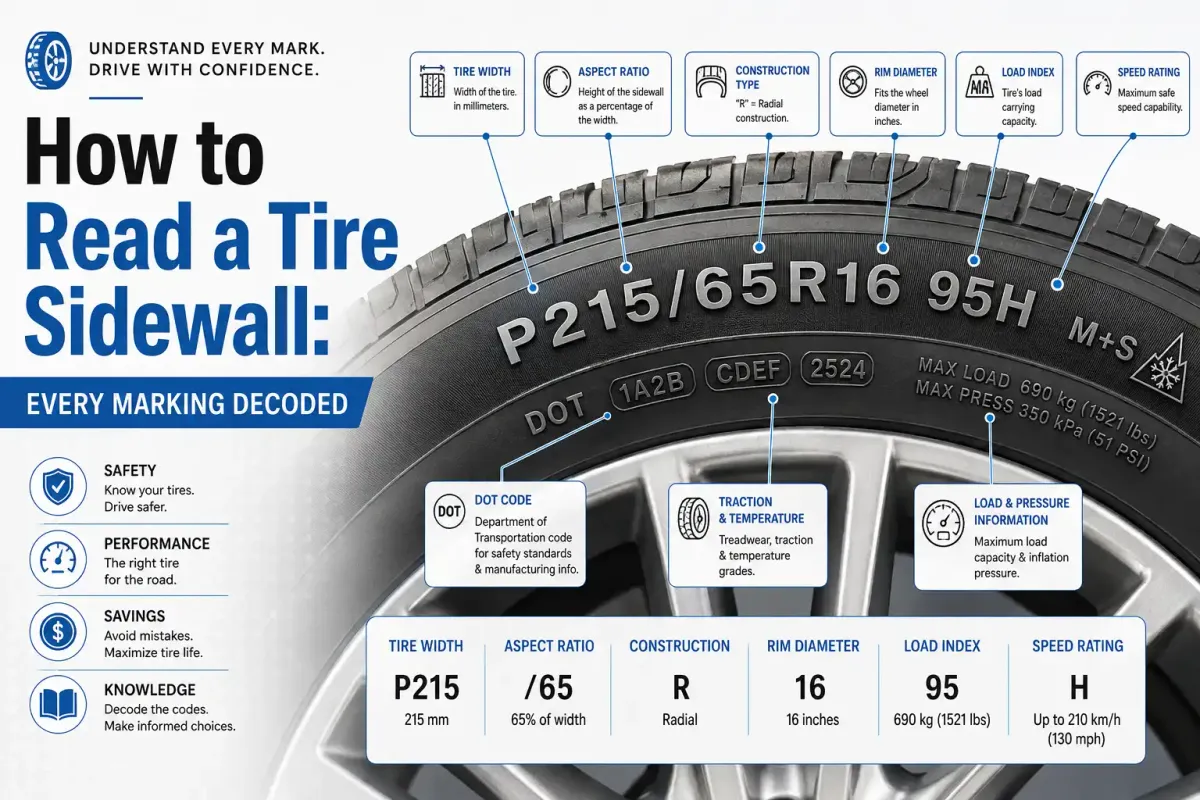
Short answer: a tire sidewall carries roughly six independent specifications plus manufacturing data, and they are not variations on one thing. Size, service type, load rating, speed rating, quality grades and construction are separate systems that happen to share a piece of rubber. Read them as one blur and you will make the classic substitution errors. Read them as six systems and the tire becomes a spec sheet you can actually use.
This page is the map. Each marking gets enough here to recognize and understand it, and links to the article that covers it properly.
The six systems, and what each one governs
| Marking | What it governs |
|---|---|
| Service type letter | Which rating conventions apply to this tire |
| Size code | Physical dimensions, nominal |
| Load index | Load rating, as an index into a standard table |
| Speed rating | Certified speed capability, and construction by proxy |
| Load range or ply rating | Load capability under an older parallel system |
| UTQG grades | Treadwear, traction and temperature, as graded by the manufacturer |
Plus the DOT code, which is manufacturing data rather than a specification, and a set of construction and mounting markings.
The size code, and where it starts
The longest string on the sidewall is the size, and it usually begins with a letter that is not part of the size at all.
That leading letter is the service type: P for passenger, LT for light truck, ST for special trailer, or nothing at all on metric sizes without a service designation. It changes which rating conventions apply, which is why it matters before you read a single digit: P, LT, ST and XL tire markings.
After it come three numbers in three different unit systems, which is the single most common source of confusion in this whole subject. Section width is in millimeters, aspect ratio is a percentage rather than a measurement, and rim diameter is in inches. Full walkthrough: reading a metric tire size.
The service description: load index and speed rating together
Immediately after the size sits a short group usually written as a two or three digit number followed by a letter. That is the service description, and it is two separate specifications printed together.
The number is the load index, an index into a standardized table rather than a weight. It is not linear, so a difference of a few points is not a difference of a few percent in anything: tire load index explained.
The letter is the speed rating. It certifies a speed capability, and it is also a proxy for construction and heat tolerance, which is why downgrading it affects more than top speed: tire speed rating letters.
Both are requirements your vehicle sets, and both are recorded on the vehicle rather than on the tire.
Load range and ply rating, which are a third system
Some tires additionally carry a load range letter, and older or heavier-duty tires may carry a ply rating.
These are not the same as the load index and they are not convertible to it by reasoning. They are parallel systems from different eras that coexist on the same product, which is exactly why a reader can find one tire described three different ways and conclude the sources disagree.
They do not disagree. They are three systems: load range vs load index vs ply rating.
UTQG: treadwear, traction and temperature
Many tires carry three Uniform Tire Quality Grading marks together: a treadwear number, a traction letter and a temperature letter.
The important caveat, which is rarely stated on consumer pages, is that treadwear grades are assigned by each manufacturer relative to its own reference. That makes comparison across brands much weaker than the numbers suggest, and it means the arithmetic people naturally do with them does not hold: UTQG grades explained.
The DOT code and what the date portion tells you
The DOT code is a manufacturing identifier rather than a specification. It identifies the plant and, at its end, the week and year of manufacture.
Two honest notes. The date portion tells you when the tire was made, which is a genuinely useful fact when buying used or from old stock. And what to do with that information, whether a tire of a given age should be replaced, is a condition and maintenance question rather than a specification question, and it is not something this site covers. Take it to a tire professional who can see the tire.
Construction and materials markings
Below the headline markings, most sidewalls carry a construction description: the number and material of the plies in the tread and in the sidewall.
This is descriptive rather than a rating. It is useful context when comparing two tires that look identical on the headline specifications, and it is not a substitute for the load and speed ratings, which are the certified figures.
Directional and asymmetric mounting markings
Some tires may only be fitted one way round, and the sidewall says so.
Directional tires carry a rotation arrow and must run in one direction. Asymmetric tires carry inside and outside markings and must be mounted with the correct face out. Getting either wrong does not stop the wheel from bolting on, which is the problem: nothing about the fitted vehicle announces the error.
If you are buying used wheels with tires already mounted, this is worth checking before you assume they can go on any corner.
The maximum pressure marking, and why it is not your inflation figure
Sidewalls carry a maximum inflation pressure. It is a limit for the tire, not a recommendation for your vehicle.
Your vehicle's inflation figure comes from the vehicle, on the Tire and Loading Information placard or in the owner's manual. This site does not publish pressure figures at all, and the distinction between a tire maximum and a vehicle specification is the reason: they are answers to two different questions and using one for the other is a genuine error.
Where the vehicle's own figures live: the Tire and Loading Information placard.
Which markings must match your vehicle's requirement
Not everything on the sidewall is a requirement. Some of it is descriptive, and some of it is a specification your vehicle sets.
The ones your vehicle sets are size, load rating and speed rating, and the service type that determines how those are expressed. Those come from the vehicle's placard and manual, not from the tire currently fitted, because the tire currently fitted may itself be wrong.
UTQG grades, construction description and brand markings are not vehicle requirements. They are how you choose between tires that already meet the requirement.
Where to get your vehicle's own requirement
Two places, in order. The Tire and Loading Information placard on the driver's door jamb, and the owner's manual for your vehicle and market.
If neither is available, that is a recoverable situation but not one to solve with a chart: when the door jamb sticker is missing. And for anything where the specification genuinely matters and you cannot find it, the tier above the owner's manual exists: owner's manual vs service manual vs repair database.
If you are working the other way round, starting from a set of wheels rather than a vehicle, the checklist is here: will these used wheels fit. And if you are changing wheel size deliberately, the constraint set is here: plus-sizing explained.
Frequently asked questions
What do all the numbers on a tire mean?
They are about six independent specifications, not one code: service type, size, load index, speed rating, load range or ply rating, and UTQG grades, plus a DOT manufacturing code and construction markings.
Which sidewall markings have to match my car?
Size, load rating and speed rating, expressed in the convention your vehicle's service type uses. Those requirements come from the vehicle's placard and manual, not from whatever tire is currently fitted.
Should I inflate to the pressure on the sidewall?
No. That figure is a maximum for the tire. Your vehicle's inflation specification is on its own placard or in its manual, and it answers a different question.
Can I tell how old a tire is from the sidewall?
The DOT code ends with the week and year of manufacture. What to do about a given age is a condition question for a tire professional, not a specification question.
Why do two tires with the same size have different ratings?
Because size and rating are separate systems. Two tires can share a size code and differ in load index, speed rating and load range, which is why substituting on size alone is unsafe.