Tire Size Numbers Meaning: P215/65R17 Explained
Three numbers in three different unit systems. Here is which is millimeters, which is a percentage, which is inches, and why that trips people up.

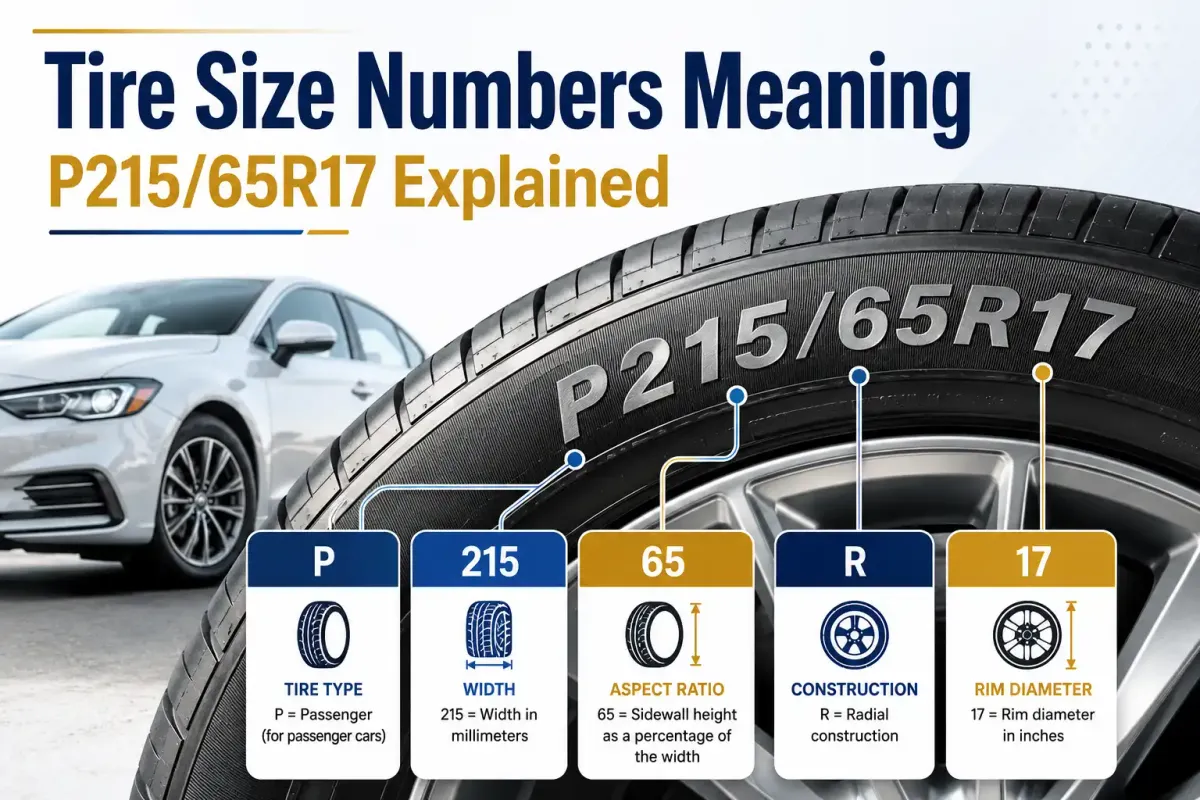
Short answer: the three numbers in a tire size are in three different unit systems, and that is why the code confuses people. Section width is in millimeters. Aspect ratio is a percentage, not a measurement. Rim diameter is in inches. Nobody designed it that way on purpose; it is what happens when a metric system is grafted onto an imperial wheel standard.
Once you know that, the code reads cleanly. Take P215/65R17 as the structure, and work through it left to right.
The service type letter at the front
The P is not part of the size. It is the service type, and it tells you which set of rating conventions applies to this tire.
P means passenger. LT means light truck. ST means special trailer. A size with no letter at all is a metric size without a service designation, which is common on vehicles from some markets.
This matters before the numbers because the same nominal size in a different service type is a different product with different rating conventions, not a stronger version of the same thing: P, LT, ST and XL tire markings.
Section width, in millimeters
The 215 is the nominal section width in millimeters, measured at the widest point of the tire's cross section.
Two words in that sentence are doing work. Nominal means it is the designated size rather than a promised measurement of the tire you receive. Section width is the widest point of the tire, which is not the same as the width of the tread contacting the road, and readers routinely assume it is.
The practical consequence is that two tires marked 215 from different manufacturers are not necessarily the same width when mounted. That is normal, it is within how the system works, and it is one reason a calculator cannot settle a fitment question: what tire size calculators cannot know.
Aspect ratio, which is a percentage and not a measurement
The 65 is the aspect ratio, and it is the number most often misread.
It is the sidewall height expressed as a percentage of the section width. It is not millimeters, it is not inches, and it is not a measurement of anything by itself. A 65 means the sidewall height is 65 percent of the section width, whatever that width happens to be.
This is why the aspect ratio cannot be compared across different widths without doing the arithmetic. Two tires both marked 65 have different sidewall heights if their widths differ, because the percentage is of different things.
The construction letter
The R stands for radial construction, and on modern passenger tires it is nearly always an R.
Other letters exist for other constructions, and where a size shows a D or a B or a hyphen instead, it is telling you the tire is built differently. On anything current you are unlikely to meet them outside specialist and classic applications.
Occasionally a letter appears before the R indicating a speed capability within the size string on some older or European conventions. Where the sidewall carries a separate service description after the size, that is the authoritative place to read the speed rating: tire speed rating explained.
Rim diameter, in inches
The 17 is the rim diameter the tire is designed to mount on, in inches.
This is the hard constraint in the code. Width and aspect ratio have some flexibility in what a given wheel can carry; rim diameter does not. A tire designed for one rim diameter does not go on a wheel of another, and no amount of fitting effort changes that.
It is also the number that moves when people talk about going to bigger wheels, and the reason plus-sizing has to be handled as a system rather than one change: plus-sizing explained.
Why the same aspect ratio means different things at different widths
Worth stating on its own, because it is the practical trap in this code.
Because the aspect ratio is a percentage of the section width, changing the width while keeping the ratio changes the sidewall height, which changes the overall diameter of the assembly. Readers who hold the aspect ratio constant while changing width, expecting the tire to stay the same height, are surprised.
Overall diameter is what the vehicle's speedometer is calibrated against, and it is what determines whether the assembly clears the bodywork and suspension. That is why any size change has to be evaluated on overall diameter rather than on any single number in the code.
What the size code does not tell you
Being clear about the gaps, because the size is only one of six systems on the sidewall:
- Not the load rating. That is the load index, in the service description after the size.
- Not the speed rating. Also in the service description.
- Not the load range or ply rating. A separate parallel system: load range vs load index.
- Not whether it fits your vehicle. The size your vehicle requires is on its own placard: the Tire and Loading Information placard.
The full sidewall, marking by marking: every number on your tire sidewall, decoded.
Frequently asked questions
Is the first number in a tire size the width in inches?
No, it is the nominal section width in millimeters. The rim diameter at the end is the number in inches, which is what makes the code confusing.
What does the middle number mean?
It is the aspect ratio, the sidewall height as a percentage of the section width. It is a ratio, not a measurement, so the same number means different heights at different widths.
What does the R stand for?
Radial construction. Nearly all modern passenger tires are radial, and other letters indicate other construction types you are unlikely to meet outside specialist applications.
Are two tires with the same size code identical in size?
Not exactly. The numbers are nominal, and real tires of the same nominal size vary between manufacturers. This is normal and is one reason a fitment cannot be settled from a calculator.
Does the size code tell me if a tire is strong enough for my car?
No. Load capability is the load index and load range, which are separate markings. Substituting on size alone is unsafe.