Load Range vs Load Index vs Ply Rating: Three Systems
One tire can carry an E, a 121 and a 10-ply marking. They are three systems from three eras, and you cannot convert between them by reasoning.

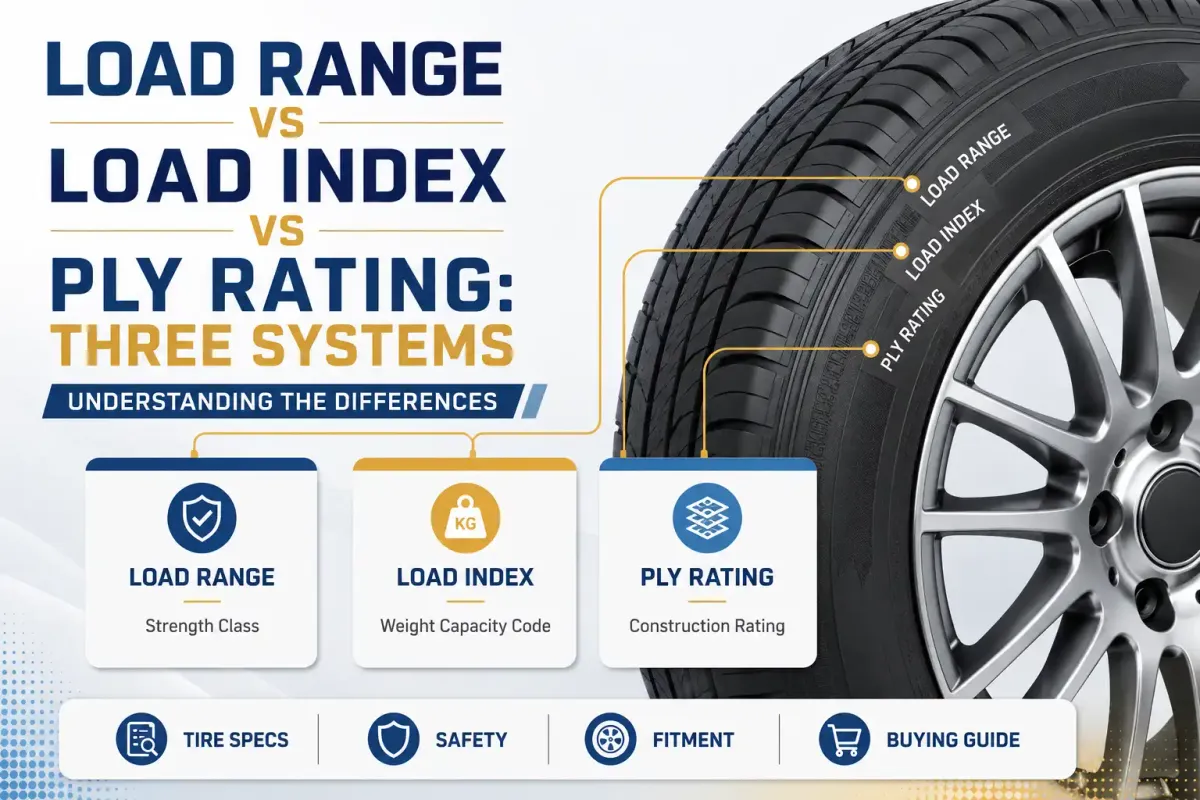
Short answer: they are three different rating systems from three different eras, and they coexist on the same tire because the industry never fully retired the old ones. A tire can legitimately carry a load range letter, a load index number and a ply rating, all describing load capability in incompatible ways. None of them contradicts the others. They are three languages for one property.
This is the single most common source of confusion in tire ratings, and the confusion is entirely reasonable. Nothing on the sidewall explains that you are looking at three systems rather than one specification written oddly.
The three systems at a glance
| System | Form | Era |
|---|---|---|
| Ply rating | A number followed by "ply" | Legacy, from bias-ply construction |
| Load range | A single letter | Successor to ply rating |
| Load index | A two or three digit number in the service description | Current comparison standard |
Ply rating, and why it stopped meaning plies
Ply rating is the oldest of the three, and its name is now misleading.
On early bias-ply tires, the number of fabric plies in the carcass genuinely correlated with load capability, and counting plies was a reasonable proxy for strength. As construction changed, particularly with the move to radial tires, that correlation broke: a modern tire achieves a given capability with far fewer physical plies than the old equivalence implied.
The industry kept the terminology as a rating rather than a count. A tire described as 10-ply today is almost certainly not built from ten plies. It is rated at what a 10-ply bias tire would have been rated at.
That is why arguing about ply counts on a modern tire is arguing about a unit that stopped being literal decades ago.
Load range, the letter system
Load range replaced ply rating as the letter-coded successor, and it maps onto the old ply ratings in a defined way.
It is a single letter, and it identifies a load and inflation category rather than a specific capacity. It appears most commonly on light truck tires and on Extra Load passenger tires.
The important property: load range is a category, and knowing the category does not by itself tell you the tire's rated load. It tells you which set of conditions the tire is rated under.
Load index, the numeric system
The load index is the current standard for comparing tires, and it is the one designed to be used numerically.
It is an index into a standardized table, printed in the service description immediately after the size. Its advantage over the other two is that it points into one table everyone agrees on, so two tires from different manufacturers with the same index are rated against the same standard.
Its trap is that the scale is not linear, so the numbers cannot be reasoned about arithmetically: tire load index explained.
Why all three can appear on one tire
Because they serve different audiences and none of them was ever fully withdrawn.
Load index is what the standards and the vehicle manufacturers work in. Load range is what the light truck tire market has used for decades and continues to use. Ply rating persists because buyers still ask for it and sellers still speak it.
A manufacturer printing all three is not being redundant. It is being legible to three sets of people who each learned a different system, and it is the honest thing to do.
What you can and cannot infer across the three
Here is the practical rule, and it is the reason this article exists.
You cannot convert between them by reasoning. There is no mental arithmetic that turns a load range letter into a load index, or a ply rating into a capacity. The relationships are defined by published tables, not by proportion.
You cannot assume a higher letter beats a higher number, or any similar cross-system comparison. The systems have different granularity and different attached conditions.
What you can do is read the markings that both tires actually share. If two tires both carry a load index, compare those. If both carry a load range, compare those. Comparing one tire's letter against another's number is not a comparison at all.
How to compare two tires when they are labeled differently
Work through it in this order.
Find a marking they have in common. Most modern tires carry a load index, which makes it the usual common ground.
Check the service type is the same. A load index on a passenger tire and on a light truck tire are rated under different conventions, so the same number is not the same claim: P, LT, ST and XL tire markings.
If there is no common marking, ask. The tire manufacturer publishes ratings for its own products, and a tire professional has the tables. That is a two-minute question with a definite answer, and it is a better use of the time than trying to derive it.
What your vehicle actually specifies
The comparison above tells you how two tires relate to each other. It does not tell you whether either one is right for your vehicle.
That requirement comes from the vehicle: the Tire and Loading Information placard in the driver's door jamb, and the owner's manual for your vehicle and market. See reading the tire lines on the loading placard.
If your vehicle's specification is expressed in a system the tire in front of you does not use, that is exactly the situation where you stop and ask a professional rather than converting. And if you cannot find the vehicle's requirement at all, the tier above the owner's manual is where it lives: owner's manual vs service manual vs repair database.
Everything else on the sidewall, in context: every number on your tire sidewall, decoded.
Frequently asked questions
Is load range the same as load index?
No. Load range is a letter identifying a load and inflation category. Load index is a number pointing into a standardized load table. They are different systems and are not convertible by reasoning.
Does 10-ply mean ten plies?
Not on a modern tire. Ply rating survived as a rating rather than a count, and a tire rated 10-ply today is built with far fewer physical plies than the name suggests.
Why does my tire have three different load markings?
Because three systems coexist and none was fully retired. Manufacturers print all three so buyers who learned different systems can all read the tire.
Which of the three should I compare on?
Whichever marking both tires actually carry, with the same service type on both. Load index is the usual common ground on modern tires.
Can I work out the load index from the load range?
Not by reasoning. The relationship is defined in published tables. Ask the tire manufacturer or a tire professional rather than estimating.