
Tire Load Index Explained: Why Lower Is Never Free
The load index is an index into a standard table, not a weight, and the scale is not linear. Here is what it rates and why going lower is never neutral.

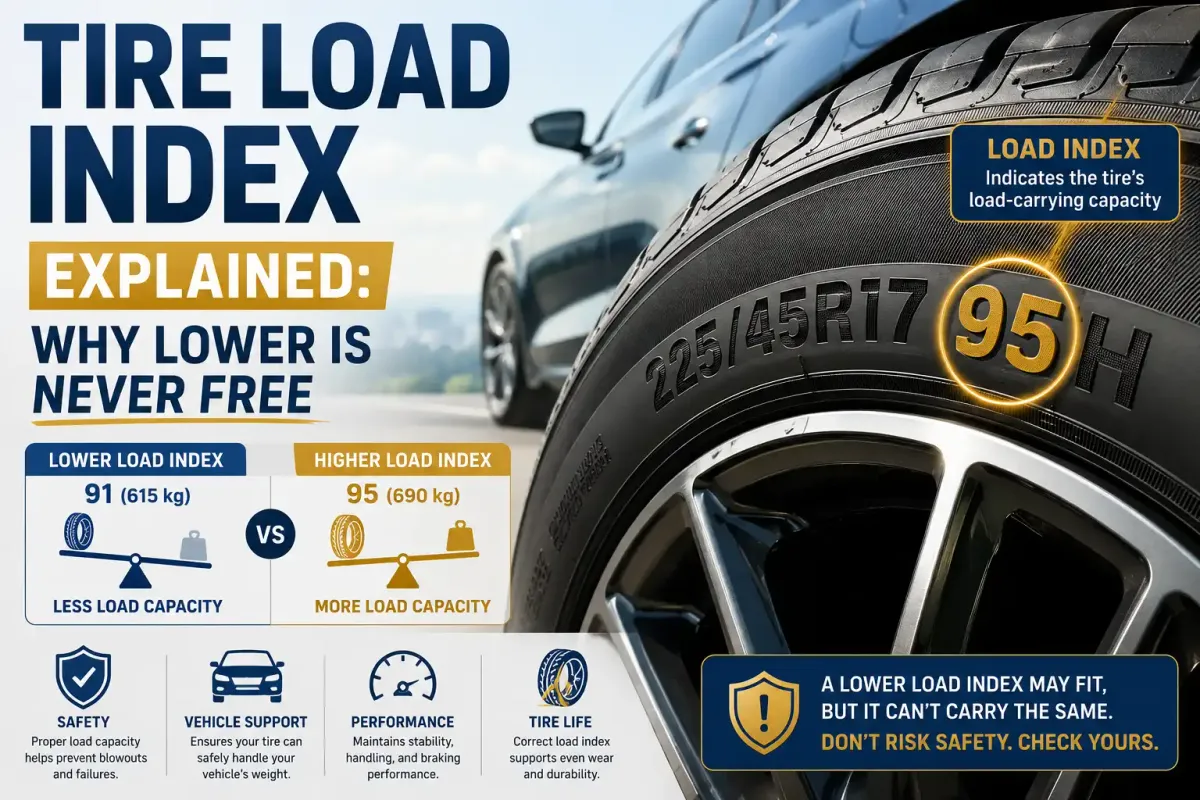
Short answer: the load index is an index into a standardized table, not a weight, and the scale is not linear. That is why the reader's instinct, that dropping from 105 to 102 is a small three-point change, is wrong in a way the number actively conceals. Three index points is not three percent of anything, and the relationship between adjacent index values is not constant across the scale.
The second thing to know is that the index is conditional. It rates the tire's load capability under specified inflation conditions, which means the number by itself is not a capacity claim. It is a capacity claim with attached conditions, and the conditions are part of the specification.
We do not publish the index-to-load table here, and we do not publish pressure figures anywhere on this site. Both are things you should read from a source that names the exact tire and the exact vehicle, and the last section says where.
What the load index is an index of
The load index is a code that points into a standardized table maintained by the tire standards organizations. Each index value corresponds to a maximum load the tire is rated to carry under specified conditions.
The word to hold onto is index. It is a lookup key, not a measurement. Nothing about the number 102 physically describes a tire; it identifies a row in a table that everyone in the industry agrees on.
This is genuinely useful design, because it means two tires from different manufacturers with the same index are rated against the same standard. It is also why treating the number as if it were a quantity produces bad reasoning.
Why the scale is not linear
This is the single most important structural fact on this page.
The index table is not a linear scale. Equal steps in index do not correspond to equal steps in rated load, and the size of a one-point step differs depending on where you are on the scale. A drop of three points near one end of the range is not equivalent to a drop of three points near the other.
The consequence for the reader in the micro-intent is direct: you cannot evaluate a change from one index to another by looking at the difference between the numbers. You have to look up both values in the table and compare what they actually rate.
That is a two-minute job with the right source and it is not something to estimate.
Where the index sits on the sidewall
The load index is part of the service description, the short group printed immediately after the size code. It is the number, and the letter following it is the speed rating.
Two markings, printed together, governing two different things. The speed rating half: tire speed rating explained.
On tires with dual designations, or on light truck tires, you may see more than one index value printed, reflecting different fitment configurations. If you are reading more than one number and are not certain which applies, that is a question for a tire professional rather than a guess.
Where this sits among everything else on the sidewall: every number on your tire sidewall, decoded.
Why the rating is conditional and not an absolute capacity
The load index rates the tire under specified inflation conditions. Change the inflation and you have changed the conditions under which that rating holds.
This is why an index number is not a standalone capacity claim, and it is why we will not give you a figure. A number without its conditions is exactly the kind of specification that reads as helpful and is not.
It is also why the service type matters. Passenger, light truck and Extra Load tires are rated under different conventions, so the same index on two different service types is not the same claim: P, LT, ST and XL tire markings.
What your vehicle requires, and where that requirement is written
Your vehicle sets a requirement, and the tire either meets it or does not.
That requirement is recorded on the vehicle, on the Tire and Loading Information placard on the driver's door jamb and in the owner's manual. It is not derived from whatever tire is currently fitted, because the tire currently fitted may itself be wrong: reading the tire lines on the loading placard.
If the placard is missing or unreadable, this is one of the items that should not be guessed: when the door jamb sticker is missing.
Why going lower is the one direction that is never neutral
Going up in index is generally a question of whether the tire is otherwise appropriate. Going down is different, and it deserves to be stated plainly.
A tire rated below the vehicle's requirement is operating outside the specification the manufacturer certified the vehicle with. The failure mode is not gradual and it is not announced: the reduced capability matters precisely at the moments the vehicle is asking most of the tire, under load, in heat, in an emergency maneuver.
That is why a lower index is never a free saving. It is a change to a safety-relevant specification, and the fact that the tire fits the wheel and the vehicle drives normally afterward is not evidence that it was acceptable.
If a shop offers a lower-rated tire, ask them directly to explain how it meets your vehicle's requirement. A competent shop will have an answer or will not make the offer.
Where to get the actual load figure for an index
Three sources, all better than a general chart:
The tire manufacturer. They publish the ratings for their own products and name the tire they apply to.
A tire professional. They have the standards tables and can apply them to your vehicle and the tire in front of them.
The tire standards organizations, which maintain the tables the index points into.
What we will not do is reproduce a load index table here. We cannot verify it against every tire and every vehicle combination, and a load figure applied to the wrong tire or the wrong conditions is exactly the class of error that this site exists to avoid. The general principle: why two websites give your car two different numbers.
And for how the index relates to the other two load systems on the same tire: load range vs load index vs ply rating.
Frequently asked questions
Does a three-point drop in load index matter?
Potentially a great deal. The scale is not linear, so the difference between the numbers does not tell you the difference in rated load. Look both values up in the standard table rather than estimating.
Is the load index a weight?
No. It is an index into a standardized table, and the load it corresponds to applies under specified inflation conditions. The number alone is not a capacity claim.
Where is the load index on the tire?
In the service description, immediately after the size code. It is the number, and the letter after it is the speed rating.
Can I fit a higher load index than my car needs?
Going up is generally a question of whether the tire is otherwise appropriate for the vehicle, which is worth confirming with a tire professional. Going down is a change to a safety-relevant specification.
Where do I find what load index my car requires?
On the Tire and Loading Information placard in the driver's door jamb, and in the owner's manual. Not from the tire currently fitted, which may itself be incorrect.