Tire and Loading Information Placard: The Tire Size Lines
The placard records the tire size your vehicle left the factory with, not what is on it today. Here is how to read it and compare it to your tires.

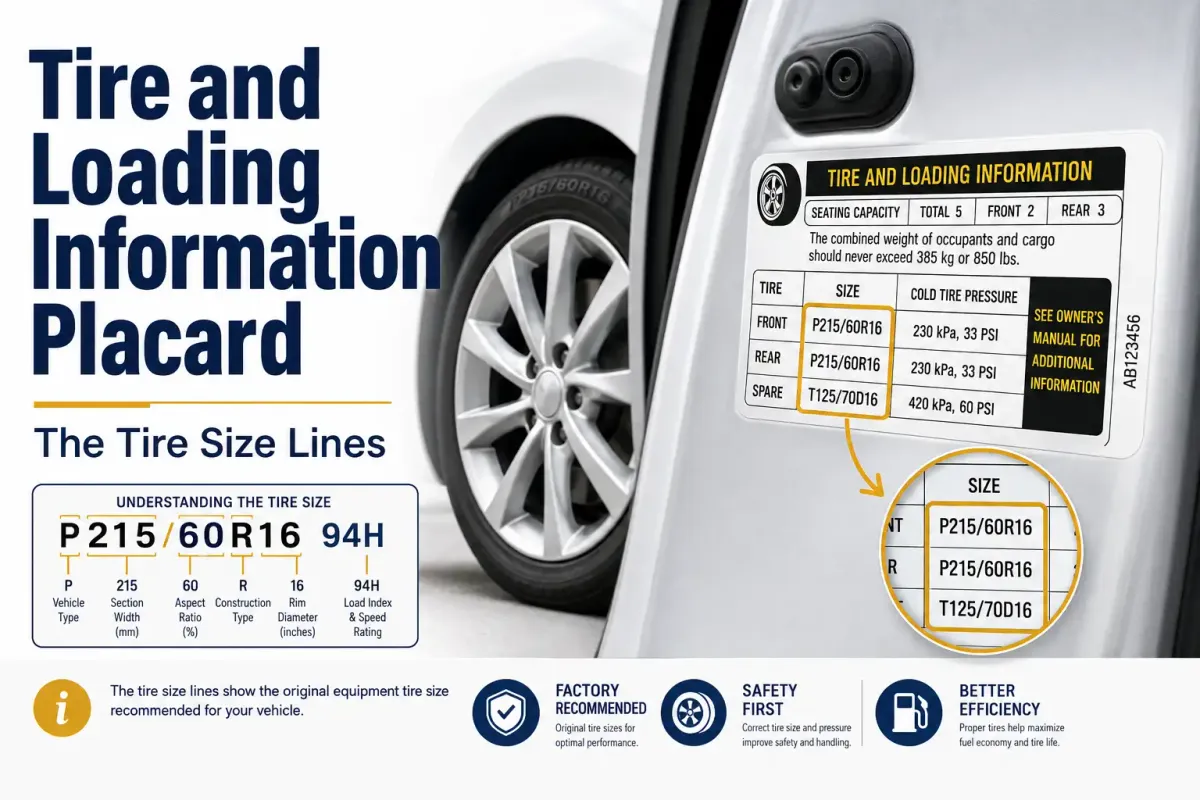
Short answer: the placard tells you what tire size your vehicle was built with, which is not the same as what is fitted to it right now. On a used vehicle those are different more often than most owners expect. The placard is the factory specification and it is the correct reference point, but confirming what is actually on the car means reading the sidewall of each tire and comparing.
Getting this wrong has real consequences. Tires are the only part of the vehicle touching the road, and fitting something that does not meet the vehicle's original rating can change how it behaves under load, in an emergency stop, or at speed. This article shows you how to read the placard and make the comparison. It does not tell you what to buy, and where the answer depends on your specific vehicle it sends you to your own placard and to a tire professional.
Where the placard is and what it looks like
Open the driver's door. The Tire and Loading Information placard is required for vehicles with a gross vehicle weight rating of 10,000 pounds or less by Federal Motor Vehicle Safety Standard 110, at 49 CFR 571.110, and the regulation requires it to sit near the certification label. On most vehicles that means the door frame or the edge of the door itself. A few manufacturers place it on the fuel filler flap or the glovebox door instead.
It is usually a white or silver label with a black border, visually distinct from the plainer certification label beside it. If you are looking at a label that has tire sizes on it, you have the right one. If you are looking at one that says the vehicle conforms to Federal Motor Vehicle Safety Standards, that is the certification label, which is a different label with a different job.
The tire size lines: front, rear and spare
The placard lists tire sizes in labeled positions. On most passenger vehicles you will see three entries: front, rear, and spare.
Front and rear are listed separately because they are not always the same. Vehicles with staggered fitments run different sizes at each axle by design, and reading only the front line on such a vehicle will give you the wrong size for half the car.
The spare is listed separately because it frequently is not the same tire at all. Temporary spares are a different size, a different construction and a different rating from the road tires, and the placard is where the vehicle tells you so.
Each entry is a tire size code, and it is dense. What each part of it means: reading a metric tire size.
How to compare the placard against the tire actually fitted
This is the part the placard cannot do for you.
Go to each tire and read the size molded into the sidewall. Compare it, character by character, to the corresponding line on the placard. Do all four, not one. Mixed sets are common on used vehicles, and the tire you happen to check first is not evidence about the other three.
You are comparing more than the three main numbers. The full sidewall code includes rating information that is part of the specification, not decoration, and a tire that matches on size can still differ on rating. The complete walkthrough of what is written on a sidewall: every number on your tire sidewall, decoded.
What a mismatch means, and the three questions it raises
A mismatch is not automatically a fault. It is a signal that a decision was made by somebody, and you do not know who or why. Three questions follow:
Was it deliberate? Owners fit different sizes on purpose, sometimes with sound reasoning and sometimes not. A previous owner's preference is not a specification.
Does it still meet the vehicle's requirements? This is the one that matters, and it is not answerable by comparing size alone. The ratings molded into the sidewall are part of the vehicle's requirement, and a tire can be the right size with a lower rating.
Was the vehicle modified in a way that made it necessary? Changed wheels can require a different tire size to keep the overall assembly workable. If the wheels are not original, the tire question is downstream of a wheel question. See will these wheels fit my car.
The load and inflation lines: what they are and where that question belongs
The placard carries more than tire sizes. It also carries load and inflation information, and it is required to.
This site does not publish tire pressure figures or pressure recommendations of any kind, and it does not cover vehicle load capacity. Both are questions where the correct answer is specific to your vehicle and its condition, and where a general figure published on a website is worse than no figure at all.
For inflation, the number on your own placard is the manufacturer's specification for your vehicle, and it is the one to use. It is not the number molded into the tire sidewall, which is a maximum for the tire rather than a recommendation for the car. That distinction is worth knowing and is as far as this article goes.
For anything about what the vehicle can carry, take it to your owner's manual and to a professional who can see the vehicle.
When the placard and the tire disagree: who to ask
If the tires on your vehicle do not match the placard and you cannot establish why, the people to ask are a tire professional and, for anything about the vehicle's original specification, the manufacturer or a dealer with your VIN.
Bring three things: a photograph of the placard, the full sidewall code from each of the four tires, and your VIN. That is enough information for a competent tire shop to tell you whether what is fitted is appropriate for the vehicle. It is not something to resolve from a chart, and it is not something this site can resolve for you, because the answer depends on the specific tires and the specific vehicle in front of you.
If the placard itself is missing or unreadable, do not guess and do not order a reproduction: when the door jamb sticker is missing.
Frequently asked questions
Is the placard tire size the only size my car can use?
It is the size the vehicle was certified with, which makes it the reference. Whether an alternative is appropriate depends on factors specific to your vehicle and is a question for a tire professional, not a chart.
My spare is a different size from my other tires. Is that wrong?
Usually not. Temporary spares are deliberately different and the placard lists them separately for that reason. Your owner's manual will cover the limitations that apply to using one.
Should I inflate to the placard number or the number on the tire?
The placard number is the vehicle manufacturer's specification for your vehicle. The figure on the sidewall is a maximum for the tire itself, not a recommendation. We do not publish pressure figures here; use your own placard.
The placard is in my glovebox, not the door. Is that normal?
Yes. The regulation requires the placard to be near the certification label, and a small number of manufacturers place both in locations other than the driver's door frame.
Two of my tires match the placard and two do not. What now?
Treat that as a question for a tire professional rather than something to resolve yourself. Bring the full sidewall codes from all four tires and a photograph of the placard.