Tire Speed Rating Explained: What Downgrading Costs
The speed rating certifies more than top speed. It is a proxy for construction and heat tolerance, which is why 'I drive slowly' is not the whole argument.

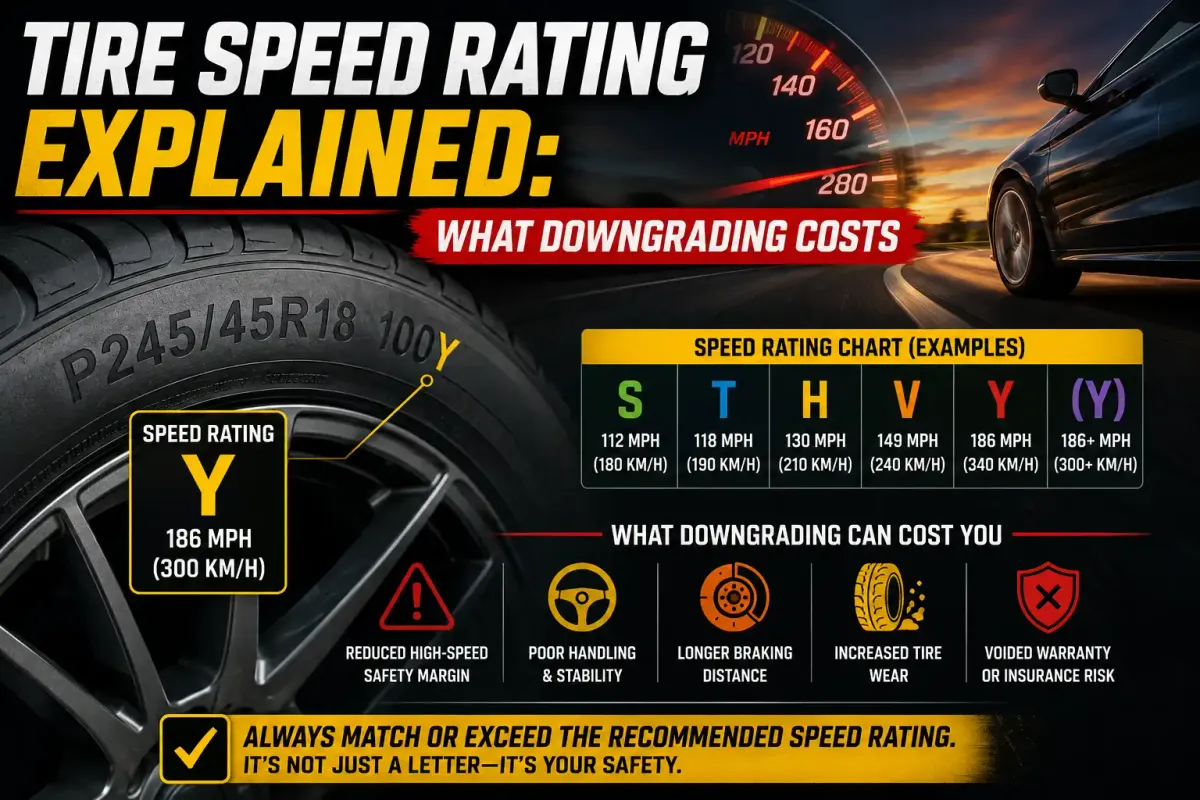
Short answer: the speed rating certifies a speed capability, but what it is really testing is how the tire handles heat, and heat is not something only fast drivers generate. That is why "I never drive that fast" is a reasonable observation and an incomplete argument. The rating correlates with construction, and construction affects how the tire behaves at speeds you do drive.
This page explains what the rating is certifying and what you are trading when you go down. It does not publish the letter-to-speed table, for the same reason it publishes no other specification: the figure that matters is the one your vehicle requires, and that is written on your vehicle.
Where the speed rating sits on the sidewall
The speed rating is a single letter at the end of the service description, the short group printed immediately after the size code.
The number before it is the load index, which governs load rather than speed. Two separate specifications, printed adjacent, and readers frequently read them as one thing: tire load index explained.
Some older and European conventions place a speed symbol inside the size string itself. Where a separate service description exists after the size, that is the authoritative place to read it. The full sidewall in context: every number on your tire sidewall, decoded.
What the rating is actually certifying
The speed rating is assigned through a standardized test in which the tire is run under load at increasing speeds for defined periods, and it certifies that the tire performed to the standard at the speed the letter designates.
Read that description again and notice what is in it: under load, for a defined period. The test is not a brief top-speed run. It is a sustained-load, sustained-speed endurance test, and what it is really measuring is whether the tire's structure survives the heat that sustained running generates.
That reframing is the whole article. The letter is a heat-and-structure certification wearing a speed label.
Why it correlates with things you notice at legal speeds
Because a tire built to survive higher sustained speeds is generally built differently.
Higher-rated tires typically use construction and compounds intended to remain stable under more thermal and mechanical stress. That construction affects how the tire behaves generally: how it responds to steering input, how much it deflects under cornering load, how it feels.
This is not a claim that a higher-rated tire is better for every driver. It is a claim that the rating is not isolated from everything else about the tire, so changing it changes more than the number. Someone who downgrades and then finds the car feels different has not imagined it.
The heat argument, which is the real one
Heat is generated by the tire flexing, and flexing happens whenever the tire is loaded and rolling. Speed increases it, but so do load, ambient temperature and underinflation.
The consequence is that a driver who never exceeds legal speeds can still ask a great deal of a tire thermally: a heavily loaded vehicle, in hot weather, on a long drive, on a tire that is not at its correct inflation. Those conditions compound.
The speed rating is one of the things standing between that combination and a structural failure. It is not the only thing, and a correctly rated tire in poor condition is not safe either, but it is the specification most directly connected to sustained thermal load.
Sustained load and ambient temperature as compounding factors
Worth separating out because it is where the "I drive slowly" argument actually breaks.
Speed, load and temperature are not independent inputs to the tire's thermal state. A vehicle carrying more weight generates more heat at the same speed. Hot road surfaces raise the starting point. Underinflation increases flex and therefore heat, which is why the vehicle's own inflation specification matters as much as the tire's ratings do.
We do not publish inflation figures. Your vehicle's figure is on its Tire and Loading Information placard and in its manual: reading the tire lines on the loading placard.
The relationship between the load rating and its own conditions runs the same way: load range vs load index vs ply rating.
What your vehicle specifies, and why the manufacturer chose it
Your vehicle's placard and owner's manual specify a speed rating, and the manufacturer chose it as part of certifying the vehicle.
That choice was not made against a typical owner's driving habits. It was made against the vehicle's capability and the conditions it might be operated in, including ones that particular owner may never reach. The specification is a property of the vehicle, not a prediction about you.
That is the honest answer to the micro-intent. The rating on your placard is not describing how fast the manufacturer expects you to drive. It is describing what the vehicle is certified to be capable of, and the tire is part of that certification.
Questions to ask before downgrading
If you are considering a lower rating, these are the questions worth putting to a tire professional who can see the vehicle:
What does my vehicle's placard specify, and is the tire being offered below it? Establish the fact before the argument.
Does the vehicle's certification depend on the specified rating? This is a question about the vehicle, and it is the one that decides whether this is a preference or a specification breach.
Are there legal or insurance implications where I am? In some jurisdictions fitting tires below the vehicle's specification has consequences beyond the mechanical ones. This varies by jurisdiction, we are not giving legal advice, and it is worth asking locally rather than assuming.
What else changes with the tire? Construction, response and wear characteristics usually differ, not just the certified speed.
A shop offering a lower-rated tire should be able to answer the first two directly. If the answer is a shrug, that is information too. And if the placard is missing so you cannot establish the requirement, do not fill the gap from a chart: when the door jamb sticker is missing.
For the other graded properties on the sidewall, which work quite differently: UTQG grades explained.
Frequently asked questions
What does the speed rating letter mean?
It certifies that the tire met a standardized endurance test at the speed the letter designates, run under load for defined periods. It is as much a heat and structure certification as a top-speed one.
Can I use a lower speed rating if I drive slowly?
It is a change to a specification your vehicle was certified with, and the rating correlates with construction and heat tolerance rather than only with top speed. Confirm with a tire professional against your vehicle's placard.
Does a higher speed rating mean a better tire?
Not automatically, and not for every driver. It means a tire built to survive higher sustained thermal and mechanical load, which affects how it behaves generally.
Where do I find my car's required speed rating?
On the Tire and Loading Information placard in the driver's door jamb, and in the owner's manual for your vehicle and market.
Is it illegal to fit a lower-rated tire?
That depends on the jurisdiction and this article does not give legal advice. It is worth asking locally, because some places attach consequences to fitting below the vehicle's specification.