Owner's Manual vs Service Manual: Which Has Your Spec
Three documents, three different readers. Which tier holds which kind of spec, and how an individual gets access to the one above the owner's manual.

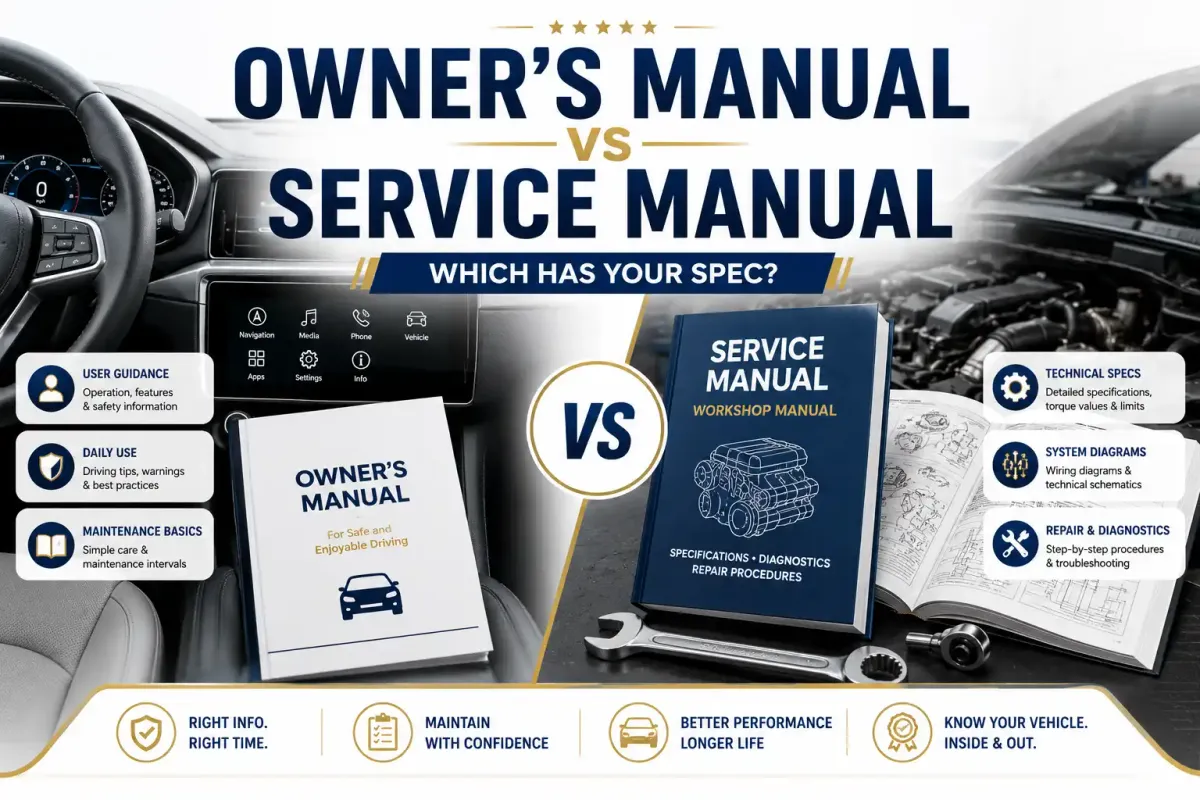
Short answer: they are three different documents written for three different readers, and the one you need depends on whether you are operating the vehicle or repairing it. The owner's manual covers operation. The factory service manual covers repair. Subscription repair databases sit on top of both and aggregate. The specification you cannot find in the manual is usually not missing, it is one tier up.
This page exists because it is where every safety-critical question on this site ends. When an article here tells you that a torque figure or a fluid specification has to come from your own vehicle's documentation, this is the page explaining what that documentation actually is and how to get into it.
The three tiers at a glance
| Written for | Typically covers | How you get it | |
|---|---|---|---|
| Owner's manual | The driver | Operation, controls, warning lights, fluid requirements, owner maintenance | Free from most manufacturers |
| Factory service manual | A technician repairing the vehicle | Procedures, torque figures, diagnostics, component specifications | Purchase, or manufacturer service information subscription |
| Repair database | A shop, aggregating many brands | Procedures and specifications across manufacturers | Subscription |
The owner's manual: written for operating the vehicle
The owner's manual is authoritative for what it covers, and what it covers is narrower than people assume.
It is the correct source for fluid requirements, for what each warning light means, for the routine maintenance the manufacturer expects an owner to perform, and for the operating limits of the vehicle's systems. When this site tells you a fluid specification lives in the owner's manual, that is not a fallback. It is the right document.
What it does not carry is repair-level detail. Torque figures for suspension, brake and engine fasteners are generally absent, along with disassembly procedures and component-level specifications. That is not an oversight. The manual's author did not anticipate you removing those parts.
If you no longer have yours, most manufacturers host it free: where to get your owner's manual free.
The factory service manual: written for repairing it
This is the document the manufacturer produced for technicians working on that vehicle. It is the authoritative source for the specifications the owner's manual omits.
Two things about it are worth understanding.
It is specific to model year and market. A service manual for the same nameplate in a different year or a different country is a different document with different numbers in it, and the difference is exactly the kind that matters. See why two websites give your car two different numbers for how often this is the underlying cause of a disagreement.
And it is a book about procedures, not a chart. A torque figure in a service manual arrives attached to a procedure, a sequence, and often conditions about thread state or whether the fastener may be reused. Stripping the number out of that context is what general torque charts do, and it is why they are unsafe.
Subscription repair databases: what they aggregate and from where
Repair databases are commercial products that aggregate service information across manufacturers into one interface, and shops use them because no shop wants a wall of manuals.
They are genuinely useful and they are a step removed from the source. They are compiling manufacturer information, which means they inherit both its accuracy and any error in the compilation. When a database and a manufacturer document disagree, the manufacturer document is the one to trust.
Several of these products sell short-term access to individuals rather than only shop subscriptions, which is worth knowing before you conclude the tier is closed to you.
Manufacturer service information portals and individual access
This is the fact that most changes what a private owner can do, and it is barely present in search results.
Manufacturers make service information available to independent repairers, and in practice that generally means it can be purchased by an individual as well, commonly through a subscription measured in days rather than years. It is not a trade-only wall.
What you get is the manufacturer's own information for your vehicle, which is the highest tier available short of a dealer. For a single job where a specification genuinely matters, a short subscription is frequently the cheapest correct answer available and it is more reliable than any chart.
To use it you will need to identify your vehicle precisely, which means the VIN and often the build date. Both are on the vehicle: what each VIN character encodes.
Which tier holds which kind of specification
A rough guide that holds most of the time:
- Fluid types and requirements: owner's manual.
- Capacities: owner's manual for the common ones, service information for the rest.
- Torque figures: service information. Almost never the owner's manual.
- Wheel torque specifically: sometimes the owner's manual, sometimes not, and it is worth checking both. See where your wheel torque spec actually lives.
- Procedures and sequences: service information only.
- Component part numbers: neither. That is a parts catalogue question.
How to tell a real service manual from a reprint or a scan
The market for these is full of resold scans, and some of them are fine while others are partial or for the wrong year.
Check that the document identifies its model year and market on its own pages rather than only in the seller's listing. Check that it is complete, because scanned copies disproportionately lose the specification tables at the back. And be cautious of anything described as covering a wide range of years in one volume, since that is either a genuine multi-year manual, which exists, or a compilation someone assembled.
When to stop searching and ask the dealer parts or service desk
There is a point at which more searching is worse than a phone call.
If you have spent an hour, found three different answers, and the fastener you are about to tighten is one where being wrong has consequences, the dealer service department has the manufacturer's information for your VIN in front of them. So does any competent independent shop with a service information subscription.
That is not a failure of research. It is the correct end of it, and it is the answer this site will keep pointing at, because a number we cannot verify for your exact vehicle is not something we are willing to publish.
Frequently asked questions
Why does my owner's manual not have torque specs?
Because it is written for operating the vehicle rather than repairing it. Repair-level specifications live in the factory service manual or manufacturer service information.
Can a private individual buy manufacturer service information?
Generally yes. Manufacturers make service information available beyond dealers, commonly including short-term subscriptions, and that is usually the highest-quality source an owner can reach.
Is a repair database as good as the factory manual?
It is a step removed. Databases compile manufacturer information, so they inherit both its accuracy and any compilation error. Where they disagree with a manufacturer document, trust the manufacturer.
Is a downloaded service manual PDF trustworthy?
Only if it identifies its model year and market on its own pages and is complete. Partial scans commonly lose the specification tables, which is usually the part you needed.
What if I still cannot find the number?
Ask a dealer service department or a shop with a service information subscription, with your VIN. That is the correct end of the search, not a shortcut around it.