UTQG Explained: Treadwear, Traction and Temperature
Treadwear grades are assigned relative to each manufacturer's own reference, which makes cross-brand comparison far weaker than the numbers suggest.

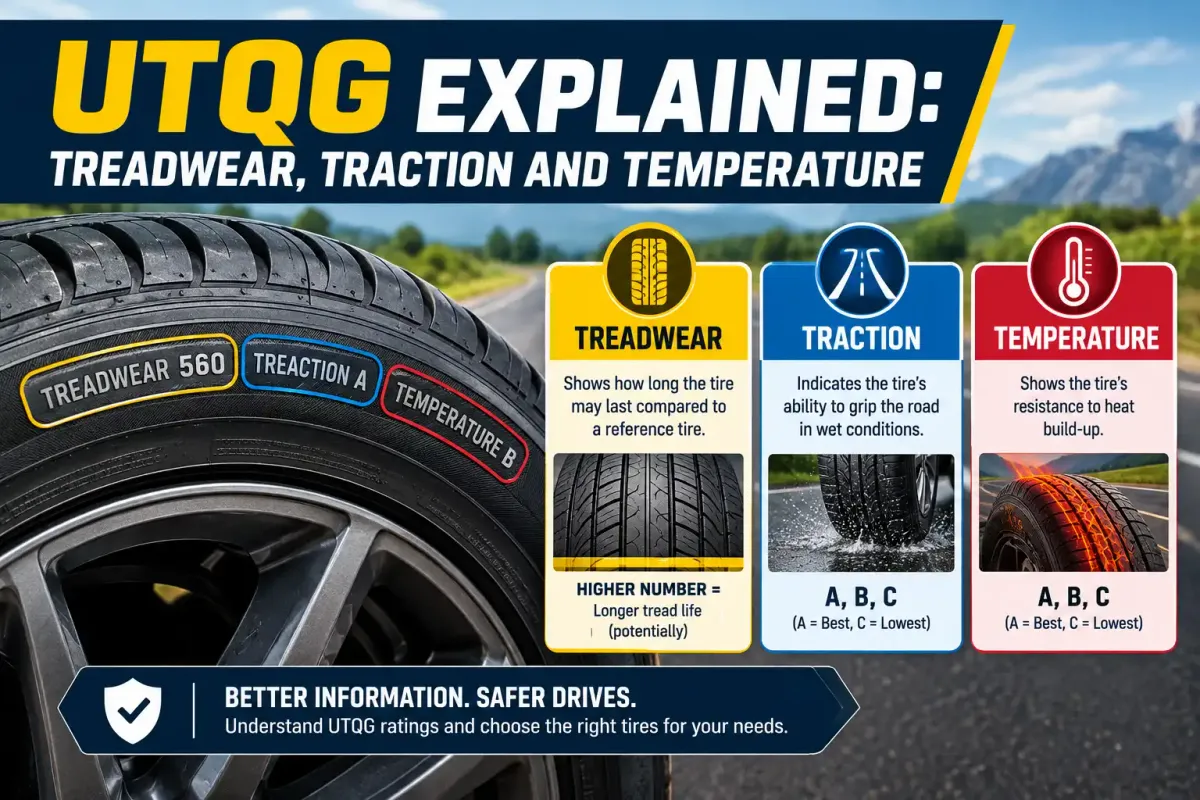
Short answer: UTQG is three separate grades, and only one of them looks like a number you can do arithmetic on, which is exactly the trap. Treadwear is a relative grade assigned by each manufacturer against its own reference, so comparing a 500 from one brand against a 400 from another is not the clean quarter-better comparison it appears to be. Traction and temperature are graded differently again.
The direct answer to the question in the title of this section: no, one is not better by a quarter, and the reason is worth understanding because it applies to a lot of published tire data.
Where UTQG appears and which tires carry it
The three grades are molded into the sidewall together, usually as a number followed by two letters, labeled with the words treadwear, traction and temperature.
Uniform Tire Quality Grading is a United States requirement, and it does not apply to every category of tire. Where you do not find these grades on a tire, that is not necessarily an omission; it may be a category the grading does not cover.
Everything else on the sidewall, in context: every number on your tire sidewall, decoded.
Treadwear: what the grade is relative to
The treadwear grade is a relative number, and the word relative is doing all the work.
The grade expresses the tire's wear performance relative to a reference tire under a standardized course test. A tire graded twice the number of another wore, in that testing, at a rate implying roughly twice the life of the reference.
Two things follow immediately. The grade is not a mileage prediction, and nothing in the system claims it is. And because it is expressed relative to a reference, the grade only means what it says if you know both tires were graded against a comparable baseline.
Why cross-brand treadwear comparison is weaker than it looks
Here is the part that consumer pages routinely skip.
Manufacturers assign their own treadwear grades based on their own testing and their own judgement of how their result maps to the grade scale. There is no central body issuing a grade for every tire on the market.
That produces a real and well-known consequence: manufacturers can be systematically conservative or systematically generous relative to one another, and there is no correction factor a buyer can apply. Comparing treadwear grades within a manufacturer's range is meaningful, because the same house judgement applies across it. Comparing across manufacturers is much softer than the precision of the numbers implies.
So the answer to "is 500 a quarter better than 400" is: within one brand's lineup, that is a reasonable directional read. Across brands, the difference may be smaller, larger, or in the other direction.
This is a specific case of a general problem worth understanding: why two websites give your car two different numbers.
Traction grades and what is being measured
Traction is graded with letters, and it measures something much narrower than the word suggests.
The traction grade comes from a test of straight-line wet stopping on specified surfaces. That is a real and useful property, and it is not the same as cornering grip, dry grip, snow performance or handling.
A tire with a high traction grade is certified to have performed well in that specific test. It is not certified to be a better tire in any general sense, and readers who treat the traction grade as an overall grip score are reading more into it than the grading system claims.
Temperature grades and what is being measured
Temperature is also graded with letters, and it measures the tire's resistance to heat generation and its ability to dissipate heat under standardized laboratory conditions.
There is a floor: tires must meet a minimum temperature grade to be sold, so the grade is not a pass or fail signal. It differentiates above a required minimum.
This grade is related in spirit to what the speed rating certifies, and the two are worth reading together, because both are ultimately about how the tire copes with sustained thermal load: tire speed rating explained.
What UTQG does not tell you about a tire
The grades are three narrow measurements, and it is easier to say what falls outside them:
- Not how long the tire will last on your vehicle. Wear depends on the vehicle, alignment, load, road surface, climate and driving. The grade is a comparative index from a controlled test.
- Not wet or dry cornering grip. Traction grades straight-line wet stopping only.
- Not snow or ice performance. Separate markings cover severe snow service.
- Not load or speed capability. Those are the load index and speed rating, which are certifications rather than grades: tire load index explained.
- Not ride, noise or comfort. Not graded at all.
How to use it sensibly anyway
None of the above makes UTQG useless. It makes it a tool with a defined range.
Use treadwear to compare within a manufacturer's range. That is where the relative grading is internally consistent and genuinely informative.
Use traction and temperature as floors rather than scores. They tell you a tire cleared a bar in a specific test. Treat them as screening criteria, not as rankings.
Do not use any of them to predict mileage, and be skeptical of any source that converts a treadwear grade into a mileage figure. That conversion requires assumptions about the vehicle and conditions that the grading system does not make and that nobody publishing a general chart can know about your car.
Do not use them to establish fitment at all. What your vehicle requires is size, load rating and speed rating, and those come from the vehicle: reading the tire lines on the loading placard.
The same caution applies to the tools that promise to settle fitment questions arithmetically: what tire size calculators cannot know.
Frequently asked questions
Is a treadwear grade of 500 better than 400?
Within one manufacturer's range, directionally yes. Across brands the comparison is much weaker, because each manufacturer assigns its own grades against its own testing and judgement.
Does the treadwear grade tell me how many miles a tire will last?
No, and it does not claim to. It is a relative index from a controlled test, and actual wear depends on the vehicle, conditions and driving. Be skeptical of any chart converting grades to mileage.
What does the traction grade measure?
Straight-line wet stopping on specified test surfaces. It is not a general grip score and says nothing about cornering, dry or winter performance.
What does the temperature grade measure?
Resistance to heat generation and the ability to dissipate heat under standardized conditions. There is a required minimum, so the grade differentiates above a floor rather than passing or failing tires.
Do all tires have UTQG grades?
No. Uniform Tire Quality Grading is a United States requirement that does not cover every category of tire, so an absent grade is not necessarily a missing marking.