Penny Tire Tread Depth Chart 2026: Complete Coin Test Guide
Penny and quarter tread depth tests explained: 32nds to mm chart, legal minimums and wet-braking data from Tire Rack, AAA and Consumer Reports.

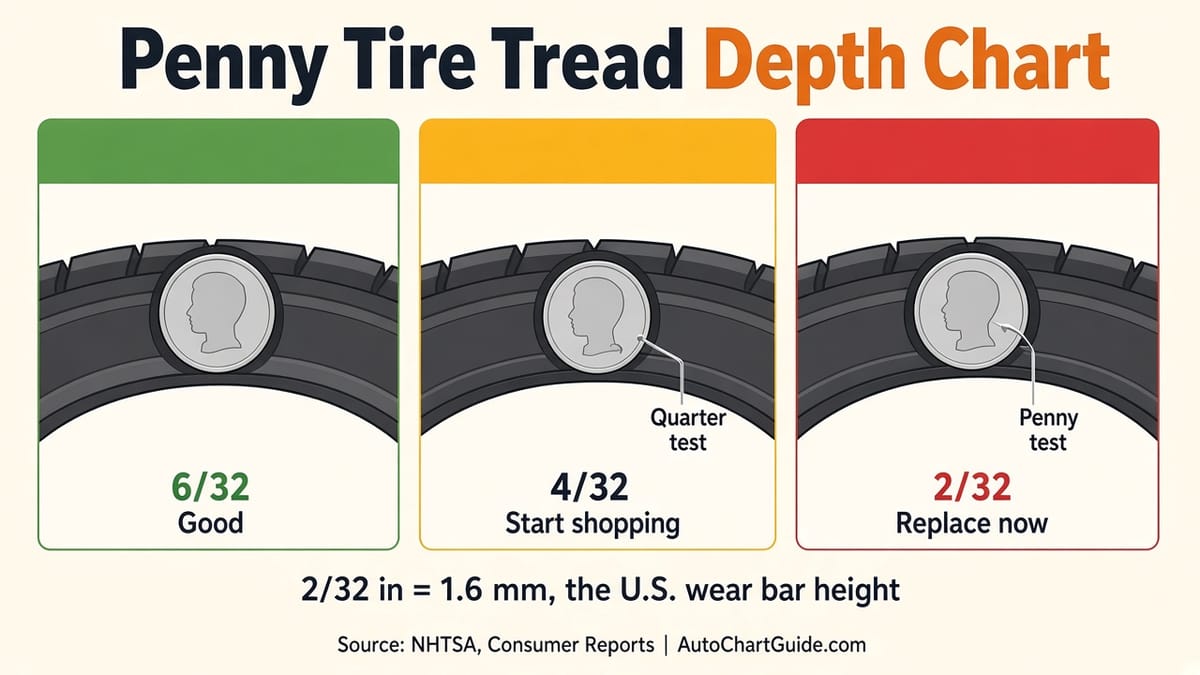
A penny tire tread depth chart turns a coin from your pocket into a rough tread gauge. Push a Lincoln penny head-first into a main groove. If you can see the top of Lincoln's head, the tread is at or below 2/32 inch (1.6 mm), the depth where NHTSA says tires are no longer safe and should be replaced. A quarter does the same job at 4/32 inch (3.2 mm), the point where Consumer Reports and AAA suggest you start shopping. Below you'll find a depth chart in 32nds, inches and millimeters, what each coin actually measures, test data showing how wet braking falls apart as tread wears, and the legal limits that apply to cars and commercial trucks.
Penny tire tread depth chart
| Tread depth | Inches | Millimeters | Quick check | What it means |
|---|---|---|---|---|
| 10/32-11/32 | 0.313-0.344 | 7.9-8.7 | Gauge | Typical new all-season passenger tire |
| 8/32 | 0.250 | 6.4 | Gauge | Good: plenty of wet and snow grip left |
| 6/32 | 0.188 | 4.8 | Gauge | About half worn. Snow traction is dropping. |
| 5/32 | 0.156 | 4.0 | Gauge | Plan your replacement |
| 4/32 | 0.125 | 3.2 | Quarter: top of Washington's head visible | Start shopping now. Wet braking is noticeably longer. |
| 3/32 | 0.094 | 2.4 | Gauge | Replace soon, especially before a wet or winter season |
| 2/32 | 0.063 | 1.6 | Penny: top of Lincoln's head visible; tread flush with the wear bars | Worn out. Replace now. |
| Below 2/32 | <0.063 | <1.6 | Wear bars flush across the tread | Below the replacement point in most states. Unsafe. |
Millimeter values are exact conversions (1/32 inch = 0.79 mm). The 2/32 and 4/32 coin readings are the ones published by NHTSA, Bridgestone, Consumer Reports and Tire Rack. We don't give coin readings for the in-between depths, because no coin feature reliably lines up with them. Use a tread depth gauge for those. Brake pads are judged the same way, by measured thickness rather than mileage; see our brake pad wear chart in mm.
How to do the penny test
NHTSA's tire safety guidance describes the test in one line: place a penny in the tread "with Lincoln's head upside down and facing you. If you can see the top of Lincoln's head, replace your tires." Bridgestone's version adds a few useful details:
- Pick a main groove. Put the penny into one of the deep grooves that run around the tire, between two tread ribs. Avoid the shallow sipes and the cross-slots.
- Head first. Turn the penny so Lincoln's head points down into the groove and his face looks at you.
- Look at the top of the head. If the rubber hides part of his head, you have more than 2/32 inch at that spot. If you can see all of it, that spot is at or below 2/32 inch.
- Repeat around the tire. Check the inner, center and outer grooves at several points around the circumference. Bridgestone says to replace the tire if any spot fails, even if the rest is deeper.
- Check all four tires and the spare if it's used. NHTSA suggests checking tread at least once a month, when you check tire pressure.
The test works because the distance from the edge of a U.S. penny to the top of Lincoln's head is about 2/32 inch. Tire Rack describes it as "the distance from the circumference of a U.S. penny to the top of Lincoln's head". It is a quick go/no-go check, not a measurement. A coin can't tell 3/32 from 7/32. It only tells you which side of the line you are on.
The quarter test: the earlier warning
The quarter test uses the same method with a different coin. Insert a quarter with Washington's head down. If the tread covers part of his head, you have at least 4/32 inch. If you can see the whole head, you're at or below 4/32. Consumer Reports and AAA both recommend this check. As Consumer Reports explains, "At 4/32 inch you still have some all-weather grip left, which will give owners time to research and shop for the best tire."
Bridgestone gives the reason: below 4/32 inch, "wet-weather stopping distances increase and the risk of hydroplaning rises dramatically." In practice, think of the quarter as the reminder to start shopping and the penny as the hard limit.
What about the Lincoln Memorial on the back?
Many articles suggest flipping the penny and using the Lincoln Memorial on the reverse of pre-2010 cents as a third depth check. We found two published versions that disagree. A Toyota dealer's service page says that if the memorial is completely hidden you have more than 3/32 inch. Car and Driver says that if the groove overlaps the top of the memorial you have at least 6/32 inch. The coin hasn't changed, so at least one is wrong, and pennies made since 2010 carry a shield design instead of the memorial. We left the memorial out of the chart. If you want readings between 2/32 and 4/32, or above 4/32, buy a tread depth gauge. They cost a few dollars at parts stores and read directly in 32nds.
Wear bars: the built-in penny test
Every passenger tire sold in the U.S. already has a 2/32 inch indicator built in. NHTSA explains in a 1996 interpretation letter that federal standards FMVSS 109 and 119 "require that all tires have treadwear indicators molded into the tread at the 2/32 of an inch tread depth level." The agency says it picked that depth "based on early studies that showed that when tread is worn to 2/32 of an inch, a tire rapidly loses its traction characteristics." Tire Rack notes that these wear bars became mandatory on August 1, 1968, and that today's FMVSS 139 keeps the same standard.
The bars are small raised bridges across the bottom of the main grooves. Many tires mark where they are with a small triangle, logo or "TWI" on the shoulder. When the tread ribs on either side wear down flush with a bar, the tire has reached 2/32 inch at that point, which is the same thing the penny tells you. NHTSA says, "When the tread is worn down so that it's level with the tread indicator, it's time to replace your tires."
How much grip you lose: the test data
Tread depth matters little on dry roads, where a bald racing slick grips best. It matters on wet roads, because the grooves have to clear water from under the contact patch. Water can't be compressed, so if the grooves can't move it out fast enough, the tire rides up onto a film of water and hydroplanes. Three independent test programs show what this means in numbers.
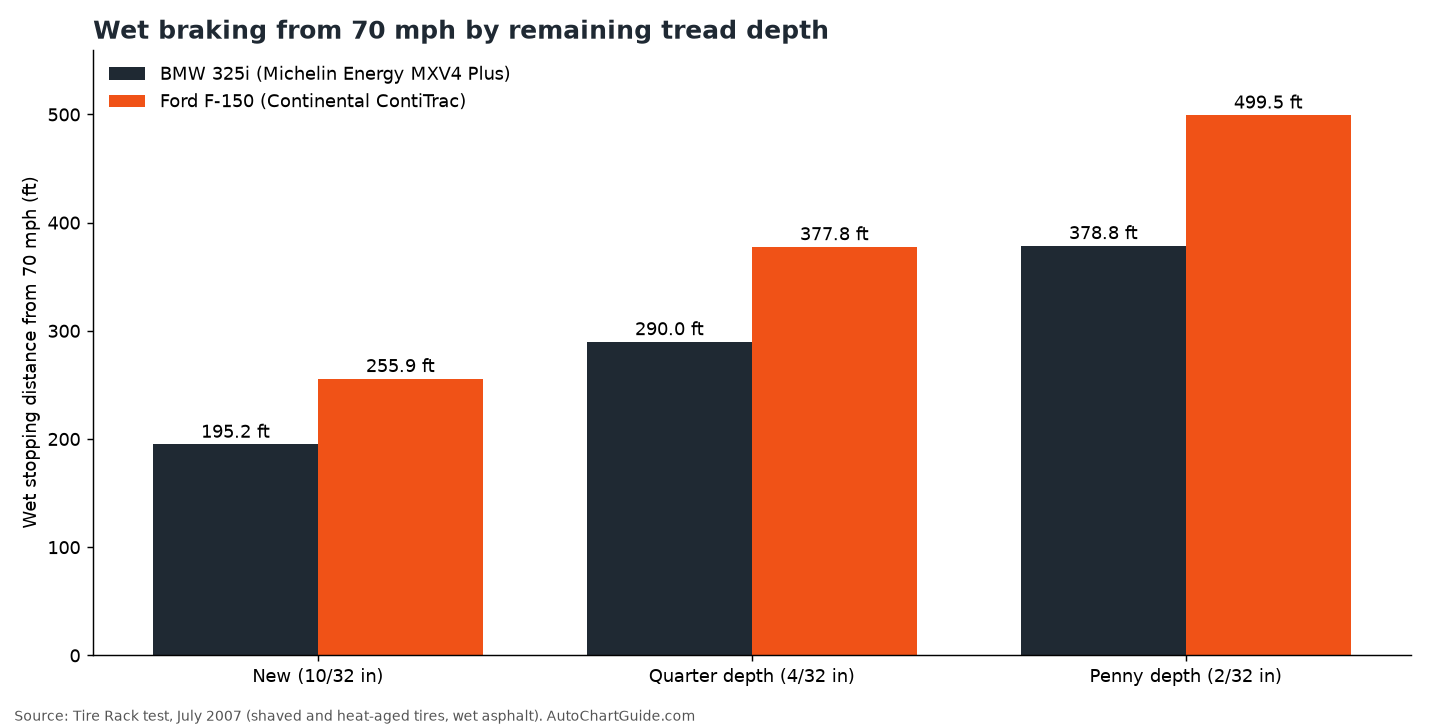
Tire Rack (2007): penny depth roughly doubles wet stopping
Tire Rack shaved sets of original-equipment tires to 4/32 and 2/32 inch, oven-aged them to simulate years of use, and ran panic stops from 70 mph on wet asphalt. A 2006 BMW 325i on new tires stopped in an average of 195.2 feet. On 4/32 inch tires it took 290.0 feet, and on 2/32 inch tires 378.8 feet. When the new tires had already brought the car to a stop, the car on penny-depth tires was still doing about 55 mph. A 2006 Ford F-150 needed 255.9 feet on new tires, 377.8 feet at 4/32 and 499.5 feet at 2/32, close to a tenth of a mile. Tire Rack concluded that the quarter is "a safer measure" than the penny.
AAA (2018): 4/32 already costs more than 40 percent
AAA's all-season tire study bought tires in the most common original sizes for a Toyota Camry and a Ford F-150, buffed them to 4/32 inch under controlled conditions, and compared them with new tires. Stopping distance from 60 mph on a wet road increased by 42 percent for the Camry and 44 percent for the F-150. At the point where the new tires had stopped, the car on worn tires was still doing about 39 mph, and it went on for an average of 87 feet more. Wet cornering grip dropped by 33 and 28 percent. AAA also notes that most tire manufacturers recommend replacing tires at 3/32 inch, and that AAA itself has traditionally recommended 4/32 inch.
Consumer Reports (2018): tire models vary a lot
Consumer Reports tested 23 all-season models new and shaved to 4/32 inch. On average, the worn tires needed almost 30 feet more to stop from 60 mph on wet pavement. The spread was large: one model gave up only 3 feet, another 51 feet. Every tire lost hydroplaning resistance. Even real tires taken from CR's 16,000-mile treadwear test had lost about 6 percent of their wet braking performance. Tread depth is the main factor, but how a tire ages also depends on the model, so wet-braking scores for worn tires are worth checking when you shop.
Legal minimum tread depth
| Vehicle / position | Minimum depth | Rule |
|---|---|---|
| Passenger cars and light trucks (most states) | 2/32 in (1.6 mm) | Set by each state. Wear bars are molded at this depth under FMVSS 109/139. |
| Commercial bus, truck or tractor: front (steer) tires | 4/32 in (3.2 mm) | 49 CFR 393.75(b) |
| Commercial vehicles: all other tires | 2/32 in (1.6 mm) | 49 CFR 393.75(c) |
For private passenger vehicles, the federal government doesn't set a removal depth. In its 1996 letter NHTSA explains that "states, not NHTSA, have the authority to enforce tire removal when the tread depth becomes worn below a certain level," and that the agency publishes inspection guidelines in 49 CFR Part 570 for states to follow. Most states that inspect vehicles use 2/32 inch. States can set a stricter limit, so check your own state's inspection rules. Pennsylvania is a good example of how they are written: its inspection regulation, 67 Pa. Code § 175.80, rejects a tire with less than 2/32 inch in two adjacent grooves at any point, or with the wear bars touching the road in any two adjacent grooves. Front tires on vehicles over 10,000 lb gross weight need 4/32 inch.
For commercial vehicles, the Federal Motor Carrier Safety Regulations are explicit. Under 49 CFR 393.75, steer tires on a bus, truck or truck tractor need at least 4/32 inch "when measured at any point on a major tread groove," and other tires need 2/32 inch. Measurements must not be taken on tie bars, humps or fillets, which is the same rule of thumb as for the penny test: measure in the main groove, not on a raised feature.
When to replace: a practical rule
Legal and safe are not the same thing. Here is a reasonable approach for most passenger vehicles, based on the guidance above:
- Above 4/32 in (quarter covers Washington's head): keep driving and check monthly.
- At 4/32 in: start shopping. If you drive a lot in the rain or on highways, replace now rather than later.
- At 3/32 in: most tire makers' recommended replacement point, according to AAA. Replace before the wet or snowy season.
- At 2/32 in (penny shows Lincoln's whole head, or tread is flush with the wear bars): replace now. The tire is worn out.
Tread depth isn't the only reason to replace a tire. NHTSA lists physical damage (cuts, cracks, bulges) and irregular wear from underinflation or overloading as reasons to stop using a tire, and notes that some vehicle and tire makers recommend replacement at six to ten years old regardless of tread. Our guide on how to read a tire sidewall shows where to find the DOT date code that tells you a tire's age.
Reading uneven wear while you measure
When you move the coin from groove to groove, compare the readings. They tell you more than the depth.
- Both shoulders worn, center deeper: usually underinflation. Check pressure against the door-jamb placard, not the sidewall maximum.
- Center worn, shoulders deeper: usually overinflation.
- One shoulder worn: usually an alignment problem, camber or toe. Bridgestone recommends having uneven wear inspected.
- Scalloped or cupped patches around the tire: often worn suspension parts or a balance problem.
- Front and rear wearing at different rates: normal for most vehicles, and the reason tires are rotated.
Always replace based on the shallowest spot. A tire that passes in the center groove but fails on the inside shoulder has failed.
Penny test vs tread gauge vs tire shop reading
A coin is a go/no-go check at one depth. A pencil-style tread depth gauge reads in 32nds and lets you track wear over time, which is useful for spotting a slow alignment problem before it ruins a set of tires. Tire shops usually measure each tire at several points and record the lowest reading. If a shop says you need tires and the penny says you don't, ask for the readings in 32nds for each groove. Both may be right: the shop might be measuring the inside shoulder you can't easily see.
Two more tips. First, new tread depth varies: Bridgestone says new passenger tires usually start at 10/32 or 11/32 inch, while some truck, SUV and winter tires start deeper. A "half worn" tire therefore isn't the same depth on every vehicle. Second, mileage warranties usually require the tire to be worn to 2/32 inch before a claim. Tire Rack argued that this encourages people to drive too long on tires that have lost much of their wet grip.
Snow, rain and deeper tread
Snow traction depends on tread depth even more than wet grip does, because the grooves pack with snow and grip snow with snow. Tires near 4/32 inch may still be fine in summer rain but noticeably weaker in snow. If you live where winters are harsh, replace all-season tires earlier, or use dedicated winter tires during the season. If you are comparing replacement tires, our UTQG rating explainer covers what the treadwear and traction grades on the sidewall can and can't tell you about wear and wet grip. Make sure the new tires match your size and service description as well. Our guide to tire size numbers walks through the codes.
Common mistakes with the penny test
- Measuring on a wear bar or tie bar. The raised feature makes the groove look shallower. Federal truck rules exclude these spots, and you should too.
- Testing only one groove. Inner-shoulder wear from alignment problems is common and easy to miss.
- Treating "passed" as "safe". A tire at 3/32 inch passes the penny test and fails the quarter test. On a wet highway, that difference is dozens of feet of braking.
- Using the coin upside up. The head must point into the groove, and you read from the coin's edge to the top of the head.
- Forgetting tire age and damage. Good tread on a cracked, decade-old tire doesn't make it safe.
Frequently asked questions
How much tread is left if I can see Lincoln's head?
About 2/32 inch (1.6 mm) or less at that spot. That is the depth NHTSA says is no longer safe and the depth of the wear bars, so replace the tire.
What does the quarter test measure?
4/32 inch (3.2 mm). If you can see the top of Washington's head, you're at or below 4/32, the depth where Consumer Reports and AAA suggest you start shopping for tires.
Is 4/32 tread depth legal?
Yes, for passenger cars in most states, where the limit is usually 2/32 inch. Commercial truck and bus steer tires must have at least 4/32 inch under 49 CFR 393.75. Wet braking at 4/32 is much worse than new: AAA measured 42-44 percent longer stops.
Is 3/32 tread depth safe?
It's above the usual legal minimum, but AAA notes that most tire makers recommend replacement at 3/32 inch. Replace soon, especially before rain or snow.
How deep is the tread on new tires?
Bridgestone says new passenger tires typically have 10/32 or 11/32 inch. Some truck, SUV and winter tires start deeper.
Does the penny test work with any penny?
Yes for the front: every Lincoln cent has the head facing the edge in the same way. The Lincoln Memorial reverse appears only on pennies minted before 2010, and published readings for it disagree, so use a gauge instead.
Where are the tread wear indicators?
They are small raised bars across the bottom of the main grooves at 2/32 inch, often marked by a small triangle or TWI on the tire's shoulder. When the tread is flush with them, replace the tire.
How often should I check tread depth?
NHTSA recommends checking tread at least once a month when you check tire pressure, and before long trips.
Sources
- NHTSA: Tire safety (TireWise)
- NHTSA: Interpretation letter on 2/32 in treadwear indicators
- eCFR: 49 CFR 393.75 Tires
- Consumer Reports: Is it safe to drive on worn tires?
- Consumer Reports: Tire traction in wet weather
- AAA: All-season tire testing report (2018)
- Tire Rack: What Honest Abe doesn't tell you about minimum tread depths
- Bridgestone: How to check tire tread depth
- 67 Pa. Code § 175.80 (Pennsylvania inspection procedure)
- Car and Driver: Hydroplaning
- Toyota of Greenville: The penny test