Trailer Tire Load Range Chart 2026: Complete PSI & Ply Guide
ST trailer tire load ranges B to G with ply rating, max cold PSI and real load ratings from Goodyear, Carlisle and Duraturn.

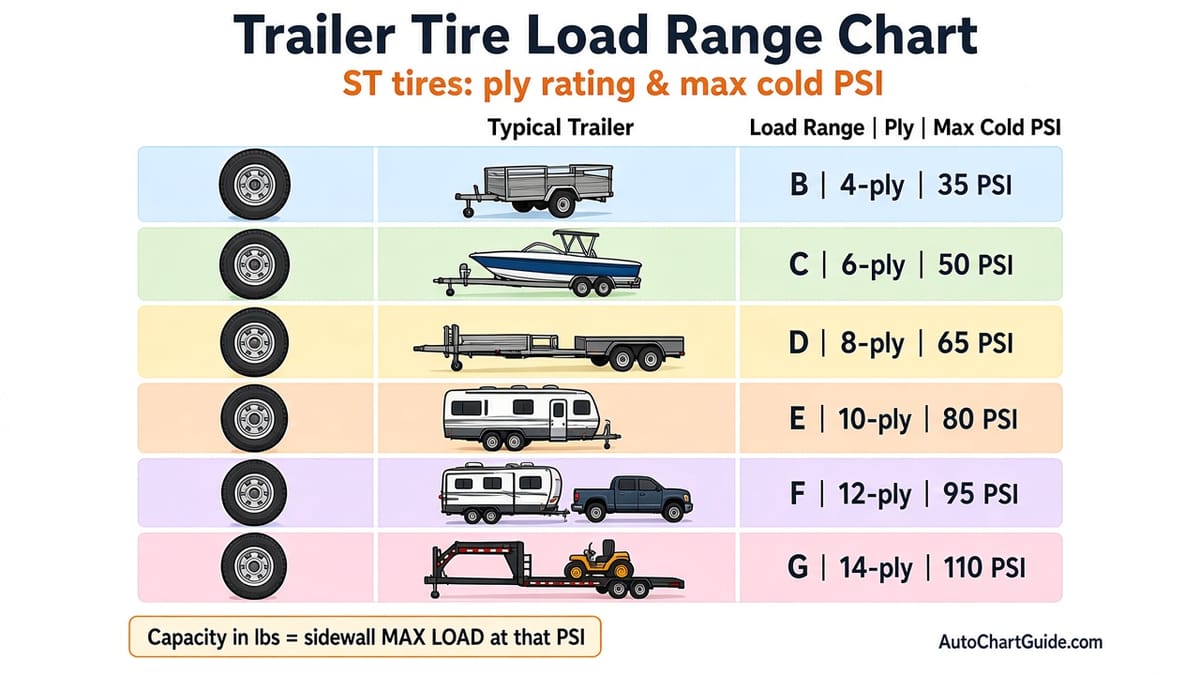
Short answer: On ST (Special Trailer) tires, the load range letter tells you the ply rating and the usual maximum cold pressure: B = 4-ply, 35 psi; C = 6-ply, 50 psi; D = 8-ply, 65 psi; E = 10-ply, 80 psi; F = 12-ply, 95 psi; G = 14-ply, 110 psi. The letter does not give a weight. A tire's capacity in pounds is the MAX LOAD molded on its sidewall, and the tire only carries that load when it's inflated to the pressure printed beside it.
This chart was checked on October 26, 2026 against published specifications from Carlisle (Radial Trail HD), Goodyear (Endurance), and Duraturn, plus the federal trailer placard rule (49 CFR 571.110) and tire documents filed with NHTSA. We didn't test any tires ourselves. Every number below comes from those documents.
Trailer tire load range chart
| Load range | Ply rating | Typical max cold pressure | Example (same size, ST225/75R15) |
|---|---|---|---|
| B | 4-ply | 35 psi | — |
| C | 6-ply | 50 psi | 2,150 lb (Carlisle) |
| D | 8-ply | 65 psi | 2,540 lb (Carlisle) |
| E | 10-ply | 80 psi | 2,830 lb (Carlisle, Goodyear) |
| F | 12-ply | 95 psi | — (size not offered in F) |
| G | 14-ply | 110 psi | — |
A tire document filed with NHTSA spells out the pattern: "Each letter of the alphabet equals 2 plies so in this case being a load range E it is a 10 ply tire." The letter system replaced literal ply counts, and it is separate from the numeric load index. Our load range vs load index guide explains how the two relate. Modern radials don't literally have 10 plies. "10-ply rated" means the tire is rated as strong as an old 10-ply bias tire.
The pressure column is typical, not universal
Most brands follow the 35/50/65/80/95 pattern. Carlisle's Radial Trail HD lists C at 50 psi, D at 65, E at 80, and F at 95. Not every brand does, though. Duraturn's ST Radial guide lists its ST225/75R15 load range D at 75 psi, its load range E at 90 psi, and its ST235/85R16 load range F at 105 psi. The loads match Carlisle's (2,540 lb for D and 2,830 lb for E). Only the pressures differ. So treat the chart as a guide, and use the pressure molded on your sidewall and printed on your trailer's placard.
Original finding: an underinflated E tire carries what a C or D tire carries
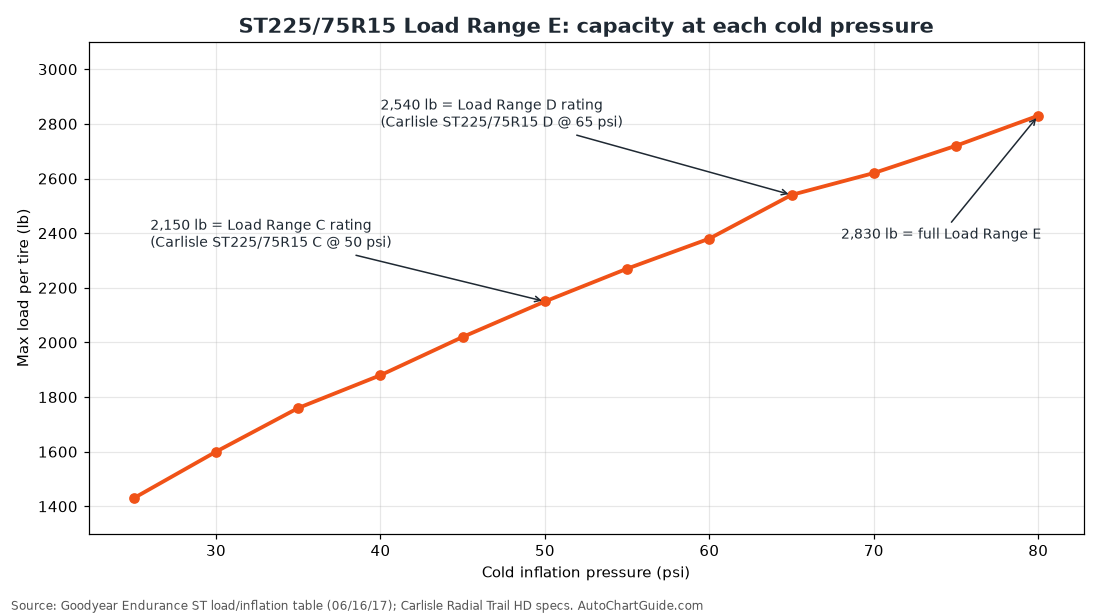
We compared Goodyear's load and inflation table for the Endurance ST225/75R15 load range E against Carlisle's ratings for the same size in lower load ranges, and they line up exactly:
- At 50 psi, the load range E tire is rated for 2,150 lb. That's the same as Carlisle's ST225/75R15 load range C at its 50 psi maximum, and only 76.0% of the tire's full 2,830 lb rating.
- At 65 psi, it's rated for 2,540 lb, the same as the load range D rating (89.8% of full capacity).
In practice, buying load range E tires and running them at load range C pressure gets you load range C capacity. The extra capacity only exists at the higher pressure. If you upgrade the load range, you also need wheels and valve stems rated for that pressure.
How much more does the next load range carry?
| Size (Carlisle Radial Trail HD) | Lower range | Higher range | Gain |
|---|---|---|---|
| ST175/80R13 | C 1,360 lb | D 1,570 lb | +15.4% |
| ST185/80R13 | C 1,480 lb | D 1,710 lb | +15.5% |
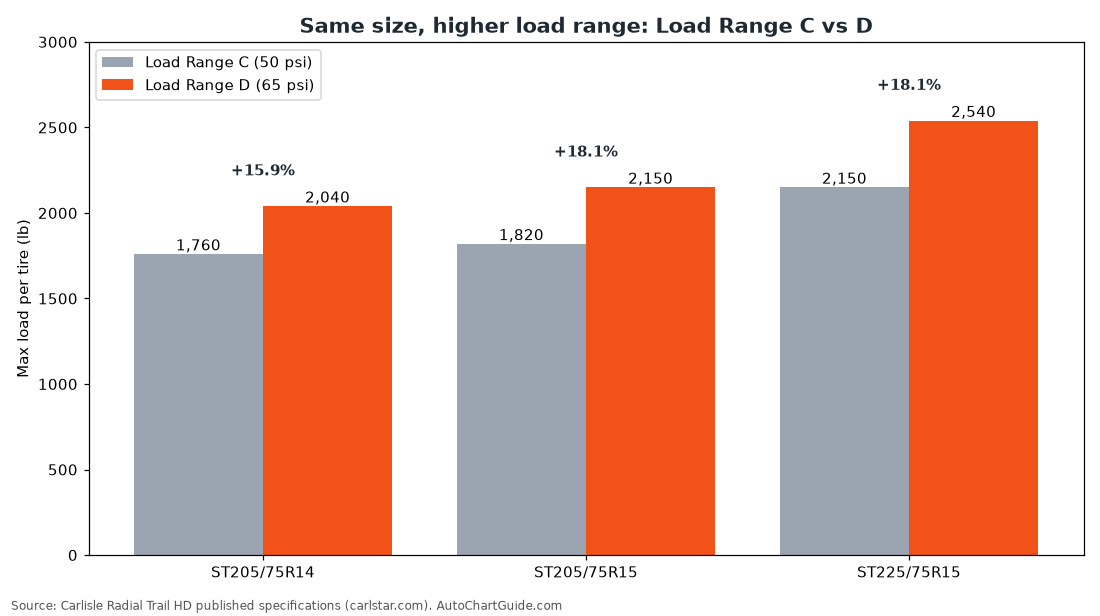
| ST205/75R14 | C 1,760 lb | D 2,040 lb | +15.9% |
| ST205/75R15 | C 1,820 lb | D 2,150 lb | +18.1% |
| ST225/75R15 | D 2,540 lb | E 2,830 lb | +11.4% |
| ST235/85R16 | E 3,640 lb | F 3,960 lb | +8.8% |
Going up one letter in the same size added between 8.8% and 18.1% capacity in this lineup, and the gains get smaller in the higher ranges. Size matters more than the letter. For example, a load range E ST235/85R16 (3,640 lb) carries 810 lb more than a load range E ST225/75R15 (2,830 lb).
Common ST sizes: max load at max pressure
| Size | Load range | Max load (single) | Pressure | Source |
|---|---|---|---|---|
| ST205/75R14 | D | 2,040 lb | 65 psi | Goodyear Endurance / Carlisle |
| ST215/75R14 | D | 2,200 lb | 65 psi | Goodyear Endurance |
| ST205/75R15 | D | 2,150 lb | 65 psi | Goodyear Endurance / Carlisle |
| ST225/75R15 | E | 2,830 lb | 80 psi | Goodyear Endurance / Carlisle |
| ST235/80R16 | E | 3,420 lb (Goodyear) / 3,520 lb (Carlisle) | 80 psi | Both |
| ST235/85R16 | E | 3,640 lb | 80 psi | Goodyear Endurance / Carlisle |
| ST255/85R16 | E | 4,080 lb | 80 psi | Goodyear Endurance / Carlisle |
The ST235/80R16 shows why you should read the sidewall: in the same size and load range, Goodyear lists 3,420 lb and Carlisle lists 3,520 lb.
How to find the load range on a trailer tire sidewall
The Airstream tire bulletin filed with NHTSA decodes a typical size, ST225/75R15. ST stands for "special trailer tire," which "should only be used on trailers." 225 is the section width in millimeters, 75 is the sidewall height as a percentage of that width, R means radial construction, and 15 is the wheel diameter in inches. The load range letter comes after the size (ST225/75R15 E) or appears as "LOAD RANGE E" elsewhere on the sidewall. For every marking in order, see our guide on how to read a tire sidewall.
Trailer tires also carry a service description. Goodyear lists the Endurance ST225/75R15 E as 117N, and Duraturn lists its ST225/75R15 E as 117/112L. The first number is the load index (two numbers mean single and dual ratings), and the letter is the speed symbol. Load index 117 matches the 2,830 lb single rating. Our tire load index explained guide covers how to look up any index. ST is a different service type from P and LT tires, and the ratings don't swap across. See LT vs P tires for the difference.
Goodyear Endurance load table: capacity at 50, 65 and 80 psi
Here are the load and inflation figures from Goodyear's Endurance ST table, which is marked "current as of 06/16/17." They show how much capacity each size gives up below its maximum pressure:
| Size (range at max psi) | 50 psi | 65 psi | 80 psi |
|---|---|---|---|
| ST205/75R14 (D) | 1,760 lb | 2,040 lb | — |
| ST215/75R14 (D) | 1,870 lb | 2,200 lb | — |
| ST205/75R15 (D) | 1,820 lb | 2,150 lb | — |
| ST225/75R15 (E) | 2,150 lb | 2,540 lb | 2,830 lb |
| ST235/80R16 (E) | 2,600 lb | 3,000 lb | 3,420 lb |
| ST235/85R16 (E) | 2,760 lb | 3,200 lb | 3,640 lb |
| ST255/85R16 (E) | 3,200 lb | 3,640 lb | 4,080 lb |
For the load range D sizes, the 50 psi value is 86.3% (ST205/75R14), 85.0% (ST215/75R14) and 84.7% (ST205/75R15) of the 65 psi maximum. For the load range E sizes, the 50 psi value is 75.8% to 78.4% of the 80 psi maximum. The higher the rated pressure, the more capacity you lose by under-inflating. Goodyear's table also shows the 50 psi figures for its D sizes match Carlisle's load range C ratings for the same sizes (1,760, 1,870 and 1,820 lb).
Worked example: checking tires against an axle rating
Say your trailer's certification label shows a GAWR of 5,200 lb on each of two axles. These are example numbers, so use the ones on your own label. Each axle has two tires, so each tire has to carry at least 5,200 ÷ 2 = 2,600 lb.
- ST205/75R15 D at 65 psi: 2,150 lb. That's 450 lb short per tire, so it doesn't qualify.
- ST225/75R15 D at 65 psi: 2,540 lb. That's 60 lb short, so it doesn't qualify.
- ST225/75R15 E at 80 psi: 2,830 lb. That leaves 230 lb of margin per tire, so it qualifies, but only at 80 psi. At 65 psi it drops to 2,540 lb and no longer qualifies.
- ST235/80R16 E at 80 psi: 3,420 lb (Goodyear). It qualifies with more margin, but it needs 16-inch wheels.
Even if the tires add up, never load the trailer past its GVWR or past the cargo figure on its placard. The tow vehicle has its own limits too; our Jeep Gladiator towing capacity chart shows how they are published for one midsize pickup. Load cargo evenly from side to side, because one overloaded tire can fail even when the axle total looks fine.
Wheel width and pressure limits when you change load range
Every size has an approved rim width range. Goodyear lists 5.0 to 6.5 inches for the ST205/75R14 and ST205/75R15, 5.5 to 7.0 inches for the ST215/75R14, 6.0 to 7.0 inches for the ST225/75R15, 6.0 to 7.5 inches for the ST235/80R16 and ST235/85R16, and 6.5 to 8.0 inches for the ST255/85R16. Goodyear also warns: "Do not attempt to mount 16" rim diameter tires on 16.5" rim diameter wheels; this may result in serious injury or death." Before moving up a load range, make sure the wheel is rated for both the higher pressure and the new tire's load. That information is on the wheel or from its manufacturer.
Always set pressure cold
The Airstream bulletin explains why you should check pressure before driving. After a trip, the reading "will read higher as the tire heats up," and that's "taken into consideration when the manufacture[r] sets the rating." Set pressure while the tires are cold, and don't let air out of hot tires to bring them down to the cold number. The trailer placard required by 49 CFR 571.110 lists the recommended cold pressure for the original tires.
How to choose the right load range for your trailer
- Start with the trailer's labels. Under 49 CFR 571.110, a trailer must have a tire and loading placard next to its certification label. The placard lists the tire size and cold pressure and states "The weight of cargo should never exceed XXX kilograms or XXX pounds." The certification label gives the GVWR and each axle's GAWR.
- Make sure the tires can carry each axle's rating. Add up the MAX LOAD figures for the tires on each axle. The total should be at least that axle's GAWR. For example, four ST225/75R15 E tires are rated for 4 × 2,830 = 11,320 lb at 80 psi.
- Don't downgrade. In NHTSA recall 16V-322, Keystone RV trailers were built with tires rated for 1,870 lb (load range C) instead of the specified tires. The recall notice warns that "an overloaded tire leads to an increased risk of tire failure."
- Check the wheel before you upgrade. Going from D (65 psi) to E (80 psi) only helps if the wheel and valve stem are rated for 80 psi.
- Check the speed rating too. Speed ratings vary by tire (see tire speed rating explained). Carlisle lists 75 to 87 mph depending on size, and the Goodyear Endurance has an N (87 mph) speed symbol.
Always follow your trailer manufacturer's placard and owner's manual and the tire maker's instructions. This chart doesn't replace them.
FAQ
Is load range D the same as 8-ply?
Yes. Load range D is 8-ply rated, and most brands set its maximum cold pressure at 65 psi (Duraturn uses 75 psi).
How much weight can a load range E trailer tire carry?
It depends on the size. An ST225/75R15 E is rated for 2,830 lb and an ST235/85R16 E for 3,640 lb, both at 80 psi. Read the MAX LOAD on your tire's sidewall.
Can I run load range E tires at lower pressure?
You can, but the capacity drops. Goodyear's table rates the ST225/75R15 E at 2,150 lb at 50 psi, which is load range C capacity. Use the pressure on your trailer's placard, and never go above the maximum molded on the tire.
What is the highest load range for ST tires?
Ranges run up to F (12-ply, usually 95 psi) and G (14-ply, usually 110 psi). Goodyear's Endurance table lists the ST235/85R16 at 4,400 lb at 110 psi.
How do I know if I need load range D or E?
Divide each axle's GAWR by the number of tires on that axle. Then choose a tire whose sidewall MAX LOAD meets or beats that figure at a pressure your wheels can take. The load range letter alone won't tell you.
Are 10-ply trailer tires really 10 plies?
No. "10-ply" is a rating that means load range E. It doesn't count actual layers.
Can I mix load ranges on the same trailer?
Follow the trailer's placard and manual, which list one tire specification. Each tire has its own rating, so an axle with mixed tires is limited by its weakest tire.
Does a higher load range make the ride harsher?
The sources we reviewed don't measure ride quality, so we can't give a figure. What they do show is that a higher range needs higher pressure to deliver its rating.
Sources
- Carlisle Radial Trail HD specifications (CarlStar)
- Goodyear Endurance sell sheet (Jan 2020)
- Goodyear load/inflation tables for Endurance ST tires (current as of 06/16/17)
- Duraturn ST Radial data guide
- 49 CFR 571.110 (eCFR)
- Airstream tire bulletin filed with NHTSA (MC-10211715)
- NHTSA recall 16V-322 (Keystone RV)