LT vs P Tires: What the Service Type Letter Changes
P, LT, ST and XL are not quality grades. They describe service type and rating conventions, and swapping between them changes how the tire is rated.

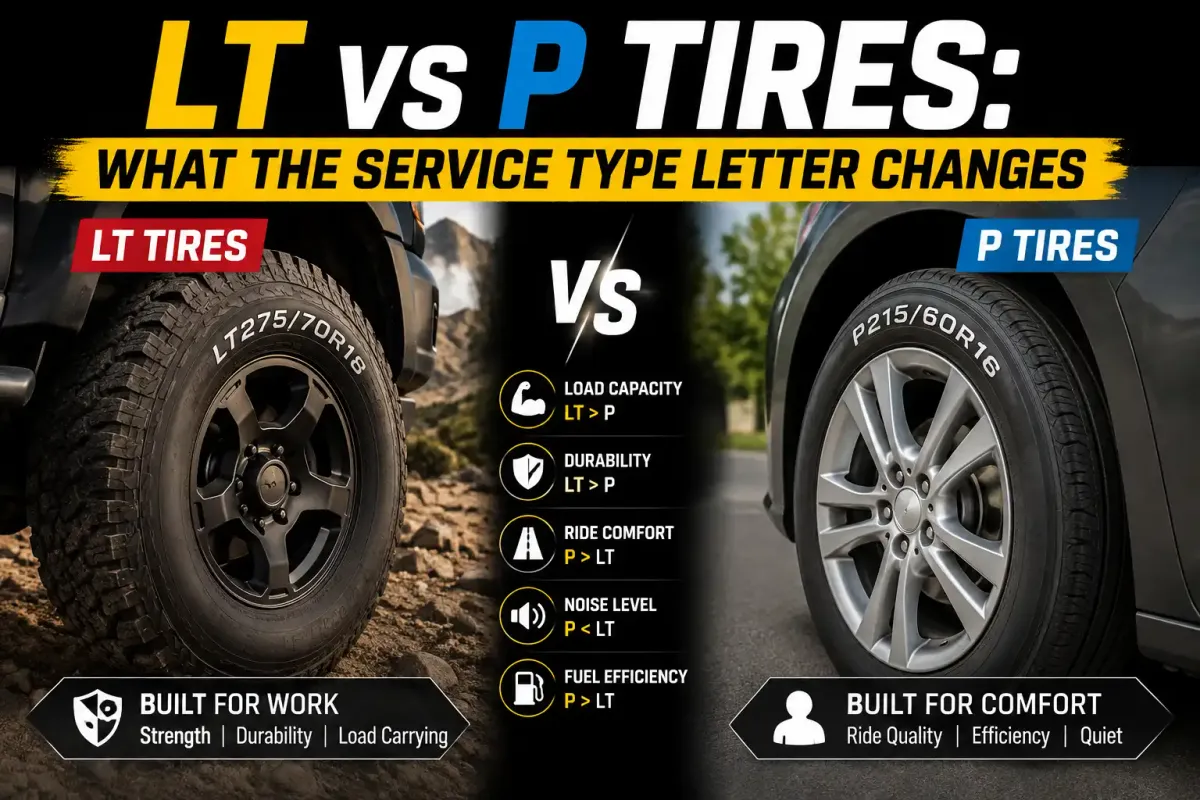
Short answer: these letters describe service type, not quality, and swapping between them changes the rating conventions rather than simply adding capability. An LT tire is not a stronger P tire. It is a tire designed and rated under a different set of assumptions about how it will be used and inflated, and its ratings are not directly comparable to a P tire's.
That distinction matters because the common framing, that LT is the tougher option, leads people to substitute across service types on the assumption they are trading up. Sometimes that is appropriate for the vehicle and sometimes it is not, and the sidewall alone does not tell you which.
P: passenger service type
A P prefix designates a passenger tire, rated under the conventions used for passenger vehicles.
This is the default on most cars, crossovers and many light trucks sold as passenger vehicles. When a vehicle's placard specifies a P-metric size, the ratings printed on that tire are being read against passenger conventions.
One point worth carrying forward: a P tire's load rating is not read the same way when the tire is fitted to a vehicle classified differently. That is a real convention in the industry, it is not something to work out from a sidewall, and it is a reason to take a service type change to a tire professional rather than to a chart.
LT: light truck service type
An LT prefix designates a light truck tire, built and rated for heavier duty use.
LT tires are typically constructed for higher load capability and are rated at inflation conventions different from passenger tires. That combination is why they are not a drop-in upgrade: the rating that makes an LT tire capable is conditional on the vehicle actually running it as intended.
The practical consequences of fitting LT tires to a vehicle specified for P tires include changes to ride, to how the vehicle responds, and to the inflation the tire needs to reach its rating. Those are real changes, not preferences, and whether they are acceptable on your vehicle is a question for someone who can see it.
ST: special trailer, and why it does not belong on a car
ST designates special trailer service, and this is the one where a substitution error is genuinely dangerous.
ST tires are designed for trailer axles. The loading, steering and handling demands on a trailer tire are different from those on a vehicle that is steered and driven, and ST tires are built and rated for the former.
Fitting an ST tire to a car or truck is not a marginal decision. It is using a product outside the service it was designed for. If you find ST tires on a vehicle that is driven rather than towed, treat that as something to raise with a tire professional promptly.
This site does not cover towing or trailers in any form, so ST tires appear here only so you can recognize the marking and know it is not for your vehicle.
No letter at all: metric sizing without a service designation
Plenty of tires carry a size with no service type prefix. This is common on vehicles from some markets and is not a defect or an omission.
It means the tire is designated under metric conventions without a US service type letter. Its load and speed ratings are still printed in the service description after the size, and those remain the figures to read.
Where a vehicle's placard specifies a size with no prefix and you are offered one with a prefix, or the reverse, that is a service type change and belongs in the same category as everything else on this page.
XL and Extra Load, which is a different kind of marking
XL is the fourth confusion, and it is a different class of marking entirely.
XL, sometimes written Extra Load or Reinforced, is not a service type. It sits alongside the size and indicates the tire is built to carry more load than a standard tire of the same size, at a correspondingly different inflation convention.
Two things follow. Comparing an XL tire against a standard tire on load index alone is not a like-for-like comparison, because the conditions attached to those indices differ. And XL is not interchangeable with LT, despite both being described in casual conversation as the heavier duty option.
The parallel systems that govern load capability, and how to read across them: load range vs load index vs ply rating.
Why swapping service type changes the rating conventions
The general principle, stated once so it applies to all of the above.
A load index is an index into a table, and which table, and under what inflation conditions, depends on the tire's service type and any Extra Load designation. Two tires can show the same load index and be rated under different conditions.
That is why "the number is the same or higher, so it is fine" is not a safe rule when the service type has changed. The number means something slightly different on each side of the comparison. What the index is and is not: tire load index explained.
What to confirm before changing service type
If you are considering a service type different from what the vehicle specifies, three things need confirming, and none of them from a website:
What your vehicle actually specifies. The Tire and Loading Information placard on the driver's door jamb, and the owner's manual: reading the tire lines on the loading placard.
Whether the substitution is appropriate for this vehicle. A tire professional who can see the vehicle and its use, not a chart and not us.
What inflation the substituted tire requires to reach its rating. This follows from the tire and the vehicle together. We publish no pressure figures anywhere on this site, and this is one of the clearest cases why: the correct figure depends on the specific combination in front of you.
The failure mode if this goes wrong is a tire operating outside its rating, which is a loss of capability exactly when the vehicle is asking most of it. That is worth a conversation with a professional rather than a purchase decision made online.
The whole sidewall in context: every number on your tire sidewall, decoded. And the size code itself: reading a metric tire size.
Frequently asked questions
Is an LT tire better than a P tire?
Neither is better. They are different service types rated under different conventions. LT is built for heavier duty use, and whether that suits your vehicle is a question for a tire professional.
Can I put LT tires on my car?
It is a service type change, not an upgrade, and it affects ride, response and the inflation the tire needs to reach its rating. Confirm with a professional who can see the vehicle rather than substituting on the sidewall alone.
What does XL mean on a tire?
Extra Load, sometimes written Reinforced. It is not a service type. It indicates a tire built to carry more load than a standard tire of the same size, under different inflation conditions.
Are ST tires OK on a car?
No. ST is special trailer service, designed for trailer axles rather than for a vehicle that is steered and driven. If you find them fitted to a driven vehicle, raise it with a tire professional.
My placard says P and the shop offered LT. Should I take it?
That is a service type change and it should be justified for your specific vehicle and use. Ask the shop to explain why, and check it against your placard and owner's manual.