Door Jamb Sticker Missing? What to Do (Not Order One)
A reproduction label carries no authority. Recover the information first from the manual, the manufacturer and a dealer, then decide about a replacement.

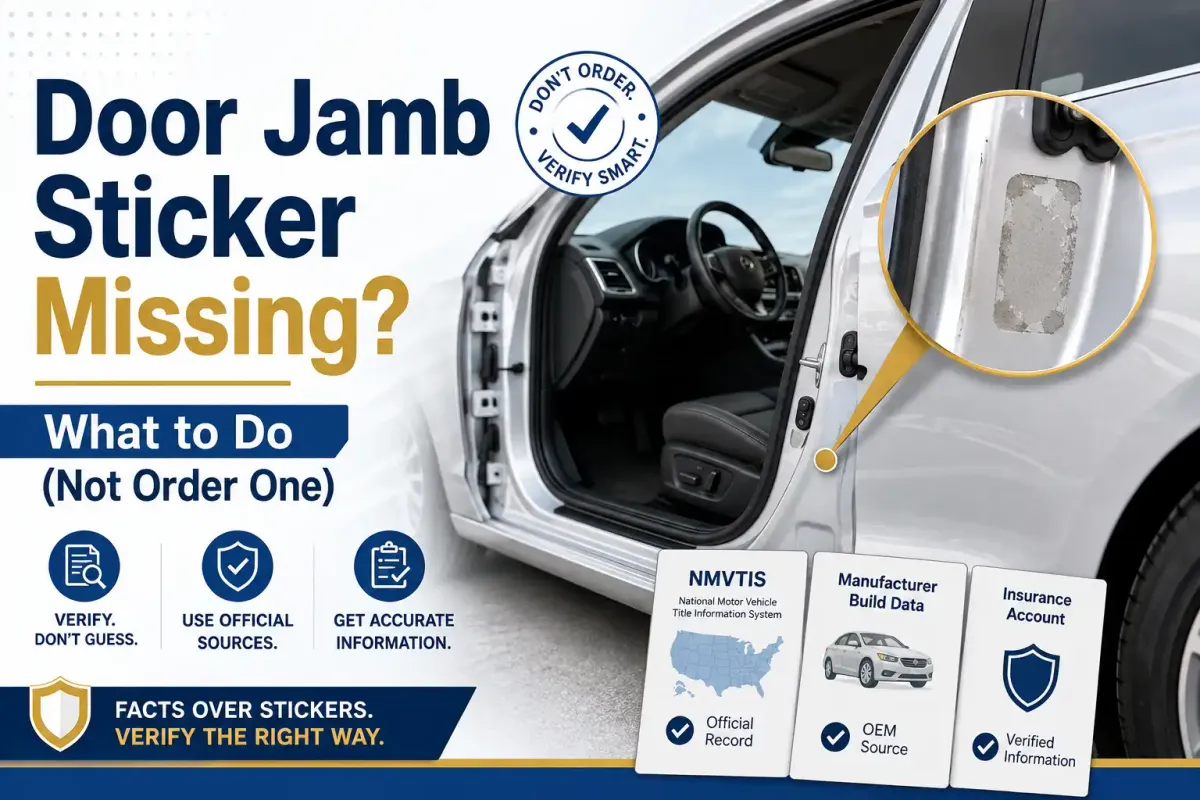
Short answer: recover the information first, and worry about the physical label second. The instinct is to order a replacement sticker, and that is the wrong first move, because a reproduction label reproduces whatever data you gave the seller. If your information was wrong, you have made a wrong number look official for every future owner of the vehicle.
Some of what a missing placard held is safety relevant. The failure mode is not dramatic and that is precisely the problem: a vehicle running on guessed specifications does not announce itself until something is being asked of it. Where that applies below, this article routes you to your own documentation and to a professional rather than filling the gap with a figure.
Why an aftermarket reproduction label is not a source
Reproduction labels are sold widely and they are printed to order. The seller has no access to your vehicle's build record. They print what you send them.
That produces a specific hazard. A label that looks like a factory label carries the visual authority of one, and the next owner has no way to know it was assembled from a forum post. A missing label is an honest gap that prompts someone to go and find the real answer. A wrong reproduction label closes that prompt with a lie.
There is a legitimate use for reproduction labels, which is restoring a vehicle whose real data you have already established from the manufacturer. That is the last step of this process rather than the first.
Recovering the same information from the owner's manual
Start here, because it is free and immediate.
The owner's manual carries a good deal of what a placard holds, including the tire sizes the vehicle was built with and the manufacturer's inflation guidance. Where the manual and a missing placard overlap, the manual is an equally authoritative manufacturer document.
If you do not have the manual, most manufacturers host it free: where to get your owner's manual free. Make sure you get the edition for the market your vehicle was sold in, because a manual from another market is a different document with different specifications in it.
Recovering it from the manufacturer via VIN
The manufacturer holds the build record, and the VIN is the key to it.
The VIN appears in several places on the vehicle beyond the door jamb, including the base of the windshield and the vehicle's title and registration documents, so a missing door label does not usually mean a missing VIN. Structure and how to read it: what each VIN character encodes.
With the VIN, the manufacturer's owner portal may give you the original window sticker, which covers the equipment question. What it generally will not give you is the certification data, which is where a dealer comes in.
What a dealer can look up that you cannot
A franchised dealer for the brand has access to manufacturer systems that the public portal does not expose, and configuration data is what a parts department deals in all day.
Go with a specific question rather than an open request. "The tire placard is missing and I need to know the original tire sizes for this VIN" is answerable in a couple of minutes. "Can you tell me everything about my car" is not.
Ask them to confirm what they are reading from, so you know whether you are getting the build record or somebody's interpretation of the model.
The safety-relevant items that must not be guessed
Some of what a missing placard held should not be filled in from a chart, a forum or this website. Specifically:
- Original tire size and the tire ratings the vehicle requires. Fitting tires that do not meet the vehicle's requirement changes how it behaves under load and in an emergency. See reading the tire lines on the loading placard for what the label held.
- Inflation guidance. We do not publish pressure figures. Use the manufacturer's figure for your vehicle from the manual or the manufacturer.
- Load and weight ratings. This site does not cover vehicle load capacity at all, and a guessed figure here is worse than no figure.
The common thread: each of these describes what the vehicle was certified to do. A number that belongs to a similar vehicle is not a substitute for a number that belongs to yours.
When a professional is the correct answer
Take it to a professional when the missing information is about tires, brakes or anything load bearing, and you cannot recover the manufacturer's figure.
A tire professional can see the vehicle, read what is currently fitted, and work from the manufacturer's data rather than from an approximation. That is a different quality of answer from anything derivable at a keyboard, and for a safety-relevant specification it is the right one.
Bring the VIN, photographs of any labels the vehicle still has, and the full sidewall codes from all four tires.
Replacing the label legitimately, once you have the real data
Once the manufacturer's data is in hand, a replacement label becomes reasonable.
Two conditions. Every figure on it comes from the manufacturer, not from a forum, a chart or a similar vehicle. And it is accurate for this specific vehicle, not for the model.
Some manufacturers supply replacement labels through their parts systems, which is the cleanest route because the data comes from the source. Ask the parts department before going to a third party.
If the label is present but you suspect it belongs to another vehicle, for example after a door replacement, the check is the VIN: the number on the certification label should match the one visible through the windshield. See reading the door jamb label line by line for what each field should say. And when sources conflict, there is a ranking: why two websites give your car two different numbers.
Frequently asked questions
Can I just order a replacement door jamb sticker?
You can, but not as a first step. Reproduction labels print whatever you send, so ordering one before you have the manufacturer's data makes a guess look official.
Where else can I find my tire size if the placard is gone?
The owner's manual for your vehicle and market carries it, and a dealer can confirm the original sizes from the VIN. Do not take it from a general chart.
Is it illegal to drive without the door jamb label?
Requirements vary by jurisdiction and this article does not give legal advice. The practical problem is that safety-relevant information about the vehicle is unverified, which is worth resolving regardless.
My door label shows a different VIN from my windshield. What does that mean?
Most often a replaced door carrying its donor vehicle's labels. Stop trusting the label and work from the VIN on the vehicle and its title.
Can I read the original specs off a similar car?
No. Configuration, build date and market differences mean a similar vehicle is not the same vehicle, and this is exactly the class of error that produces wrong specifications.