Plus-Sizing Explained: Keeping Diameter, Changing Wheels
Holding overall diameter keeps the speedometer honest, but that is only the first constraint. Load rating and clearance do not carry over automatically.

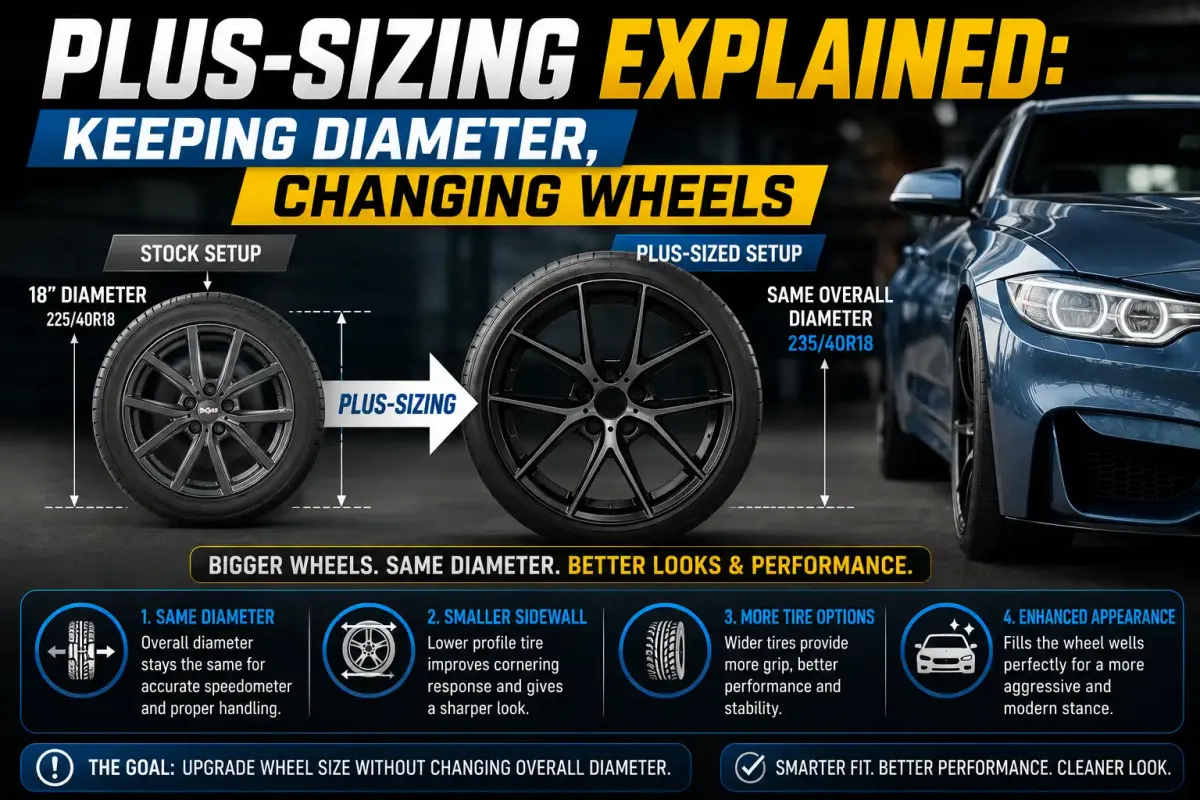
Short answer: keep the overall diameter of the wheel and tire assembly the same and the speedometer stays honest, because it is calibrated to a rolling circumference rather than to a wheel size. That is the principle, and it is correct. What it is not is a complete fitment check. Matching diameter is the first constraint of several, and the ones people drop are the safety-relevant ones.
What plus-sizing actually means
Plus-sizing is fitting a larger diameter wheel while reducing the tire's sidewall height, so the combined assembly stays close to its original overall diameter.
Going up one inch in rim diameter while dropping the aspect ratio to compensate is described as plus one, two inches as plus two, and so on. The compensation happens in the tire because the tire is the only part of the assembly with adjustable height.
The reason to do it is usually appearance or a wish for more responsive steering, since a shorter sidewall deflects less. The reason to be careful is everything below.
Why overall diameter is the constraint that matters for the speedometer
Your speedometer does not measure road speed directly. It counts rotations of something in the drivetrain and converts that to speed using an assumption about how far the vehicle travels per rotation.
That assumption is the rolling circumference of the wheel and tire assembly. Change the circumference and the conversion is wrong by the same proportion, in the same direction, at every speed.
So an assembly with a larger overall diameter makes the speedometer read low, and a smaller one makes it read high. The odometer is affected identically, which matters for service records and for anything measured in distance.
This is why the diameter constraint gets all the attention. It is real, it is the most obvious consequence, and it is the one that can be reasoned about arithmetically.
Why aspect ratio has to fall as rim diameter rises
The arithmetic follows directly from how a tire size is constructed.
Overall diameter is the rim diameter plus twice the sidewall height. Sidewall height is the aspect ratio applied to the section width. So if rim diameter goes up and you want overall diameter to stay put, sidewall height has to come down, which means aspect ratio has to come down, unless width comes down too.
In practice section width usually goes up when rim diameter does, which means aspect ratio has to fall further than it first appears, because the ratio is a percentage of a larger number. Anyone holding aspect ratio constant while increasing width is increasing overall diameter without meaning to.
How the size code is built, and why the ratio behaves this way: reading a metric tire size.
The constraints that diameter matching does not cover
Matching overall diameter says nothing about any of the following, and each is an independent requirement.
Whether the wheel fits the vehicle at all. Bolt pattern, offset, center bore and seat type are unaffected by the tire's dimensions: will these used wheels fit.
Whether the wheel width suits the tire. Tires have a range of rim widths they are designed to mount on, and a tire mounted outside that range is not being used as intended.
Whether the tire meets the vehicle's ratings. Covered below, and it is the one that gets dropped.
Whether the assembly clears. Also below, and no calculation can settle it.
Load and speed ratings do not carry over automatically
This is the part that turns plus-sizing from a styling question into a safety one.
Load index and speed rating are properties of the specific tire, not of the size. Changing size means selecting a different tire, and there is no rule that the new one carries equal or better ratings. Lower aspect ratio tires in particular are a different design category, and their ratings have to be checked rather than assumed.
Your vehicle sets a requirement, and it is recorded on the vehicle rather than derived from what is currently fitted: reading the tire lines on the loading placard.
Then check the candidate tire against it. The load index is an index into a table and its scale is not linear, so comparing the numbers by eye does not work: tire load index explained.
Meeting the diameter target with a tire that does not meet the vehicle's load requirement is a failed plus-size, however good it looks.
Clearance, which no calculator can see
The final constraint, and the one that has to be assessed on the vehicle.
A plus-sized assembly is usually wider, and the tire has to clear suspension components, brake components, liners and bodywork through the full range of steering lock and suspension travel, in combination.
No calculator has a model of your vehicle. It works from nominal dimensions and geometry and has no knowledge of your fenders, your suspension or your brakes: what tire size calculators cannot know.
Nominal dimensions are also not the tire you receive. Two tires of the same stated size differ between manufacturers, and the difference is exactly the scale that decides a marginal clearance case.
What to confirm before ordering
Five things, and none of them from a website:
- The vehicle's required load and speed ratings, from its own placard and manual.
- The candidate tire's ratings, from the tire manufacturer.
- The wheel's fitment specifications against the vehicle, from the wheel manufacturer.
- The tire's approved rim width range, from the tire manufacturer.
- Clearance, assessed on the vehicle by someone who does this regularly.
We publish no sizes and no worked examples for any vehicle, because the combination in front of you is the only one that matters and it is not one we can see. The full sidewall, so you can read what a candidate tire is telling you: every number on your tire sidewall, decoded.
Frequently asked questions
Does plus-sizing affect the speedometer?
Only if the overall diameter changes. The speedometer is calibrated to a rolling circumference, so keeping the assembly's diameter constant keeps the reading correct. Diameter changes shift both speedometer and odometer proportionally.
Is plus-sizing safe?
It can be, if every constraint is met: wheel fitment, rim width range, the vehicle's load and speed requirements, and clearance through full travel and lock. Matching diameter alone does not make it safe.
Do I lose load capacity when plus-sizing?
Possibly. Ratings belong to the specific tire, not the size, and there is no rule that a replacement carries equal or better ratings. Check the candidate against the vehicle's requirement.
Why does aspect ratio drop when rim size increases?
Because overall diameter is rim diameter plus twice the sidewall height. Raising rim diameter while holding overall diameter means sidewall height, and therefore aspect ratio, has to fall.
Can a tire size calculator tell me if it will fit?
No. It computes geometry from nominal dimensions and has no model of your vehicle's fenders, suspension or brakes, and no knowledge of how a specific tire differs from its nominal size.