Speed Rating on Tires Chart 2026: Complete Letter Guide
Speed rating on tires chart: every letter from L to (Y) in mph and km/h, from UNECE R30 and USTMA, plus ZR markings and replacement rules.

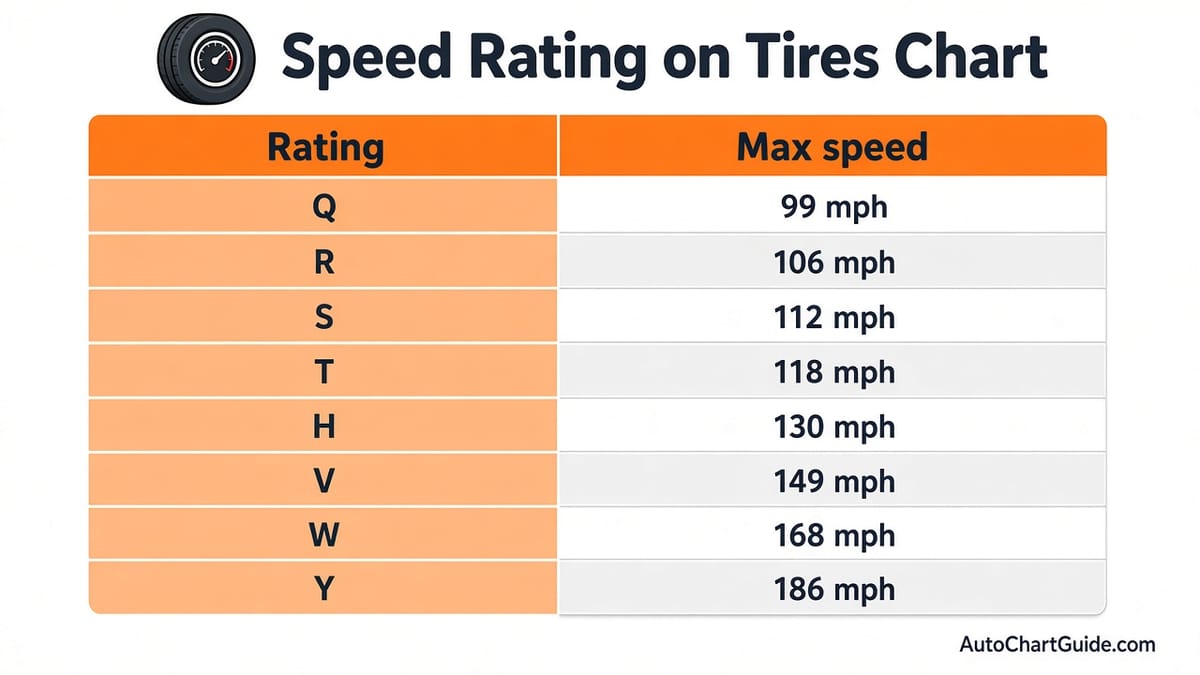
Short answer: a tire's speed rating is the letter at the end of the service description, such as the H in 91H. Each letter stands for a maximum speed set in laboratory testing: Q is 99 mph (160 km/h), R 106 mph, S 112 mph, T 118 mph, U 124 mph, H 130 mph, V 149 mph, W 168 mph and Y 186 mph (300 km/h). A Y in brackets, as in (95Y), means more than 186 mph. Replace tires with at least the speed rating your vehicle came with, and treat the rating as a test limit, not a safe road speed.
The speed categories in kilometers per hour are defined in UNECE Regulation No. 30, paragraph 2.29.1, the international tire approval rule. The mph figures and U.S. marking rules come from the U.S. Tire Manufacturers Association's Tire Care and Safety Guide (2024 edition), with replacement guidance from Bridgestone's Tire Maintenance, Safety and Warranty Manual and Michelin's tyre speed rating chart. All were read on 2026-10-26.
Speed rating on tires chart
This is the full list of speed categories in UNECE Regulation No. 30, with the mph equivalents the USTMA and tire makers publish. R30 defines a speed category as "the maximum speed which the tyre can sustain, expressed by speed category symbol".
| Speed symbol | Max speed (km/h) | Max speed (mph) | Note |
|---|---|---|---|
| L | 120 | 75 | Lowest category in R30; Michelin lists 75 mph |
| M | 130 | 81 | |
| N | 140 | 87 | |
| P | 150 | 93 | |
| Q | 160 | 99 | USTMA example: LT245/75R16 120/116Q |
| R | 170 | 106 | |
| S | 180 | 112 | |
| T | 190 | 118 | |
| U | 200 | 124 | |
| H | 210 | 130 | Sits between U and V |
| V | 240 | 149 | ZR optional above this speed |
| W | 270 | 168 | May be marked ZR |
| Y | 300 | 186 | May be marked ZR |
| (Y) | over 300 | over 186 | Must be marked ZR, service description in brackets |
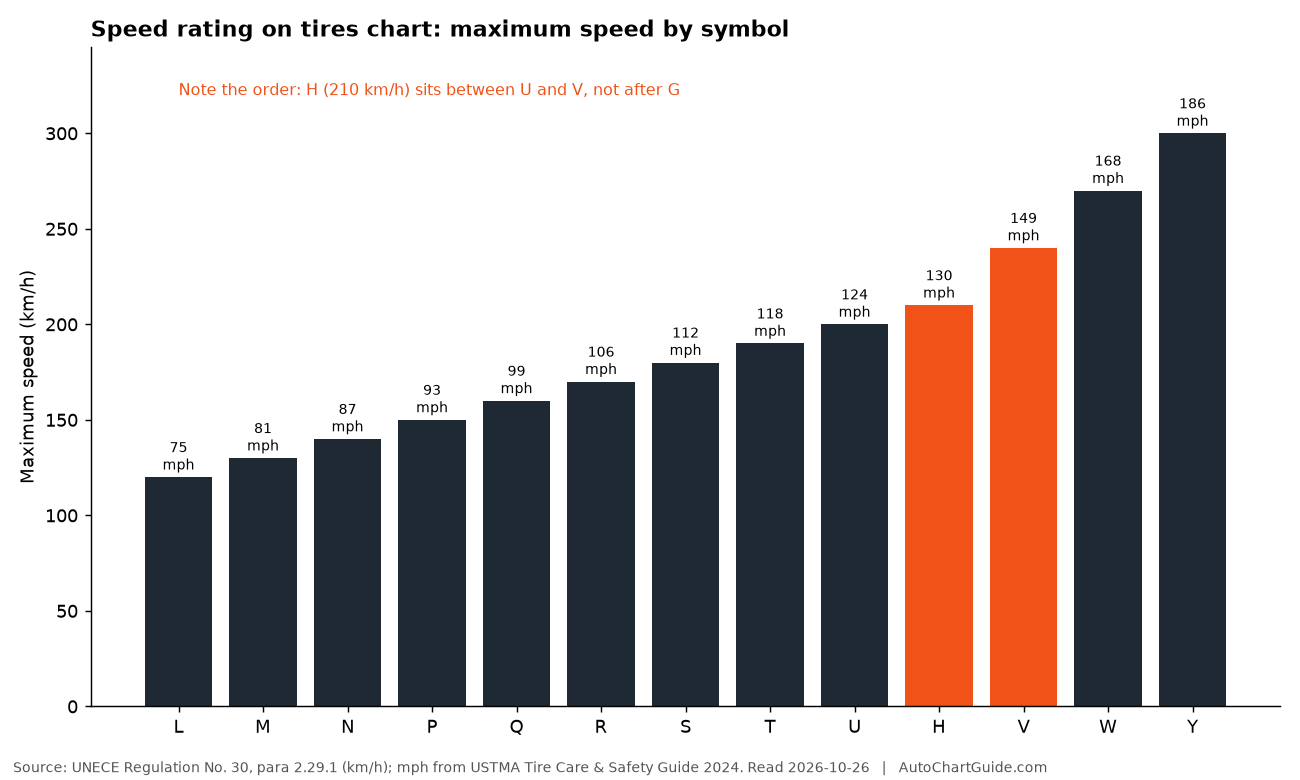
The mph values are rounded conversions of the metric categories, and every source we checked rounds them the same way. 240 km/h is 149.1 mph, published as 149; 270 km/h is 167.8 mph, published as 168; 300 km/h is 186.4 mph, published as 186. The underlying definition is metric, so if you ever need more precision, convert from the km/h figure.
Where the speed rating sits on the sidewall
The speed rating is part of the service description, which follows the tire size. The USTMA guide uses P225/60R16 97T as its example: 97 is the load index and T the speed symbol. On a light truck tire such as LT245/75R16 120/116Q Load Range E, the Q is the speed symbol and Load Range E describes the tire's load and inflation limits. Our guide on how to read a tire sidewall covers every marking around it.
UNECE R30, as amended, defines the service description as "the association of the load-capacity index with a speed-category symbol (for example, "94H")". The vehicle's tire placard, usually on the driver's door frame, and the owner's manual show the service description the vehicle maker specified.
Why H comes after U
The chart is alphabetical from L to U, then jumps to H at 210 km/h, between U and V. Bridgestone's guide notes that the system "uses letters A through Z" and that speed "goes up as the rating advances alphabetically" in general, while pointing out quirks. H is the obvious one. If you compare tires by letter, remember that an H-rated tire (130 mph) is rated higher than a T or U tire, and lower than V.
Z, ZR, W, Y and (Y): the high-speed ratings
The top of the scale is where most of the confusion lives, because two marking systems overlap. R30 says that on radial tires "suitable for speeds in excess of 240 km/h but not exceeding 300 km/h (tyres marked with the speed symbol "W" or "Y" as part of the service description), the letter "R" ... may be replaced with the inscription "ZR"". Above 300 km/h, ZR is required, and "the service description shall be marked within brackets, for example, "(95Y)"".
The USTMA guide gives these worked examples, which are the clearest way to read the markings:
| Marking | Maximum speed (USTMA) |
|---|---|
| P275/40ZR17 | Above 149 mph; consult the tire maker |
| P275/40R17 93W | 168 mph |
| P275/40ZR17 93W | 168 mph |
| P275/40ZR17 93Y | 186 mph |
| P275/40ZR17 (93Y) | Above 186 mph; consult the tire maker |
Goodyear Canada's chart describes W and Y as subcategories of Z and cites the Tire and Rim Association's 2007 yearbook for the rule that ZR "may" appear above 149 mph and must appear above 186 mph. The practical rule is simple: if a tire shows ZR without a speed letter in the service description, you do not know its exact limit, and the USTMA says to consult the tire maker.
What the rating does and does not mean
A speed rating is a laboratory result. The USTMA says ratings "are based on laboratory tests that relate to performance on the road, but are not applicable if tires are under inflated, over loaded, worn out, damaged, or altered." It adds that a rating does "not imply that a vehicle can be safely driven at the maximum speed for which the tire is rated, particularly under adverse road and weather conditions".
Bridgestone's manual says the same in more detail: actual speed capability "may be less than its rated speed since it is affected by factors such as inflation pressure, load, tire condition (including damage), wear, vehicle condition (including alignment), driving conditions, and duration at which the speed is sustained." Michelin frames the rating as "the maximum speed at which a tyre can carry its maximum load".
So a V-rated tire on a family car is not an invitation to drive at 149 mph. What the higher letter usually tells you is that the tire was built to handle more heat and stress, which is why vehicle makers specify a minimum. Our article on what downgrading a speed rating costs goes into the heat argument in depth.
Repairs void the rating
Bridgestone's manual is explicit: "The tire's speed rating is void if the tire is repaired, retreaded, damaged, abused, or otherwise altered from its original condition. Thereafter, it should be treated as a non-speed rated tire." That matters if you have had a puncture plugged. The tire may still be serviceable for normal driving if properly repaired, but its letter no longer applies. Bridgestone also notes that "non-speed rated tires are usually for ordinary passenger car or light truck service and not for high speed driving."
Replacement rules: same or higher
All the sources agree on the core rule. Bridgestone: "To avoid reducing the speed capability of the vehicle, replace a speed rated tire only with another tire having at least the same speed rating." Its reasoning: "It is the 'top speed' of the 'slowest' tire on the vehicle which limits the vehicle's top speed without tire failure." Michelin says you can fit a higher speed index but "should never mount tyres with a lower speed index", with an exception for winter tires.
Goodyear Canada adds a mixing rule: it does not recommend mixing speed ratings, and if different ratings are fitted they should be installed in pairs on the same axle, with the vehicle's speed capability limited by the lowest-rated tires. Bridgestone's tire-mixing warning says an improper mix "is dangerous" and that "your vehicle's handling characteristics can be seriously affected".
The winter tire exception
Winter tires are the accepted exception. Bridgestone says that for winter tires used in cold conditions "it is generally acceptable to apply a tire with a lower speed rating than your original tires; however, speed should be reduced accordingly. All winter tires should be the same speed rating." It adds that "some vehicles have specific recommendations regarding winter tire use", so check the owner's manual first.
Speed rating and load: two halves of one code
The speed letter and the load index are tested together, which is why they appear together. A tire's rated speed assumes it is carrying no more than its rated load at the right pressure. The USTMA guide warns that the load index "should not be used independently to determine replacement tire acceptability for load capacity", and the same is true of the speed letter. When you replace tires, match or exceed both, and check the pressure the vehicle maker specifies. Our guide to the tire load index covers that half.
Light truck tires show this clearly. The USTMA example LT245/75R16 120/116Q carries a Q rating, 99 mph, which is lower than most passenger car tires. That reflects the different duty of a load-carrying LT tire, not poor quality. Our article on LT vs P tires explains the service type letter.
Temporary spares and high-speed pressure
Temporary spare tires are a special case. UNECE R30 requires them to carry the words "TEMPORARY USE ONLY" in letters at least 12.7 mm high, and T-type temporary spares must also carry the legend "INFLATE TO 420 kPa (60 psi)". These tires are not meant to replace a road tire at the road tire's speed. The spare's own markings and the owner's manual set its limits, and they are usually far below the speed rating of the tires it stands in for.
Pressure also changes with speed. Bridgestone's manual tells drivers to "refer to your vehicle owner's manual for any tire pressure recommendations for high speed driving." Some vehicle makers give a higher pressure for sustained high speed or full load. A tire's speed rating assumes the correct pressure for the conditions, so a tire run below the recommended pressure at speed is outside the conditions the rating describes, exactly as the USTMA warns.
How to check the speed rating your vehicle needs
- Read the tire placard. It is usually on the driver's door frame and lists the original tire size and service description.
- Check the owner's manual. Some manuals give minimum speed ratings, winter tire guidance or different ratings for different trims.
- Read the sidewall of the current tires. They may not be the originals, so treat them as a cross-check, not the authority.
- Match or exceed the letter. Use the chart above to compare letters by speed, remembering that H sits between U and V.
- Consider repairs. If a tire has been repaired, Bridgestone treats it as non-speed-rated from then on.
Worked examples
Replacing 215/55R17 94V tires
The V means 149 mph (240 km/h). Acceptable replacements carry V, W, Y or (Y). A 94H tire, at 130 mph, would be a downgrade, which Michelin and Bridgestone advise against except for winter tires.
A tire marked 245/40ZR18 with no letter after the load index
ZR alone tells you the tire is rated above 149 mph, but not how far above. The USTMA's guidance is to consult the tire maker for its maximum speed.
Winter tires on a car that came with H-rated tires
Bridgestone says a lower speed rating is generally acceptable for winter tires in cold conditions, provided you reduce speed accordingly and fit all four with the same rating. A T-rated winter tire is good for 118 mph in the lab, but road conditions in winter are the real limit.
Frequently asked questions
What does H mean on a tire?
H is a speed rating of 210 km/h, or 130 mph. In the chart it sits between U (124 mph) and V (149 mph), even though it comes earlier in the alphabet.
What is the speed rating of a V tire?
V means a maximum of 240 km/h, or 149 mph, under the standardized laboratory test.
Can I use a lower speed rating than the original?
Generally no. Bridgestone and Michelin advise replacing tires with at least the original speed rating. The accepted exception is winter tires, where a lower rating is generally acceptable if you reduce speed and fit all four with the same rating.
Can I put higher speed rated tires on my car?
Yes. Michelin says fitting a higher speed index is perfectly possible. Make sure the load index and size are also correct.
What does ZR mean on a tire?
ZR may be used on radial tires rated above 240 km/h (149 mph) and must be used above 300 km/h (186 mph). Without a W, Y or (Y) in the service description, the exact limit comes from the tire maker.
Does a repaired tire keep its speed rating?
No. Bridgestone says the speed rating is void if the tire is repaired, retreaded, damaged, abused or altered, and it should then be treated as a non-speed-rated tire.
Can I mix tires with different speed ratings?
It is not recommended. Goodyear says that if different ratings are fitted they should be in pairs on the same axle, and the vehicle is then limited by the lowest-rated tires.
Is it safe to drive at my tire's rated speed?
Not necessarily. The USTMA says speed ratings do not imply a vehicle can be safely driven at that speed, and they do not apply to under-inflated, overloaded, worn or damaged tires.
Sources
- United Nations Economic Commission for Europe, Regulation No. 30 (Rev.3), paragraphs 2.29, 3.1.3.4 and 3.1.4.1, and amendment text (2024), read 2026-10-26.
- U.S. Tire Manufacturers Association, Tire Care and Safety Guide (2024), read 2026-10-26.
- Bridgestone, Tire Maintenance, Safety and Warranty Manual, read 2026-10-26.
- Michelin UK, Understanding tyre load rating and tyre speed rating, read 2026-10-26.
- Goodyear Canada, Indice de vitesse du pneu (French), read 2026-10-26.