Helmet Size Chart by Age 2026: Complete Fit Guide
Typical head sizes by age from WHO, kids' helmet sizes from Giro, Bell, woom, Bobike and Fox, the CPSC Age 1 vs Age 5 labels, and the NHTSA fit check.

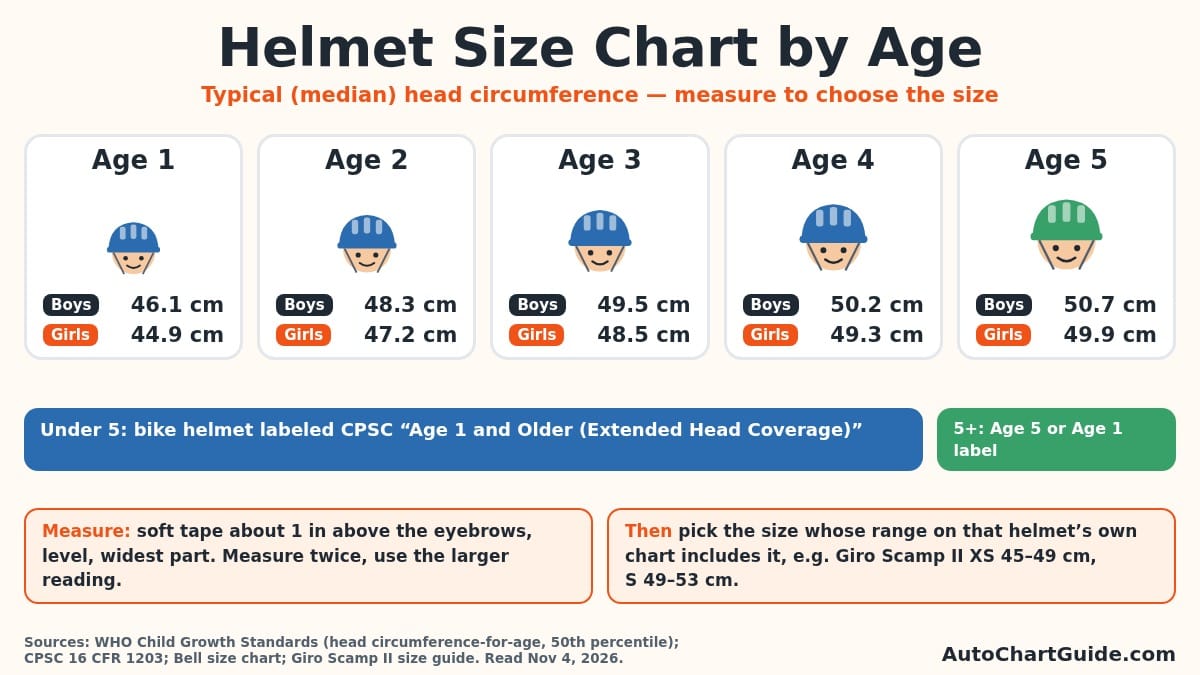
Short answer: there is no official helmet size for each age, because helmets are sized by head circumference, not birthdays. Age does tell you roughly what to expect. In the World Health Organization growth standards the median head measures 46.1 cm for boys and 44.9 cm for girls at age 1, 48.3 and 47.2 cm at age 2, and 50.7 and 49.9 cm at age 5. That puts most toddlers in a toddler/XS helmet of about 45–50 cm and most 5-year-olds in a small kids size of about 49–53 cm. For a child under 5, choose a bike helmet labeled for "Persons Age 1 and Older (Extended Head Coverage)." Then measure, and buy from the helmet's own chart.
The head-size figures come from the WHO Child Growth Standards head circumference-for-age tables (boys and girls, birth to 5 years). The rules come from the CPSC bicycle helmet standard, 16 CFR Part 1203, CPSC's Which Helmet for Which Activity? guide (publication 349, January 2026), NHTSA's Fitting Your Bike Helmet sheet (DOT HS 811 568) and the motorcycle helmet standard FMVSS No. 218. Size ranges come from the Giro, Bell, woom, Bobike and Fox Racing size guides. All were read on November 4, 2026. This page restates published guidance and maker data. Always follow the instructions that come with your child's helmet.
Helmet size chart by age (1 to 5 years)
This is the core chart. Each row shows the WHO typical range of head circumference at that age, from the 3rd to the 97th percentile, with the median in bold. The last column is the U.S. certification label to look for on a bicycle helmet at that age.
| Age | Boys: typical range (3rd to 97th percentile) | Boys median | Girls: typical range (3rd to 97th percentile) | Girls median | CPSC label to look for on a bike helmet |
|---|---|---|---|---|---|
| 1 year | 43.6 to 48.5 cm | 46.1 cm | 42.3 to 47.5 cm | 44.9 cm | Age 1 and Older (Extended Head Coverage) |
| 18 months | 44.9 to 49.9 cm | 47.4 cm | 43.6 to 48.8 cm | 46.2 cm | Age 1 and Older (Extended Head Coverage) |
| 2 years | 45.7 to 50.8 cm | 48.3 cm | 44.6 to 49.8 cm | 47.2 cm | Age 1 and Older (Extended Head Coverage) |
| 3 years | 46.8 to 52.1 cm | 49.5 cm | 45.9 to 51.2 cm | 48.5 cm | Age 1 and Older (Extended Head Coverage) |
| 4 years | 47.5 to 53.0 cm | 50.2 cm | 46.7 to 52.0 cm | 49.3 cm | Age 1 and Older (Extended Head Coverage) |
| 5 years | 47.9 to 53.5 cm | 50.7 cm | 47.2 to 52.6 cm | 49.9 cm | Age 5 and Older, or Age 1 and Older |
Source: WHO Child Growth Standards, head circumference-for-age percentile tables for boys and girls, birth to 5 years (read Nov 4, 2026). Label column: 16 CFR 1203.6 and CPSC, which says helmets for children up to age five must cover more of the head. WHO publishes no head-size standard past age 5, so this table stops there.
Two things in this table matter more than any single number. First, boys' heads run about one centimeter larger than girls' at every age shown. Second, the spread at each age is wide: roughly 5 cm between the 3rd and 97th percentiles. The kids' helmet sizes in this guide each span between 1 and 7 cm, most of them 3 to 4 cm. That is why two children of the same age can need different sizes.
Why age alone picks the wrong helmet
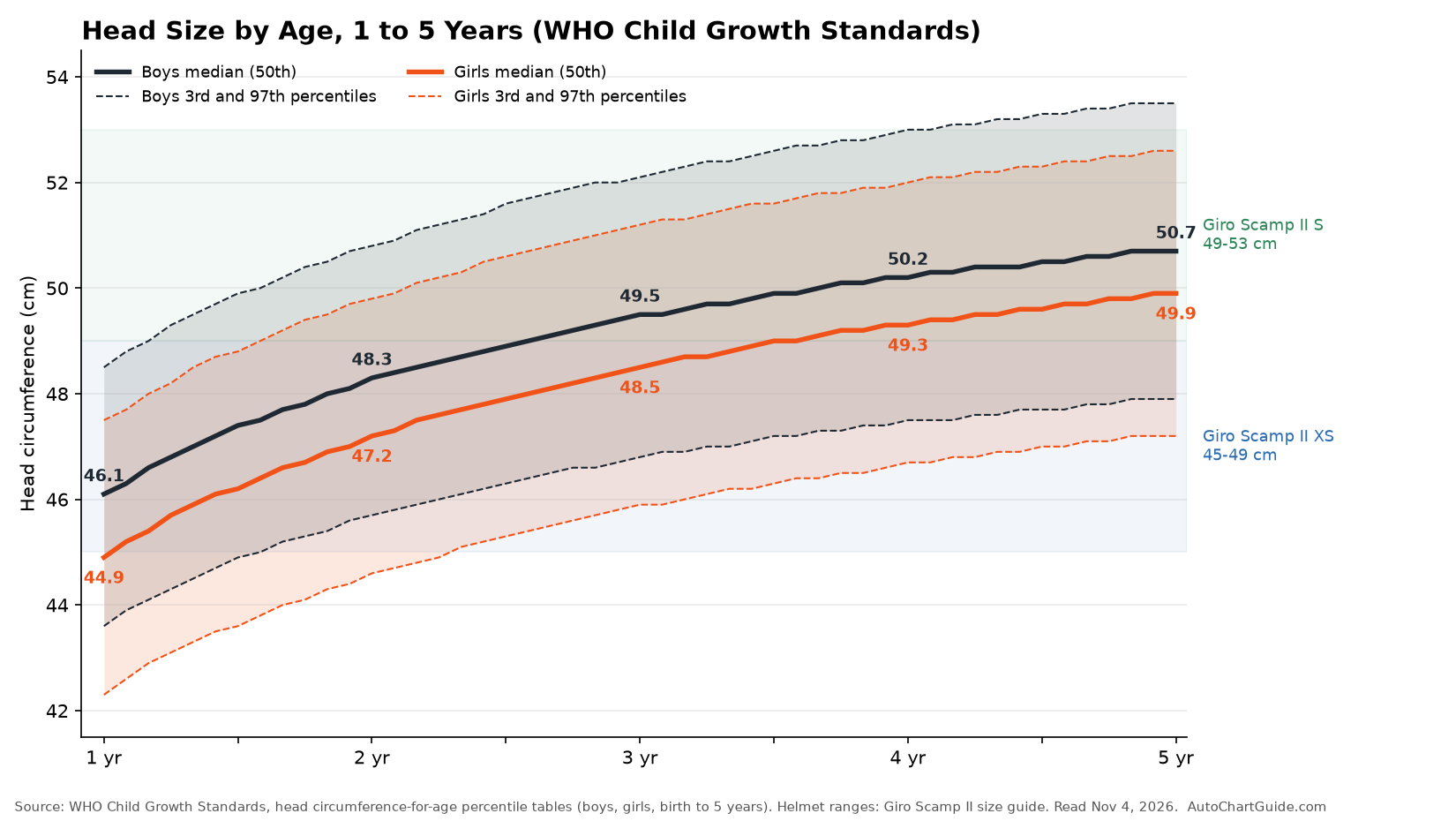
A child's head grows fastest in the first year. In the WHO boys' table the median rises from 34.5 cm at birth to 46.1 cm at 12 months. From age 1 to age 5 it grows only about another 4.6 cm for boys and 5.0 cm for girls. So after the first birthday, head size changes slowly, and the differences between children are bigger than the change from one year to the next.
The WHO numbers make this concrete. A 2-year-old boy at the 97th percentile measures 50.8 cm. That is larger than the median 5-year-old girl at 49.9 cm. A 5-year-old boy at the 3rd percentile, 47.9 cm, has a smaller head than the median 2-year-old boy at 48.3 cm. A box that says "ages 3–5" cannot be right for both.
There is also a gap at the bottom. The median 1-year-old girl measures 44.9 cm, which is below the smallest Giro (45 cm), Bell (45 cm) and woom (46 cm) sizes in this guide. Of the makers here, only Bobike's XXS starts lower, at 44 cm, and it is a European EN 1078 helmet. A small 1-year-old may simply not fit a toddler helmet yet. If the helmet will not fit snugly with the fit system fully tightened, it does not fit.
This is the same lesson as our weight car seat age chart: age bands tell you when most children reach a stage, but the measurement and the product's own label decide what your child uses.
Kids helmet sizes by brand
Helmet makers use names like toddler, child, XS and youth, but the names do not mean the same thing from brand to brand. The table lists the ranges exactly as each maker publishes them.
| Helmet (maker) | Size | Head circumference (as published) | Standard / label on the maker's page | What the maker says about age |
|---|---|---|---|---|
| Giro Scamp II | XS | 45–49 cm | CPSC Age 1 and Older (Extended Head Coverage) | "The XS is designed for riders aged 1 and older" |
| Giro Scamp II | S | 49–53 cm | CPSC (S for riders aged 5 and older) | "the Small is for riders aged 5 and older" |
| Bell Sidetrack II | Universal Toddler | 45–52 cm (17 3/4–20 1/2 in) | Page states CPSC Age 5 and Older; check the label in the helmet | No age given on the size chart |
| Bell Sidetrack II | Universal Child | 47–54 cm (18 1/2–21 1/4 in) | As above | No age given |
| Bell Sidetrack II | Universal Youth | 50–57 cm (19 5/8–22 1/2 in) | As above (320 g, size Y) | No age given |
| woom READY | XS | 46–50 cm (18.2–19.6 in) | CPSC Age 1 and Older (Extended Head Coverage) | Range covers "kids aged 1 to 14" |
| woom READY | S | 50–53 cm (19.7–20.8 in) | CPSC Age 1 and Older (Extended Head Coverage) | As above |
| woom READY | M | 53–57 cm (20.9–22 in) | CPSC Age 5 and Older | As above |
| Bobike Kids | XXS | 44–48 cm | EN 1078 (European standard) | 9 months–2 years ("estimated by circumference") |
| Bobike Kids | XS | 48–52 cm | EN 1078 | 2–4 years |
| Bobike Kids | S | 52–56 cm | EN 1078 | From 5 years |
| Fox Racing Youth V1 (dirt bike, ATV, side-by-side) | YS / YM / YL | 49–51 / 51–52 / 52–53 cm | DOT and ECE 22.06 | No age given; "If you are between sizes, we suggest opting for the larger size" |
Sources: each maker's product page and size guide, read Nov 4, 2026. Ranges and labels are copied as published; we have not converted or rounded them. Bobike helmets are built to the European EN 1078 standard; a helmet sold for bicycling in the U.S. must carry the CPSC label.
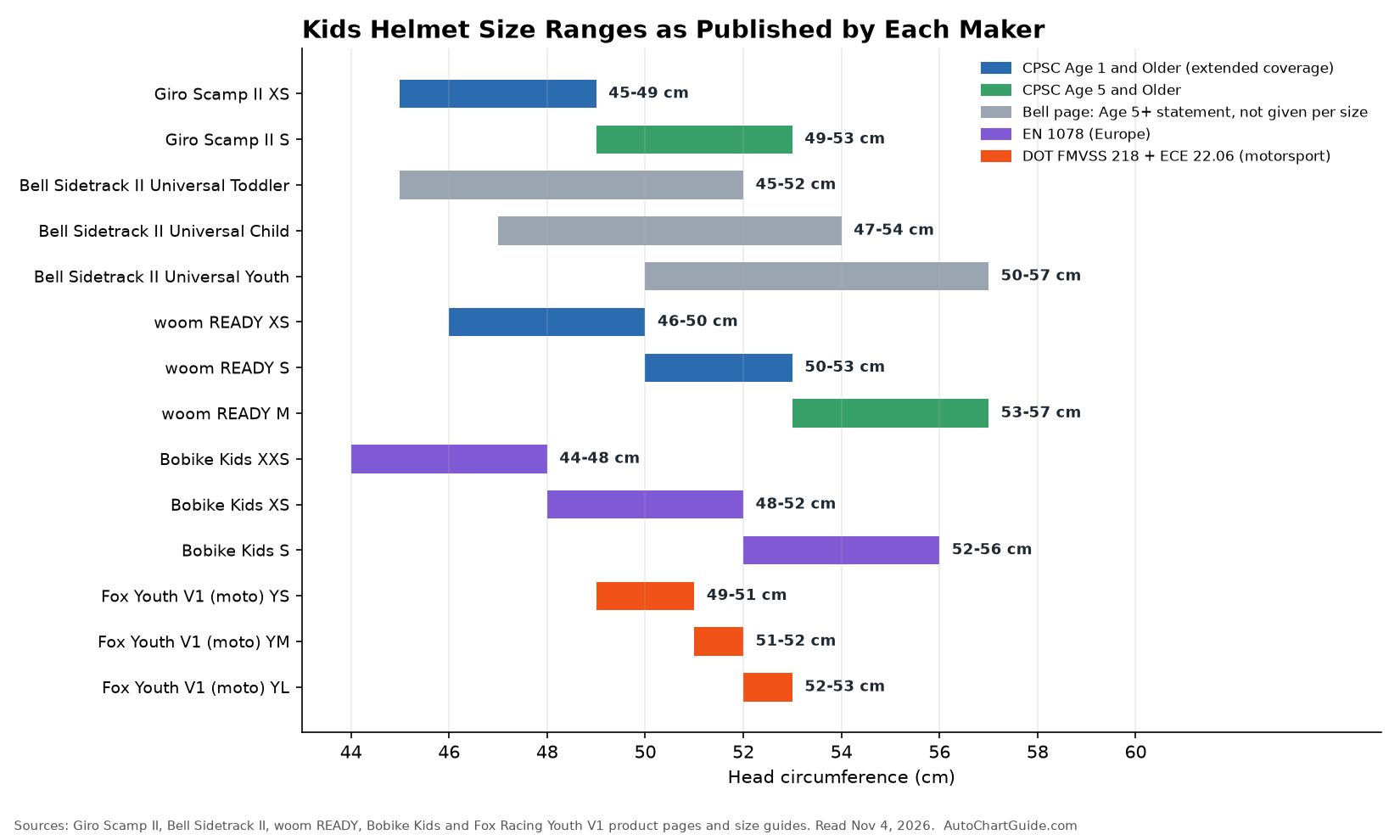
Look at the small sizes. Giro's S (49–53 cm) is for riders aged 5 and older, while woom's S (50–53 cm) carries the Age 1 and Older extended-coverage label. Bobike's S starts at 52 cm. A label that says "S" tells you nothing until you read the centimeters, and the CPSC label tells you how much of the head the helmet was tested to protect.
Ranges also overlap. Bell's three Sidetrack II sizes overlap by several centimeters, so a 50 cm head fits all three on paper. In that case, try the candidates on; the deciding test is how each one sits on the child's head and whether it passes the fit check below. Charts copied between websites often drop these details, the same problem we cover in why car specs differ between websites. Use the maker's own page for the exact model.
CPSC labels: "Age 1 and Older" vs. "Age 5 and Older"
Since February 1999, every bicycle helmet made or imported for sale in the United States must meet the CPSC standard. Under 16 CFR 1203.6, the certification label must read either "Complies with U.S. CPSC Safety Standard for Bicycle Helmets for Persons Age 5 and Older" or "Complies with U.S. CPSC Safety Standard for Bicycle Helmets for Persons Age 1 and Older (Extended Head Coverage)."
The difference is coverage. CPSC explains that the standard "requires that helmets intended for children up to age five cover more of the head to provide added protection to the more fragile areas of a young child's head." In the regulation, that shows up in 16 CFR 1203.11: the impact test line for helmets intended for persons age 1 and older is drawn from a different figure (Figure 5) than the one for helmets intended only for persons 5 years of age and older (Figure 4), and impact sites may be anywhere on or above that line. For both types, the peak acceleration of any impact "shall not exceed 300 g."
In practice:
- Under 5: buy a helmet with the Age 1 and Older (Extended Head Coverage) label.
- 5 and older: either label is acceptable. An Age 1 helmet that still fits gives extra coverage.
- Under 1: the AAP says infants younger than 12 months are "too young to wear a helmet" and should not be carried on a bicycle. Children 12 months to 4 years who sit well unsupported and can hold up a lightweight helmet may ride in a trailer or rear-mounted seat, according to the AAP's HealthyChildren.org guidance.
CPSC also warns against novelty and toy helmets, which "are not made to comply with any standard and can be expected to offer little or no protection." The label inside the helmet is the thing to check, not the picture on the box.
Ages 5 to 14: when growth tables run out
The WHO standards end at age 5, and we have not found an official head-size table for older children that is published as open data. Past age 5, the practical guide is each maker's youth range. In this guide:
- Giro's Universal Youth and Bell's Universal Youth both list 50–57 cm.
- woom's largest size, M, is 53–57 cm, and woom says its three sizes cover kids aged 1 to 14.
- Giro's adult S starts at 51 cm, so a child with a large head can move into a small adult helmet.
A child is ready for the next size when the head measures above the top of the current helmet's range, or when the helmet no longer sits level and snug with the fit system loosened all the way. Re-measure from time to time as the child grows.
Youth motorcycle, dirt bike and ATV helmets
Bike helmets are the wrong tool once there is an engine. CPSC's activity table lists a motocross or motorcycle helmet meeting Snell M2020 or CM2016 and DOT FMVSS 218 for ATV riding, dirt and mini-bike riding, motocross and side-by-side (UTV/ROV) riding. CPSC notes that Snell CM2016 helmets are "designed specifically for use in children's motorsports." For moped riding, and for motorized bicycles and powered scooters capable of maintained speeds of at least 20 mph, CPSC lists a moped or motorcycle helmet.
Motorcycle helmets are sized the same way, by head circumference, and many also list a hat size. Fox Racing's Youth V1 is one example:
| Helmet | Youth size | Hat size (as published) | Head circumference |
|---|---|---|---|
| Fox Youth V1 | YS | 6 1/8–6 3/8 | 49–51 cm (19.3–20.1 in) |
| Fox Youth V1 | YM | 6 3/8–6 1/2 | 51–52 cm (20.1–20.5 in) |
| Fox Youth V1 | YL | 6 1/2–6 5/8 | 52–53 cm (20.5–20.9 in) |
| Fox V1 (adult) | XS | 6 5/8–6 3/4 | 53–54 cm (20.9–21.3 in) |
| Fox V1 (adult) | S | 6 7/8–7 | 55–56 cm (21.7–22.0 in) |
Source: Fox Racing Youth V1 size guide, read Nov 4, 2026. Fox lists youth and adult V1 sizes in one chart.
The federal standard ties helmet size to the headform used in testing. Under FMVSS 218, a helmet's "discrete size" is the diameter of an equivalent circle in inches (the familiar hat-size number) or its circumference in centimeters. Small helmets are tested on a small headform, and so on:
| Labeled helmet size (hat size) | European size | Test headform under FMVSS 218 S6.1.1 |
|---|---|---|
| Up to 6 3/4 | Up to 54 | Small |
| Over 6 3/4 up to 7 1/2 | Over 54 up to 60 | Medium |
| Over 7 1/2 | Over 60 | Large |
Source: 49 CFR 571.218, S6.1.1. A helmet whose size range spans two bands is tested on each headform (S6.1.2).
Every compliant helmet must carry the DOT symbol, the words "FMVSS No. 218" and "CERTIFIED," and a separate label with the maker's name, the discrete size and the month and year of manufacture. It is the helmet's version of the federal certification label described in our guide to the door jamb sticker on your car. A youth passenger on a road motorcycle, such as the touring bikes in our Harley-Davidson models chart, needs a DOT helmet that fits, not a bicycle helmet. State laws on child passengers vary, so check yours.
How to measure a child's head
- Use a soft tape. Bell suggests a flexible measuring tape, or a string and a ruler.
- Place it about 1 in (2.5 cm) above the eyebrows, level all the way around. Bell says "snug but NOT tight." woom adds that the tape should sit slightly above the ears and around the widest part of the head.
- Measure twice and use the larger reading, as Bell's guide advises.
- Write it in centimeters. Every maker in this guide publishes its kids' ranges in cm, and some add inches.
- Compare with that helmet's chart, not a generic chart. Giro adds that the helmet should fit "with a little room when the fit system is loose."
CPSC's advice is to bring the child with you when you buy a helmet so it can be tried on. With online orders, measure first and keep the packaging until you have done the fit check below.
Fit check: the NHTSA steps
Size gets you in the right range. Fit is what keeps the helmet in place in a fall. NHTSA's fitting sheet gives these checks:
- Position: level on the head and low on the forehead, one or two finger-widths above the eyebrow.
- Side straps: adjust the sliders so the straps form a "V" under, and slightly in front of, the ears.
- Buckle: centered under the chin.
- Chin strap: snug, so that no more than one or two fingers fit under it.
- Mouth test: open wide. The helmet should pull down on the head. If not, tighten the chin strap.
- Rocking test: the helmet should not rock forward, backward or side to side. If it rocks more than an inch, readjust.
If it rocks back more than two fingers above the eyebrows, NHTSA says to shorten the front strap. If it rocks forward into the eyes, tighten the back strap. Use only the pads and adjusters that came with the helmet. CPSC says not to add extra padding or parts and "do not wear a helmet that does not fit correctly."
Worked examples
| Child | Measured head | Sizes whose published range includes it | Label to check |
|---|---|---|---|
| 22-month-old, rides in a bike trailer | 47 cm | Giro Scamp II XS (45–49), woom READY XS (46–50), Bell Universal Toddler (45–52), Bell Universal Child (47–54) | Age 1 and Older (Extended Head Coverage) |
| 6-year-old on a pedal bike | 52 cm | Giro Scamp II S (49–53), woom READY S (50–53), Bell Universal Child (47–54), Bell Universal Youth (50–57) | Any CPSC bicycle label; Age 1 and Older gives more coverage |
| 10-year-old on a youth dirt bike | 52.5 cm | Fox Youth V1 YL (52–53) | DOT FMVSS 218; a bicycle helmet is the wrong type |
Worked examples use the published ranges above. They are illustrations of the method, not fit recommendations for a particular child.
In the first example, four sizes include 47 cm. Trying them on with the fit check is the only way to choose between them. In the second, the child is past 5, so any CPSC label is allowed, though an Age 1 helmet that fits gives more coverage. In the third, the size is easy; the helmet type is the real decision.
Growing room, sizing up and replacement
Advice on sizing up is not uniform. NHTSA says to "buy a helmet that fits your head now, not a helmet to grow into." woom says that "if you fall on the cusp of two sizes, it's better to size up," and Fox Racing says the same for its helmets. These fit together: never buy a size the child is not yet in, but when the measurement is right at the boundary, the larger size may still fit snugly with its dial or pads. The fit check is the final word.
Replace a helmet after a crash. CPSC explains that bicycle helmets are built for a single impact: the foam crushes to absorb energy and "will not protect you again," so replace it even if no damage is visible. Without a maker's guidance, CPSC says it "may be prudent" to replace a helmet within 5–10 years. woom sets a firmer limit of five years from the production date printed inside its READY helmet. Cracks, crushed foam, worn straps or missing pads are all reasons to replace a helmet sooner.
One more CPSC warning applies to kids in particular. Children should not wear helmets on playgrounds or while climbing trees, because the chin strap can catch and pose a strangulation risk.
Troubleshooting a kids helmet that will not fit
- Too loose at the tightest setting: the helmet is too big. Try the next size down or another brand whose range starts lower.
- Too tight at the loosest setting: the child has outgrown it. Move to the next size or a youth or small adult size.
- Sits high on the forehead: adjust the front and rear straps as NHTSA describes, so the helmet sits one or two finger-widths above the eyebrows. If it still rides up, try a different size or model.
- Between two sizes: try both on. If both pass the fit check, the maker’s advice (woom, Fox) is to go up.
Frequently asked questions
What size helmet does a 2-year-old need?
Measure first. In the WHO growth standards the median 2-year-old head is 48.3 cm for boys and 47.2 cm for girls, and most fall between about 44.6 and 50.8 cm. That usually lands in a toddler or XS size such as Giro's Scamp II XS (45–49 cm), but only the tape measure and the helmet's own size chart can confirm it. Look for the CPSC "Age 1 and Older (Extended Head Coverage)" label.
Can a 1-year-old wear a bike helmet?
The CPSC bicycle helmet standard covers children age 1 and older, and helmets for children up to age five must cover more of the head. The American Academy of Pediatrics says infants younger than 12 months are too young to wear a helmet and should not be carried on a bicycle at all.
Is helmet size based on age or head size?
Head size. Age labels on boxes are rough guides. NHTSA's advice is to measure your head to find your size, and the makers in this guide all size their helmets by head circumference in centimeters.
What does "Age 5 and Older" on a helmet mean?
It is one of the two certification statements the CPSC standard (16 CFR 1203) allows. A helmet labeled "Age 1 and Older (Extended Head Coverage)" is tested over a larger area of the head. For a child under 5, look for the Age 1 label.
Should I buy a helmet my child can grow into?
NHTSA says to buy a helmet that fits your head now, not one to grow into. Some makers, including woom and Fox Racing, suggest the larger size when a measurement falls right on the line between two sizes. Either way, the helmet must still fit snugly and pass the fit check.
How often should I check my child's helmet size?
Check the fit before each ride, as NHTSA advises adjusting as needed every ride. A child has outgrown a helmet when it no longer sits level and snug with the fit system at its loosest setting, or when the head measures above the top of that size's published range.
Can my child use a bike helmet on an ATV or dirt bike?
No. CPSC's "Which Helmet for Which Activity?" lists a motocross or motorcycle helmet meeting DOT FMVSS 218 (or Snell M2020 or CM2016) for ATV, dirt bike, mini bike and side-by-side riding. Snell CM2016 is designed specifically for children's motorsports.
When should a child's helmet be replaced?
After any crash or significant impact, even without visible damage, according to CPSC and NHTSA. Without a maker's guidance, CPSC says it may be prudent to replace a helmet within 5–10 years. woom limits its READY helmet to five years from the production date.
Sources
- World Health Organization, Child Growth Standards: head circumference-for-age (boys and girls percentile tables, birth to 5 years). Read Nov 4, 2026.
- 16 CFR Part 1203, Safety Standard for Bicycle Helmets (eCFR, current). Read Nov 4, 2026.
- CPSC, Recreational Helmets (Nov 7, 2006). Read Nov 4, 2026.
- CPSC, Which Helmet for Which Activity? (Publication 349, January 2026). Read Nov 4, 2026.
- NHTSA, Fitting Your Bike Helmet (DOT HS 811 568, April 2012). Read Nov 4, 2026.
- 49 CFR 571.218, FMVSS No. 218 Motorcycle Helmets (eCFR, current). Read Nov 4, 2026.
- American Academy of Pediatrics, HealthyChildren.org: How to Protect Child Passengers on Adult Bikes (last updated Aug 3, 2022). Read Nov 4, 2026.
- Bell Helmets, Sidetrack II and Bell Helmet Size Charts. Read Nov 4, 2026.
- Giro, Scamp II Helmet and size guide. Read Nov 4, 2026.
- woom, READY Kids' Helmet. Read Nov 4, 2026.
- Bobike, Kids helmet (XXS–S). Read Nov 4, 2026.
- Fox Racing, Youth V1 Helmet and size guide. Read Nov 4, 2026.