Chevy Engine Swap Compatibility Chart 2026: Complete Guide
Which Chevy engines swap into what: shared bellhousing pattern, the LS short crank flange, 24x vs 58x reluctors, GM LS and LT1 E-ROD kit needs, and EPA/California rules.

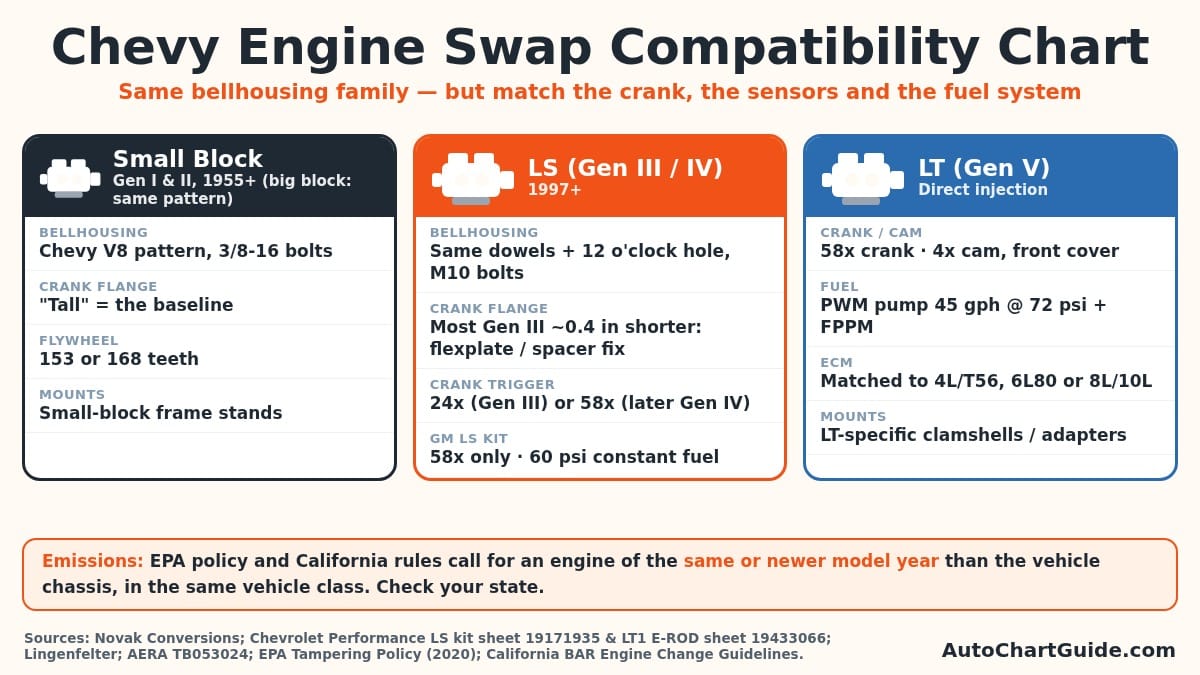
Short answer: A Chevy engine swap is compatible when five things match: the bellhousing bolt pattern, the crankshaft flange depth, the motor mounts, the crank trigger (24x or 58x) and the fuel and control system, plus your emissions rules. Classic small blocks, big blocks, the 4.3L V6 and LS engines all share the Chevrolet V8 bellhousing pattern, but most Gen III LS cranks sit about 0.4 inch shorter. Gen III LS engines read a 24x crank wheel, later Gen IV and Gen V engines a 58x wheel. GM's LS crate-engine kit needs a constant 60 psi of fuel; its LT1 E-ROD kit needs a PWM pump good for 45 gph at 72 psi.
We built this chart from manufacturer and regulator documents, all read on November 4, 2026. The engine-control figures come from Chevrolet Performance's LS Series Crate Engine Control System instruction sheet (19171935, Rev 19MY16) and its LT1 E-ROD instruction sheet (19433066, Rev 24JA23). Bellhousing and crank-flange details come from adapter maker Novak Conversions' Gen III+ crank spacing guide. Reluctor data comes from Lingenfelter Performance Engineering's reluctor wheel table and an AERA Engine Builders Association bulletin. The legal section quotes the EPA tampering policy and California's engine change guidelines. We have not performed a swap for this article and do not invent fitment. Where the sources leave a gap, the table says so.
Before you buy anything, identify both engines exactly. A model name is not enough: the same 5.3L was built with a 24x and a 58x crank wheel in different years. Our guide to finding your engine code shows where to read it on the VIN, the emissions label and the block.
Chevy engine swap compatibility chart
This is the master chart. Each row is a GM engine family; each column is one of the things that has to match. Read across the row for the engine you want to install, then compare it with the row for the engine that came out of your vehicle.
| Engine family | Block-to-bellhousing | Crank flange and flywheel | Crank / cam sensing | Fuel and controls | What it means for a swap |
|---|---|---|---|---|---|
| Gen I & II small-block V8 (Novak: 1955-1998+; 265, 283, 305, 307, 327, 350, 400) | Chevrolet V8 pattern, 3/8-16 bolts | "Tall" flange (the baseline); 153- or 168-tooth flywheels and flexplates | Not covered by the GM LS/LT kits in this guide | Varies by engine; check the engine you have | The reference point: classic Chevy bellhousings, transmissions and small-block frame stands were built around it |
| Big-block V8 (Novak: 1965-2007+; 409-454, 7.4L, 8.1L) | Same Chevrolet V8 pattern (Novak bellhousing list) | Not covered in this guide | Not covered in this guide | Varies | Bolts to the same bellhousings; Novak says it is best suited to wide-frame Jeeps |
| 90-degree V6 and Chevy inline 6 (4.3L; 194-292 cu in) | Same Chevrolet V8 pattern (Novak) | 4.3L: small-block spacing (Novak crank chart) | Not covered | Varies | Same bellhousing family as the small block; Novak says the inline 6 shares its transmission compatibility |
| Gen III LS (1997 on: LS1, LS6, LM7, LQ4, LQ9...) | Same dowels; 12 o'clock hole added, ~1:30 hole closed; M10 bolts | Most are "short", about 0.4 in closer to the block; 168-tooth only | 24x crank reluctor; cam sensor at the rear of the block | GM controls; the Chevrolet Performance LS kit is designed for 58x, not 24x | Needs adapter mounts, the right flexplate/spacer for older automatics, and a 24x-capable controller |
| Gen IV LS, early (2005 LS2 Corvette; 2005-06 LS2 GTO and SSR) | As Gen III | Check (Novak's chart covers Gen III) | 24x crank with 1x cam gear (Lingenfelter) | E40 PCM in Lingenfelter's table | Treat as 24x even though it is a Gen IV engine |
| Gen IV LS, 58x (2006-07 LS2 Corvette, LS3, LS7, most 2007-on trucks; check the code) | As Gen III | Check (Novak's chart covers Gen III) | 58x crank; 4x cam target, sensor in the front cover | Chevrolet Performance LS kit: 58x, 4x, electronic throttle, 60 psi constant fuel | The GM crate-engine controller kit is designed for this group |
| Gen V LT (LT1 crate engine based on a 2022 Camaro LT1) | Confirm with the bellhousing maker | Not covered in the GM sheet beyond flexplate and pilot bearings | 58x crank; 4x cam target, sensor in the front cover | Direct injection; PWM lift pump with FPPM, 45 gph at 72 psi; ECM matched to the transmission | Needs LT-specific mounts or clamshells, a returnless PWM fuel system, and the matching controller |
Sources: Novak Conversions (bellhousing catalog, Gen III+ crank spacing guide, Chevrolet engine gateway), Lingenfelter reluctor table, Chevrolet Performance LS controller sheet 19171935 and LT1 E-ROD sheet 19433066. "Not covered" means our sources do not give a figure, so we do not.
Two patterns stand out. First, the rear of the block barely changed for decades. Novak calls the Chevy small block/LS interface "arguably the most popular and consistent engine block bolt pattern of all time" and says it "has remained virtually unchanged since 1955." Its LS bellhousings fit the small block, big block, 90-degree V6, Chevy inline six and LS Gen III+ engines. Second, nearly everything else changed. The crank flange moved, the flange bolt pattern shrank with each generation, the crank trigger and the cam sensor location changed, and the fuel system moved to constant-pressure injection and then to direct injection.
So "will it bolt in?" usually has an easy answer at the bellhousing and a harder one everywhere else. The rest of this guide takes each column in turn.
Quick swap-path chart: what each common swap needs
Most searches for a Chevy engine swap chart come down to a handful of combinations. This table pulls the requirements for each one from the sections below.
| Swap | Bellhousing | Flexplate / flywheel | Mounts | Electronics and fuel |
|---|---|---|---|---|
| Small block or big block into a car that had a small block | Same Chevrolet V8 pattern | Match the crank generation (Gen I two-piece seal, Gen II one-piece seal and Gen III flange bolt patterns all differ) | Small-block frame stands | Whatever the engine was built with |
| 24x Gen III LS (e.g. 1999-2007 LM7 5.3L) into an old Chevy | Bolts up; LS bellhousings add the 12 o'clock hole | With an early Chevy automatic: dished flexplate, slightly elongated converter holes, crank spacer behind the flexplate (Novak scenario 3) | Adapter plates to small-block mounts, or swap mounts | A controller that reads 24x; the GM LS kit in this guide is 58x-only |
| 58x LS3, LS7 or 2007+ truck LS | As above | As above for older automatics; 4L80E: flat six-bolt flexplate with the crank spacer between crank and flexplate (scenario 4) | As above | GM LS kit: 400 kPa (60 psi) constant fuel, 40 or 50 gph minimum |
| Gen V LT (LT1) | Use a bellhousing listed for Gen V | Kits ship with an automatic flexplate; GM lists two LT1 pilot bearings for manuals | LT-specific clamshells or adapters | LT1 E-ROD kit matched to 4L/T56, 6L80 or 8L/10L; PWM pump with FPPM, 45 gph at 72 psi |
Summary of the documents cited in each section below. Always confirm with the instructions for the parts you buy.
Bellhousing pattern: what bolts to what
According to Novak's Chevrolet engine gateway and its Chevy bellhousing catalog, these engines all share the Chevrolet V8 bellhousing pattern:
- Chevy small-block V8 (Gen I and II, 265 through 400 cubic inches)
- Chevy big-block V8
- The 90-degree Chevy V6 (4.3L and its relatives)
- The Chevy inline six (194 through 292 cubic inches), which Novak says has "the same block / bellhousing pattern as the Small Block V8 series"
- GM Gen III and later LS engines
Novak describes three differences on the LS. GM "opened up the bolt hole on the LS / Vortec blocks at the 12 o'clock position, as viewed from the rear," a hole that had become a "vestigial, untapped boss" on late Gen I and II blocks. At the same time GM "closed off the bolt hole at the ~1:30 o'clock position." And Gen III engines use metric M10 fasteners instead of 3/8-16. The locating dowel positions and diameters are "fully identical."
In practice, an older small-block bellhousing bolts to an LS with one hole unused, and an LS bellhousing bolts to an older block with the 12 o'clock hole empty. Novak notes that the LS bellhousing also has holes for the structural oil pan bolts, and that a few pans put those holes in odd places. If they do not line up, it says you can switch to a standard pan or leave those bolts out.
On the transmission side, Novak's bellhousings use the "standard GM Saginaw-Muncie bolt pattern," with a 5-1/8-inch bore for the SM465 and a 4-11/16-inch bore for most others (SM420, AX15, T90, T150, T14, T15, T18, T176 and some Ford gearboxes). Gen V LT engines are a separate case. We did not find a primary source that settles whether LT and LS bellhousings interchange, so buy a bellhousing whose maker lists Gen V LT fitment.
Crank flange depth: the 0.4-inch problem
This is where most first-time LS swaps go wrong. Novak explains that "most of the Gen III engines" have "a shorter crank flange, offset of about 4/10" closer to the block." That does not matter with the transmission GM paired with the engine. It does matter when you bolt an older automatic or manual to an LS. Novak's chart shows which engines are tall and which are short:
| Engine | Years | Transmission | Crank flange |
|---|---|---|---|
| 4.3 | 1986-2013 | Manual & auto | Tall (small-block spacing) |
| 4.8 | 1999-2000 | Manual | Tall (312 casting) |
| 4.8 | 1999-2000 | Auto | Short (482 casting) |
| 4.8 | 2001+ | Manual & auto | Short (482 casting) |
| 5.3 | 1999+ | Auto | Short |
| 5.7 | 1997+ | Manual & auto | Short |
| 6.0 | 1999 & 2000 | Manual & auto | Tall (215 casting) |
| 6.0 | 2001+ | Manual & auto | Short (216 casting) |
Source: Novak Conversions, "The Novak Guide to GM Gen III+ Engine Crank Spacing & Interchange," chart copied as published. Novak says the short flange sits "about 4/10" closer to the block.
The tall-flange exceptions are the 1999-2000 4.8L with a manual (312 casting) and the 1999-2000 6.0L (215 casting). Novak shows these "protruding 4/10ths of an inch past the other LS / Vortec engines."
Automatic transmissions
GM handled the short crank in two ways at the factory, according to Novak. Gen III engines with the 4L60E got a dished flexplate and a 4L60E converter "with an extended pilot hub to reach the shorter crank." Engines with the 4L80E got a flat flexplate plus a crank spacer and longer bolts. Novak says the same spacer and bolts are recommended "as a GM Performance part for Gen III+ retrofits to earlier automatics such as the Th250, TH400, and TH700R4 / 4L60 / Early 4L60E." It lists four scenarios:
- Early 4.8L or 6.0L with the extended crank and an early Chevy automatic: flat flexplate, no crank spacer.
- 5.3L, 5.7L or other short-crank Gen III+ with the 4L60E (deep bellhousing, tall converter): dished flexplate, no spacer.
- Short-crank Gen III+ with an early Chevy automatic: dished flexplate with "slightly elongated torque converter holes," spacer behind the flexplate.
- Short-crank Gen III+ with the 4L80E: flat six-bolt 4L80E flexplate with the spacer between crank and flexplate.
Novak adds that later converters have a metric bolt pattern on a slightly smaller diameter, which is why the 4L60E flexplate's converter holes may need elongating for an older transmission. It says this "is best done in a mill with a rotary table."
Manual transmissions
Two details matter. Novak says that in 2001 GM eliminated the small (about 1-inch) pilot bushing bore that Chevy engines had used "since at least the 1940's" by deepening the larger 1.7-inch torque converter pilot bore. So a 1997-2000 Gen III engine usually takes a Gen I-style pilot bushing, while a 2001-on engine needs a bushing for the later bore. Novak also warns that the factory recessed flywheel on later short-crank 4.8L and 6.0L engines leaves "over 20% of the clutch face" uncontacted with many older 10-spline transmissions. Its suggested fix is an aftermarket flywheel with a 12-inch classic GM clutch.
Ring gears changed too. Novak says Gen I and II engines used two flywheel diameters with 153 or 168 teeth, but Gen III engines "feature only the large diameter, 168 tooth flywheels and flexplates." The crank flange bolt patterns of Gen I (two-piece rear main seal), Gen II (one-piece seal) and Gen III+ "are all different and will not permit any interchange between them." A small-block flywheel will not bolt to an LS crank.
24x vs. 58x: the crank trigger chart
The crank reluctor wheel decides which engine computer can run the engine. Lingenfelter's table lists a 24x wheel on "all Gen III V8 engines (LS1, LS6, LQ4, LQ9) and early Gen IV V8 engines," and a 58x wheel on later Gen IV engines. The AERA bulletin puts it more simply: "Originally, the LS & LT family of engines came with a 24 tooth reluctor wheel and after 2006 all applications went to a 58 tooth reluctor wheel." It warns that the wrong wheel causes a no-start with the check engine light on.
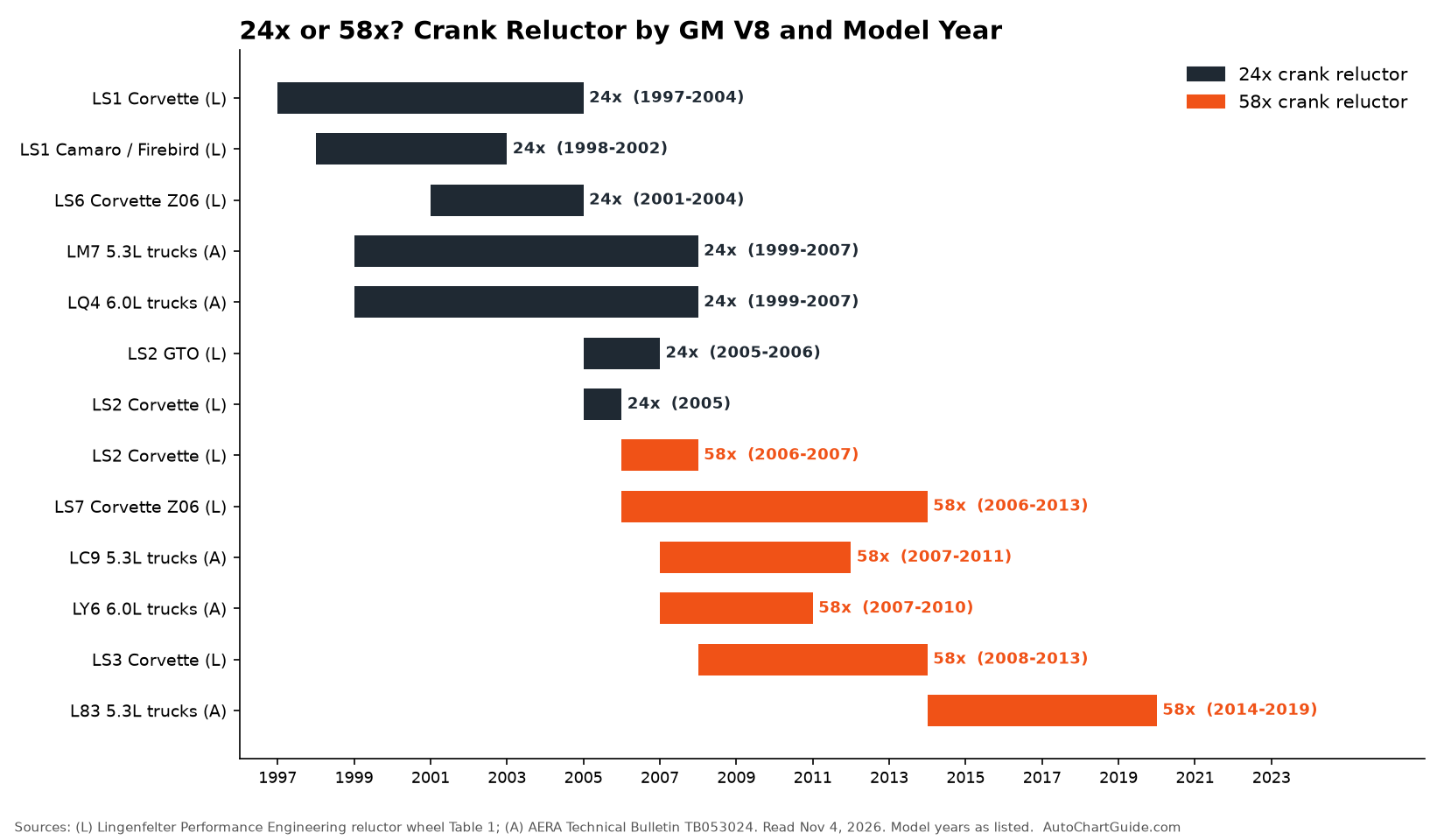
| Engine (vehicle) | Model years | Crank reluctor | Cam gear / sensing | PCM/ECM type | Source |
|---|---|---|---|---|---|
| LS1 (Corvette) | 1997-2004 | 24x | 1x on camshaft (rear sensor) | Warren | Lingenfelter |
| LS1 (Camaro, Firebird) | 1998-2002 | 24x | 1x on camshaft | Warren | Lingenfelter |
| LS6 (Corvette Z06) | 2001-2004 | 24x | 1x on camshaft | Warren | Lingenfelter |
| LM7 5.3L (Silverado, Sierra, Tahoe, Yukon and others) | 1999-07 | 24X | - | - | AERA |
| LQ4 6.0L (Silverado, Sierra, Express, Savana, Yukon, Hummer) | 1999-07 | 24X | - | - | AERA |
| LS2 (2005 Corvette) | 2005 | 24x | 1x (three-bolt gear) | E40 | Lingenfelter |
| LS2 (GTO) | 2005-2006 | 24x | 1x | E40 | Lingenfelter |
| LS2 (Corvette) | 2006 | 58x | 4x | E38 | Lingenfelter |
| LS7 (Corvette Z06) | 2006-2013 | 58x | 4x | E38 | Lingenfelter |
| LC9 5.3L (Silverado, Sierra, Tahoe, Yukon and others) | 2007-11 | 58X | - | - | AERA |
| LY6 6.0L (Silverado, Sierra, Suburban, Yukon, Express, Savana) | 2007-10 | 58X | - | - | AERA |
| LS3 (Corvette) | 2008-2013 | 58x | 4x | E38 | Lingenfelter |
| LS3 and L99 (Camaro) | 2010-2015 | 58x | 4x | E38 | Lingenfelter |
| L83 5.3L (Silverado, Sierra, Yukon, Tahoe, Suburban) | 2014-19 | 58X | - | - | AERA |
Sources: Lingenfelter Performance Engineering, "GM Gen III And Gen IV V8 Crankshaft and Camshaft Reluctor Wheel Images," Table 1; AERA Engine Builders Association Technical Bulletin TB053024, "Reluctor Wheel Caution on GM LS and LT Family Engines." A dash means that source does not list the field.
The cam sensor moved at the same time. On 1997-2004 LS1, LS6 and other Gen III engines, Lingenfelter says the timing chain gear has no reluctor teeth "since the camshaft position sensor is at the back of the block and senses the camshaft speed from the reluctor machined into the back of the camshaft itself." The 58x engines use a 4x target and a sensor in the front timing cover. The 2005 LS2 sits in between: a 24x crank with a 1x camshaft gear.
Two cautions from the sources. Lingenfelter says the LS9's 58x wheel "is smaller [in] diameter and requires a different sensor." And AERA's truck table shows overlap in the 2005-2009 transition years: the LH6 5.3L, for example, is listed as 24x for 2005-06 and 58x for 2007-09. Check the engine code and year together. If you are buying from a salvage yard, our guide to why a salvage yard "fits" result is not a guarantee explains how to confirm the donor before you pay.
Engine controllers and transmission signals
Chevrolet Performance sells two kinds of controller packages covered here: the LS Series Crate Engine Control System for its LS crate engines, and E-ROD kits that include the engine, controls and emissions parts as one package. Their requirements set the boundaries of a "plug and play" swap.
LS crate engine control system
| Requirement in the GM LS kit sheet | What Chevrolet Performance says |
|---|---|
| Engines covered | LS Series crate engines "with 58x crankshaft reluctor wheels, 4x camshaft indexing, and electronic throttle control (ETC) - typically 2006 and newer" |
| Fuel pressure | "400 kPa (60 psi) constant pressure"; do not vacuum-reference the fuel system |
| Fuel flow (minimum at 400 kPa) | 40 gph for LS2/LS3/LS376; 50 gph for LSX454 and LS7 |
| Vehicle speed input (optional) | Programmed for 40 pulses per revolution; harness plugs into the 4L60 and 4L80 output speed sensor |
| Axle ratio and tires | Calibration set to 3.42:1, "okay for ratio from 3.08 to 4.11"; tire diameter between 26 and 30 inches |
| Tachometer output | 2 pulses per revolution, low-voltage square wave (some tachs need a pull-up resistor) |
| MAF sensor | Middle of a straight 4-inch tube at least 6 inches long, at least 10 inches from the throttle body |
| Ground and power | Minimum 3/4-inch braided ground strap engine to chassis recommended; battery feed with minimum 8-gauge wire |
| Flywheel / flexplate | Engines ship with an automatic flexplate; manual clutch and flywheel bought separately |
| Engine oil | "All LS Chevy Performance Crate Engines require a special oil meeting GM Standard GM4718M" |
Source: Chevrolet Performance, LS Series Crate Engine Control System instruction sheet, part no. 19171935, Rev 19MY16. Kits listed on the sheet: 19354328 (LS3, also used for LS2), 19354330 (LS376-480), 19354332 (LS376-525), 19354334 (LS7), 19354342 and 19354344 (LSX454 auto and manual).
The kit sheet also says the LS3 control system "is now used for LS2 applications" and has been updated for LS2 engines with 58X crank sensing, but LS2 owners must buy a new MAP sensor (55573248) because "the LS2 MAP sensor port in the intake manifold is too small." The LS3 system "contains the necessary software to operate Chevy Performance 4LXX electronic transmission control systems."
The oil requirement is easy to miss. GM's sheet says not every synthetic meets GM4718M, so look for that standard on the label. Our explainer on what an OEM oil approval actually means covers how to read those claims.
LT1 E-ROD (Gen V)
The LT1 E-ROD kit is based on "the Chevrolet Generation V LT1 Series architecture from a 2022 Chevrolet Camaro." GM warns that model year 2022 and newer "has a component change that is not compatible with model year 2021 and older engines," so components should not be mixed with earlier E-ROD kits. There are three versions, one per transmission family:
| LT1 E-ROD kit | Transmission it is calibrated for | Speed signal |
|---|---|---|
| 19433063 | 4L automatic and 6-speed manual | 40 pulses per revolution from a tailshaft sensor (T56 Super Magnum also provides 40) |
| 19433869 | 6L80 automatic | Per kit calibration |
| 19433059 | 8L and 10L automatic | Over CAN; the harness speed sensor is not used |
Source: Chevrolet Performance LT1 E-ROD Instruction Sheet 19433066, Rev 24JA23. GM: "The ECM in each of these kits are not programmed identically and are not interchangeable."
Other LT1 E-ROD requirements from the same sheet:
- Vehicle weight: maximum GVWR of 5,725 lb.
- Axle and tires: calibrated for 3.42:1, "suitable for a ratio from 3.08 to 4.11," with 26- to 30-inch tires (the same window as the LS kit).
- Cylinder deactivation: the hardware is still in the engine, but the Chevrolet Performance control kit disables it.
- Sensing: 58X crank encoder and a front-cover cam sensor reading a 4X target on the phaser rotor.
- Manual transmissions: GM lists two pilot bearings, 14061685 for a long input shaft and 12557583 for a short one, and says to "verify fit prior to installing the transmission or damage will occur."
- Brakes: "An auxiliary vacuum pump may need to be purchased to ensure proper vacuum to support power brakes under all operating conditions."
- Exhaust: the supplied oxygen sensors, catalytic converters and exhaust manifolds, "or similar OEM LT style," must be used for emissions compliance.
Because both kits are calibrated around a 3.42:1 axle, a swap is a good time to check the rear gear. If you are re-gearing as part of the project, our Winters quick change gear chart shows how ratio and tire diameter set engine rpm at a given speed.
Fuel system requirements: LS vs. LT
The two GM kits want different fuel systems, and neither matches what a carbureted engine came with.
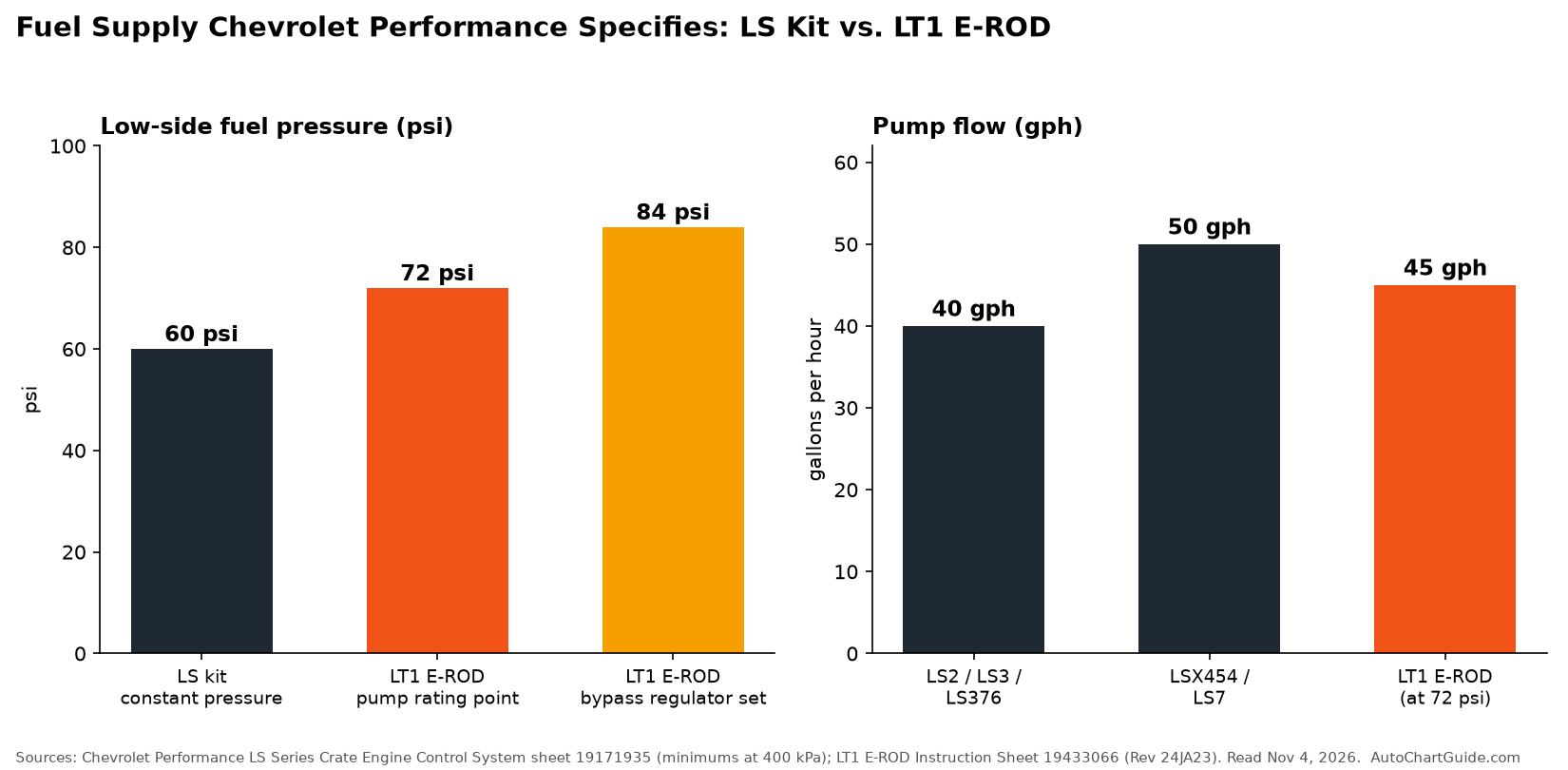
- LS crate engine kit: "a constant 400 kPa (60 psi) with the engine running." The sheet's list of don'ts includes: "Vacuum reference the fuel system, it must run constant 400 kPa (60 psi)." Minimum flow at 400 kPa is 40 gph for LS2, LS3 and LS376 engines and 50 gph for the LSX454 and LS7.
- LT1 E-ROD: "A PWM (pulse width modulated) fuel pump capable of 45 G/H (Gallons per hour) at 72 psi (500 kPa) is recommended." The supplied Fuel Pump Power Module (FPPM) "IS REQUIRED"; without it the ECM sets diagnostic codes that "may cause rejection at the inspection station." With a GM pump no regulator is needed. With an aftermarket pump that lacks an internal relief valve set at 84 psi, GM says to add an adjustable bypass regulator set at 84 psi, mounted near the tank with the pressure sensor. A cam-driven high-pressure pump on the engine supplies the direct injectors.
The LT1 sheet also sets evaporative-system rules: the fuel tank, fill pipe and cap "must be equivalent to those offered by large volume OEM's for 2006 model year or later vehicles," with hoses meeting SAE J30R9 permeation requirements and connections per SAE J2044.
Motor mounts and oil pans
In a chassis built for a small block, the mount question for an LS or LT is about adapters or swap-specific mounts. Holley's Hooker LS swap mount brackets bolt to Gen III/IV engines and "work with all small-block Chevy mounts and frame towers." Holley says its plates can place the engine "in the stock location or move it forward 1/2, 1-1/4, or 3-inches," and it also sells a version for clamshell-type mounts such as a G-body. For LT engines, Holley's LT swap guide says its Hooker BlackHeart LT clamshell mounts put the engine "in the exact same spot where it would be if it was an LS block with the LS clamshell mount," so LS swap headers and exhaust line up.
Oil pans are the usual clearance problem. In its LS swap oil pan guide, Holley says "the crossmember and steering linkage are the usual interference points." It gives these depths, measured from the pan rail to the lowest point:
| Oil pan | Depth (rail to lowest point) | Holley notes |
|---|---|---|
| Junkyard 5.3L truck pan | 8.25 in | Rear sump; "can hang lower than the crossmember" |
| GM muscle car pan (same design as Hummer H3 Alpha / Colorado pan) | 7.75 in | "Offers fitment on many applications" but can hang below the crossmember |
| Holley 302-1 LS swap pan | 5.71 in | Intended for first-generation F-body (1967-69) and X-body (1968-74); fits many 1955-1987 GM applications |
| Holley 302-2 | Not listed | Extra front clearance; G-body fitment |
| Holley 302-3 | Not listed | Extra front sump clearance; Fox-body Mustang |
Source: Holley, "How to Determine the Correct Oil Pan for Your LS Swapped Vehicle," September 3, 2020. Holley lists 6 to 6.2 quarts with filter for its three pans.
Holley also notes that the rear of the oil pan must be "perfectly flush with the rear of the block" because the bellhousing bolts to the pan. That is the structural pan connection Novak mentions on the bellhousing side.
Emissions and legality: same-or-newer rule
An engine swap is also an emissions change. This section restates what the regulators publish. It is not legal advice, and state inspection rules vary, so check with your state agency before you buy an engine.
Federal (EPA). The EPA Tampering Policy of November 23, 2020 replaced the older Engine Switching Fact Sheet. It says a person installing an engine into a different vehicle has a reasonable basis if the result is "(a) in the same product category (e.g., light-duty vehicle) as the engine originally powered, and (b) identical (with regard to all emissions-related elements of design) to a certified configuration of the same or newer model year as the vehicle chassis." The alternative is emissions testing under the policy's Reasonable Basis D. EPA adds that "it is generally not possible to put an engine into a chassis of a different manufacturer and have it conform to a certified configuration."
California (BAR and CARB). BAR's Engine Changes page separates an engine replacement (same make, cylinders and engine family, or a configuration the manufacturer offered for that vehicle) from an engine change. Every engine change needs an initial BAR Referee inspection and a Referee label. The main rules in the guidelines:
| California engine change rule (BAR/CARB guidelines) | What it requires |
|---|---|
| Model year | "The installed engine must be of the same model year or newer than the model year of the recipient vehicle" |
| Engine classification | Donor and recipient must share the GVWR-based class (passenger car, LDT1, LDT2, LHD1, LHD2, MDV...); a heavy-duty truck engine may not go into a light-duty truck |
| Non-certified engines | "Non-emissions controlled engines, such as industrial and off-road-use-only engines, and non-certified 'crate engines', MAY NOT be installed in any emission- controlled vehicle" |
| Certification type | Same certification (California or Federal), or the engine must meet the more stringent standard; a Federal engine may not go into a California vehicle |
| Smog tests | BAR-97 tailpipe test (not diesel or hybrid), BAR-OIS for OBD II engines, MIL check, visual and functional tests, visible smoke and liquid fuel leak tests, to donor-vehicle requirements |
| Catalysts | Close-coupled converter within 6 inches of stock position (and no closer); other devices within 12 inches |
| Oxygen sensors | Within 1 inch of the original location relative to the after-treatment device |
| Inspection | Initial inspection at a BAR Referee; Referee label inside the engine compartment |
Source: Bureau of Automotive Repair, Smog Check Reference Guide, Appendix D "State of California - Engine Change Guidelines" (revision table current to 07/03/2025), and BAR "Engine Changes" page.
Vehicles originally equipped with OBD II "must receive an OBD II certified engine," with the donor vehicle's transmission, evaporative, exhaust and intake configuration. The guidelines' footnote says OBD II "generally applies to model years 1996 and newer for gasoline vehicles." The certified configuration is printed on the under-hood label; our guide to the under-hood emissions label explains how to read it.
CARB-exempted packages. BAR recommends a California-certified engine or a CARB-exempted engine package. CARB Executive Order D-126-30 exempts the Chevrolet Performance LS3-6.2L V8 E-ROD Kit (part numbers 19257230 and 19257234) "for all 1995 and older passenger cars and light duty truck 1 vehicles." It says the kit is derived from a certified 2011 Camaro LS3, requires complete removal of the stock pre-1996 engine and its exhaust and evaporative systems, and that "installation of any modified or add-on parts to this engine package shall be prohibited unless prior approval is obtained from the Air Resources Board." The LT1 E-ROD sheet shows its own engine label with a CARB E.O. number in the D-126 series.
Worked examples
Example 1: 2005 5.3L truck engine into a car that had a 350 and a TH350
Per AERA, a 1999-2007 LM7 5.3L is 24x. Per Novak, a 1999-on 5.3L with an automatic has the short crank flange. So the TH350 bellhousing bolts on (the 12 o'clock hole stays empty), but the converter will not reach without Novak's scenario 3: dished flexplate, elongated converter holes and the crank spacer behind the flexplate. The Chevrolet Performance LS controller kit is designed for 58x engines, so this engine needs a controller that reads 24x. Add adapter plates to the small-block frame stands and check the truck oil pan against the crossmember. Holley measured the junkyard 5.3L truck pan in its article at 8.25 inches deep.
Example 2: LS3 crate engine with a 4L60E
The LS3 is 58x, so the Chevrolet Performance LS kit applies. The fuel system must hold a constant 60 psi and flow at least 40 gph at that pressure. The kit's speed input plugs into the 4L60 output speed sensor (40 pulses per revolution). If the engine has the short crank flange, Novak's scenario 2 (short-crank Gen III+ engine with a 4L60E) calls for the dished flexplate and no spacer. If the axle is outside 3.08 to 4.11:1, or the tires outside 26 to 30 inches, the calibration is outside GM's stated window.
Example 3: LT1 crate engine with an 8L90
Use LT1 E-ROD kit 19433059, the 8L/10L version. The speed signal comes over CAN, so the harness speed sensor is not used. The fuel system needs a PWM pump good for 45 gph at 72 psi under the FPPM's control. Mounts must be LT-specific. If the vehicle is in California, the kit's own EO and the BAR guidelines decide whether it qualifies, and the GVWR must be 5,725 lb or less.
Step-by-step: checking a swap before you buy
- Identify the donor exactly. Engine code, model year and casting where relevant. GM's RPO codes on the donor vehicle can help confirm what it was built with.
- Check the crank trigger (24x or 58x) against the chart above and choose a controller that supports it.
- Check crank flange depth (tall or short) and pick the flexplate, spacer or pilot bushing for your transmission.
- Plan the mounts and oil pan together. Engine position decides pan, header and steering clearance.
- Plan the fuel system: constant 60 psi for the GM LS kit, a PWM pump and FPPM for the LT1 E-ROD.
- Plan signals: vehicle speed (40-pulse sensor or CAN), tach output, and electronic transmission control if needed.
- Check the emissions path for your state before buying: same-or-newer engine, same vehicle class, all emissions equipment, or a CARB-exempted package.
Common swap mistakes the sources warn about
- Assuming "LS" means one controller. 24x and 58x engines need different controls; the wrong reluctor gives a no-start (AERA).
- Ignoring the 0.4-inch flange difference. An old automatic's converter will not engage properly without the correct flexplate or spacer (Novak).
- Vacuum-referencing an LS kit fuel system. GM's sheet lists this as a "don't."
- Skipping the FPPM on an LT1 E-ROD. GM says codes will set that "may cause rejection at the inspection station."
- Mixing E-ROD generations. GM says 2022-on LT1 E-ROD components are not compatible with 2021 and older engines.
- Installing a non-certified crate engine in an emission-controlled California vehicle. The BAR guidelines prohibit it.
- Forgetting brake vacuum. GM says an auxiliary vacuum pump may be needed with the LT1.
FAQ
Will an LS bolt up to a small-block Chevy transmission?
The bolt pattern does. Novak says the Gen III block has essentially the same rear-face pattern and identical dowel positions as the earlier small blocks, with one hole moved to 12 o'clock and M10 bolts. The catch is crank flange depth: most Gen III engines sit about 0.4 inch closer to the block, so an older automatic needs the right flexplate and GM's crank spacer, and a manual needs the correct pilot bushing and flywheel.
How do I tell if my LS is 24x or 58x?
Go by engine code and model year from a reluctor table, then confirm on the engine. Lingenfelter lists all Gen III V8s and the 2005 LS2 Corvette and 2005-06 LS2 GTO as 24x, and the 2006-on Corvette LS2, LS7 and LS3 as 58x. Gen III engines read the cam at the rear of the block; Gen IV 58x engines put the cam sensor in the front cover. AERA's truck table shows the change around 2007.
Can I use the Chevrolet Performance LS controller kit on a junkyard 5.3?
Only if the engine matches what the kit is designed for. GM's sheet says the kit runs LS crate engines with 58x crank wheels, 4x cam indexing and electronic throttle, typically 2006 and newer. A 1999-2007 LM7 5.3 is 24x according to AERA, so it is outside that design.
What fuel pressure does an LS or LT swap need?
For the Chevrolet Performance LS controller kit: a constant 400 kPa (60 psi), not vacuum-referenced, with at least 40 gph (LS2, LS3, LS376) or 50 gph (LSX454, LS7). For the LT1 E-ROD: a PWM pump capable of 45 gph at 72 psi (500 kPa) run by the supplied FPPM, plus an 84 psi bypass regulator if an aftermarket pump has no internal relief valve. The direct-injection pump on the engine makes the high pressure.
Do LS motor mounts fit small-block frame stands?
Not directly. Holley's Hooker adapter plates bolt to the LS and accept stock small-block Chevy mounts and frame towers, placing the engine in the stock location or 1/2, 1-1/4 or 3 inches forward. For LT engines Holley offers clamshell mounts that put the engine in the same spot as an LS with LS clamshells.
Is an engine swap legal for emissions?
Federally, EPA's 2020 tampering policy says the person doing an engine switch has a reasonable basis if the result is in the same product category and identical to a certified configuration of the same or newer model year as the chassis, or if emissions testing supports it. California requires a BAR Referee inspection for any engine change, a same-or-newer engine, matching GVWR class, and it bans non-certified crate engines in emission-controlled vehicles. Check your own state's rules.
What is an E-ROD?
Chevrolet Performance's emissions-packaged crate engine kits. CARB Executive Order D-126-30 exempts the LS3 6.2L E-ROD kit (part numbers 19257230 and 19257234) for 1995 and older passenger cars and light-duty truck 1 vehicles. The LT1 E-ROD sheet lists a maximum vehicle GVWR of 5,725 lb.
Which oil pan do I need for an LS swap?
It depends on the crossmember and steering. Holley measured the GM muscle-car pan at 7.75 inches from pan rail to lowest point and a junkyard 5.3 truck pan at 8.25 inches; its 302-1 swap pan is 5.71 inches deep and is aimed at 1967-69 F-body and 1968-74 X-body cars.
Sources
- Chevrolet Performance, LS Series Crate Engine Control System instruction sheet, part no. 19171935, Rev 19MY16: PDF. Read November 4, 2026.
- Chevrolet Performance, LT1 E-ROD Instruction Sheet, part no. 19433066, Rev 24JA23: PDF. Read November 4, 2026.
- California Air Resources Board, Executive Order D-126-30, General Motors LLC LS3-6.2L V8 E-ROD Kit (October 19, 2010): PDF. Read November 4, 2026.
- U.S. EPA, "The EPA Enforcement Policy on Vehicle and Engine Tampering and Aftermarket Defeat Devices under the Clean Air Act," November 23, 2020: PDF. Read November 4, 2026.
- California Bureau of Automotive Repair, Smog Check Reference Guide, Appendix D "State of California - Engine Change Guidelines": PDF; and "Engine Changes": web page. Read November 4, 2026.
- Novak Conversions, "The Novak Guide to GM Gen III+ Engine Crank Spacing & Interchange": web page; "Chevy Bellhousings": web page; "The Novak Gateway to Chevrolet & GM Engines": web page. Read November 4, 2026.
- Lingenfelter Performance Engineering, "GM Gen III And Gen IV V8 Crankshaft and Camshaft Reluctor Wheel Images" with Table 1: PDF. Read November 4, 2026.
- AERA Engine Builders Association, Technical Bulletin TB053024, "Reluctor Wheel Caution on GM LS and LT Family Engines": PDF. Read November 4, 2026.
- Holley, "How to Determine the Correct Oil Pan for Your LS Swapped Vehicle" (September 3, 2020): article; Hooker 12611HKR LS swap engine mount brackets: product page; "How To Swap An LT-Based Engine Into Any Car" (December 8, 2020): article. Read November 4, 2026.