Tire Size Calculators: What They Cannot Possibly Know
A calculator does geometry from nominal dimensions. It has no model of your vehicle and no knowledge of how a real tire differs from its stated size.

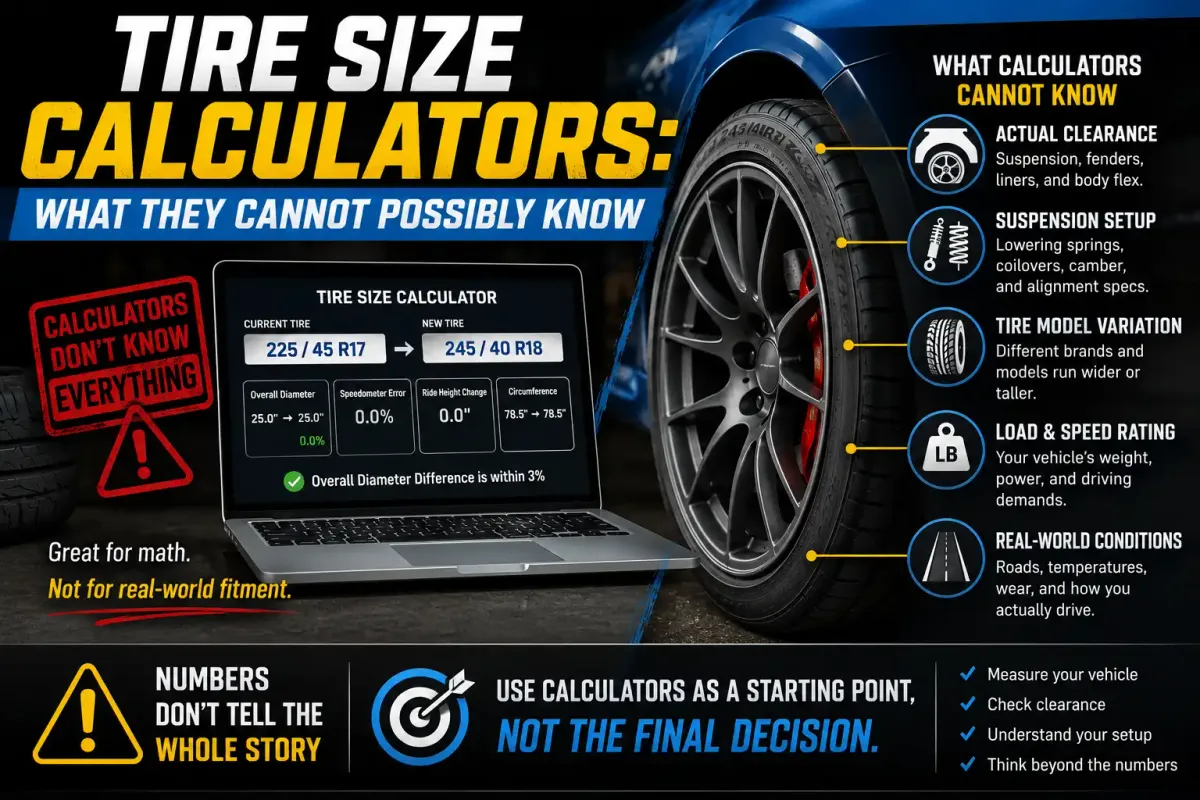
Short answer: no, the calculator does not know about your fenders, and it was never designed to. A tire size calculator does geometry. It takes the nominal numbers from two size codes and computes how the resulting circles compare. It has no model of your vehicle, no knowledge of your suspension travel, and no information about how the specific tire you are considering differs from its stated dimensions.
That is not a criticism of calculators. It is a description of what they are, and it matters because the output looks like a fitment answer and is not one.
What a size calculator is actually computing
Feed a calculator two tire sizes and it does a small amount of arithmetic.
It takes the section width, applies the aspect ratio to get sidewall height, doubles that and adds the rim diameter to get overall diameter. It does this for both sizes and reports the difference, usually as a percentage and often translated into a speedometer error.
That is the whole operation. It is correct arithmetic on the numbers it was given, and the numbers it was given are the nominal values in a size code: reading a metric tire size.
Nominal dimensions versus the tire you receive
The size code is a designation, not a measurement of the product.
Section width is a nominal figure, and a real tire's measured width depends on its construction and on the rim width it is mounted to. Sidewall height follows from the width, so it inherits the same variation. Overall diameter is built from both, so it inherits both.
None of that variation is a defect. It is how the designation system works: sizes are categories that real products sit within, not exact specifications each product meets.
Why two tires of the same size are not the same size
Follow that through and the practical consequence is clear.
Two tires marked with identical size codes, from different manufacturers or from different lines within one manufacturer, can differ measurably in mounted width and in overall diameter. Different tread designs, different sidewall constructions and different intended uses all move the actual dimensions.
A calculator cannot see any of that. It is comparing two size codes, not two tires. When its output says the difference is within some small percentage, it is telling you the difference between the designations, and the real difference between the products may be larger.
This is a specific case of a general pattern worth recognizing: why two websites give your car two different numbers.
What the calculator has no way of knowing about your vehicle
The list is longer than most people expect:
- Fender and liner clearance, at rest and through full suspension travel.
- Steering lock clearance, which is often the binding constraint at the front.
- Suspension component clearance on the inboard side.
- Brake caliper clearance, which is a wheel question the tire calculation never touches.
- Whether the wheel fits at all. Bolt pattern, offset, center bore and seat type are entirely outside the calculation: will these used wheels fit.
- Whether the tire meets the vehicle's ratings. Load index and speed rating are properties of the specific tire and appear nowhere in the geometry: tire load index explained.
- The rim width range the tire is approved for.
A calculator that returns a green result has told you the two sizes are geometrically close. It has not told you any of the above.
Where calculators are genuinely useful
They are useful, and dismissing them would be wrong.
Screening a shortlist. If you are considering several sizes, the calculator eliminates the ones that are geometrically nowhere near the original in seconds.
Understanding speedometer effect. The relationship between overall diameter and speedometer reading is proportional and the calculator handles it correctly.
Learning how the size code behaves. Changing one number and watching the output is a fast way to build intuition about why aspect ratio interacts with width the way it does: plus-sizing explained.
How to use one as a filter rather than a decision
The discipline that keeps a calculator useful:
Treat a fail as final and a pass as provisional. If the geometry is well off, that size is out. If the geometry is close, that size has passed one check out of several.
Never use it to compare ratings, because it does not have them. Ratings come from the tire manufacturer and from your vehicle's placard: reading the tire lines on the loading placard.
Do not treat a small percentage as a safety margin. The percentage describes nominal dimensions, and the real difference between two products may be larger.
What to verify with a person
Everything the calculator cannot see, which is most of what decides the outcome.
A tire professional can tell you whether a size is appropriate for your wheel width, whether the tire meets your vehicle's requirements, and whether the assembly clears. That last one usually means putting the vehicle on a lift and checking through the range of movement, which is not something to substitute a calculation for.
For the vehicle's own specifications, the tier above the owner's manual is where wheel and tire data lives: owner's manual vs service manual vs repair database. And what the tire itself is telling you, marking by marking: every number on your tire sidewall, decoded.
Frequently asked questions
Are tire size calculators accurate?
The arithmetic is accurate. The inputs are nominal size designations rather than measurements of real tires, so the output describes how two size codes compare, not how two products compare.
Will a calculator tell me if a tire fits my car?
No. It computes geometry and has no model of your vehicle's fenders, suspension, brakes or steering lock, and no knowledge of the wheel's fitment specifications.
Why do two tires with the same size measure differently?
Because size codes are designations that real products sit within. Construction, tread design and mounted rim width all affect actual dimensions.
Can I trust the speedometer error a calculator reports?
The relationship it uses is correct, but it is calculated from nominal dimensions. Treat the figure as indicative rather than exact.
What should I use a calculator for?
Screening a shortlist and understanding how the size code behaves. Treat a geometric fail as final and a pass as one check out of several.