Rear Window Car Decal Size Chart 2026: Complete Fit Guide
Every published rear window decal size, from corner accents to full-window perforated graphics, plus state rules, film limits, letter heights and how to measure.

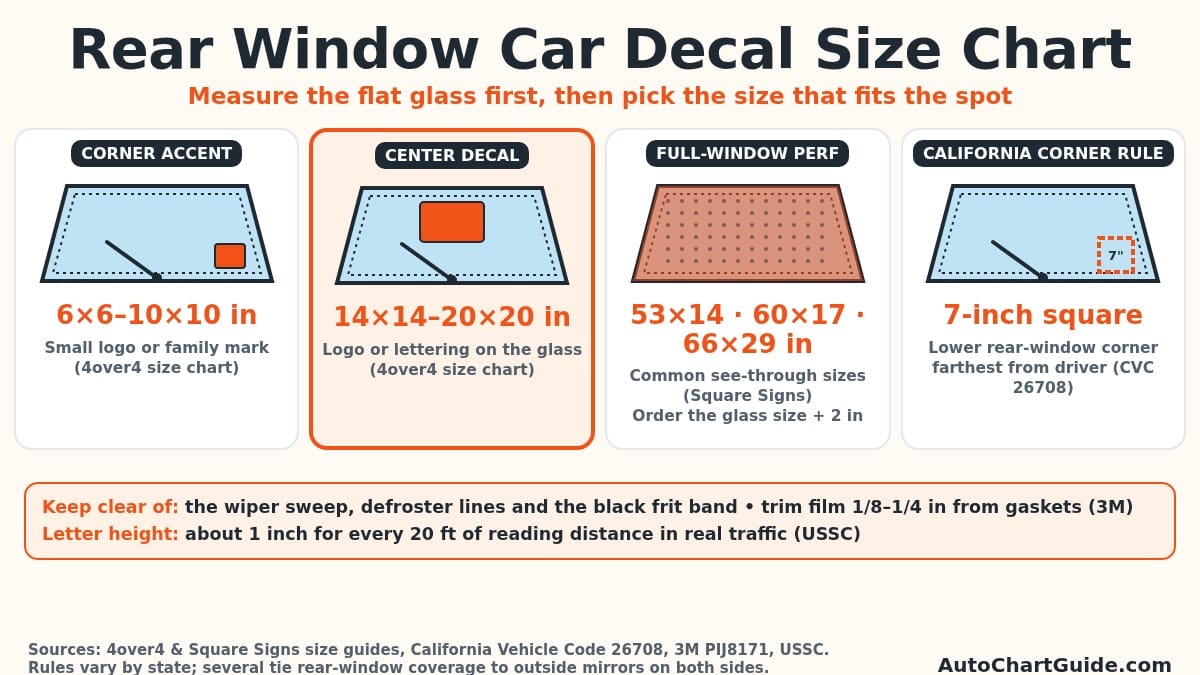
Short answer: There is no single standard size for a rear window car decal. The size depends on where it goes on the glass. Printers' own size guides put a corner accent at 6 × 6 to 10 × 10 inches and a centered rear-window decal at 14 × 14 to 20 × 20 inches (4over4). A full-window perforated (see-through) graphic is sized to the whole glass: Square Signs lists common sizes of 53 × 14, 60 × 17, 66 × 20 and 66 × 29 inches. Both Square Signs and Printmoz tell you to order it 2 inches wider and taller than the window and trim it after it is on. If you drive in California without outside mirrors on both sides, the law limits stickers on the rear window to a 7-inch square in the lower corner farthest from the driver. For text that drivers can read behind you, plan on roughly 1 inch of capital-letter height for every 20 feet of reading distance.
No carmaker or standards body publishes a "decal size" for rear windows, so this guide uses what can be checked. Sizes come from the printers' own published guides (4over4's size chart, dated July 21, 2026, and the Square Signs and Printmoz product pages). The legal limits come from the official text of six state vehicle codes and the federal mirror standard, FMVSS No. 111. Film limits come from 3M's and Avery Dennison's technical bulletins, and letter heights from the United States Sign Council Foundation sign standards. We read all of them on November 3, 2026. Where the printers and the film makers disagree, we point it out.
Rear window car decal size chart
This chart lists every rear-window size we could find in a published source, grouped by type of decal. Read it as a menu of common sizes, not a rule. Your own window's flat area decides what fits.
| Decal type or placement | Size range or listed sizes | Who publishes it | Best for |
|---|---|---|---|
| Corner accent (rear window) | 6 × 6 to 10 × 10 in | 4over4 size chart | Small logo, family or club mark in a corner of the glass |
| Small, subtle window decal | 6 × 6 to 8 × 8 in (6 × 6 in is the smallest they print) | Square Signs | Logo, phone number, parking permit |
| Centered rear-window decal | 14 × 14 to 20 × 20 in | 4over4 size chart | Logo, business name or team mark read from behind |
| "Standard, most popular" window decal | 12 × 12 to 18 × 24 in | Square Signs | Business names, social handles, slogans on rear or side glass |
| Large rear-window graphic | 24 × 36 in and up | Square Signs | Statement graphics on large rear windows |
| Full-window perforated (see-through) | 53 × 14, 60 × 17, 66 × 20, 66 × 29 in (plus 24 × 24 in) | Square Signs | Full coverage on sedans, pickups, SUVs, vans and fleet vehicles |
| Full-window perforated (see-through) | 42 × 20, 48 × 22, 52 × 24, 65 × 30 in | Printmoz | Full coverage; any custom size up to 57 × 118 in |
| Side window decal (for comparison) | 6 × 4 to 12 × 8 in | 4over4 size chart | Smaller marks on rear side glass |
| Bumper sticker (for comparison) | 11.5 × 3 in | 4over4 size chart | The one near-standard vehicle sticker size |
| California corner allowance | 7-inch square, lower rear-window corner farthest from the driver | California Vehicle Code 26708(b)(3) | Stickers on a car without the dual-mirror exemption |
Sizes are width × height in inches, as listed by each source. Printer sizes are what each company sells or recommends, not a legal or industry standard. Sources: 4over4 "Custom Car Decal and Sticker Size Chart by Placement" (July 21, 2026); Square Signs car window and perforated decal pages; Printmoz rear window graphics page; California Vehicle Code 26708.
The numbers look inconsistent at first: 4over4 calls 14 × 14 to 20 × 20 inches a full rear-window decal, while the perforated sizes run to 66 inches wide. They describe different products. A printed or cut-vinyl decal sits on the flat middle of the glass, with clear glass around it, so it is limited to the flattest area. A perforated graphic covers the whole window edge to edge and is trimmed to shape after it goes on, so it is sized to the full glass plus a trimming margin. Decide which kind you want before you look at numbers.
Square Signs also gives two different maximum widths for the same product: 58 inches in its size text and 52 inches in its specification table. If you need a wide piece, ask the printer which is right before you design to the edge.
Rear window decal sizes by vehicle type
The rear glass on a sedan, an SUV and a pickup are three different shapes, and printers size for that. 4over4 gives width ranges for a decal on the glass, and Square Signs names the perforated sizes it suggests for each vehicle type.
| Vehicle | Decal on the glass (4over4) | Full-window perforated size (Square Signs) | What limits the size |
|---|---|---|---|
| Sedan | 12 to 16 in wide, set low and centered | 53 × 14 in ("small pickups and sedans") | Steeply raked glass with a shallow flat center |
| SUV, hatchback, crossover | 16 to 20 in wide, above the wiper sweep | 60 × 17 in ("trucks, vans, and SUVs") | Near-upright glass with a rear wiper |
| Pickup | Two 10 to 12 in decals on the fixed panes, or one perforated graphic across the width | 53 × 14 in (small pickups) to 66 × 29 in (large pickups) | Sliding center pane on many trucks |
| Van and box truck | 20 in and up, sized to one door | 66 × 20 in (fleet) to 66 × 29 in (large vans, buses) | Split rear doors |
Square Signs' quoted vehicle descriptions are in quotation marks. Neither printer publishes rear-glass dimensions for specific models, and we have not invented any. Measure your own window.
On an SUV or hatchback the rear wiper sets the usable height. 4over4 says to measure "from the wiper at rest to the top of the glass" and keep the decal above the sweep. If you are not sure where the arm parks or how long the blade is, our guide on how to find your wiper blade size covers the rear wiper, which is usually a size of its own. On pickups the sliding center pane is the main limit. Printmoz says a perforated decal can go on a sliding rear window but that it is "not recommended", because the moving pane can tear the adhesive.
How to measure your rear window for a decal
Every printer we read says the same thing first: measure your own glass. The dimensions that matter are the flat, clear area for a decal on the glass, and the whole window for full coverage. Here is a step-by-step method built from the printers' and film makers' instructions:
- Clean the glass and find the edges of the usable area. Rear glass has a black dotted or solid band around the edge (the frit), and most rear windows have defroster lines. 4over4 measures "across the flat glass inside the defroster lines" and keeps clear of "the black band around the edge of the glass".
- Measure the flat width and height. Write down three numbers: the width of the flat area, its height, and the smallest gap to anything the vinyl must not cross, such as a defroster tab or the frit. 4over4 recommends about an inch of clear space around the decal and counting any curve as margin.
- Mark the wiper sweep. Run the rear wiper and note the top of its arc. A decal on an SUV or hatchback belongs above that line, or entirely clear of it.
- Check the camera, brake light and handle. Some rear glass carries the third brake light, a camera or a trunk handle. California and Texas name the rear wiper motor and trunk handle or hinges as exempt objects, which tells you they count as things on the glass. Your owner's manual usually describes the rear defroster, camera and wiper, and how the maker says to clean the glass.
- For full coverage, add 2 inches. Square Signs says to order a perforated decal "2 inches wider and longer than the actual window", and Printmoz says the same. The extra is trimmed off after application.
- Plan the trim line. 3M says to cut the film 1/8 to 1/4 inch (3 to 6 mm) away from rubber gaskets and never to lay it over them. Avery says that on glass with a bare edge, film can be trimmed 3 to 5 mm in from the edge.
- Keep key art in the center. Square Signs, Printmoz and 4over4 all say to keep text and logos away from the edges, so trimming never cuts into them. 4over4 adds 0.125 inch of bleed around printed art.
Worked example
Say you measure an SUV's rear glass (these numbers are an example, not a published spec for any model). The whole window measures 44 × 18 inches, and the flat area above the wiper sweep and inside the frit measures 30 × 9 inches.
- Perforated full-window graphic: order 46 × 20 inches (44 + 2 by 18 + 2) and trim it on the glass. Check first that the film maker approves it for a window with a wiper and a defroster (see below).
- Centered decal on the glass: an inch of clear space all round leaves 28 × 7 inches. A 20-inch-wide decal, at the top of 4over4's 16 to 20 inch SUV range, fits with room to spare.
- Text: 7 inches of usable height leaves room for one line of about 4.4-inch capitals, the height you would need for a driver two seconds behind you at 30 mph (worked out in the letter-height section below).
How big should the letters be?
A rear-window decal with a phone number or business name is only useful if the driver behind can read it. The best published basis for letter size is the USSC Foundation's sign standard, which defines a legibility index: the number of feet of reading distance per inch of capital-letter height. The standard says an average value of 30 "may be used", but notes that real driving cuts legibility. It says the average can drop "to 20 feet of distance per inch of letter height", and that all-capital text needs 15 percent taller letters than mixed case.
| Reading distance | Average sign value (30 ft per inch) | Real-world driving value (20 ft per inch) | ALL CAPS at 20 ft per inch (+15%) |
|---|---|---|---|
| 25 ft | 0.8" | 1.3" | 1.4" |
| 50 ft | 1.7" | 2.5" | 2.9" |
| 75 ft | 2.5" | 3.8" | 4.3" |
| 100 ft | 3.3" | 5.0" | 5.8" |
| 150 ft | 5.0" | 7.5" | 8.6" |
Capital-letter height in inches = distance in feet ÷ legibility index, rounded to 0.1 in. The two index values and the 15% all-caps increase come from the USSC Foundation's on-premise sign standards; applying them to a car window is our calculation.
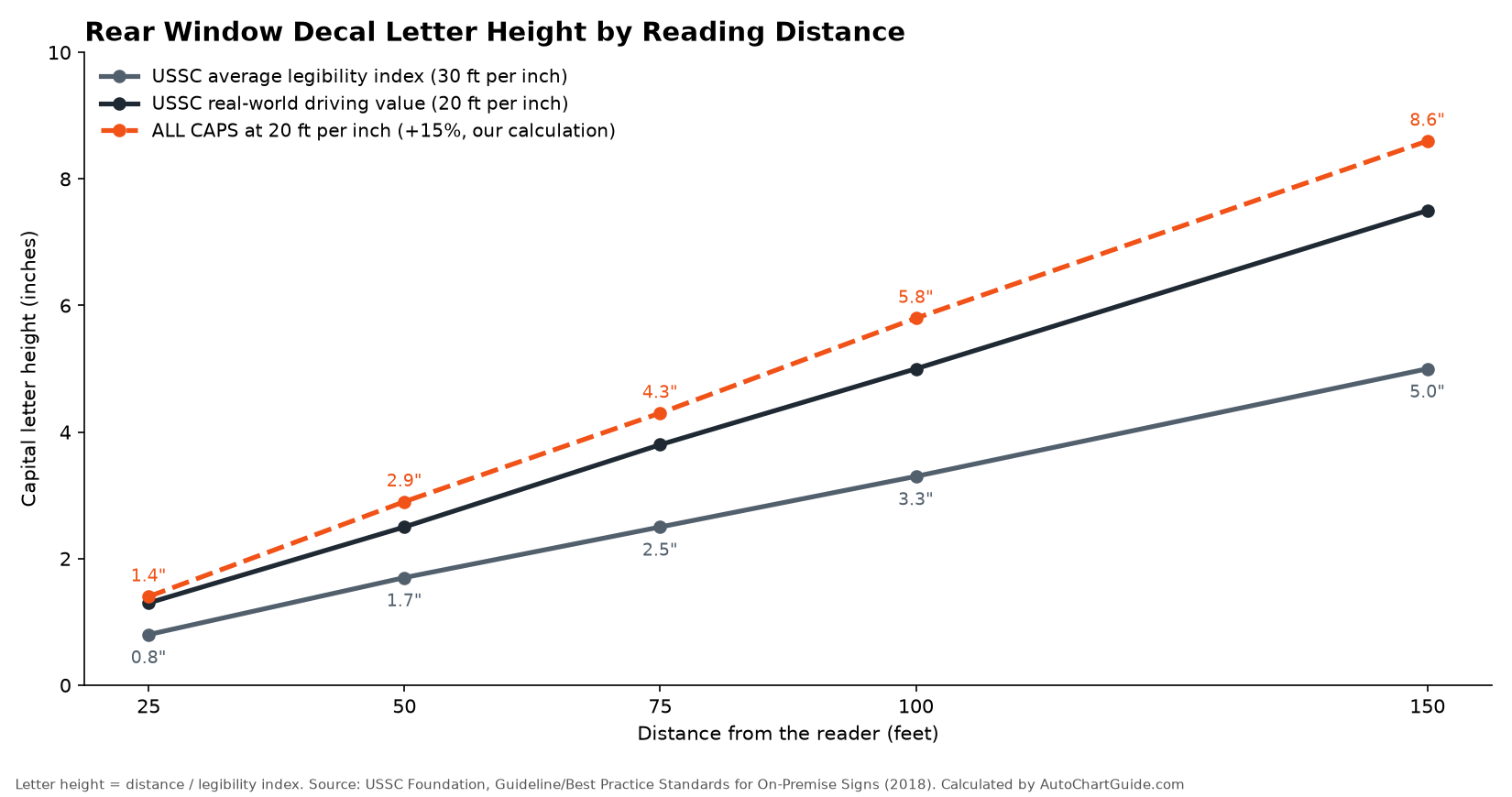
To pick a distance, the USSC standard converts speed to distance with a simple multiplier: miles per hour × 1.47 = feet per second. A driver two seconds behind you at 30 mph is about 88 feet back (30 × 1.47 × 2). At 20 feet per inch, that calls for about 4.4-inch capitals, which is why a phone number in 1-inch type is wasted on a rear window. Letter style and color matter too: the USSC tables rate legibility by font, letter color, background color and lighting. Printmoz advises using as much contrast as possible and warns that dark colors can get lost on a fully tinted window.
Are rear window decals legal?
Usually, within limits. Every code we checked limits material that blocks the driver's view, and four of the six (California, Texas, Illinois and Michigan) tie rear-window coverage to having an outside mirror on each side. Only California, among the codes we read, sets a size for rear-window stickers.
| Jurisdiction | What the law says about the rear window | Mirror condition | Source |
|---|---|---|---|
| California | Nothing may be placed on the rear window, except signs or stickers in a 7-inch square in the lower corner farthest from the driver. The rear window is exempt entirely if the car has both outside mirrors. | Outside mirrors on both sides showing at least 200 ft to the rear | Vehicle Code 26708 |
| Texas | An object or material on the rear window that obstructs or reduces the driver's clear view is an offense. | Rear window exempt with an outside mirror on each side showing 200 ft to the rear | Transportation Code 547.613 |
| Florida | No sign, poster or nontransparent material on the rear windows that "materially obstructs, obscures, or impairs" the driver's clear view. A noncriminal, nonmoving infraction. | Not mentioned in this section | Statutes 316.2004 |
| Illinois | A "perforated window screen or other decorative window application" is allowed on windows behind the driver if the front side windows are untreated. | A side mirror on each side is required when rear windows are treated | 625 ILCS 5/12-503 |
| Michigan | A "perforated window screen, or other decorative window application" on the rear window is allowed. No rear-window material with total solar reflectance of 35% or more. | Obstructed rear view allowed only with 2 outside mirrors, one on each side | MCL 257.709 |
| Washington | No sign, poster or nontransparent material on the rear windows that obstructs the driver's clear view of the highway. | Not mentioned in this section | RCW 46.37.410 |
Summarized from the official statute text, read November 3, 2026. This is not legal advice. Local rules and enforcement differ, and other states have their own wording, so check your state's vehicle code or DMV.
The federal mirror standard explains why the mirror condition matters. Under FMVSS No. 111, a passenger car needs an inside rearview mirror and a driver-side outside mirror; a passenger-side outside mirror is required only if the inside mirror does not give the required view. Trucks and multipurpose vehicles up to 4,536 kg (10,000 lb) GVWR can meet the standard with outside mirrors on both sides instead. So a car can leave the factory legal with no right-hand mirror, and on such a car, covering the rear window could break the Texas or California rule. FMVSS 111 also requires a rearview camera image on vehicles up to 4,536 kg GVWR built on or after May 1, 2018. Never cover the camera lens, wherever it sits on your vehicle.
Two more legal points come up often. Illinois and Texas both carve out certificates and stickers that State or local authorities require on the windows (Texas says "as required by law"), so do not cover a required sticker with a new decal. And Michigan bans rear-window material with a total solar reflectance of 35 percent or more, which can rule out mirror-like reflective film over the glass.
Perforated (see-through) rear window decals
Perforated film is printed vinyl full of small holes. From outside, the eye sees the printed image; from inside, the black backing and the holes let the driver see out. The ratio printed on the film describes how much of it is printed face and how much is open hole. The film makers' documents give exact figures:
| Film (maker) | Pattern | Open area | Hole size | Maker's note on use |
|---|---|---|---|---|
| 3M Scotchcal IJ8171 | 50/50 | 50% | not stated in bulletin | Not suitable for windows with built-in heating, defrosting elements or wipers, or "any regulated vehicle window" |
| Avery Dennison MPI 2509 | 50/50 | 50% | 2 mm | Listed for passenger vehicles (Avery Asia Pacific bulletin, 35% VLT compliance note) |
| Avery Dennison MPI 2709 | 60/40 | 40% | 1.5 mm | "Not recommended for use on private passenger vehicles" |
| Avery Dennison HP MPI 2728 | 65/35 | 35% | "1.5 mil" (as printed) | "Intended for stationary windows" |
| Printmoz rear window graphics | 60/40 | 40% | 1.60 mm | Sold for vehicle rear windows |
| Square Signs perforated decals | 70/30 "print-to-perforation" | not stated as a percentage | not stated | Sold for vehicle rear windows |
Sources: 3M Product Bulletin PIJ8171; Avery Dennison IB 1.5 (Revision 5, August 2025), MPI 2709 data sheet (August 2025) and HP MPI 2728 data sheet (November 2016); Printmoz and Square Signs product pages. Avery's MPI 2728 sheet prints the hole size as "1.5 mil"; its 1.5 mm siblings suggest a typo, but we show only what the sheet says.
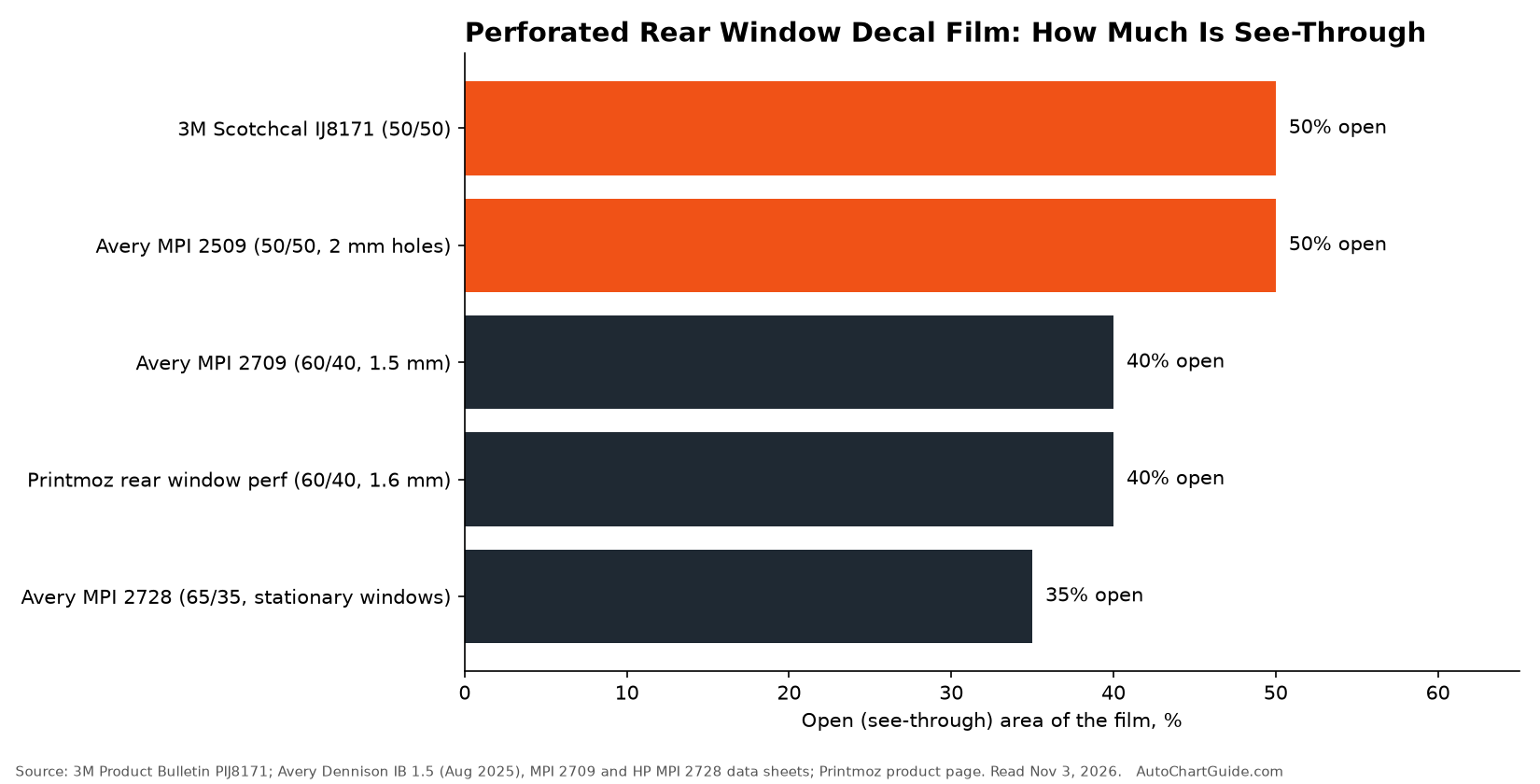
A higher open area means more light and a clearer view out, at the cost of a fainter image. The film makers are more cautious than the printers who sell finished decals:
- 3M's vehicle application bulletin says not to apply perforated film to "windows with windshield wipers" or windows that roll down, and that 3M "does NOT support applying perforated window graphic film when a driver's view will be obstructed and/or where local laws prohibit its use." Its IJ8171 product bulletin also lists windows with "built-in heating, defrosting elements or wipers" as unsuitable, and names "non-vertical windows" as a case where the driver's view may be blocked.
- Avery Dennison's perforated film bulletin warns that "rear windows of hatch back or sedans" angled more than 20 degrees from vertical "will have reduced visibility", and advises against fitting film to them. It also says never to apply perforated film wet, because water trapped in the holes reduces the view.
- Printmoz's FAQ says you can still use the rear wiper and the defroster with its decal.
Those statements conflict, and we cannot settle which applies to your car. We give more weight to the film makers' warnings, because they wrote the material specifications. If your rear window has a wiper or a defroster grid, ask the printer which film it uses and check that film maker's bulletin. Avery adds that printed perforated film must be laminated so water and dirt do not fill the holes. Printmoz says its rear window graphics come with a laminate included, and Square Signs warns that clogged holes can block the view.
Cut vinyl, printed decal or perforated: which size suits which?
4over4 separates the two common types. A sticker is a full printed design with its background, applied in one piece. A decal is usually cut vinyl with the background removed, so only the letters or graphic stay on the glass. That difference changes how big you can go:
- Cut vinyl lettering leaves clear glass between the letters, so a 20-inch-wide name across the top of the glass blocks far less view than a solid 20-inch rectangle. Printmoz recommends cut lettering for shapes and individual letters, because it cannot cut its perforated material that way.
- Printed opaque decals block the view everywhere they sit. They suit the corner accent sizes (6 × 6 to 10 × 10 in) and California's 7-inch corner square.
- Perforated graphics are the only type sold for full-window coverage. They suit the 53 × 14 to 66 × 29 inch sizes, if the law and the film maker allow them on your window.
Color matters as much as size if you want the decal to match the car. If you are picking a vinyl color to go with the paint, find the factory color first with our guide to paint code location by make. Our Dupli-Color paint chart shows how one aftermarket paint maker matches factory paint codes to its own products, which is the same lookup you will do when you ask a vinyl supplier for a close match.
Common rear window decal mistakes
- Measuring the whole window for a decal on the glass. The frit band, the curve at the edges and the wiper path all take space. Size to the flat area, not the frame.
- Putting the decal in the wiper sweep. The blade drags across the edge every time it runs. Rear blades also vary, and our Michelin wiper blade size chart shows how rear blades are sold as a separate range with their own lengths and adapters.
- Ordering perforated film to the exact window size. Both perforated printers say to add 2 inches and trim on the glass; an exact-size piece leaves gaps at the curved edges.
- Small text. 1-inch letters are legible at about 20 to 30 feet under the USSC values, which is close range in traffic.
- Applying perforated film wet. Avery says water stays in the holes and reduces the view; its films must be applied dry.
- Covering the camera, third brake light or a required sticker. These have legal and safety jobs, as the federal and state rules above show.
- Assuming a printer's legal statement covers your state. Square Signs' own pages tell buyers to check local and state regulations, and say Square Signs bears no responsibility for misuse.
Frequently asked questions
What is the standard size for a rear window car decal?
There is none. Printers' guides put corner accents at 6 × 6 to 10 × 10 inches and centered decals at 14 × 14 to 20 × 20 inches. Full-window perforated graphics are sized to the glass plus 2 inches each way.
How big should a back window decal be on an SUV?
4over4 suggests 16 to 20 inches wide, kept above the wiper sweep. Square Signs lists 60 × 17 inches as a perforated size for SUVs, trucks and vans. Measure your own glass first.
What size perforated decal fits a pickup rear window?
Square Signs lists 53 × 14 inches for small pickups and 66 × 29 inches for large vans and pickups. 4over4 suggests two 10 to 12 inch decals on the fixed panes of a sliding window.
Is it legal to put a decal on my rear window?
Usually, if it does not block your view or you have outside mirrors on both sides. California allows stickers in a 7-inch square in the lower corner farthest from the driver, and exempts the whole rear window if both outside mirrors are fitted. Check your own state's code.
Can I put a decal over the rear defroster lines?
3M lists windows with built-in heating or defrosting elements as unsuitable for its IJ8171 perforated film, while Printmoz says its decals still let the defroster work. 4over4 measures the flat glass inside the defroster lines. Ask your printer which film it uses and check that maker's guidance.
Can you see through a perforated rear window decal?
Yes, partly. The makers' films we checked are 35 to 50 percent open area. Avery warns that rear windows angled more than 20 degrees from vertical lose much of that visibility.
How tall should the letters on a rear window decal be?
Use about 1 inch of capital-letter height for every 20 feet of reading distance, the USSC's real-world driving value. A driver two seconds behind you at 30 mph is about 88 feet away, which calls for capitals about 4.4 inches tall.
Should I order a full rear window decal bigger than the glass?
Yes, for perforated full-coverage graphics. Square Signs and Printmoz both say to order it 2 inches wider and taller and trim it on the glass, keeping 1/8 to 1/4 inch away from rubber gaskets as 3M advises.
Sources
- California Legislative Information, Vehicle Code 26708 (amended Stats. 2025, Ch. 417, effective January 1, 2026). Read November 3, 2026.
- Texas Legislature, Transportation Code Chapter 547, Section 547.613 (Restrictions on windows). Read November 3, 2026.
- Florida Legislature, Florida Statutes 316.2004, Obstruction to driver's view or driving mechanism. Read November 3, 2026.
- Illinois General Assembly, 625 ILCS 5/12-503, Windshields must be unobstructed. Read November 3, 2026.
- Michigan Legislature, MCL 257.709, Windshields and windows. Read November 3, 2026.
- Washington State Legislature, RCW 46.37.410, Windshields must be unobstructed. Read November 3, 2026.
- Electronic Code of Federal Regulations, 49 CFR 571.111, Standard No. 111; Rear visibility. Read November 3, 2026.
- 3M Commercial Solutions, Instruction Bulletin: Application: Vehicles, and Product Bulletin PIJ8171, Scotchcal Perforated Window Graphic Film (Release H, effective January 2013). Read November 3, 2026.
- Avery Dennison Graphics Solutions, IB 1.5 Application Instructions for Perforated Window Films (Revision 5, August 2025), MPI 2709 PWF Product Data Sheet (Revision 5, August 2025) and HP MPI 2728 Perforated Window Film 65/35 Product Data Sheet (Revision 6, November 15, 2016). Read November 3, 2026.
- USSC Foundation, Guideline Standards for On-Premise Signs (2018), legibility index and viewer reaction distance sections. Read November 3, 2026.
- 4over4, "Custom Car Decal and Sticker Size Chart by Placement" (4over4.com guide, published July 21, 2026). Read November 3, 2026.
- Square Signs, "Custom Car Window Decals" and "Perforated Car Window Decals" product pages (squaresigns.com). Read November 3, 2026.
- Printmoz, "Custom Rear Window Graphics" product page (printmoz.com). Read November 3, 2026.