Winters Quick Change Gear Chart 2026: Official Ratio Tables
Winters' official quick change gear tables: every 10-spline 8500 Series set with 4.12, 4.57 and 4.86 final drives, plus 6-spline, 7-inch and Xtremeliner charts.

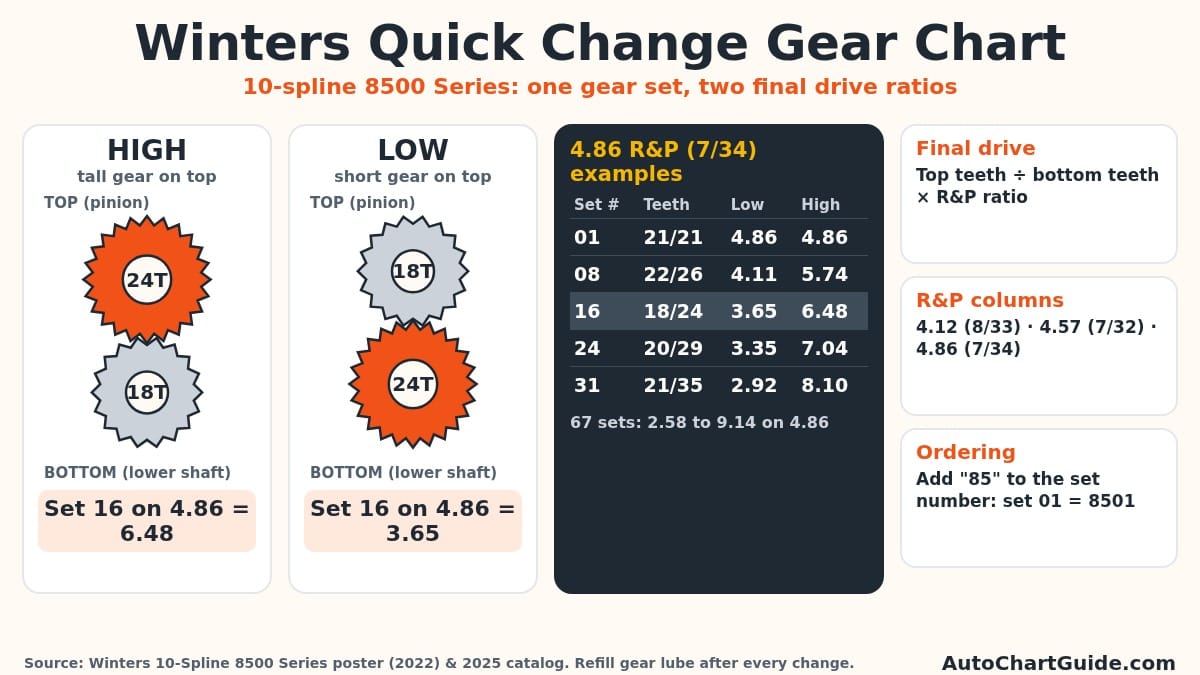
Short answer: A Winters quick change gear chart lists each spur gear set by number, its tooth counts, its low and high spur ratios, and the final drive ratio it gives with each ring and pinion. On Winters' 10-spline 8500 Series chart, final drive equals the spur ratio times the R&P ratio, so on a 4.86 R&P the 67 sets give final ratios from 2.58 to 9.14. Put the tall gear on top for the "high" ratio and the short gear on top for the "low" one.
Every figure below comes from Winters Performance Products' own documents, all read on November 2, 2026: the Winters gear charts page and the four PDF charts it links (the 10-spline 8500 Series poster, the 6-spline, 7-inch and Xtremeliner charts), plus Winters' 2025 Independent quick change catalog, its 2024 Modified catalog and its FAQ page. We have not tested any gear set. Where we did our own arithmetic, we say so and show the method.
Winters Quick Change Gear Chart at a Glance
Winters publishes four separate gear charts, one for each gear family. They are not interchangeable, so the first step is knowing which family your rear end uses. The 10-spline chart covers what Winters calls its standard quick change gears; the others cover the 6-spline, 7-inch and Xtremeliner gears. This summary shows what each chart contains.
| Gear chart (Winters) | Series / ordering | Ring & pinion columns on the chart | Gear sets listed | Final drive range on the chart |
|---|---|---|---|---|
| 10-spline | 8500 Series; add "85" to the set number (Winters' example: 8501) | 4.12 (8/33), 4.57 (7/32), 4.86 (7/34) | 67 | 2.19 to 9.14 |
| 6-spline | 4400 Series (1 in wide), prefix 44; 4500 Series (1-3/8 in wide), prefix 45 (examples 4401, 4501) | 3.78, 4.11, 4.33, 4.88, 5.13, 5.38 | 36 | 1.80 to 7.95 in the 3.78 column |
| 7-inch | 3800 Series; prefix 38 (example 3801) | 3.78 (9-34), 4.57 (7-32), 5.13 (8-41) | 15 | 2.53 to 7.70 |
| Xtremeliner | 30800 Series; prefix 308 (example 30801 = set #1) | 2.00 (17-34), 3.08 (12-37) | 11 | 1.20 to 5.14 |
Sources: the four Winters gear chart PDFs and the 2025 Independent catalog, read November 2, 2026. Ranges are the lowest and highest printed figures.
All four charts state SAE 8620 steel for the gears. The 6-spline chart also says the gears are crown cut, and its footer reads "8 3/8" Quick Change Gears." The 10-spline poster is the newest of the four documents (the PDF is dated September 2022), and the same 8500 Series table appears in both Winters catalogs we checked, the 2024 Modified catalog and the 2025 Independent catalog.
How to Read the Winters Quick Change Gear Chart
Each row is one gear set: two spur gears that slide onto the splined ends of the lower shaft and the pinion at the back of the rear end. The row tells you everything you need about that pair:
- Gear set # is Winters' catalog number for the pair. On the 10-spline chart you order it by adding "85" in front, so set 01 is 8501. Letters such as 15A or 07A are separate sets, not variants of the plain number.
- Number of teeth gives both gears, for example 19/20 for set 15.
- Low and high spur ratio are the same pair installed both ways. Set 15 is .950 one way and 1.053 the other, because 19/20 = 0.950 and 20/19 = 1.053.
- The R&P columns are the final drive ratios: spur ratio multiplied by the ring and pinion ratio. On the 10-spline chart that means 4.12 (8/33 teeth), 4.57 (7/32) and 4.86 (7/34).
Orientation is the part people get backwards. Winters' 10-spline poster labels HIGH as "tall gear on top" and LOW as "short gear on top." "Tall" means the gear with more teeth. Winters' final drive formula, (# teeth top gear) ÷ (# teeth bottom gear) × R&P ratio, shows why: with the bigger gear on top (on the pinion), the ratio goes up. Using set 16 (18/24) on a 4.86 R&P, 24 ÷ 18 × 4.86 = 6.48 high, and 18 ÷ 24 × 4.86 = 3.65 low. Those are the two figures printed in the chart, and they show how one pair of gears can cover very different tracks simply by flipping it.
10-Spline Quick Change Gear Chart (8500 Series)
This is the full 8500 Series table as printed on Winters' 10-spline poster, all 67 sets, in Winters' own order (sorted from the 1.000 set outward by spur ratio, which is why the set numbers are not in numerical order). The same table, with the same note to add "85" to the set number, appears in the 2025 Independent catalog, which gives 8501 as the ordering example.
| Set # | Low spur | High spur | Teeth | 4.12 Low | 4.12 High | 4.57 Low | 4.57 High | 4.86 Low | 4.86 High |
|---|---|---|---|---|---|---|---|---|---|
| 01 | 1.000 | 1.000 | 21/21 | 4.12 | 4.12 | 4.57 | 4.57 | 4.86 | 4.86 |
| 02 | .964 | 1.037 | 27/28 | 3.97 | 4.27 | 4.41 | 4.74 | 4.69 | 5.04 |
| 05 | .960 | 1.042 | 24/25 | 3.96 | 4.29 | 4.39 | 4.76 | 4.67 | 5.06 |
| 15A | .955 | 1.048 | 21/22 | 3.93 | 4.32 | 4.36 | 4.79 | 4.64 | 5.09 |
| 15 | .950 | 1.053 | 19/20 | 3.91 | 4.34 | 4.34 | 4.81 | 4.62 | 5.11 |
| 26 | .931 | 1.074 | 27/29 | 3.84 | 4.43 | 4.26 | 4.91 | 4.53 | 5.22 |
| 06 | .920 | 1.087 | 23/25 | 3.79 | 4.48 | 4.20 | 4.97 | 4.47 | 5.28 |
| 25 | .909 | 1.100 | 20/22 | 3.75 | 4.53 | 4.16 | 5.03 | 4.42 | 5.34 |
| 12 | .897 | 1.115 | 26/29 | 3.69 | 4.60 | 4.10 | 5.10 | 4.36 | 5.42 |
| 07 | .885 | 1.130 | 23/26 | 3.65 | 4.66 | 4.04 | 5.17 | 4.30 | 5.49 |
| 07A | .875 | 1.143 | 21/24 | 3.61 | 4.71 | 4.00 | 5.22 | 4.25 | 5.55 |
| 17 | .867 | 1.154 | 26/30 | 3.57 | 4.75 | 3.96 | 5.27 | 4.21 | 5.60 |
| 17A | .857 | 1.167 | 24/28 | 3.53 | 4.81 | 3.92 | 5.33 | 4.17 | 5.67 |
| 08A | .852 | 1.174 | 23/27 | 3.51 | 4.84 | 3.89 | 5.37 | 4.14 | 5.70 |
| 08 | .846 | 1.182 | 22/26 | 3.49 | 4.87 | 3.87 | 5.40 | 4.11 | 5.74 |
| 19 | .840 | 1.190 | 21/25 | 3.46 | 4.91 | 3.84 | 5.44 | 4.08 | 5.78 |
| 09A | .833 | 1.200 | 25/30 | 3.43 | 4.94 | 3.81 | 5.48 | 4.05 | 5.83 |
| 09 | .826 | 1.211 | 19/23 | 3.40 | 4.99 | 3.78 | 5.53 | 4.02 | 5.88 |
| 11 | .815 | 1.227 | 22/27 | 3.36 | 5.06 | 3.72 | 5.61 | 3.96 | 5.96 |
| 03 | .806 | 1.240 | 25/31 | 3.32 | 5.11 | 3.69 | 5.67 | 3.92 | 6.02 |
| 13 | .800 | 1.250 | 20/25 | 3.30 | 5.15 | 3.66 | 5.71 | 3.89 | 6.07 |
| 18 | .793 | 1.261 | 23/29 | 3.27 | 5.20 | 3.62 | 5.76 | 3.85 | 6.12 |
| 18A | .786 | 1.273 | 22/28 | 3.24 | 5.24 | 3.59 | 5.82 | 3.82 | 6.18 |
| 04A | .783 | 1.278 | 18/23 | 3.22 | 5.26 | 3.58 | 5.84 | 3.80 | 6.21 |
| 20A | .778 | 1.286 | 21/27 | 3.20 | 5.30 | 3.55 | 5.88 | 3.78 | 6.25 |
| 04 | .774 | 1.292 | 24/31 | 3.19 | 5.32 | 3.54 | 5.90 | 3.76 | 6.27 |
| 20 | .769 | 1.300 | 20/26 | 3.17 | 5.36 | 3.52 | 5.94 | 3.74 | 6.31 |
| 22 | .760 | 1.316 | 19/25 | 3.13 | 5.42 | 3.47 | 6.01 | 3.69 | 6.39 |
| 16 | .750 | 1.333 | 18/24 | 3.09 | 5.49 | 3.43 | 6.09 | 3.65 | 6.48 |
| 10 | .739 | 1.353 | 17/23 | 3.05 | 5.57 | 3.38 | 6.18 | 3.59 | 6.57 |
| 10A | .733 | 1.364 | 22/30 | 3.02 | 5.62 | 3.35 | 6.23 | 3.56 | 6.62 |
| 34A | .727 | 1.375 | 16/22 | 3.00 | 5.67 | 3.32 | 6.28 | 3.54 | 6.68 |
| 34 | .724 | 1.381 | 21/29 | 2.97 | 5.69 | 3.31 | 6.31 | 3.52 | 6.71 |
| 14 | .719 | 1.391 | 23/32 | 2.96 | 5.73 | 3.29 | 6.36 | 3.49 | 6.76 |
| 14A | .714 | 1.400 | 20/28 | 2.94 | 5.77 | 3.26 | 6.40 | 3.47 | 6.80 |
| 35 | .708 | 1.412 | 17/24 | 2.92 | 5.82 | 3.24 | 6.45 | 3.44 | 6.86 |
| 32 | .704 | 1.421 | 19/27 | 2.90 | 5.86 | 3.22 | 6.49 | 3.42 | 6.90 |
| 32A | .697 | 1.435 | 23/33 | 2.87 | 5.91 | 3.19 | 6.56 | 3.39 | 6.97 |
| 24 | .690 | 1.450 | 20/29 | 2.84 | 5.97 | 3.15 | 6.63 | 3.35 | 7.04 |
| 36 | .680 | 1.471 | 17/25 | 2.80 | 6.06 | 3.11 | 6.72 | 3.31 | 7.14 |
| 37 | .677 | 1.476 | 21/31 | 2.79 | 6.08 | 3.10 | 6.75 | 3.29 | 7.17 |
| 27 | .647 | 1.545 | 22/34 | 2.67 | 6.37 | 2.96 | 7.06 | 3.15 | 7.51 |
| 43 | .640 | 1.563 | 16/25 | 2.64 | 6.44 | 2.93 | 7.14 | 3.11 | 7.59 |
| 28 | .633 | 1.579 | 19/30 | 2.61 | 6.51 | 2.89 | 7.22 | 3.08 | 7.67 |
| 28A | .630 | 1.588 | 17/27 | 2.59 | 6.54 | 2.88 | 7.26 | 3.06 | 7.71 |
| 29 | .625 | 1.600 | 15/24 | 2.58 | 6.59 | 2.86 | 7.31 | 3.04 | 7.77 |
| 39 | .621 | 1.611 | 18/29 | 2.56 | 6.64 | 2.84 | 7.36 | 3.02 | 7.83 |
| 30 | .615 | 1.625 | 16/26 | 2.54 | 6.70 | 2.81 | 7.43 | 2.99 | 7.89 |
| 40 | .613 | 1.632 | 19/31 | 2.53 | 6.72 | 2.80 | 7.46 | 2.98 | 7.93 |
| 41 | .607 | 1.647 | 17/28 | 2.50 | 6.81 | 2.76 | 7.53 | 2.95 | 8.00 |
| 31 | .600 | 1.667 | 21/35 | 2.47 | 6.87 | 2.74 | 7.62 | 2.92 | 8.10 |
| 33A | .593 | 1.688 | 16/27 | 2.44 | 6.95 | 2.71 | 7.71 | 2.88 | 8.20 |
| 33 | .588 | 1.700 | 20/34 | 2.42 | 7.00 | 2.69 | 7.77 | 2.86 | 8.26 |
| 31A | .583 | 1.714 | 21/36 | 2.40 | 7.06 | 2.67 | 7.83 | 2.84 | 8.33 |
| 30A | .577 | 1.733 | 15/26 | 2.38 | 7.14 | 2.64 | 7.92 | 2.80 | 8.42 |
| 50 * | .571 | 1.750 | 20/35 | 2.35 | 7.21 | 2.61 | 8.00 | 2.78 | 8.50 |
| 51 * | .567 | 1.765 | 17/30 | 2.34 | 7.27 | 2.59 | 8.07 | 2.75 | 8.57 |
| 52 * | .563 | 1.778 | 18/32 | 2.32 | 7.32 | 2.57 | 8.12 | 2.73 | 8.64 |
| 53 * | .559 | 1.789 | 19/34 | 2.30 | 7.37 | 2.55 | 8.18 | 2.72 | 8.69 |
| 54 * | .556 | 1.800 | 15/27 | 2.29 | 7.42 | 2.54 | 8.23 | 2.70 | 8.74 |
| 55 * | .552 | 1.813 | 16/29 | 2.27 | 7.47 | 2.52 | 8.28 | 2.68 | 8.80 |
| 56 * | .548 | 1.824 | 17/31 | 2.26 | 7.51 | 2.51 | 8.33 | 2.67 | 8.86 |
| 57 * | .533 | 1.875 | 16/30 | 2.20 | 7.73 | 2.44 | 8.57 | 2.59 | 9.11 |
| 58 * | .531 | 1.882 | 17/32 | 2.19 | 7.76 | 2.43 | 8.60 | 2.58 | 9.14 |
| 23 | .667 | 1.500 | 22/33 | 2.75 | 6.18 | 3.05 | 6.86 | 3.24 | 7.29 |
| 21 | .655 | 1.526 | 19/29 | 2.70 | 6.29 | 2.99 | 6.98 | 3.18 | 7.41 |
| 21A | .652 | 1.533 | 15/23 | 2.69 | 6.32 | 2.98 | 7.01 | 3.17 | 7.45 |
Source: Winters 10-Spline Quick Change Gears poster, 8500 Series (PDF dated September 2022), read November 2, 2026. Columns are final drive ratios. * Sets 50 to 58 sit under the poster's bracket "For Limited Horsepower Applications."
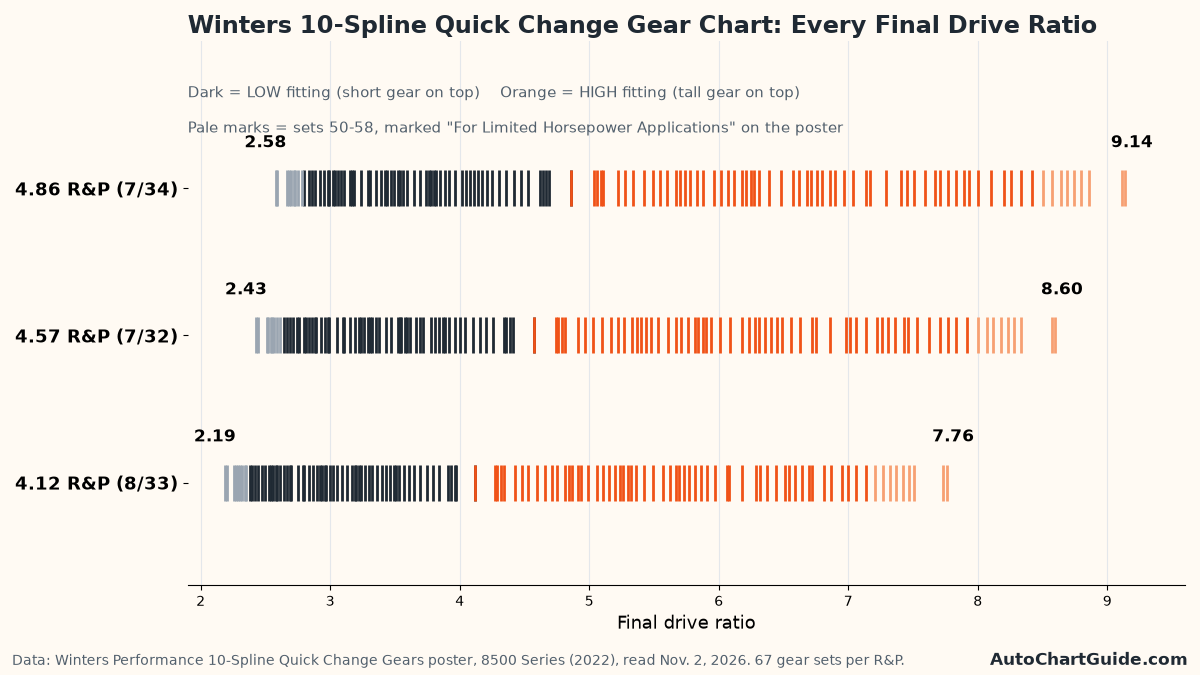
Three things stand out once the table is in front of you. First, set 01 (21/21) is the only 1.000 set, so it simply passes the R&P ratio through: 4.12, 4.57 or 4.86. Second, the steps near 1.000 are small. On a 4.86 R&P, the nearest choices either side of 4.86 are set 02 at 4.69 low and 5.04 high, so there is nothing on this chart between 4.69 and 4.86, or between 4.86 and 5.04. Third, the far ends of the chart are marked. Sets 50 through 58, from 20/35 to 17/32, sit under a bracket on the poster that reads "For Limited Horsepower Applications." Those are the sets that produce the most extreme ratios, up to 9.14 high and down to 2.58 low on a 4.86, and the poster does not set a horsepower figure, so ask Winters before running them in a high-power car.
Gearing Formulas Printed on the Chart
Winters prints four formulas on its 10-spline poster. They are the tools you need to move from "what ratio do I have" to "what set do I buy."
- RPM (based on ratio): ratio × mph × 336 ÷ tire diameter.
- Ratio (based on rpm): rpm × tire diameter ÷ (mph × 336).
- Gear-based rpm change: rpm ÷ current ratio × new ratio = new rpm.
- Final drive ratio: top gear teeth ÷ bottom gear teeth × R&P ratio.
The 336 is a unit constant, not a tuning factor. A mile is 63,360 inches; divide that by 60 minutes and by pi and you get about 336.1, which turns mph and a tire diameter in inches into wheel revolutions per minute. Multiply by the final drive and you have engine rpm in a direct-drive car. If your car runs through a transmission gear other than 1:1, that ratio has to be included as well.
The tire diameter is the number most people get wrong. The formula wants the real rolling diameter of your tire, not the number you get from the size code. Our guide to what the numbers in a tire size mean explains why the size is nominal, and our article on what tire size calculators cannot know explains why real tires of the same size differ. On a race car, measure the tire you are running, and measure it again when stagger or tire pressure changes.
Worked Examples Using the Chart
These examples use Winters' formulas and the ratios printed in its chart. The tire sizes and speeds are illustrative inputs we chose, not Winters figures, so substitute your own.
Example 1: engine rpm from a ratio
A car with a 4.86 R&P and set 01 (21/21) runs a 4.86 final drive. With a 27-inch tire at 100 mph: 4.86 × 100 × 336 ÷ 27 = 6,048 rpm.
Example 2: finding the ratio for a target rpm
Say you want 7,500 rpm at 110 mph on a 26.5-inch tire. Ratio = 7,500 × 26.5 ÷ (110 × 336) = 5.38 (rounded). Now look down the chart for the closest printed figure in your R&P column:
| Target | R&P | Nearest printed ratio | Set # | Fitting | Teeth |
|---|---|---|---|---|---|
| 5.38 | 4.12 | 5.36 | 20 | High (tall gear on top) | 20/26 |
| 5.38 | 4.57 | 5.37 | 08A | High | 23/27 |
| 5.38 | 4.86 | 5.34 | 25 | High | 20/22 |
| 5.38 | 4.86 | 5.42 | 12 | High | 26/29 |
All values read from the Winters 10-spline chart above. Target from the worked example in the text.
On a 4.86 rear there is no 5.38: you choose between 5.34 (set 25) and 5.42 (set 12), which is the decision you make on the night based on whether you want to be safe on rpm or a little more aggressive off the corner.
Example 3: predicting the rpm change from a gear swap
Winters' 6-spline and Xtremeliner charts print their own example of the gear-based rpm change: 8,000 ÷ 6.58 × 6.35 = 7,720. Applied to the 10-spline chart: if you see 7,200 rpm with set 20 high on a 4.86 (6.31) and swap to set 18A high (6.18), the same engine speed at the same road speed drops to about 7,200 ÷ 6.31 × 6.18 = 7,052 rpm.
Why your own math can be a hundredth off
We recalculated every final drive in the 10-spline table from the tooth counts. Winters' spur ratios all match the tooth counts to three decimals. The final drive columns match to within about 0.02, which is normal rounding: the chart rounds the spur ratio, and the R&P labels (4.12, 4.57, 4.86) are themselves rounded from 33/8, 32/7 and 34/7. The largest difference we found is set 41 high in the 4.12 column, printed as 6.81, where 28 ÷ 17 × 33/8 works out to 6.79. If two sets are that close, compare them by tooth count rather than by the printed second decimal.
How to Choose a Gear Set: Step by Step
- Confirm the gear family. 10-spline, 6-spline, 7-inch or Xtremeliner. The charts use different set numbers and different tooth counts, as shown below.
- Confirm your ring and pinion ratio. Use the paperwork for your rear end or the method in Winters' "Ring and Pinion Ratio" tech video, which its FAQ page links. Do not assume it from the car's history.
- Measure the tire. Use the real rolling diameter, not the size code.
- Calculate the target ratio from the rpm you want at the speed you reach, with Winters' ratio formula.
- Find the nearest printed ratio in your R&P column, and note whether it is the low or high fitting.
- Order by set number. For 10-spline, add "85" to the set number, as Winters' catalog shows with 8501.
- Install the right way up. High is tall gear on top; low is short gear on top.
- Refill and record. Refill the gear cavity, and write down the set, fitting and result.
That last step is what makes the chart useful over a season. A simple log, like the spec file described in our guide to keeping a record of your car specifications, lets you go straight back to the set that worked at a given track instead of recalculating from memory. The same habit pays off with other tuning parts on a race car, such as carburetor accelerator pump cams, where our Holley accelerator pump cam chart lists the number on each cam.
6-Spline Quick Change Gear Chart (4400 and 4500 Series)
Winters' 6-spline chart covers two gear widths: the 4400 Series (1 inch wide) and the 4500 Series (1-3/8 inch wide). The chart says to add prefix 44 to the set number for 1-inch gears and prefix 45 for 1-3/8-inch gears, with 4401 and 4501 as its examples. The poster prints six R&P columns: 3.78 (9-34 teeth), 4.11 (9-37), 4.33 (9-39), 4.88 (8-39), 5.13 (8-41) and 5.38 (8-43). Winters' 2025 Independent catalog prints the same 36 sets in a text table with the 3.78 column, which is the version reproduced here because every figure can be checked against the catalog text. For the other five R&P columns, read the 6-spline poster linked above, or multiply the spur ratio by your R&P ratio and expect the same small rounding differences.
| Set # | Low spur | High spur | Teeth | 3.78 Low | 3.78 High |
|---|---|---|---|---|---|
| 01 | 1.000 | 1.000 | 24/24 | 3.78 | 3.78 |
| 12 | 0.655 | 1.526 | 19/29 | 2.48 | 5.77 |
| 02 | 0.958 | 1.043 | 23/24 | 3.62 | 3.94 |
| 13 | 0.652 | 1.533 | 15/23 | 2.47 | 5.80 |
| 03 | 0.920 | 1.087 | 23/25 | 3.48 | 4.11 |
| 14 | 0.636 | 1.571 | 14/22 | 2.41 | 5.94 |
| 03B | 0.895 | 1.118 | 17/19 | 3.38 | 4.22 |
| 15 | 0.625 | 1.600 | 15/24 | 2.36 | 6.05 |
| 03A | 0.880 | 1.136 | 22/25 | 3.33 | 4.30 |
| 16 | 0.615 | 1.625 | 16/26 | 2.33 | 6.14 |
| 04 | 0.846 | 1.182 | 22/26 | 3.20 | 4.47 |
| 17 | 0.600 | 1.667 | 18/30 | 2.27 | 6.30 |
| 05 | 0.808 | 1.238 | 21/26 | 3.05 | 4.68 |
| 18 | 0.591 | 1.692 | 13/22 | 2.23 | 6.40 |
| 05A | 0.792 | 1.263 | 19/24 | 2.99 | 4.77 |
| 18A | 0.571 | 1.750 | 16/28 | 2.16 | 6.62 |
| 06 | 0.778 | 1.286 | 21/27 | 2.94 | 4.86 |
| 19 | 0.560 | 1.786 | 14/25 | 2.12 | 6.75 |
| 24 | 0.767 | 1.304 | 23/30 | 2.90 | 4.93 |
| 20 | 0.556 | 1.800 | 15/27 | 2.10 | 6.80 |
| 25 | 0.750 | 1.333 | 18/24 | 2.84 | 5.04 |
| 27 | 0.542 | 1.846 | 13/24 | 2.05 | 6.98 |
| 07 | 0.741 | 1.350 | 20/27 | 2.80 | 5.10 |
| 21 | 0.531 | 1.882 | 17/32 | 2.01 | 7.12 |
| 23 | 0.727 | 1.375 | 16/22 | 2.75 | 5.20 |
| 28 | 0.528 | 1.895 | 19/36 | 2.00 | 7.16 |
| 08 | 0.714 | 1.400 | 20/28 | 2.70 | 5.29 |
| 29 | 0.522 | 1.917 | 12/23 | 1.97 | 7.25 |
| 22 | 0.704 | 1.421 | 19/27 | 2.66 | 5.37 |
| 26 | 0.517 | 1.933 | 15/29 | 1.96 | 7.31 |
| 09 | 0.696 | 1.438 | 16/23 | 2.63 | 5.43 |
| 30 | 0.500 | 2.000 | 20/40 | 1.89 | 7.56 |
| 10 | 0.682 | 1.467 | 15/22 | 2.58 | 5.54 |
| 31 | 0.488 | 2.050 | 20/41 | 1.84 | 7.75 |
| 11 | 0.667 | 1.500 | 18/27 | 2.52 | 5.67 |
| 32 | 0.475 | 2.105 | 19/40 | 1.80 | 7.95 |
Source: Winters 2025 Independent quick change catalog, "6-Spline (Mini Diff) Gear Chart," 3.78 R&P (9-34 teeth), read November 2, 2026.
Notice that 6-spline set 01 is 24/24, not 21/21, and that set 15 here is 15/24 (0.625), nothing like 10-spline set 15 (19/20). The set numbers belong to each chart, so a "set 15" from one family tells you nothing about another.
7-Inch Quick Change Gear Chart (3800 Series)
The 7-inch chart lists 15 sets for Winters' 7-inch quick change gears, P/N 3800 Series. Winters says to add prefix 38 to the set number, with 3801 as the example. This chart prints spur ratios to two decimals and uses three R&P ratios: 3.78 (9-34 teeth), 4.57 (7-32) and 5.13 (8-41). It also carries an installation note: install quick change gears with the shoulder facing out toward the gear cover bearings.
| Set # | Low spur | High spur | Teeth | 3.78 Low | 3.78 High | 4.57 Low | 4.57 High | 5.13 Low | 5.13 High |
|---|---|---|---|---|---|---|---|---|---|
| 1 | 1.00 | 1.00 | 25/25 | 3.78 | 3.78 | 4.57 | 4.57 | 5.13 | 5.13 |
| 2 | .96 | 1.05 | 23/22 | 3.63 | 3.97 | 4.39 | 4.80 | 4.92 | 5.39 |
| 3 | .92 | 1.08 | 26/24 | 3.48 | 4.08 | 4.20 | 4.94 | 4.72 | 5.54 |
| 4 | .90 | 1.11 | 21/19 | 3.40 | 4.20 | 4.11 | 5.07 | 4.62 | 5.69 |
| 5 | .88 | 1.14 | 24/21 | 3.33 | 4.31 | 4.02 | 5.21 | 4.51 | 5.85 |
| 6 | .85 | 1.17 | 27/23 | 3.21 | 4.42 | 3.88 | 5.35 | 4.36 | 6.00 |
| 7 | .83 | 1.20 | 30/25 | 3.14 | 4.54 | 3.79 | 5.48 | 4.26 | 6.16 |
| 8 | .82 | 1.22 | 22/18 | 3.10 | 4.61 | 3.75 | 5.58 | 4.21 | 6.26 |
| 9 | .80 | 1.25 | 25/20 | 3.02 | 4.73 | 3.66 | 5.71 | 4.10 | 6.41 |
| 10 | .79 | 1.27 | 28/22 | 2.99 | 4.80 | 3.61 | 5.80 | 4.05 | 6.52 |
| 11 | .77 | 1.29 | 31/24 | 2.91 | 4.88 | 3.52 | 5.90 | 3.95 | 6.62 |
| 12 | .74 | 1.35 | 23/17 | 2.80 | 5.10 | 3.38 | 6.17 | 3.80 | 6.93 |
| 13 | .73 | 1.37 | 26/19 | 2.76 | 5.18 | 3.34 | 6.26 | 3.74 | 7.03 |
| 14 | .72 | 1.38 | 29/21 | 2.72 | 5.22 | 3.29 | 6.31 | 3.69 | 7.08 |
| 15 | .67 | 1.50 | 30/20 | 2.53 | 5.67 | 3.06 | 6.86 | 3.44 | 7.70 |
Source: Winters 7 Inch Quick Change Gears chart, P/N 3800 Series (chart marked ©2007), read November 2, 2026. Teeth are printed in the order Winters uses on this chart.
Xtremeliner Quick Change Gear Chart (30800 Series)
The Xtremeliner chart covers the 30800 Series. Winters says to add prefix 308 to the set number, with 30801 = gear set #1 as its example. It lists 11 sets with two R&P ratios, 2.00 (17-34 teeth) and 3.08 (12-37 teeth), which is why its final ratios run much lower than the other charts, from 1.20 to 5.14. The same shoulder-out installation note appears here.
| Set # | Low spur | High spur | Teeth | 2.00 Low | 2.00 High | 3.08 Low | 3.08 High |
|---|---|---|---|---|---|---|---|
| 01 | 1.000 | 1.000 | 21/21 | 2.00 | 2.00 | 3.08 | 3.08 |
| 15 | 0.950 | 1.052 | 19/20 | 1.90 | 2.10 | 2.93 | 3.25 |
| 25 | 0.909 | 1.100 | 20/22 | 1.82 | 2.20 | 2.80 | 3.39 |
| 17A | 0.857 | 1.167 | 24/28 | 1.71 | 2.33 | 2.64 | 3.59 |
| 03 | 0.806 | 1.240 | 25/31 | 1.61 | 2.48 | 2.49 | 3.82 |
| 16 | 0.750 | 1.333 | 18/24 | 1.50 | 2.67 | 2.31 | 4.11 |
| 14 | 0.719 | 1.391 | 23/32 | 1.44 | 2.78 | 2.22 | 4.29 |
| 36 | 0.680 | 1.471 | 17/25 | 1.36 | 2.94 | 2.09 | 4.53 |
| 21 | 0.655 | 1.526 | 19/29 | 1.31 | 3.05 | 2.02 | 4.71 |
| 28 | 0.633 | 1.579 | 19/30 | 1.27 | 3.16 | 1.93 | 4.84 |
| 31 | 0.600 | 1.667 | 21/35 | 1.20 | 3.33 | 1.85 | 5.14 |
Source: Winters Xtremeliner 30800 Series Quick Change Gears poster (©2019), read November 2, 2026.
Changing Gears, Oil and Maintenance
The spur gears sit behind the rear gear cover, so a gear change means removing the cover, catching the oil that drains out, sliding both gears off their splines, fitting the new pair (or flipping the same pair), and refitting the cover. Winters links a gear change demonstration video from its FAQ page. What Winters' documents add are the details that are easy to skip.
Refill the gear cavity every time. Every Winters chart repeats the reminder. The 10-spline poster recommends "a semi-synthetic SAE 80W/90 with Moly, like our High Performance Supreme gear oil by Schaeffer's, or a full synthetic 75W/90 lube," and the FAQ gives the same advice. Winters' 2025 catalog describes that Supreme 80W-90 as a semi-synthetic hypoid lube with moly. If you are wondering how gear oil service categories work, our explainer on GL-4 vs GL-5 gear oil covers what those designations mean.
Check the level the way Winters describes. For a 10-inch full-size rear, the FAQ says to fill until oil comes out of the fill level plug on the front of the right side bell. For an 8-inch ring and pinion in a full-size housing, it says 1/2 inch below the large inspection plug on the rear right-hand side. The 2025 Independent catalog adds, for its 10-inch diffs, to keep oil 1-1/2 inches below the axle centerline (3 quarts, 2.8 liters), check with the diff level, and warns that overfilling causes excessive heat.
Torque the cover. The same 2025 catalog lists quick change torque specs for its 10-inch quick change diffs, including gear cover high nuts at 20 ft-lbs. If your wrench reads in newton-meters, our ft-lb to Nm conversion guide shows the conversion. Use the figures for your own rear end if Winters' documentation for it differs.
Vent the rear. Winters' FAQ says proper venting is important and that most rears have a breather provision in the top of the center section.
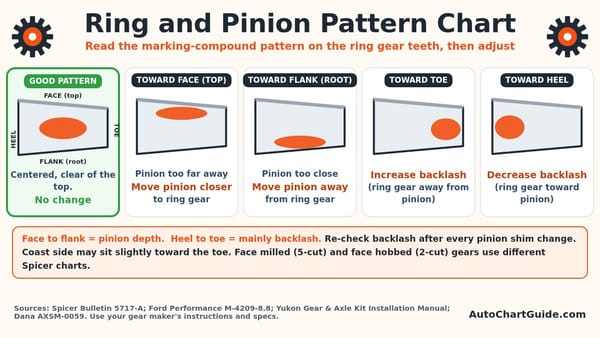
Follow the replacement intervals. Winters' FAQ recommends replacing your most-used quick change gears yearly in high horsepower racing applications, replacing rear end oil every 5 races, inspecting the ring and pinion after every race for pitting and excessive wear on the pinion, and in high horsepower applications thoroughly inspecting and maintaining the rear end every 20 races (seasonally in other applications). If an inspection ends with a new ring and pinion, our ring and pinion pattern chart explains how to read the marking-compound pattern during setup.
Break in new parts. The 2025 catalog's break-in procedure says to avoid full throttle loads and high rpm for at least 20 miles, starting at 30 percent power and building gradually to no more than 80 percent, then to drain and refill the gear lube in both the rear end and the quick change gear cavity.
Common Mistakes With Quick Change Gear Charts
- Reading the wrong R&P column. The same set is 4.12-based in one column and 4.86-based in another. Confirm the ring and pinion first.
- Installing high when you meant low. Tall gear on top is high. Get it backwards and the ratio is the other figure in the row.
- Mixing charts. Set numbers repeat across the 10-spline, 6-spline and 7-inch charts with different gears.
- Using the tire size code for diameter. The rpm formula needs the real rolling diameter.
- Running the extreme sets in a high-power car. Sets 50 to 58 on the 10-spline chart are marked for limited horsepower applications.
- Skipping the refill. Oil drains out of the gear cavity when the cover comes off. Refill it.
- Ordering from a calculated ratio. Buy a set Winters lists. A ratio you calculated is only useful if a real set produces it.
Frequently Asked Questions
What does "low" and "high" mean on a Winters quick change gear chart?
They are the two ways to install the same gear set. Winters' 10-spline poster labels HIGH as "tall gear on top" and LOW as "short gear on top." High gives the numerically higher final drive (more acceleration, more rpm at a given speed); low gives the numerically lower one.
How do I order a Winters 10-spline quick change gear set?
Winters says to add "85" in front of the gear set number from the 8500 Series chart. Its catalog gives 8501 as the example, which is set 01.
Which ring and pinion ratios does the Winters 10-spline chart cover?
Three: 4.12 (8/33 teeth), 4.57 (7/32 teeth) and 4.86 (7/34 teeth). The 6-spline, 7-inch and Xtremeliner charts use different ring and pinion ratios.
How do I calculate final drive on a quick change?
Winters' formula is top gear teeth divided by bottom gear teeth, multiplied by the ring and pinion ratio. For example, set 16 (18/24) with the 24-tooth gear on top on a 4.86 R&P gives 6.48, the figure printed on the chart.
What is the 336 in the Winters rpm formula?
It is the constant Winters prints for converting speed in mph and tire diameter in inches to rpm: rpm = ratio x mph x 336 / tire diameter. It comes from 63,360 inches in a mile divided by 60 minutes and by pi, which is about 336.1.
Are gear set numbers the same across Winters charts?
No. Set 15 is 19/20 on the 10-spline chart, 15/24 on the 6-spline chart and 30/20 on the 7-inch chart. Always read the chart for the gear family your rear end uses.
What gear oil does Winters recommend for a quick change?
Winters' poster and FAQ recommend a semi-synthetic SAE 80W-90 with moly, such as its High Performance Supreme gear oil by Schaeffer's, or a full synthetic 75W-90. Refill the gear cavity after every gear change.
How often should quick change gears be replaced?
In high horsepower racing applications, Winters recommends replacing your most-used quick change gears yearly. It also recommends replacing rear end oil every 5 races.
Can I calculate a ratio that is not on the chart?
You can calculate any combination, but only buy a set that Winters actually lists. Your own math may differ from the printed figure by a hundredth or two, because the chart is rounded.
Sources
- Winters Performance Products, Gear Charts page, read November 2, 2026.
- Winters Performance Products, 10-Spline Quick Change Gears, 8500 Series poster (PDF, September 2022), read November 2, 2026.
- Winters Performance Products, Six Spline P/N 4400 and 4500 Series gear chart (PDF, ©2019), read November 2, 2026.
- Winters Performance Products, 7 Inch Quick Change Gears, P/N 3800 Series chart (PDF, chart ©2007), read November 2, 2026.
- Winters Performance Products, Xtremeliner 30800 Series Quick Change Gears poster (PDF, ©2019), read November 2, 2026.
- Winters Performance Products, 2025 Independent Quick Changes and Driveline Components catalog (PDF, May 2025), read November 2, 2026.
- Winters Performance Products, 2024 Modified Quick Changes and Driveline Components catalog (PDF, November 2024), read November 2, 2026.
- Winters Performance Products, Frequently Asked Questions, read November 2, 2026.