15 Inch Tire Size Chart 2026: Complete Diameter Guide
15 inch tire size chart: diameter, width, sidewall and revs per mile for 18 sizes, checked against Continental specs, plus how to compare sizes.

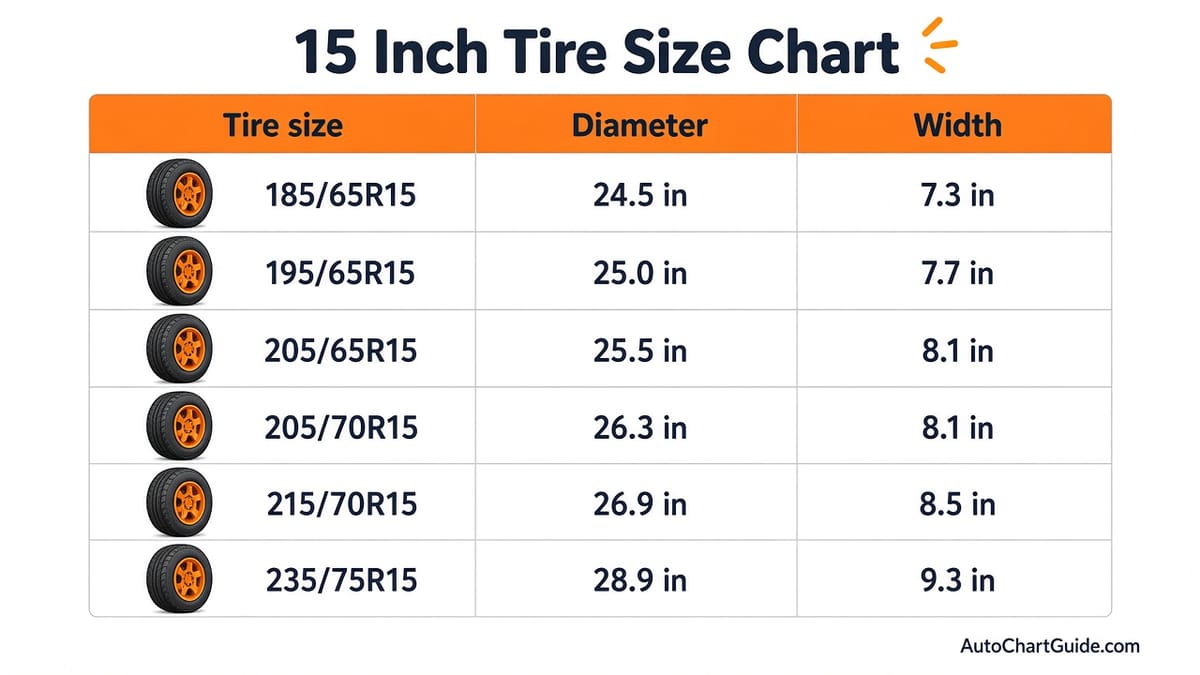
Short answer: a 15 inch tire size chart shows how tall and wide each tire that fits a 15-inch wheel is. The common passenger sizes run from 175/65R15, about 24.0 inches tall, to 235/75R15, about 28.9 inches tall. The four sizes Firestone lists as its most popular 15" tires are 195/65R15 (25.0 in tall, 7.7 in wide), 205/65R15 (25.5 in), 205/70R15 (26.3 in) and 235/75R15 (28.9 in). Light-truck flotation sizes such as 31x10.50R15 give the height and width directly in inches. Fit the size on your vehicle's tire placard unless you have checked a change carefully.
The list of sizes comes from Firestone's 15 inch tire size page, read on 2026-10-26, which names the most popular 15" tires and the other 15" sizes it sells. The diameters, widths, sidewall heights and revolutions per mile are calculated by us from the size code itself, using the method set out below. To check that arithmetic against a real tire, we compared it with Continental's published ControlContact Tour M A/S specifications, read the same day. Measured tires differ slightly from the nominal figures, and the section on that difference explains why.
15 inch tire size chart
Every size Firestone lists for 15-inch wheels is below, from shortest to tallest within each type. "Width" is the nominal section width, "sidewall" the height from wheel rim to tread, and "vs 195/65R15" is the change in overall diameter compared with the most common size on Firestone's list. Revolutions per mile are geometric, from the unloaded diameter.
| Size | Diameter (in) | Width (in) | Sidewall (in) | Revs/mile (calc.) | vs 195/65R15 |
|---|---|---|---|---|---|
| 175/65R15 | 24.0 | 6.9 | 4.5 | 842 | -4.1% |
| 185/55R15 | 23.0 | 7.3 | 4.0 | 876 | -7.9% |
| 185/60R15 | 23.7 | 7.3 | 4.4 | 850 | -5.0% |
| 185/65R15 | 24.5 | 7.3 | 4.7 | 824 | -2.0% |
| 195/60R15 | 24.2 | 7.7 | 4.6 | 833 | -3.1% |
| 195/65R15 (popular) | 25.0 | 7.7 | 5.0 | 807 | +0.0% |
| 205/65R15 (popular) | 25.5 | 8.1 | 5.2 | 791 | +2.0% |
| 205/70R15 (popular) | 26.3 | 8.1 | 5.6 | 767 | +5.3% |
| 205/75R15 | 27.1 | 8.1 | 6.1 | 744 | +8.5% |
| 215/70R15 | 26.9 | 8.5 | 5.9 | 751 | +7.5% |
| 215/75R15 | 27.7 | 8.5 | 6.3 | 728 | +10.9% |
| 225/70R15 | 27.4 | 8.9 | 6.2 | 736 | +9.7% |
| 225/75R15 | 28.3 | 8.9 | 6.6 | 713 | +13.2% |
| 235/75R15 (popular) | 28.9 | 9.3 | 6.9 | 698 | +15.6% |
| 265/75R15 | 30.6 | 10.4 | 7.8 | 658 | +22.7% |
| 30x9.50R15 | 30.0 | 9.5 | 7.5 | 672 | +20.1% |
| 31x10.50R15 | 31.0 | 10.5 | 8.0 | 651 | +24.1% |
| 33x12.50R15 | 33.0 | 12.5 | 9.0 | 611 | +32.1% |
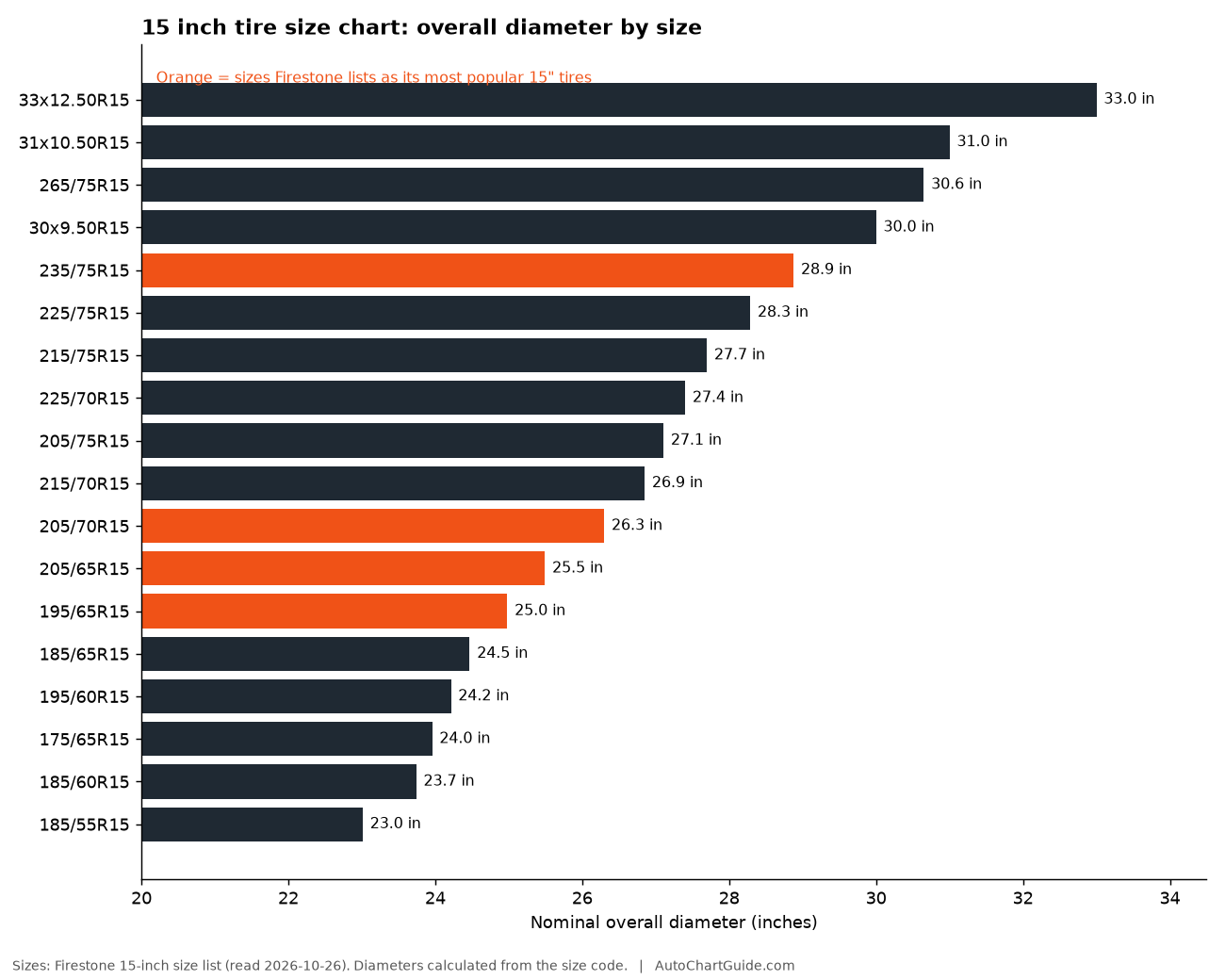
The chart makes one thing obvious: "15 inch" tells you only the wheel, not the tire. Tires that all mount on a 15-inch wheel range from 23.0 inches tall to 33.0 inches tall in this list, a 10-inch spread. A 185/55R15 from a small car and a 33x12.50R15 from a lifted pickup share nothing but the bead diameter.
How the numbers are calculated
A metric size like 195/65R15 holds three numbers. The first, 195, is the section width in millimeters. The second, 65, is the aspect ratio: the sidewall height as a percentage of the width. The R means radial construction, and 15 is the wheel diameter in inches. Our guide to tire size numbers walks through each part on the sidewall.
From those numbers the arithmetic is straightforward:
- Sidewall height = width x aspect ratio / 100. For 195/65R15 that is 195 x 0.65 = 126.75 mm, or 4.99 inches.
- Overall diameter = wheel diameter + two sidewalls. That is 15 + 2 x 4.99 = 24.98 inches, which rounds to 25.0.
- Width in inches = 195 / 25.4 = 7.68 inches.
- Circumference = diameter x pi = 78.5 inches.
- Revolutions per mile = 63,360 inches in a mile / circumference = about 807.
Flotation sizes, used on light trucks, are written differently. In 31x10.50R15, 31 is the overall diameter in inches, 10.50 the section width in inches and 15 the wheel. The sidewall is (31 - 15) / 2 = 8.0 inches. Firestone writes these sizes with a slash, as in 31/10.50R15; the more common sidewall form uses an x.
Checking the math against a real tire
Continental publishes measured specifications for each size of its ControlContact Tour M A/S, and four of them are 15-inch sizes. Here is how they compare with the calculated figures:
| Size | Continental diameter (in) | Our diameter (in) | Continental revs/mile | Our revs/mile | Load index / max load / range | Approved rim width (in) |
|---|---|---|---|---|---|---|
| 185/60R15 | 23.7 | 23.7 | 875 | 850 | 84 / 1,102 lb / SL | 5.0-6.5 |
| 185/65R15 | 24.5 | 24.5 | 849 | 824 | 88 / 1,235 lb / SL | 5.0-6.5 |
| 195/65R15 | 25.0 | 25.0 | 832 | 807 | 91 / 1,356 lb / SL | 5.5-7.0 |
| 205/65R15 | 25.5 | 25.5 | 815 | 791 | 99 / 1,709 lb / XL | 5.5-7.5 |
The diameters match to the tenth of an inch: Continental lists 23.7, 24.5, 25.0 and 25.5 inches for the same four sizes we calculate at 23.74, 24.47, 24.98 and 25.49. That confirms the arithmetic.
The revolutions per mile do not match, and the gap is consistent. Continental's figures are about 3 percent higher in every case: 832 against our 807 for 195/65R15, and 815 against 791 for 205/65R15. That is expected. Our number assumes a perfect circle of the unloaded diameter. A real tire carrying a car flattens where it meets the road, so it rolls on a slightly smaller effective radius and turns more times per mile. When you need revolutions per mile for speedometer work, use the tire maker's published figure, not a calculated one. Our article on what tire size calculators cannot know goes into this in more detail.
The section width shows a similar effect. Continental lists 195/65R15 at 7.9 inches "(6.0)", meaning measured on a 6.0-inch rim, while the nominal 195 mm is 7.68 inches. Actual width depends on the rim it is mounted on and on the tire's design.
Load capacity is not in the size
Two tires with the same size can carry different loads. Continental's specification for 195/65R15 shows load index 91, a maximum load of 1,356 lb and the standard load (SL) range. Its 205/65R15 is load index 99, 1,709 lb, and an extra load (XL) tire. The 185/60R15 is load index 84 at 1,102 lb, and the 185/65R15 is 88 at 1,235 lb. Continental lists a maximum inflation pressure of 51 psi for all four.
That maximum pressure is the most the tire can safely hold, not the pressure to run. Your vehicle's tire placard gives the recommended pressure for the original size. If you change size, the load index has to be at least as high as the original, and the placard pressure may no longer be right. Our guides to the tire load index and the difference between LT and P tires explain how to compare them.
Rim width: which wheel each size fits
A 15-inch wheel also has a width, and each tire size is approved for a range of rim widths. Continental's specs give these ranges for its four sizes: 5.0 to 6.5 inches for 185/60R15 and 185/65R15, 5.5 to 7.0 inches for 195/65R15, and 5.5 to 7.5 inches for 205/65R15. A wider tire generally needs a wider range of rims. The ranges come from the tire maker, so check the specific tire you are buying rather than assuming another brand is the same. Our article on whether wheels will fit your car covers width, offset and the other numbers to check.
Choosing a different 15 inch size
A size change changes more than the look. Using the chart:
- Overall diameter. Moving from 195/65R15 to 205/65R15 makes the tire about 2 percent taller. Moving to 215/70R15 makes it about 7.5 percent taller. A taller tire turns fewer times per mile, so the speedometer reads lower than your real speed.
- Clearance. A taller or wider tire may rub on suspension parts, fender liners or the body at full lock or full compression.
- Load and speed rating. The replacement has to meet or exceed the original load index and, normally, the speed rating.
- Electronic systems. Stability control, ABS and some driver-assist systems use wheel speed, which depends on tire diameter.
A common rule of thumb in the tire trade is to keep a replacement within about 3 percent of the original diameter. That is a convention, not a standard, and your vehicle maker's approved sizes always take priority. If you want to change wheel size as well, our article on plus-sizing tires shows how to keep the diameter while moving to a larger wheel. Our 18 inch tire size chart works through a 17-to-18-inch example in which 225/65R17 to 225/60R18 changes height by only 0.4 percent.
15 inch sizes that are close in diameter
Several sizes on Firestone's list end up within about 1 percent of each other in height, which is useful when the exact original size is hard to find. These pairs come straight from the calculated chart:
- 205/75R15 and 215/70R15: 27.1 and 26.9 inches tall, about 1.0 percent apart. The 215 is 0.4 inch wider with a slightly shorter sidewall.
- 215/75R15 and 225/70R15: 27.7 and 27.4 inches, about 1.1 percent apart, with the 225 again wider and lower.
- 265/75R15 and 31x10.50R15: 30.6 and 31.0 inches, about 1.1 percent apart. The metric size is narrower, at 10.4 inches against 10.5.
- 185/65R15 and 195/60R15: 24.5 and 24.2 inches, about 1.1 percent apart.
Close diameter is only the first check. Each pair differs in width, and the load index and speed rating have to suit your vehicle. Treat these as candidates to research, not automatic substitutes, and confirm with your vehicle maker or a tire professional before switching.
Sidewall height and what it changes
Because every tire here shares the same 15-inch wheel, the differences in height all come from the sidewall. On the chart, sidewalls range from about 4.0 inches on a 185/55R15 to 9.0 inches on a 33x12.50R15. A taller sidewall gives more rubber between the wheel and the road, which generally means more cushioning over bumps and more protection for the rim, and is one reason trucks and off-road vehicles use taller 15-inch sizes. A shorter sidewall flexes less in corners. Those are general tendencies; the tire's construction and load range matter as much as the geometry.
You can work out any 15-inch size the same way. For 225/75R15, the sidewall is 225 x 0.75 = 168.75 mm, or 6.64 inches. Add two of those to 15 and you get 28.3 inches, which is the figure in the chart. If a size is not in this list, the same two steps will give you a nominal height you can compare against your current tires. Our 17 inch tire size chart applies the same method to every 17-inch size and checks it against 18 sizes Continental has measured.
Where to find the right size for your vehicle
Firestone's page points to the same places a technician would check: "on the inside frame of the driver's side door, inside the glove box door, your driver's manual or your tire's sidewall." The door-frame placard is the authoritative one for the original size and pressure. The sidewall shows what is fitted now, which may not be the original. The U.S. National Highway Traffic Safety Administration's tire safety pages explain the placard and the sidewall markings in more detail.
Worked examples
Replacing 195/65R15 tires
The placard says 195/65R15, load index 91. The chart gives a 25.0-inch diameter and about 807 calculated revolutions per mile. Any 195/65R15 tire with load index 91 or higher and the original speed rating is a direct replacement. Continental's version, for example, is 91H.
Considering 205/65R15 instead
205/65R15 is 25.5 inches tall, about 2 percent more than 195/65R15, and 0.4 inch wider. It is within the 3 percent rule of thumb, but check the rim width range (Continental's needs 5.5 to 7.5 inches) and the clearance. Your speedometer would read roughly 2 percent low: at a true 60 mph it would show about 59.
Upsizing a pickup from 235/75R15
235/75R15 is 28.9 inches tall. A 31x10.50R15 is 31.0 inches, about 7 percent taller and 1.25 inches wider. That is well beyond the 3 percent rule. It usually needs suspension or body changes and a speedometer recalibration, and the load ratings of flotation tires are different again.
Frequently asked questions
What is the most common 15 inch tire size?
Firestone lists 195/65R15, 205/65R15, 205/70R15 and 235/75R15 as its most popular 15" tires. 195/65R15 is about 25.0 inches tall and 7.7 inches wide.
How tall is a 205/65R15 tire?
About 25.5 inches. The sidewall is 205 x 0.65 = 133 mm (5.25 in), so the diameter is 15 + 2 x 5.25 = 25.49 inches. Continental lists its 205/65R15 at 25.5 inches.
How tall is a 235/75R15 tire?
About 28.9 inches tall and 9.3 inches wide, with a 6.9-inch sidewall, calculated from the size code.
Can I put 205/65R15 instead of 195/65R15?
Often, but check first. It is about 2 percent taller and 0.4 inch wider, so confirm the rim width range, clearance and load index, and expect the speedometer to read about 2 percent low.
What size is a 31x10.50R15 tire?
31 inches tall, 10.5 inches wide, on a 15-inch wheel. Flotation sizes state the diameter and width directly in inches.
Why does my tire's revs per mile differ from a calculator?
A calculator uses the unloaded diameter. A loaded tire flattens at the road and rolls on a smaller radius, so it turns more often. Continental's published figures are about 3 percent higher than the geometric ones.
Are all 15 inch tires interchangeable?
No. 15 inch only means the wheel diameter. Tires that fit a 15-inch wheel in this chart range from 23.0 to 33.0 inches tall, with different widths and load ratings.
Where do I find my car's tire size?
On the tire placard on the driver's door frame, inside the glove box door, in the owner's manual or on the tire sidewall. The placard shows the original size and pressure.
Sources
- Firestone, 15 Inch Tires, read 2026-10-26. Most popular and other 15" sizes, where to find your size.
- Continental Tire, ControlContact Tour M A/S Specifications, read 2026-10-26. Measured diameter, width, revolutions per mile, load index, maximum load and pressure, approved rim width.
- National Highway Traffic Safety Administration, Tires, read 2026-10-26.
- AutoChartGuide calculations from the size codes (method above), 2026-10-26.