18 Inch Tire Size Chart 2026: Complete Height & Width Guide
Height, width and sidewall for all 42 sizes that fit an 18-inch wheel, checked against published Continental and Maxxis specs.

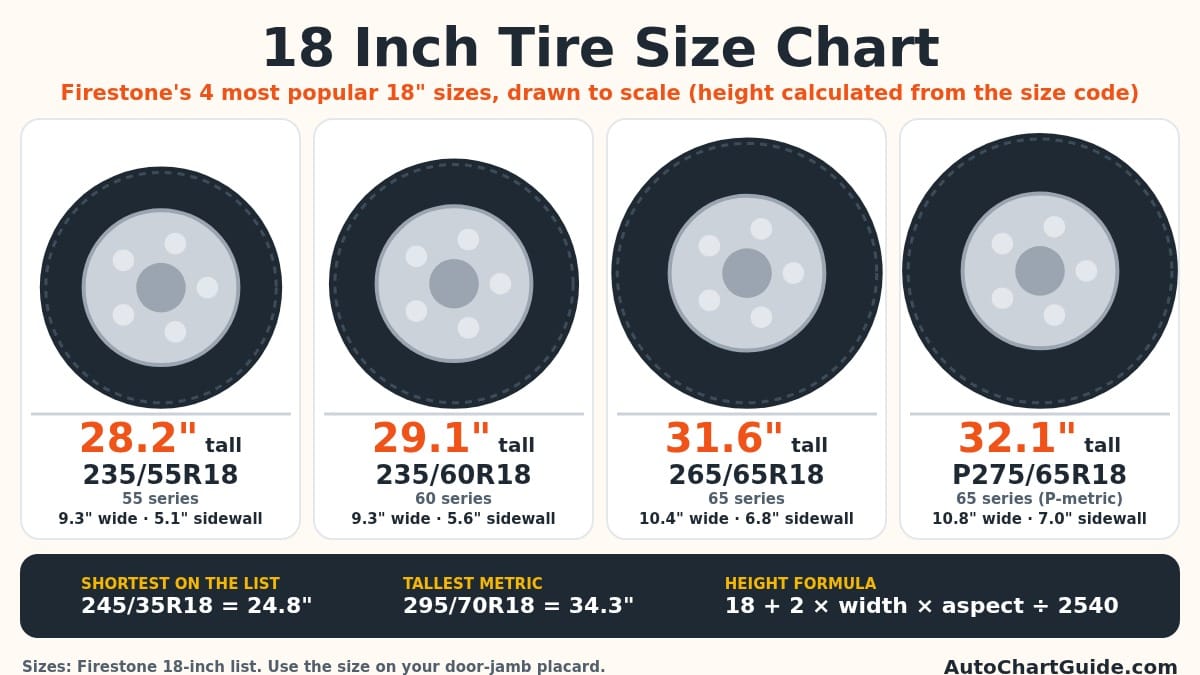
Short answer: an 18 inch tire size chart shows how tall and wide each tire that mounts on an 18-inch wheel is. On Firestone's list of 18" sizes, metric tires run from about 24.8 inches tall (245/35R18) to 34.3 inches tall (295/70R18). Flotation sizes go up to 35 inches nominal (35x12.50R18). Firestone names four sizes as its most popular 18" tires: 235/55R18 (28.2 in), 235/60R18 (29.1 in), 265/65R18 (31.6 in) and P275/65R18 (32.1 in). The tire your vehicle needs is the one on its door-jamb placard or in the owner's manual.
The list of 42 sizes comes from Firestone's 18-inch tires page, read on November 2, 2026. We calculated the diameters, widths, sidewall heights and revolutions per mile from the size codes ourselves, with the method shown below. To test that arithmetic against real tires, we compared it with the specifications Continental publishes for 38 different 18-inch sizes across four tire lines, and with the 18-inch truck and flotation sizes Maxxis lists for its RAZR MT. All of those pages were also read on November 2, 2026. Every figure we calculated is labelled as calculated.
18 Inch Tire Size Chart: Every Size on Firestone's List
Below are all 42 sizes Firestone lists for 18-inch wheels. They are split into three groups by aspect ratio, because the aspect ratio is what separates a low-profile performance tire from a tall truck tire on the same wheel. "Diameter" is the nominal overall height of the tire, "width" is the nominal section width, and "sidewall" is the height of rubber from the wheel rim to the tread. The revolutions per mile are geometric figures from the unloaded diameter. Real tires turn about 3 percent more often, for reasons covered further down. Sizes Firestone marks as most popular are labelled.
Low-profile 18-inch sizes (35, 40 and 45 series)
| Size | Diameter (in) | Width (in) | Sidewall (in) | Revs/mile (calc.) |
|---|---|---|---|---|
| 245/35R18 | 24.8 | 9.6 | 3.4 | 815 |
| 215/40R18 | 24.8 | 8.5 | 3.4 | 814 |
| 255/35R18 | 25.0 | 10.0 | 3.5 | 806 |
| 225/40R18 | 25.1 | 8.9 | 3.5 | 804 |
| 265/35R18 | 25.3 | 10.4 | 3.7 | 797 |
| 235/40R18 | 25.4 | 9.3 | 3.7 | 794 |
| 275/35R18 | 25.6 | 10.8 | 3.8 | 788 |
| 215/45R18 | 25.6 | 8.5 | 3.8 | 787 |
| 245/40R18 | 25.7 | 9.6 | 3.9 | 784 |
| 225/45R18 | 26.0 | 8.9 | 4.0 | 777 |
| 255/40R18 | 26.0 | 10.0 | 4.0 | 775 |
| 235/45R18 | 26.3 | 9.3 | 4.2 | 766 |
| 275/40R18 | 26.7 | 10.8 | 4.3 | 756 |
| 245/45R18 | 26.7 | 9.6 | 4.3 | 756 |
| 285/40R18 | 27.0 | 11.2 | 4.5 | 748 |
| 255/45R18 | 27.0 | 10.0 | 4.5 | 746 |
Sizes: Firestone 18-inch tires page, read November 2, 2026. Dimensions calculated by AutoChartGuide from the size code; nominal, unloaded.
Mid-profile 18-inch sizes (50, 55 and 60 series)
| Size | Diameter (in) | Width (in) | Sidewall (in) | Revs/mile (calc.) |
|---|---|---|---|---|
| 215/50R18 | 26.5 | 8.5 | 4.2 | 762 |
| 225/50R18 | 26.9 | 8.9 | 4.4 | 751 |
| 235/50R18 | 27.3 | 9.3 | 4.6 | 740 |
| 215/55R18 | 27.3 | 8.5 | 4.7 | 738 |
| 245/50R18 | 27.6 | 9.6 | 4.8 | 730 |
| 225/55R18 | 27.7 | 8.9 | 4.9 | 727 |
| 235/55R18 (popular) | 28.2 | 9.3 | 5.1 | 716 |
| 245/55R18 | 28.6 | 9.6 | 5.3 | 705 |
| 225/60R18 | 28.6 | 8.9 | 5.3 | 704 |
| 255/55R18 | 29.0 | 10.0 | 5.5 | 694 |
| 235/60R18 (popular) | 29.1 | 9.3 | 5.6 | 693 |
| 245/60R18 | 29.6 | 9.6 | 5.8 | 682 |
| 255/60R18 | 30.0 | 10.0 | 6.0 | 671 |
| 265/60R18 | 30.5 | 10.4 | 6.3 | 661 |
Sizes: Firestone 18-inch tires page, read November 2, 2026. Dimensions calculated by AutoChartGuide from the size code; nominal, unloaded.
Tall 18-inch sizes (65 and 70 series) and flotation sizes
| Size | Diameter (in) | Width (in) | Sidewall (in) | Revs/mile (calc.) |
|---|---|---|---|---|
| 235/65R18 | 30.0 | 9.3 | 6.0 | 672 |
| 255/65R18 | 31.1 | 10.0 | 6.5 | 650 |
| 265/65R18 (popular) | 31.6 | 10.4 | 6.8 | 639 |
| 255/70R18 | 32.1 | 10.0 | 7.0 | 629 |
| 275/65R18 | 32.1 | 10.8 | 7.0 | 629 |
| P275/65R18 (popular) | 32.1 | 10.8 | 7.0 | 629 |
| 285/65R18 | 32.6 | 11.2 | 7.3 | 619 |
| 265/70R18 | 32.6 | 10.4 | 7.3 | 619 |
| 33x12.50R18 | 33.0 | 12.5 | 7.5 | 611 |
| 275/70R18 | 33.2 | 10.8 | 7.6 | 608 |
| 295/70R18 | 34.3 | 11.6 | 8.1 | 589 |
| 35x12.50R18 | 35.0 | 12.5 | 8.5 | 576 |
Sizes: Firestone 18-inch tires page, read November 2, 2026. Dimensions calculated by AutoChartGuide from the size code; nominal, unloaded. Firestone writes the flotation sizes as 33/12.50R18 and 35/12.50R18; their diameters and widths are the nominal figures in the size code.
Firestone lists P275/65R18 and 275/65R18 as separate entries. They have the same nominal dimensions. The P prefix marks a P-metric passenger tire; a size with no prefix carries no US service-type letter, and swapping one for the other is a service type change, not a like-for-like replacement. Our guide to what the P and LT letters change explains why that letter matters even when the numbers match.
What the Chart Shows: One Wheel, a 10-Inch Spread
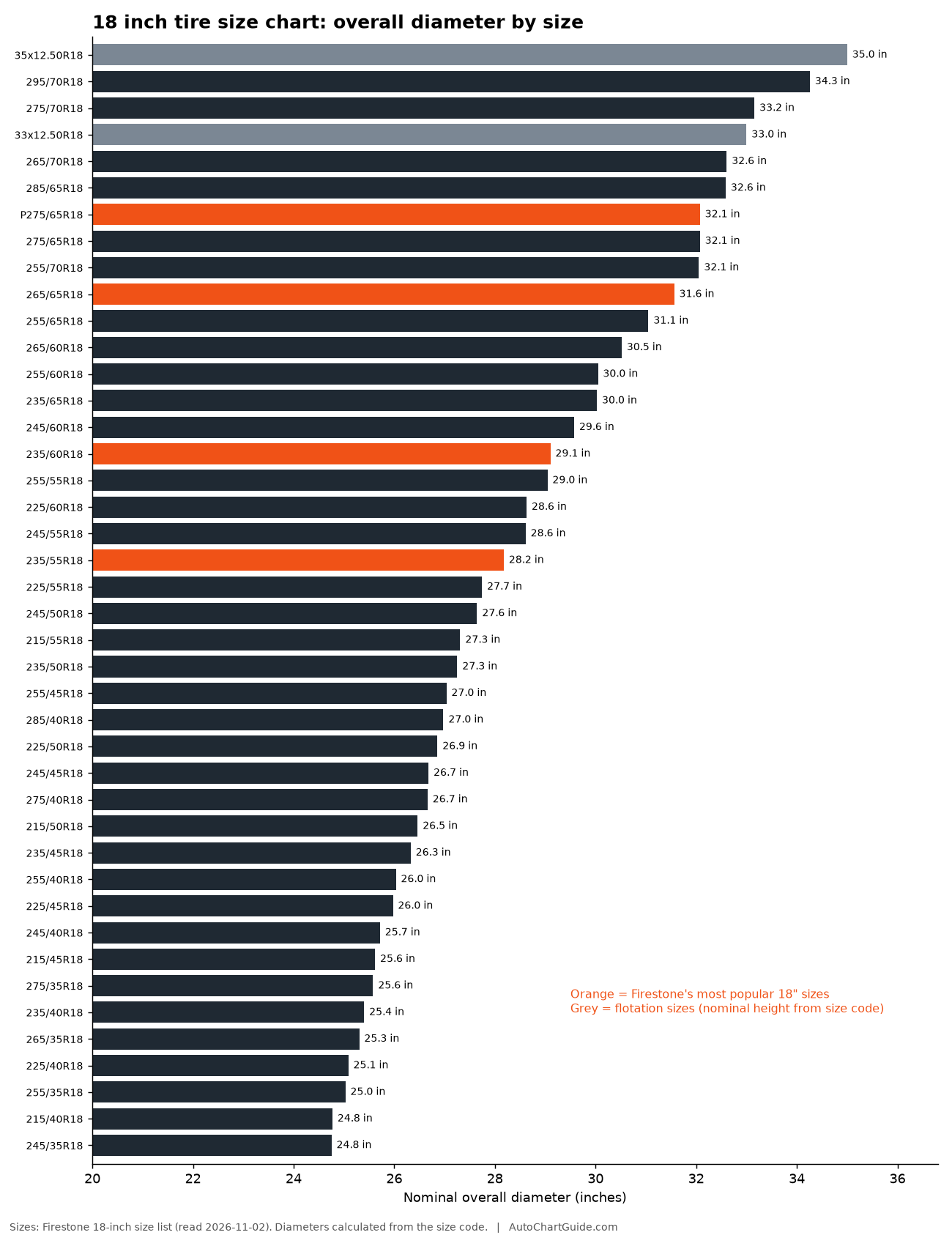
"18 inch" describes the wheel, not the tire. Every tire in the chart has an 18-inch bead diameter and fits an 18-inch wheel of a suitable width, yet the overall heights on Firestone's list run from 24.75 inches (245/35R18) to 35 inches (35x12.50R18). That is a spread of more than 10 inches.
All of that difference is sidewall. A 245/35R18 has a sidewall of about 3.4 inches. A 35x12.50R18 has a sidewall of 8.5 inches. A tire for a low sports sedan and a tire for a lifted pickup share nothing except the bead size, which is why the wheel diameter alone tells you very little about what will fit.
Width varies too, but less. The metric sizes on the list run from 215 mm (8.5 inches) to 295 mm (11.6 inches) wide. The two flotation sizes are 12.5 inches wide nominal.
The chart also shows how crowded the middle of the range is. 18 of the 42 sizes on Firestone's list fall between 26 and 30 inches tall, often only a few tenths of an inch apart. That is why two different size codes can be near-equivalents in height while differing in width, rim width range and load capacity.
The Four Most Popular 18-Inch Tire Sizes
Firestone names four sizes as its most popular 18" tires. Their calculated dimensions are:
| Size | Diameter (in) | Width (in) | Sidewall (in) |
|---|---|---|---|
| 235/55R18 | 28.2 | 9.3 | 5.1 |
| 235/60R18 | 29.1 | 9.3 | 5.6 |
| 265/65R18 | 31.6 | 10.4 | 6.8 |
| P275/65R18 | 32.1 | 10.8 | 7.0 |
Sizes: Firestone, "The most popular 18" tires", read November 2, 2026. Dimensions calculated from the size code.
All four are 55, 60 or 65 series sizes. The 235/55R18 and 235/60R18 are the same width and differ only in sidewall: the 60 series is about 0.9 inch taller. The 265/65R18 and P275/65R18 are taller still, at about 31.6 and 32.1 inches. Continental's published diameters agree: 28.2 inches for 235/55R18, 29.1 inches for 235/60R18, 31.6 inches for 265/65R18 and 32.1 inches for 275/65R18.
A popular size is not a recommendation for your vehicle. Two vehicles that both use 18-inch wheels can need tires that differ by several inches in height. Popularity only tells you that a size is easy to find.
How to Calculate the Height of Any 18-Inch Tire
Every figure in the chart comes from the size code. The method works for any metric size, including ones that are not on the list. Our guide to what the numbers in a tire size mean explains each part of the code in more detail.
- Read the width. In 245/45R18, the 245 is the section width in millimetres. Divide by 25.4 to get inches: 245 / 25.4 = 9.65 inches.
- Work out the sidewall. The 45 is the aspect ratio: the sidewall is 45 percent of the width. 245 x 0.45 = 110.25 mm, or 4.34 inches.
- Add two sidewalls to the wheel. The tire has a sidewall above and below the wheel, so the overall height is 18 + 2 x 4.34 = 26.68 inches.
- Find the circumference. Multiply the diameter by pi: 26.68 x 3.1416 = 83.8 inches.
- Find revolutions per mile. A mile is 63,360 inches, so 63,360 / 83.8 = about 756 revolutions per mile, unloaded.
In one line: diameter in inches = 18 + (2 x width x aspect ratio) / 2540. Flotation sizes such as 33x12.50R18 are simpler. The first number is the nominal overall height in inches, the second is the nominal width in inches, and the R18 is the wheel diameter. A 33x12.50R18 therefore has a nominal sidewall of (33 - 18) / 2 = 7.5 inches.
Continental lists its 245/45 ZR 18 ExtremeContact DWS06 Plus at 26.7 inches, which matches the 26.68 inches worked out above. Continental writes its ExtremeContact DWS06 Plus sizes with "ZR", as in 245/45 ZR 18. ZR is a high-speed marking and does not change the dimensions.
Do Real Tires Match the Chart? Continental's Published Figures
Continental publishes a specification line for every size of each tire model, including a measured tire diameter and revolutions per mile. Across the ControlContact Tour M A/S, CrossContact LX25, TerrainContact A/T and ExtremeContact DWS06 Plus, 38 different 18-inch sizes appear. Here they are next to our calculated figures:
| Size | Continental tire | Continental diameter (in) | Our diameter (in) | Continental revs/mile | Our revs/mile |
|---|---|---|---|---|---|
| 245/35R18 | ExtremeContact DWS06 Plus | 24.8 | 24.75 | 839 | 815 |
| 215/40R18 | ExtremeContact DWS06 Plus | 24.8 | 24.77 | 839 | 814 |
| 255/35R18 | ExtremeContact DWS06 Plus | 25.0 | 25.03 | 830 | 806 |
| 225/40R18 | ExtremeContact DWS06 Plus | 25.1 | 25.09 | 828 | 804 |
| 265/35R18 | ExtremeContact DWS06 Plus | 25.3 | 25.30 | 821 | 797 |
| 235/40R18 | ExtremeContact DWS06 Plus | 25.4 | 25.40 | 818 | 794 |
| 275/35R18 | ExtremeContact DWS06 Plus | 25.6 | 25.58 | 812 | 788 |
| 215/45R18 | ExtremeContact DWS06 Plus | 25.6 | 25.62 | 811 | 787 |
| 245/40R18 | ExtremeContact DWS06 Plus | 25.7 | 25.72 | 808 | 784 |
| 285/35R18 | ExtremeContact DWS06 Plus | 25.9 | 25.85 | 803 | 780 |
| 225/45R18 | ExtremeContact DWS06 Plus | 26.0 | 25.97 | 800 | 777 |
| 255/40R18 | ExtremeContact DWS06 Plus | 26.0 | 26.03 | 798 | 775 |
| 295/35R18 | ExtremeContact DWS06 Plus | 26.1 | 26.13 | 795 | 772 |
| 235/45R18 | ControlContact Tour M A/S | 26.3 | 26.33 | 789 | 766 |
| 265/40R18 | ExtremeContact DWS06 Plus | 26.3 | 26.35 | 788 | 765 |
| 275/40R18 | ExtremeContact DWS06 Plus | 26.7 | 26.66 | 779 | 756 |
| 245/45R18 | ExtremeContact DWS06 Plus | 26.7 | 26.68 | 779 | 756 |
| 225/50R18 | ControlContact Tour M A/S | 26.9 | 26.86 | 773 | 751 |
| 255/45R18 | ExtremeContact DWS06 Plus | 27.0 | 27.04 | 768 | 746 |
| 235/50R18 | CrossContact LX25 | 27.3 | 27.25 | 762 | 740 |
| 215/55R18 | CrossContact LX25 | 27.3 | 27.31 | 761 | 738 |
| 245/50R18 | ExtremeContact DWS06 Plus | 27.6 | 27.65 | 751 | 730 |
| 225/55R18 | CrossContact LX25 | 27.7 | 27.74 | 749 | 727 |
| 235/55R18 | CrossContact LX25 | 28.2 | 28.18 | 737 | 716 |
| 245/55R18 | ExtremeContact DWS06 Plus | 28.6 | 28.61 | 726 | 705 |
| 225/60R18 | CrossContact LX25 | 28.6 | 28.63 | 726 | 704 |
| 255/55R18 | CrossContact LX25 | 29.0 | 29.04 | 715 | 694 |
| 235/60R18 | ControlContact Tour M A/S | 29.1 | 29.10 | 714 | 693 |
| 245/60R18 | CrossContact LX25 | 29.6 | 29.57 | 702 | 682 |
| 235/65R18 | CrossContact LX25 | 30.0 | 30.03 | 692 | 672 |
| 255/60R18 | CrossContact LX25 | 30.0 | 30.05 | 691 | 671 |
| 265/60R18 | CrossContact LX25 | 30.5 | 30.52 | 681 | 661 |
| 255/65R18 | CrossContact LX25 | 31.1 | 31.05 | 669 | 650 |
| 265/65R18 | TerrainContact A/T | 31.6 | 31.56 | 658 | 639 |
| 255/70R18 | TerrainContact A/T | 32.1 | 32.06 | 648 | 629 |
| 275/65R18 | TerrainContact A/T | 32.1 | 32.07 | 648 | 629 |
| 265/70R18 | TerrainContact A/T | 32.6 | 32.61 | 637 | 619 |
| LT275/70R18 | TerrainContact A/T | 33.2 | 33.16 | 627 | 608 |
Source: Continental Tire specification pages for each model, read November 2, 2026. Where a size appears in more than one model, the first model checked is shown (order: ControlContact Tour M A/S, CrossContact LX25, TerrainContact A/T, ExtremeContact DWS06 Plus). Continental writes the DWS06 Plus sizes with ZR, e.g. 245/40 ZR 18. "Our" figures are calculated from the size code.
Two results stand out.
Diameters match to within 0.05 inch. For every one of the 38 sizes, Continental's published diameter is within 0.05 inch of the figure calculated from the size code. Continental rounds to a tenth of an inch, so a difference of 0.05 inch is simply rounding. For these passenger and light-truck tires, the size code predicts the published height.
Revolutions per mile run about 3 percent higher. Continental's revolutions per mile were between 2.9 and 3.1 percent higher than the geometric figure for every size. For 235/60R18, the geometric figure is 693 and Continental lists 714. The reason is that a tire under load flattens where it meets the road, so it rolls on a radius slightly smaller than its unloaded radius and turns more often per mile. If you need an exact figure for speedometer or gearing work, use the tire maker's own revolutions per mile for the exact tire, not the geometric number.
Three of Continental's 18-inch sizes, 265/40R18, 285/35R18 and 295/35R18, are not on Firestone's list, which is a reminder that no single maker's list covers every size. The arithmetic works for them as well: 265/40R18 calculates to 26.35 inches and Continental lists 26.3.
Truck and Flotation 18-Inch Sizes: Where the Chart Drifts
Size codes describe categories, not exact products. Our explainer on why tire size calculators are not exact covers the general reason. The 18-inch mud-terrain sizes Maxxis lists for its RAZR MT show it clearly, and in two different directions.
| Size | Calculated or nominal height (in) | Maxxis overall diameter (in) | Difference (in) | Maxxis section width (in) |
|---|---|---|---|---|
| LT275/65R18 | 32.07 | 32.5 | +0.43 | 11.1 |
| LT275/70R18 | 33.16 | 33.5 | +0.34 | 11.3 |
| LT285/65R18 | 32.59 | 32.8 | +0.21 | 11.5 |
| LT285/75R18 | 34.83 | 35.0 | +0.17 | 11.8 |
| LT295/65R18 | 33.10 | 33.5 | +0.40 | 12.1 |
| LT295/70R18 | 34.26 | 34.6 | +0.34 | 12.3 |
| 33X12.50R18LT | 33.00 | 32.9 | -0.10 | 12.8 |
| 35X12.50R18LT | 35.00 | 34.8 | -0.20 | 13.2 |
| 37X12.50R18LT | 37.00 | 36.9 | -0.10 | 13.0 |
Source: Maxxis Canada RAZR MT specification table, read November 2, 2026. Maxxis lists 35X12.50R18LT in two load versions, both 34.8 inches; it is shown once. Calculated height for LT metric sizes from the size code; nominal height for flotation sizes.
For the six LT metric sizes, Maxxis lists overall diameters 0.17 to 0.43 inch taller than the size code gives. LT275/65R18, for example, calculates to 32.07 inches and Maxxis lists 32.5. For the three flotation sizes it goes the other way: the 33x12.50R18LT is listed at 32.9 inches, the 35x12.50R18LT at 34.8 inches and the 37x12.50R18LT at 36.9 inches, each slightly under its nominal height.
Compare Continental's TerrainContact A/T in LT275/70R18. Continental lists it at 33.2 inches, matching the calculated 33.16 inches, while Maxxis lists its LT275/70R18 RAZR MT at 33.5 inches. Same size code, 0.3 inch apart. Why one maker's tire runs taller is not stated on either page; tread depth is one plausible factor (Maxxis lists 18/32 inch for that size, Continental 16/32 inch), but that is our inference, not a published explanation.
For a truck, a few tenths of an inch can decide whether a tire clears a control arm or the body at full lock. If clearance is tight, check the published overall diameter and section width for the exact tire model rather than relying on the size code. If you balance big 18-inch truck tires with beads, our balancing beads for tires chart lists the maker amounts, from 4 oz for a 275/65R18 on a half-ton truck to 12 oz for a 37x12.50R18 mud-terrain on ECO Balance's chart.
Sidewall Height and What It Changes
Within one wheel size, all of the difference in height is sidewall. In the chart, sidewalls run from about 3.4 inches on a 245/35R18 to 8.5 inches on a 35x12.50R18. A shorter sidewall flexes less, which generally sharpens steering response and passes more road impact through to the cabin and the wheel. A taller sidewall generally does the opposite and gives the rim more protection from potholes and rocks. These are general tendencies of tire construction, not measured properties of any particular tire in the chart.
The aspect ratio also changes how the same width behaves. A 255/35R18 and a 255/70R18 are both 10 inches wide nominal, but one is 25.0 inches tall and the other 32.1 inches. Choosing between them is never a question of preference: the vehicle was designed around one height, and changing it changes the speedometer, gearing, ground clearance and the space the tire needs in the wheel well.
Rim Width Ranges for 18-Inch Tires
An 18-inch wheel also has a width, and each tire size is approved for a range of rim widths. Continental's specs give the ranges for its 18-inch sizes. A selection is below. Continental gives each section width followed by a rim width in brackets, which we read as the rim the width was measured on:
| Size | Continental tire | Approved rim width (in) | Section width (measuring rim) (in) |
|---|---|---|---|
| 215/55 R 18 | CrossContact LX25 | 6.0 to 7.5 | 8.9 (7.0) |
| 235/55 R 18 | CrossContact LX25 | 6.5 to 8.5 | 9.6 (7.5) |
| 235/45 R 18 | ControlContact Tour M A/S | 7.5 to 9.0 | 9.3 (8.0) |
| 255/35 ZR 18 | ExtremeContact DWS06 Plus | 8.5 to 10.0 | 10.2 (9.0) |
| 255/65 R 18 | CrossContact LX25 | 7.0 to 9.0 | 10.2 (7.5) |
| 265/65 R 18 | TerrainContact A/T | 7.5 to 9.5 | 10.7 (8.0) |
| 275/35 ZR 18 | ExtremeContact DWS06 Plus | 9.0 to 11.0 | 10.9 (9.5) |
| 295/35 ZR 18 | ExtremeContact DWS06 Plus | 10.0 to 11.5 | 11.9 (10.5) |
Source: Continental Tire specification pages, read November 2, 2026.
The pattern is clear: wider tires need wider wheels. A 215/55R18 is approved on 6.0 to 7.5-inch wheels, while a 295/35R18 needs 10.0 to 11.5 inches. Section width also depends on the rim a tire is mounted on, which helps explain why 235/55R18 is 9.6 inches wide in Continental's figures rather than the 9.25 inches the size code suggests. The approved range comes from the tire maker, so check the range for the exact tire you are buying against the width of your wheels.
Load Index and Load Range: Same Size, Different Capacity
Size tells you the dimensions, not how much a tire can carry. Two tires in the same size can have very different load ratings, and Continental's specs show it within single tire lines:
| Size | Continental tire | Load index | Load range | Max load (lb) | Max inflation (psi) |
|---|---|---|---|---|---|
| 235/60 R 18 | CrossContact LX25 | 103 | SL | 1,929 | 51 |
| 235/60 R 18 | CrossContact LX25 | 107 | XL | 2,149 | 51 |
| 265/70 R 18 | TerrainContact A/T | 116 | SL | 2,756 | 44 |
| LT265/70 R 18 | TerrainContact A/T | 124 | E | 3,525 | 80 |
| 275/65 R 18 | TerrainContact A/T | 116 | SL | 2,756 | 44 |
| LT275/65 R 18 | TerrainContact A/T | 123 | E | 3,415 | 80 |
Source: Continental Tire CrossContact LX25 and TerrainContact A/T specification pages, read November 2, 2026. Maximum load applies at the tire's specified pressure; use the pressure on your vehicle's placard.
The CrossContact LX25 in 235/60R18 comes as a standard load (SL) tire with load index 103 (1,929 lb) and as an extra load (XL) tire with load index 107 (2,149 lb). The TerrainContact A/T in 265/70R18 is a passenger tire with load index 116 (2,756 lb), while the LT265/70R18 in the same line is a Load Range E light-truck tire rated 3,525 lb, with a maximum inflation pressure of 80 psi instead of 44 psi. Those maximum loads apply only at the tire's specified pressure; the pressure to run on your vehicle is the one on its placard.
A replacement should carry at least the load index your vehicle was built with. Our guide to the tire load index explains why a lower number is never a free substitution.
Changing Tire Size on the Same 18-Inch Wheels
The arithmetic in the chart lets you see what a size change does before you buy. Take a vehicle on 235/60R18 tires. A 235/65R18 is 0.93 inch taller, or 3.2 percent. Because the speedometer counts wheel turns, it would read about 3 percent low: at a true 60 mph it would show about 58.2 mph. The odometer would undercount distance by the same proportion.
A bigger jump is common on trucks. Going from 265/65R18 to 275/70R18 adds about 1.59 inches of height (5.1 percent), lifts the axle by about 0.8 inch and makes the speedometer read about 57.1 mph at a true 60. Changes of that size also affect clearance and effective gearing, so they need checking against the vehicle maker's information rather than a chart.
Width changes are smaller than they look. A 255/60R18 is 10 mm, about 0.39 inch, wider than a 245/60R18 and about 0.48 inch taller. Even that can matter where the tire sits close to a strut, so check clearance and the rim width range.
Plus-Sizing To or From 18-Inch Wheels
Moving to a larger wheel while keeping the overall height close is called plus-sizing. The tire has to make up the extra wheel diameter with sidewall alone. Our article on plus-sizing tires covers the full set of checks; here is the arithmetic for 18-inch wheels.
From 17 to 18 inches. A 225/65R17 is about 28.52 inches tall. On an 18-inch wheel, 225/60R18 is about 28.63 inches, 0.4 percent taller, and 235/55R18 is about 28.18 inches, 1.2 percent shorter. Both are close in height, but they differ in width and load index, so the choice depends on what the vehicle maker approves. Our 17 inch tire size chart lists every 17-inch size calculated the same way.
From 18 to 20 inches. A 235/60R18 is about 29.10 inches tall. On a 20-inch wheel, 235/50R20 is about 29.25 inches (0.5 percent taller) and 245/50R20 about 29.65 inches (1.9 percent taller). On the 235/50R20 the sidewall drops from about 5.6 inches to about 4.6 inches, which is the trade-off of a bigger wheel.
The same method works in the other direction, for example when fitting a set of smaller wheels for winter: pick the size on the smaller wheel whose calculated height is closest to the original, then confirm it is on the vehicle maker's approved list.
How to Choose the Right 18-Inch Tire Size
- Start with the vehicle's size. Firestone's page says the size "can be found in a few locations: on the inside frame of the driver's side door, inside the glove box door, your driver's manual or your tire's sidewall." The door-jamb label is the tire and loading information placard, which shows the size the vehicle was built with.
- Find that size in the chart to see its height, width and sidewall. If it is not listed, calculate it with the formula above.
- Check any alternative against the vehicle maker's approved sizes. NHTSA's advice is direct: "To maintain tire safety, purchase new tires that are the same size as the vehicle's original tires or another size recommended by the vehicle manufacturer." (NHTSA, Tires.)
- Match or exceed the load index and service type (P, LT or none) of the original tire.
- Check the rim width range of the exact tire against your wheels.
- For lifted or modified trucks, use published dimensions for the exact tire model, since truck sizes can differ from the size code by several tenths of an inch.
- If in doubt, ask. NHTSA adds: "If you have any doubt about the correct size to choose, consult with the tire dealer."
Common Mistakes With 18-Inch Tire Sizes
- Treating "18 inch" as a tire size. It is only the wheel diameter. The tires on Firestone's list differ by more than 10 inches in height.
- Assuming the most popular size fits. Popularity says nothing about your vehicle; the placard does.
- Ignoring the letters. 275/65R18 and LT275/65R18 share nominal dimensions, but Continental rates its TerrainContact A/T versions at 2,756 lb (44 psi maximum) and 3,415 lb (80 psi maximum). A P prefix is a third service type again.
- Using a calculator's revolutions per mile for exact work. Continental's loaded figures were about 3 percent higher for every 18-inch size we checked.
- Trusting nominal flotation heights for clearance. Maxxis lists its 35x12.50R18LT at 34.8 inches, and its LT metric sizes run taller than the code. Check the exact tire.
Frequently Asked Questions
What is the most common 18 inch tire size?
Firestone lists 235/55R18, 235/60R18, 265/65R18 and P275/65R18 as its most popular 18" tires. They are about 28.2, 29.1, 31.6 and 32.1 inches tall, calculated from the size code.
How tall is a 235/60R18 tire?
About 29.1 inches. The sidewall is 235 x 0.60 = 141 mm (5.55 in), so the diameter is 18 + 2 x 5.55 = 29.10 inches. Continental lists its 235/60R18 tires at 29.1 inches.
How tall is a 265/65R18 tire?
About 31.6 inches tall and 10.4 inches wide nominal, with a 6.8-inch sidewall. Continental lists its 265/65R18 TerrainContact A/T at 31.6 inches.
What size is a 33 inch tire on an 18 inch wheel?
The flotation size 33x12.50R18 is 33 inches tall nominal; Maxxis lists its 33x12.50R18LT RAZR MT at 32.9 inches. Among metric sizes on Firestone's list, 275/70R18 calculates to 33.2 inches, and Maxxis lists its LT275/70R18 RAZR MT at 33.5 inches.
Is a 35x12.50R18 really 35 inches tall?
Not exactly. Maxxis lists its 35x12.50R18LT RAZR MT at 34.8 inches. The 35 in the size code is a nominal height.
Can I put 235/65R18 instead of 235/60R18?
Only if your vehicle maker approves it. 235/65R18 is about 0.93 inch (3.2 percent) taller, so the speedometer would read about 58.2 mph at a true 60 mph, and clearance, load index and rim width range all need checking.
Are all 18 inch tires the same size?
No. 18 inch is only the wheel diameter. Tires on Firestone's 18-inch list range from about 24.8 to 35 inches tall, with very different widths and load ratings.
What 18-inch size is closest to 225/65R17?
225/65R17 is about 28.5 inches tall. On 18-inch wheels, 225/60R18 (28.63 in) is about 0.4 percent taller and 235/55R18 (28.18 in) about 1.2 percent shorter. Check your vehicle maker's approved sizes before changing.
Why does my tire's revs per mile differ from a calculator?
A calculator uses the unloaded diameter. A loaded tire flattens where it meets the road and rolls on a smaller radius, so it turns more often. Continental's published figures for 18-inch sizes were 2.9 to 3.1 percent higher than the geometric ones.
Where do I find my vehicle's tire size?
On the tire placard on the driver's door frame, inside the glove box door, in the owner's manual or on the tire sidewall. The placard shows the size the vehicle was built with.
Sources
- Firestone, "18-Inch Tires" size page (Bridgestone Americas). Read November 2, 2026.
- Continental Tire, ControlContact Tour M A/S specifications. Read November 2, 2026.
- Continental Tire, CrossContact LX25 specifications. Read November 2, 2026.
- Continental Tire, TerrainContact A/T specifications. Read November 2, 2026.
- Continental Tire, ExtremeContact DWS06 Plus specifications. Read November 2, 2026.
- Maxxis Canada, RAZR MT specifications. Read November 2, 2026.
- NHTSA, Tires (TireWise: tire size and safety information). Read November 2, 2026.