Trailer Tire Speed Rating Chart 2026: Complete ST Guide
ST trailer tire speed ratings explained: no symbol = 65 mph, L, M and N letters, the 10 psi rule above 65 mph, and real examples from Goodyear and Carlstar.

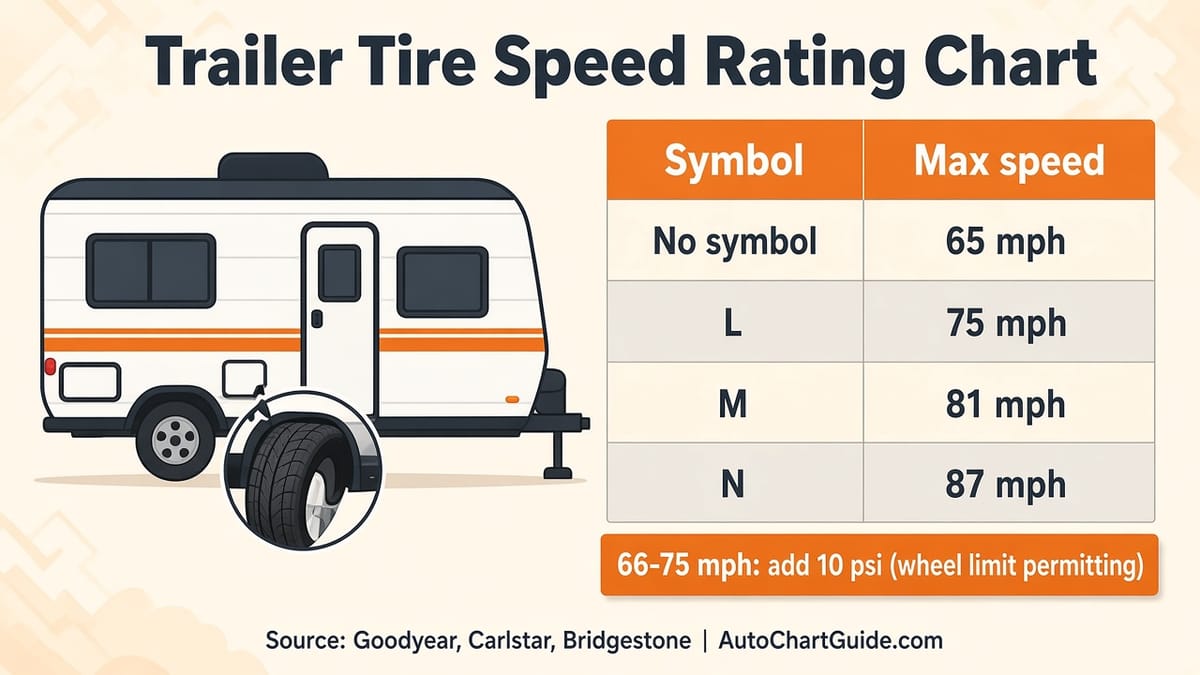
A trailer tire speed rating chart answers a question many towers never ask: how fast is my trailer tire actually built to go? For ST (Special Trailer) tires with no speed symbol, Goodyear's trailer tire bulletin says the rating is 65 mph, based on Tire and Rim Association (TRA) load and inflation tables. Newer ST tires usually carry a letter: L = 75 mph, M = 81 mph, N = 87 mph. Going above 65 mph on an ST tire calls for 10 psi more cold pressure for 66-75 mph, and only if the wheel and valve can take it. Below are the full chart, a real tire line where the rating changes from one size to the next, and the inflation and load rules that go with it.
Trailer tire speed rating chart
| Sidewall marking | Max speed | Km/h | Where it applies | Source |
|---|---|---|---|---|
| No speed symbol (ST tire) | 65 mph | 105 | Older and budget ST tires, rated per TRA tables | Goodyear PSB 2014-01 |
| J (non-metric / bias trailer tires) | 62 mph | 100 | Some non-metric trailer sizes | Carlstar FAQ |
| L | 75 mph | 120 | Many current ST radials, some sizes of premium lines | Carlstar specs and FAQ |
| M | 81 mph | 130 | Common on upgraded ST radials | Bridgestone manual, Carlstar specs |
| N | 87 mph | 140 | Goodyear Endurance, some Carlstar sizes | Goodyear Endurance sell sheet, Carlstar |
| Q | 99 mph | 160 | Rare on ST tires, common on winter and LT tires | Bridgestone manual |
| R / S / T | 106 / 112 / 118 mph | 170 / 180 / 190 | LT and passenger tires sometimes used on trailers | Bridgestone manual |
The letter is the last character of the service description that follows the size, for example the "N" in ST225/75R15 117N. The number in front of it (117) is the load index. If there is no letter after the size, treat the tire as a 65 mph ST tire, or 62 mph if the maker says so. See the section on the 62 vs 65 mph default below.
What a speed rating means and what it doesn't
A speed symbol is a laboratory result, not a recommended cruising speed. Bridgestone's tire safety manual describes the ratings as "based on standardized laboratory tests under specific, controlled conditions," and warns that real speed capability "may be less than its rated speed since it is affected by factors such as inflation pressure, load, tire condition (including damage), wear, vehicle condition (including alignment), driving conditions, and duration at which the speed is sustained." Carlstar says the same about its own trailer tires: speed ratings are test speeds, they apply to the tire alone and not to a particular vehicle, and an N-rated tire does not mean the trailer can safely be towed at 87 mph. Carlstar recommends towing at no more than 60 mph.
The rating is also void once the tire is changed from its original condition. Bridgestone says a tire's speed rating "is void if the tire is repaired, retreaded, damaged, abused, or otherwise altered," after which it should be treated as non-speed-rated. A trailer tire with a plug, a sidewall scuff from a curb, or a history of running underinflated no longer has its marked rating.
The 65 mph rule for ST tires
For decades nearly all ST tires were sold without a speed symbol. Goodyear's Product Service Bulletin 2014-01, which replaced bulletin 2011-13, explains how those tires are rated:
- ST tires "are speed rated at 65 MPH (105 km/h) under normal inflation and load conditions."
- That rating "is based on Tire and Rim Association loads and inflation pressures for ST trailer tires without a service description for speeds up through 65 mph."
- For 66 to 75 mph, Goodyear recommends raising cold pressure by 10 psi above the trailer placard pressure.
- The extra 10 psi "does not provide any additional load carrying capacity."
- Do not exceed the maximum pressure of the wheel or the valve stem. If either limit prevents the increase, "the 65 mph rated speed must [be] observed as the maximum speed."
The earlier 2011 bulletin added a practical detail: many trailer makers set the placard pressure on the assumption of 65 mph, so the 10 psi bump applies to the placard figure. If the placard says its pressure is good for speeds above 65 mph, no extra adjustment is needed.
Valve stems and wheels are the hidden limit
The 10 psi bump is often blocked by hardware, not the tire. Goodyear notes that snap-in rubber valve stems for the standard 0.453 inch valve hole are rated for 65 or 80 psi depending on type. A load range E tire already runs 80 psi at its maximum load, so adding 10 psi requires a clamp-in metal valve such as a TR416S, rated to 200 psi. Wheels have their own maximum pressure, usually stamped on the inside of the rim. If you can't find it, Goodyear says to ask the wheel or trailer maker, and you may have to dismount the tire to see the marking. If either the wheel or valve can't take the higher pressure, the speed limit stays at 65 mph.
Do speed symbols change the rules?
Newer ST tires with L, M or N symbols are built and tested to higher speeds, and their makers publish load and pressure figures for those tires. Several sources still apply TRA-style adjustments to symbol-marked ST tires above 65 mph: 10 psi more for 66-75 mph, and for higher speeds 10 psi more plus a 10 percent load reduction. These adjustments come from industry tables, and their wording varies between manufacturers. When the tire maker publishes a specific chart for your tire, follow it. When it doesn't, the conservative approach is to treat 65 mph as the speed at which the tire carries its full rated load at the placard pressure. Above that, add pressure within wheel and valve limits and leave some reserve in load.
The speed symbol is still the absolute ceiling. No load or pressure adjustment lets you exceed the speed shown by the letter, and a tire with no symbol should never be treated as if it had one.
Example: one tire line, three speed ratings
Speed ratings aren't set per tire model. They are set per size and load range. Carlstar's specification table for its Radial Trail HD, one of the most common OE trailer radials, shows this clearly:
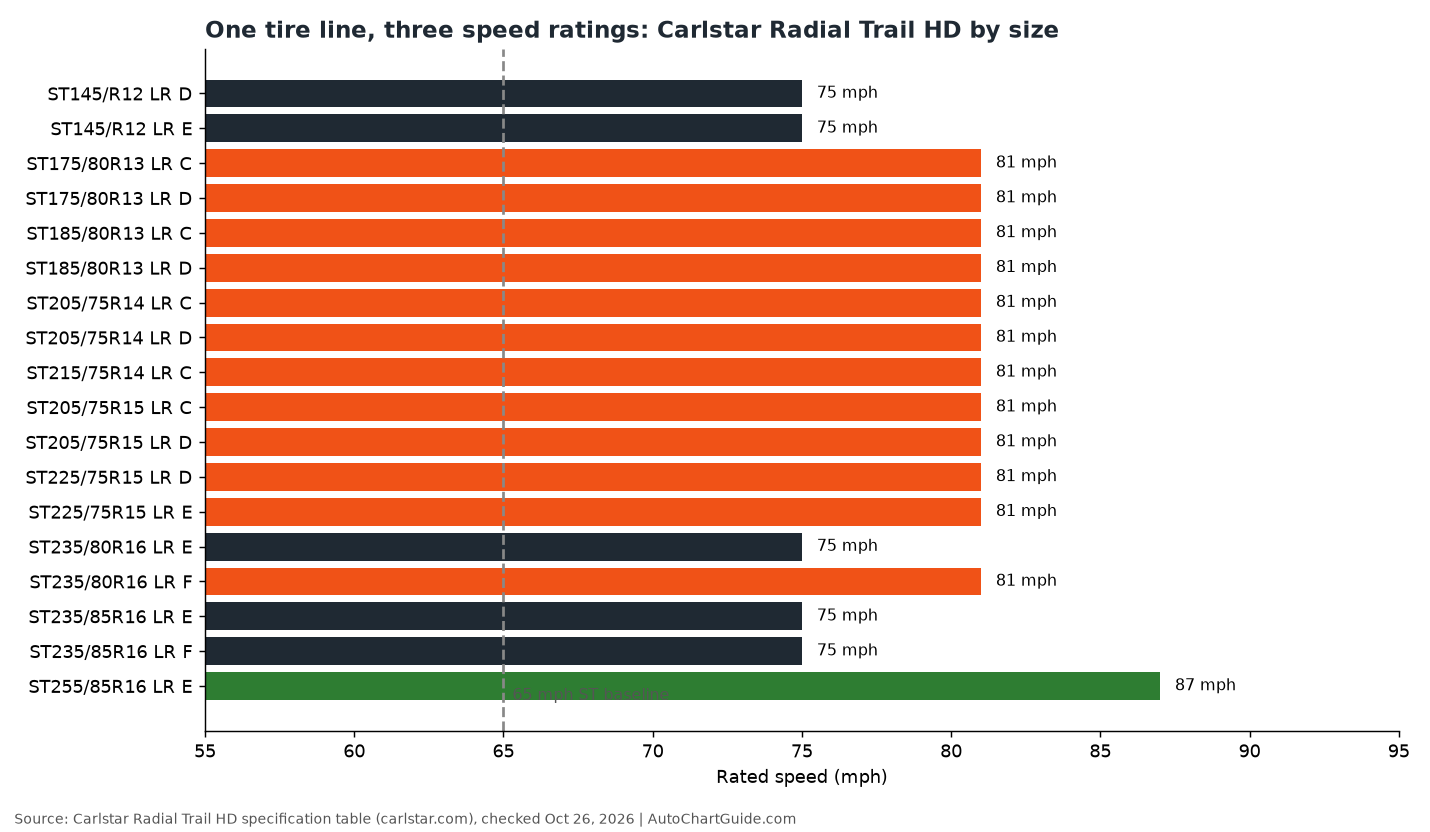
| Size | Load range | Rated load (lb) | PSI | Rated speed |
|---|---|---|---|---|
| ST205/75R14 | D | 2,040 | 65 | 81 mph |
| ST225/75R15 | D | 2,540 | 65 | 81 mph |
| ST225/75R15 | E | 2,830 | 80 | 81 mph |
| ST235/80R16 | E | 3,520 | 80 | 75 mph |
| ST235/80R16 | F | 3,740 | 95 | 81 mph |
| ST235/85R16 | E | 3,640 | 80 | 75 mph |
| ST235/85R16 | F | 3,960 | 95 | 75 mph |
| ST255/85R16 | E | 4,080 | 80 | 87 mph |
Two trailers on "Radial Trail HD" tires can have different speed ratings, and the ST235/80R16 jumps from 75 to 81 mph when you move from load range E to F. Goodyear takes a simpler approach: its Endurance sell sheet lists every size, from ST205/75R14 105N to ST255/85R16 129N, as N-rated, with a maximum speed of 140 km/h (87 mph). Read the marking on your own sidewall rather than relying on the product name.
The 62 vs 65 mph question
Sources don't agree on the default for an unmarked trailer tire. Goodyear's bulletin, citing the TRA Year Book, says ST tires without a service description are rated at 65 mph. Carlstar's FAQ says that "if the tire is not marked with a speed symbol, the default speed rating for trailer tires is 62 mph," and also that most trailer tires are "rated at 65 mph (J: ST tires) and at 62 mph (J: non-metric tires)." In practice, metric ST radials (sizes like ST225/75R15) are generally treated as 65 mph tires, while some non-metric bias trailer tires (sizes like 4.80-12) are treated as 62 mph. If your tire is unmarked and you can't confirm with the maker, use 62 mph as the safe assumption.
ST, LT and passenger tires on a trailer
Some owners replace ST tires with LT tires to get a higher speed rating. That can work, but it isn't a direct swap. Goodyear's bulletin notes that LT tires "do not have the same load carrying capacity as ST tires," so the size or inflation must be adjusted to carry the trailer's load. LT load tables are calculated differently from ST tables. A same-size LT tire usually carries less at the same pressure, so you may need a larger size or a higher load range. Our guide to the difference between LT and P tires explains the load-table logic, and the tire load index explainer shows how to read the number before the speed letter.
Carlstar explains why ST tires exist at all. Their stiffer sidewalls are designed to reduce sway, and passenger tires, with their more flexible sidewalls, "can result in trailer sway problems." Whichever type you choose, the trailer's tire and loading placard and its owner's manual remain the reference for size, load and pressure.
Commercial rules: speed-restricted tires
For commercial motor vehicles, federal law treats low speed ratings as a hard limit. Under 49 CFR 393.75(f), no motor vehicle may be operated with speed-restricted tires labeled with a maximum speed of 55 mph or less, under FMVSS 119, at speeds above the rated limit. Some industrial and farm trailer tires carry these restrictions. If you haul commercially, check every tire for a speed-restriction marking.
How to choose and run trailer tires for the speed you tow
- Find the trailer's placard and certification label. They list the original tire size, load range and cold pressure, and sometimes a speed note.
- Read each sidewall. Note the size, load range, load index and speed symbol, if any. Our guide on how to read a tire sidewall covers the codes and the DOT date.
- Decide your real towing speed. Be honest: if you regularly cruise at 70 mph on interstates, plan for it.
- If you tow above 65 mph on unmarked ST tires, add 10 psi over the placard pressure, provided the wheel and valve ratings allow. Otherwise keep to 65 mph.
- If you're replacing tires, choose a speed symbol comfortably above your towing speed. An N-rated tire gives the most margin.
- Keep load capacity in reserve. Heat from speed and from load add up. Running near both limits at once is the most common way ST tires fail.
- Check cold pressure every morning on trips. Goodyear recommends checking every morning while traveling and monthly in storage.
Why trailer tires fail at speed
ST tires usually fail from heat. Every flex of the sidewall creates heat, and both speed and underinflation increase the number and depth of flexes. A trailer tire running 10 psi low at 70 mph flexes much more than it was designed to. Trailers also make it easy to miss a problem: you can't feel a soft trailer tire through the steering wheel, and on tandem axles one tire can quietly carry extra load when its partner loses pressure. A TPMS for the trailer is worth having for that reason alone. Tread separations and blowouts usually follow a long period of mild abuse, not a single event, which is why pressure checks and speed discipline matter more than the brand on the sidewall.
Age matters too. A trailer that sits for most of the year can wear out tires by age rather than tread. Check the DOT date code and replace old tires even if the tread looks good. NHTSA notes that some vehicle and tire makers recommend replacing tires that are six to ten years old regardless of tread, and that the last four digits of the DOT code give the week and year of manufacture.
Speed ratings vs our other trailer tire guides
Speed ratings are one part of trailer tire selection. For passenger tires, the general letter system, including the H out of alphabetical order and V/W/Y at the top, is covered in our tire speed rating explainer. This chart focuses on trailer-specific tires and their rules.
Frequently asked questions
What is the speed rating of a trailer tire with no letter?
Goodyear, citing Tire and Rim Association tables, rates ST tires without a speed symbol at 65 mph under normal load and inflation. Carlstar uses 62 mph as the default for unmarked tires, so if you can't confirm with the maker, assume 62 mph.
Can I drive 70 mph on ST trailer tires?
Only with adjustments. For unmarked ST tires, Goodyear recommends adding 10 psi of cold pressure above the placard for 66-75 mph, provided the wheel and valve are rated for it. Otherwise 65 mph is the maximum. Check your trailer manual as well.
What does N mean on a trailer tire?
N is a speed symbol meaning 87 mph (140 km/h). The Goodyear Endurance is N-rated in all listed sizes. Carlstar notes that speed ratings are test speeds, not recommended towing speeds.
What is the L speed rating?
L means 75 mph (120 km/h). Several Carlstar Radial Trail HD sizes, such as ST235/85R16, are rated at 75 mph.
Does adding air let a trailer tire carry more weight?
No. Goodyear says the extra 10 psi used for higher speeds does not add any load capacity. Never exceed the wheel or valve stem maximum pressure.
Is an M-rated trailer tire good for highway towing?
An M rating means 81 mph in the lab, which gives margin above typical towing speeds. Keep pressure at the placard figure, keep the load within capacity, and follow the trailer maker's speed advice. Carlstar recommends no more than 60 mph.
Can I put LT tires on my trailer for a higher speed rating?
You can, but Goodyear notes that LT tires don't carry the same load as same-size ST tires, so you may need a larger size or higher load range and must follow the LT load/inflation tables.
Does a tire repair affect the speed rating?
Yes. Bridgestone says a speed rating is void once the tire is repaired, retreaded, damaged or otherwise altered, and the tire should then be treated as non-speed-rated.
Sources
- Goodyear Product Service Bulletin 2014-01: Tires for trailer use only (hosted by Tire Rack)
- Goodyear Product Service Bulletin 2011-13 (archived copy)
- Goodyear Endurance sell sheet (Jan 2020)
- Carlstar Radial Trail HD specifications
- Carlstar / Carlisle trailer tire FAQ
- Carlstar FAQ (default speed rating)
- Bridgestone tire maintenance and safety manual (2024)
- Bridgestone: Tire speed rating
- NHTSA: Tire safety
- eCFR: 49 CFR 393.75 Tires