Balancing Beads for Tires Chart 2026: Official Maker Amounts
How many ounces of balancing beads each tire needs, from the ECO Balance and Würth charts, with motorcycle, low-profile, TPMS and tire warranty guidance.

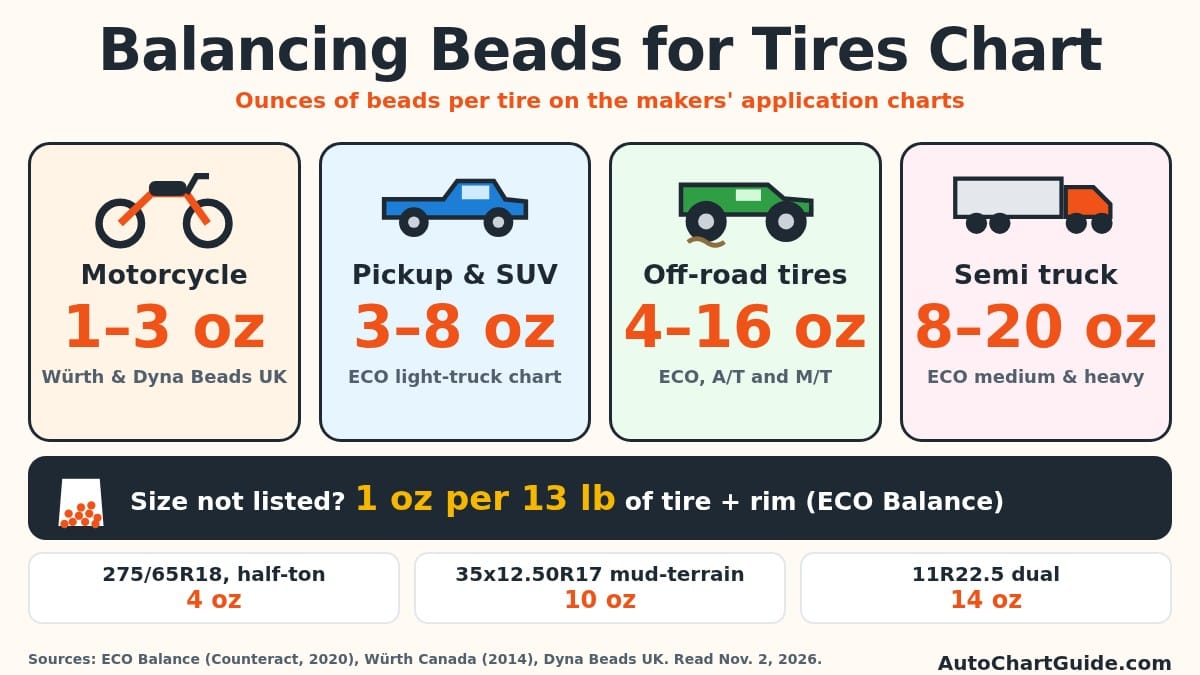
Short answer: a balancing beads for tires chart tells you how many ounces of beads to put in each tire, and the amount rises with the size and weight of the tire. On the ECO Balance application chart published by Counteract, light-truck and SUV tires take 3 to 8 oz per tire, off-road flotation tires 4 to 16 oz, and medium and heavy truck tires 8 to 20 oz. Motorcycle charts from Würth Canada and Dyna Beads UK run from 1 to 3 oz. ECO Balance's rule of thumb, useful when a size is not listed, is one ounce of beads for every thirteen pounds of tire and rim. The right amount is the one on the chart of the bead brand you are actually installing, because brands do not agree.
The figures below come from the bead makers' own documents: the ECO Balance application chart (a 2020 PDF from Counteract's ECO line, hosted by distributor Myers Tire Supply), the Würth Canada tire balancing beads application chart (2014 catalog pages), the Dyna Beads UK car, low profile, motorcycle and 4x4 charts, and the TECH Tire Repairs catalog. Counteract's help center explains how its amounts are set, and what tire makers say about beads comes from Michelin, Bridgestone and Goodyear. All were read on November 2, 2026. We parsed both full charts from ECO Balance and Würth and compared them value by value; every count in this article comes from that comparison.
Balancing Beads for Tires Chart: Amounts by Vehicle Type
Start here if you just need the ballpark. Each row is the lowest and highest amount a maker lists for that class of tire. Find your exact size in the detailed tables further down before you buy, because two tires in the same class can differ by several ounces.
| Tire type | Chart | Ounces per tire |
|---|---|---|
| Light truck & SUV, half-ton | ECO Balance (Counteract) | 3 to 8 oz |
| Light truck & SUV, one-ton and up | ECO Balance (Counteract) | 4 to 8 oz |
| Off-road flotation, all-terrain tread | ECO Balance (Counteract) | 4 to 14 oz |
| Off-road flotation, mud-terrain tread | ECO Balance (Counteract) | 6 to 16 oz |
| Medium & heavy truck, single or dual | ECO Balance (Counteract) | 8 to 20 oz |
| Light truck & SUV, all sizes | Würth Canada | 3 to 8 oz |
| Off-road flotation | Würth Canada | 3 to 12 oz |
| Medium & heavy truck | Würth Canada | 6 to 20 oz |
| Motorcycle and scooter | Würth Canada; Dyna Beads UK | 1 to 3 oz |
| Low-profile car tires (maintenance amount, with wheel weights) | Dyna Beads UK | 2 to 6 oz |
Sources: ECO Balance application chart (Counteract, 2020 PDF); Würth Canada tire balancing beads application chart (2014); Dyna Beads UK motorcycle and low profile tyre pages. Read November 2, 2026. Ranges are the lowest and highest figure on each chart.
Two things stand out. First, motorcycle amounts are small: 1 to 3 oz per tire on both Würth's and Dyna Beads UK's charts. Second, truck and off-road amounts climb quickly as tires get bigger, which is why the heavy-truck chart goes up to 20 oz. The ranges are wide because the tables cover everything from a 215/75R14 light-truck tire to a wide 445/65R22.5.
Light Truck and SUV Chart (Half-Ton vs One-Ton)
For pickups and SUVs, both ECO Balance and Würth split their light-truck chart into two columns: "1/2 Ton" and "1 Ton+". The same tire size gets more beads on the heavier truck. On the ECO chart, 128 of the 173 sizes with both columns filled list a larger amount for one-ton trucks than for half-tons. Nine sizes, such as 7.50R16 and 11R16, have a figure only in the one-ton column. The table shows common sizes from 15 to 22 inches with both makers' figures side by side.
| Tire size | ECO 1/2 ton | ECO 1 ton+ | Würth 1/2 ton | Würth 1 ton+ |
|---|---|---|---|---|
| 225/75R15 | 4 oz | 4 oz | 4 oz | 4 oz |
| 235/75R15 | 4 oz | 4 oz | 4 oz | 4 oz |
| 245/75R16 | 3 oz | 4 oz | 3 oz | 4 oz |
| 265/75R16 | 4 oz | 6 oz | 4 oz | 6 oz |
| 285/75R16 | 4 oz | 6 oz | 4 oz | 6 oz |
| 215/85R16 | 3 oz | 4 oz | 3 oz | 4 oz |
| 235/85R16 | 3 oz | 4 oz | 3 oz | 4 oz |
| 255/85R16 | 4 oz | 6 oz | 4 oz | 5 oz |
| 245/70R16 | 3 oz | 4 oz | 3 oz | 4 oz |
| 265/70R16 | 3 oz | 4 oz | 3 oz | 4 oz |
| 245/65R17 | 3 oz | 4 oz | 3 oz | 4 oz |
| 265/65R17 | 4 oz | 6 oz | 4 oz | 6 oz |
| 245/70R17 | 4 oz | 6 oz | 4 oz | 6 oz |
| 265/70R17 | 6 oz | 6 oz | 6 oz | 6 oz |
| 285/70R17 | 6 oz | 6 oz | 6 oz | 6 oz |
| 315/70R17 | 6 oz | 8 oz | 6 oz | 8 oz |
| 235/80R17 | 6 oz | 6 oz | 6 oz | 6 oz |
| 255/75R17 | 6 oz | 6 oz | 6 oz | 6 oz |
| 275/65R18 | 4 oz | 6 oz | 4 oz | 6 oz |
| 275/70R18 | 4 oz | 6 oz | 4 oz | 6 oz |
| 285/65R18 | 4 oz | 6 oz | 4 oz | 6 oz |
| 265/60R18 | 3 oz | 6 oz | 3 oz | 5 oz |
| 275/60R18 | 4 oz | 6 oz | 4 oz | 6 oz |
| 285/55R18 | 3 oz | 4 oz | 3 oz | 4 oz |
| 255/55R19 | 3 oz | 4 oz | 3 oz | 4 oz |
| 275/60R20 | 4 oz | 6 oz | 4 oz | 6 oz |
| 275/65R20 | 4 oz | 6 oz | 4 oz | 6 oz |
| 275/55R20 | 3 oz | 4 oz | 3 oz | 4 oz |
| 285/50R20 | 3 oz | 4 oz | 3 oz | 4 oz |
| 325/60R20 | 4 oz | 6 oz | 4 oz | 6 oz |
| 305/45R22 | 4 oz | 6 oz | 4 oz | 6 oz |
| 325/50R22 | 4 oz | 6 oz | 4 oz | 6 oz |
Sources: ECO Balance application chart for SUV and light truck (Counteract, 2020 PDF); Würth Canada application chart by tire, passenger vehicle and light truck (2014). Read November 2, 2026. Ounces per tire. A selection of common sizes; both charts list about 180 light-truck sizes from 14 to 24 inches.
The column headings describe the truck, not the tire: the same size gets more beads on a one-ton truck than on a half-ton. Neither chart says which column a 3/4-ton truck belongs in. Because Dyna Beads UK says surplus beads simply spread around the tire, the higher one-ton figure is the cautious choice in our reading, but the bead maker can give you a definite answer. The size code is the same one explained in our guide to what the numbers in a tire size mean; if your truck wears LT-prefixed tires, our guide to the difference between LT and P tires explains what that letter changes.
The two light-truck charts are very close. Of the 180 sizes that appear on both, 159 have identical figures in every column. In the other 21, ECO Balance's 2020 chart is exactly 1 oz higher in one or both columns: 255/85R16, for example, is 4 and 5 oz on Würth's chart and 4 and 6 oz on ECO's. In no case is the ECO figure lower.
Off-Road and Mud-Terrain Tire Chart
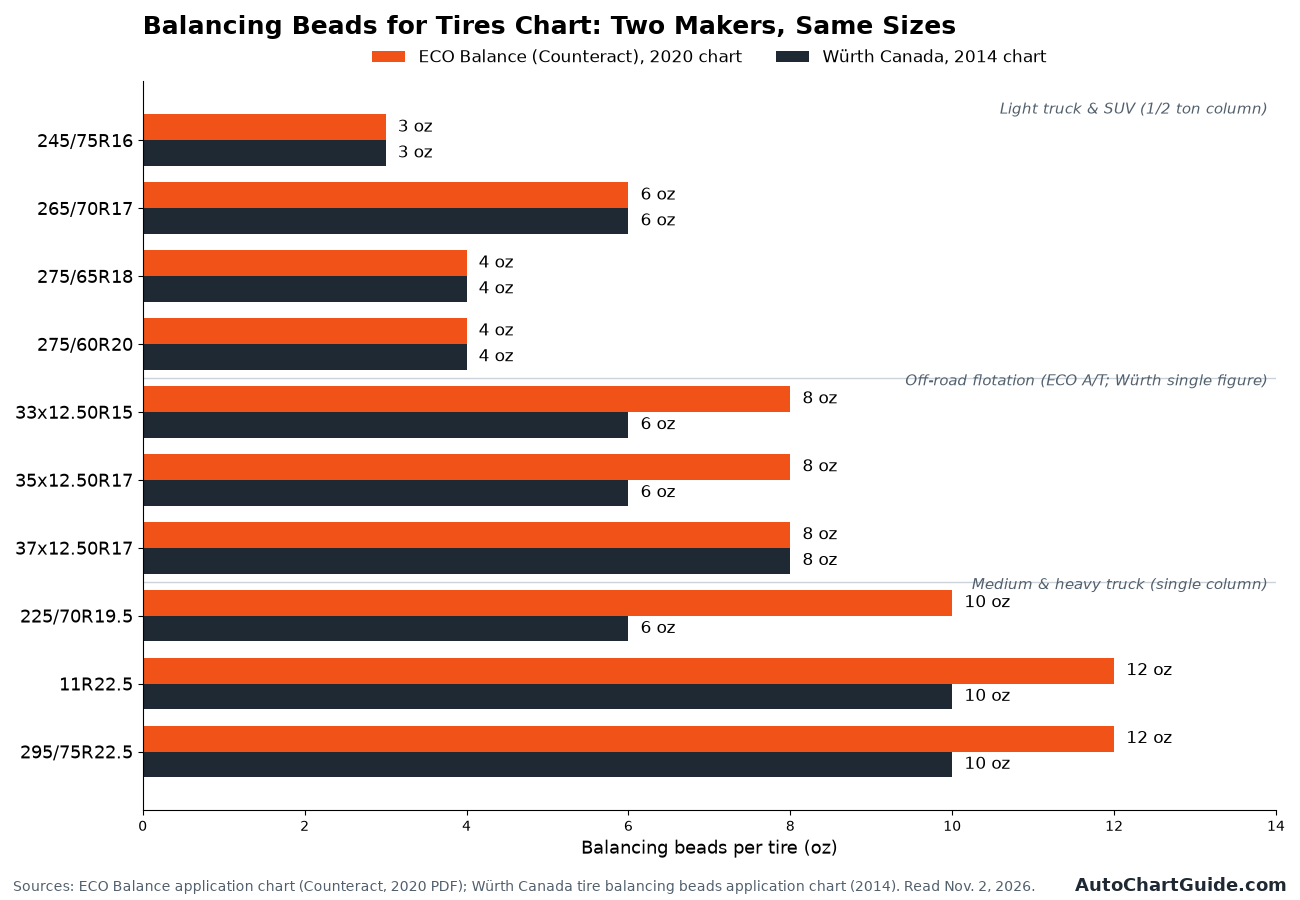
Flotation sizes such as 33x12.50R15 or 37x12.50R17 get their own off-road chart. ECO Balance lists two amounts for each: one for all-terrain (A/T) tread and a larger one for mud-terrain (M/T) tread. Of the 54 off-road sizes where ECO gives both figures, 53 list more beads for mud-terrain tread. Würth's 2014 off-road table lists one figure per size, and it is lower than ECO's all-terrain figure for 54 of the 55 sizes the charts share; the one match is 37/12.50R17 at 8 oz.
| Tire size | ECO all-terrain | ECO mud-terrain | Würth (one figure) |
|---|---|---|---|
| 31x10.50R15 | 6 oz | 8 oz | 4 oz |
| 33x12.50R15 | 8 oz | 10 oz | 6 oz |
| 35x12.50R15 | 8 oz | 10 oz | 6 oz |
| 37x12.50R15 | 10 oz | 12 oz | 8 oz |
| 33x12.50R16.5 | 8 oz | 10 oz | 6 oz |
| 35x12.50R16.5 | 8 oz | 10 oz | 6 oz |
| 37x12.50R16.5 | 10 oz | 12 oz | 8 oz |
| 33x12.50R17 | 8 oz | 10 oz | 6 oz |
| 35x12.50R17 | 8 oz | 10 oz | 6 oz |
| 37x12.50R17 | 8 oz | 10 oz | 8 oz |
| 37x13.50R17 | 12 oz | 14 oz | 10 oz |
| 40x13.50R17 | 12 oz | 14 oz | 10 oz |
| 35x12.50R18 | 8 oz | 10 oz | 6 oz |
| 37x12.50R18 | 10 oz | 12 oz | 8 oz |
| 35x12.50R20 | 8 oz | 10 oz | 6 oz |
| 37x12.50R20 | 10 oz | 12 oz | 8 oz |
| 38x15.50R15 | 12 oz | 14 oz | 10 oz |
| 40x17B15 | 12 oz | 14 oz | 10 oz |
| 44x18.50B16.5 | 14 oz | 16 oz | 12 oz |
Sources: ECO Balance off-road application chart (Counteract, 2020 PDF), A/T and M/T tread columns; Würth Canada off-road and deep tread chart (2014). Read November 2, 2026. Both charts write flotation sizes with a slash, e.g. 35/12.50R17.
That gap is bigger than on the light-truck chart. A 31/11.50R15 is 4 oz on Würth's chart and 8 oz (A/T) or 10 oz (M/T) on ECO's. Neither document explains the difference. Counteract's help center says the company "always recommends an amount based on the worst possible imbalance for that tire size," and names tread design as one of the factors, which is consistent with ECO's higher mud-terrain numbers. Dyna Beads UK adds a practical reason off-road tires need balancing in the first place: mud that builds up on the inside of the rim and in the tread lugs can "induce ferocious inbalance."
For 18-inch and 20-inch flotation sizes, ECO lists 8 oz (A/T) and 10 oz (M/T) for 35x12.50, and 10 and 12 oz for 37x12.50. Our 18 inch tire size chart shows how those flotation sizes compare in height with the metric sizes on the same wheel.
Medium and Heavy Truck Chart (Single vs Dual)
On commercial trucks, the split is single versus dual wheel positions. ECO Balance gives a higher amount for duals on 45 of the 62 medium and heavy sizes that have both figures. Würth's medium-truck table uses the same layout, but its numbers are often lower: across the 131 single or dual figures the two charts share for medium and heavy trucks, 48 match and ECO is higher in the other 83.
| Tire size | ECO single | ECO dual | Würth single | Würth dual |
|---|---|---|---|---|
| 225/70R19.5 | 10 oz | 10 oz | 6 oz | 8 oz |
| 245/70R19.5 | 10 oz | 10 oz | 6 oz | 8 oz |
| 8R19.5 | 10 oz | 10 oz | 6 oz | 8 oz |
| 11.00R20 | 12 oz | 14 oz | 12 oz | 14 oz |
| 11R22.5 | 12 oz | 14 oz | 10 oz | 12 oz |
| 12R22.5 | 12 oz | 14 oz | 12 oz | 14 oz |
| 255/70R22.5 | 10 oz | 12 oz | 8 oz | 10 oz |
| 275/80R22.5 | 12 oz | 14 oz | 10 oz | 12 oz |
| 295/75R22.5 | 12 oz | 14 oz | 10 oz | 12 oz |
| 295/80R22.5 | 14 oz | 16 oz | 12 oz | 14 oz |
| 315/80R22.5 | 16 oz | – | 14 oz | – |
| 385/65R22.5 | 14 oz | 16 oz | 12 oz | – |
| 425/65R22.5 | 16 oz | 16 oz | 14 oz | – |
| 445/65R22.5 | 20 oz | – | 16 oz | – |
| 445/50R22.5 | 20 oz | – | 16 oz | – |
| 11R24.5 | 12 oz | 14 oz | 10 oz | 12 oz |
| 285/75R24.5 | 12 oz | 14 oz | 10 oz | 12 oz |
Sources: ECO Balance medium and heavy duty truck chart (Counteract, 2020 PDF); Würth Canada medium trucks chart (2014). Read November 2, 2026. A dash means the chart gives no figure for that position.
Wide-base sizes such as 445/50R22.5 and 445/65R22.5 are listed at 16 oz by Würth and 20 oz by ECO. Michelin's technical bulletin on internal balancing materials is written for Michelin truck tires, and it is covered in the warranty section below.
Motorcycle Balancing Beads Chart
Motorcycle charts are organized by tire width in millimeters rather than by full size code. They give the same amounts for most rear tire widths but split the front widths differently.
| Tire | Würth Canada | Dyna Beads UK |
|---|---|---|
| Front, 60 to 110 mm wide | 1 oz (80 to 120 mm) | 1 oz (60 to 110 mm) |
| Front, 120 mm wide | 1 oz (80 to 120 mm band) | 2 oz (120 to 200 mm band) |
| Front, 130 mm wide | 2 oz | 2 oz |
| Front, spoked wheel 80 to 120 mm | 2 oz | – |
| Front, BMW Telelever | 2 oz (80 to 120 mm) | 2 oz (80 to 120 mm) |
| Rear, 60 to 110 mm wide | – | 1 oz |
| Rear, 120 to 240 mm wide | 2 oz (130 to 240 mm) | 2 oz (120 to 240 mm) |
| Rear, 250 to 360 mm wide | 3 oz | 3 oz |
| Rear, 195 to 205 mm car tire | 3 oz | 3 oz |
| Dual-purpose / off-road with rim lock, front 80 to 120 mm | 2 oz | 2 oz |
| Dual-purpose / off-road with rim lock, rear 130 to 230 mm | 3 oz | 3 oz |
| Scooter, 10-inch wheel | 1 oz | 1 oz |
| Scooter, 11- or 12-inch wheel and up | 2 oz (12 in and up) | 2 oz (11 in and up) |
Sources: Würth Canada motorcycle application chart (2014); Dyna Beads UK motorcycle tyre charts. Read November 2, 2026. Dyna Beads UK also lists 2 oz for Goldwing tires front and rear. A dash means that chart has no separate entry.
The 120 mm front tire is the clearest disagreement: it falls in Würth's 1 oz band and Dyna Beads UK's 2 oz band. Both list 2 oz front and 3 oz rear for dual-purpose and off-road tires with rim locks, and Dyna Beads UK says its rim-lock amounts have 1 oz added for the weight of the rim lock. Würth also adds "an additional 1 oz" for thin tires with wire spokes and tubes. Dyna Beads UK also warns against beads for motorcycle road racing, because "the inner liner compound of motorcycle road racing tyres is too soft to allow Dyna Beads to perform properly." It says this does not apply to off-road racing.
Cars and Low-Profile Tires: Weights Come First
Dyna Beads UK deliberately keeps modern cars off its main charts. It says it does not market to modern cars and SUVs, mainly because of low-profile tires. Its official policy is that "we do not advise using Dyna Beads in any car, truck or SUV tyre with an aspect ratio 65 or below unless used in conjunction with weights."
The reason it gives is lateral imbalance: one side of the tire is heavier than the other, which produces a wobble or steering-wheel shake. Dyna Beads UK says "this type of imbalance can only be corrected by careful placement of traditional weights on the wheel rim." For low-profile tires it offers a smaller "maintenance" amount used together with wheel weights:
| Wheel diameter | Dyna Beads maintenance amount per tire |
|---|---|
| 13 to 14 in | 2 oz (59 g) |
| 15 to 16 in | 3 oz (88 g) |
| 17 to 18 in | 4 oz (118 g) |
| 19 to 20 in | 5 oz (148 g) |
| 21 to 22 in | 6 oz (177.5 g) |
Source: Dyna Beads UK, "Dynabeads & Low Profile Tyres" information sheet and low profile tyre page. Read November 2, 2026. For tires with an aspect ratio of 65 or below, used together with wheel weights. The web page prints the 21 to 22 inch amount as 6 oz / 117.5 g; the information sheet gives 177.5 g, which matches 6 oz.
Dyna Beads UK says it offers "no assurance or guarantee" that this method works on a given vehicle, and adds: "We strongly advise against using Dyna Beads in any vehicle used for racing." The same warning covers cornering at high speed and drag racing. Its lateral imbalance sheet describes a simple check: when the tire is spun on a balancing machine, compare how much weight the machine wants on the inside of the rim with how much it wants on the outside. If that proportion varies, Dyna Beads UK says you have a lateral imbalance and may need a combination of weights and beads.
On any vehicle, the chart amount only works if the tire and wheel are otherwise in good shape. Dyna Beads UK says its beads "work when the tyre/rim assembly is within vehicle manufacturers design build and use parameters," and that they are "not a magical additive" that will cure badly molded tires, rims out of true, worn track rod ends or badly adjusted wheel bearings. A wheel that is not centered on the hub is a different problem again; our explainer on hub-centric vs lug-centric wheels covers why an off-center wheel can vibrate.
How Balancing Beads Work
Balancing beads are small, hard spheres poured inside the tire. Dyna Beads describes its product as "tiny ceramic spheres, high in density and perfectly smooth." TECH's catalog explains the effect in two steps: a tire with a heavy spot on the tread pulls outward and causes vibration, and "TECH PLUS microbeads are redistributed around the tire, creating compensating force and reducing vibration."
At rest the beads sit at the bottom of the tire. Dyna Beads says that once the tire rolls they spread around its inner circumference, resist the up-and-down motion of the heavy spot, and settle within a few seconds at a point of "final precise counterbalance." Overfilling is not a balance problem in itself. Dyna Beads UK's FAQ says that if a tire needs 1 oz and gets 2 oz, "only the beads required to counteract the imbalance will be used," and the rest spread evenly around the tire.
That is also why the charts are generous. Counteract says its recommendations are based on "the worst possible imbalance for that tire size," so the listed amount is meant to cover the worst case rather than a typical tire.
How to Use the Chart: Step by Step
- Read the size off the tire. Use the full size code on the sidewall, such as 275/65R18 or 35x12.50R17, not the wheel size alone.
- Pick the right table. Light truck and SUV, off-road flotation, medium and heavy truck, or motorcycle. Counteract says it publishes six different charts by vehicle application, "so always ensure you reference the correct one."
- Pick the right column. Half-ton or one-ton for light trucks, A/T or M/T for off-road tread, single or dual for commercial trucks, front or rear for motorcycles.
- Use the chart for your bead brand. ECO's all-terrain figure is up to 4 oz higher than Würth's on the same off-road size (31/11.50R15). Even one brand's charts differ: Dyna Beads UK lists LT235/70R16 at 4 oz on its car chart and 6 oz on its 4x4 chart, where it recommends its larger 4x4 bead.
- If the size is not listed, weigh it. ECO Balance says the amount "is based on one ounce per thirteen pounds of tire and rim combination." Würth's sheet gives the same ratio, written as "one ounce per thirteen pounds of tire."
- Round up to available bags. Würth notes that "sizes can be combined to suit application needs," so two smaller bags can make up a larger amount.
Worked Examples
| Vehicle and tire | ECO Balance | Würth Canada | Note |
|---|---|---|---|
| Half-ton pickup on 275/65R18 | 4 oz (1/2 ton column) | 4 oz | Same size on a one-ton truck: 6 oz on both charts |
| Jeep on 35x12.50R17 mud-terrain tires | 10 oz (M/T); 8 oz (A/T) | 6 oz | Use the chart of the brand you buy |
| Tractor on 11R22.5, drive axle duals | 14 oz (dual) | 12 oz (dual) | Single position: 12 oz (ECO), 10 oz (Würth) |
| Motorcycle, 180 mm rear tire | – | 2 oz | Dyna Beads UK: 2 oz |
| Unlisted size, tire and wheel weigh 78 lb | 78 ÷ 13 = 6 oz (our arithmetic) | Same rule | Round up to bag sizes you can buy |
Sources: ECO Balance (2020) and Würth Canada (2014) application charts; Dyna Beads UK motorcycle chart. Read November 2, 2026.
The weight-based example is our arithmetic using the makers' 1 oz per 13 lb rule; it is not a figure from any chart. Weigh the tire and wheel together if you can, since the rule is stated for the combination. If a size is on the chart, use the chart figure instead of the rule.
Bag Sizes and Combining Bags
Beads are sold in pre-measured bags, and the bag sizes follow the chart amounts. TECH's catalog lists its TECH PLUS compound in these bags:
| TECH item no. | Bag size | Bags per box |
|---|---|---|
| TLP60 | 2 oz | 48 |
| TL100 | 3 oz | 36 |
| TL150 | 4.5 oz | 36 |
| TL200 | 6.5 oz | 24 |
| TL250 | 8.5 oz | 24 |
| TM300 | 10.5 oz | 20 |
| TM400 | 13 oz | 12 |
| TM500 | 16 oz | 12 |
| TP6000 | 21 oz | 8 |
| TP7000 | 23.5 oz | 8 |
Source: TECH Tire & Wheel Solutions catalog, Vol. 80, TECH PLUS Tire Balancing Compound, page 125. Read November 2, 2026.
If your chart amount falls between bag sizes, combine bags rather than guessing. For a 6 oz requirement with TECH's sizes, two 3 oz bags make exactly 6 oz. TECH says each bag includes "a metal self-sealing valve cap and a filtered valve core."
Installing Beads Without Causing Leaks
There are two ways in: drop the bag or pour the beads into the tire while it is off the rim, or blow or pour them through the valve stem with an applicator after removing the valve core. Both ECO Balance and Würth warn that if you pour the beads in during mounting, none of them can end up on the bead seat, the area where the tire seals against the rim. "It is imperative that none of the contents of the bag ends up on the bead seating area of the tire and rim," the ECO chart says. With throw-in bags, you open and discard only the outer bag and throw the inner bag into the tire whole.
The valve is the other leak point. ECO Balance recommends its supplied valve core and a metal valve cap "to reduce the possibility of valve leaks," and Würth recommends a long valve core or valve core filter and a metal cap. Dyna Beads UK says the filtered core exists "to prevent a bead from getting caught in the valve core mechanism." Where a filtered core does not fit, as on many motorcycle valve stems, it suggests turning the wheel so the valve is at about the 6 o'clock position and giving the stem a quick shot of air before checking pressure.
Dyna Beads UK's large 4x4 bead "is twice the size of our Standard bead and will not pass through a valve stem," so it is only for tires being mounted or broken down. If the tire stays on the rim, the smaller standard bead and an applicator are the route.
Balancing Beads and TPMS Sensors
TECH and Dyna Beads UK both say their beads can be used with tire pressure monitoring sensors. TECH describes its compound as "TPMS compatible," and Dyna Beads UK says that where the sensor is part of the valve stem, the beads "will not cause any problems," though you cannot install them through that valve with an applicator. Sensors that screw onto the outside of the valve stem, such as the Pressure Pro it names, "will require a filtered valve core."
Michelin is more cautious. Its bulletin says to "consult Michelin prior to using internal balancing materials and/or coolants in any MICHELIN® tires that have sensors in them," because the materials "may adversely affect the performance of the sensors." If your wheels have sensors, check with the sensor and tire makers before adding anything inside the tire. Our guide to TPMS sensors and new wheels explains how sensors are mounted and registered.
What Tire Makers Say About Balancing Beads and Warranty
Tire makers treat internal balancing materials differently, and the difference matters if a tire fails. These are the policies we found:
| Tire maker | Document | What it says about balancing beads |
|---|---|---|
| Michelin | Technical bulletin, internal balancing materials in truck tires (July 15, 2012) | Use "does not automatically affect the tire warranty" unless the material has high moisture content or harms the liner, casing plies or performance. More than 3% moisture (ASTM D6304) "will automatically void any mileage, number of retreads and/or time warranty." Consult Michelin before use in tires with sensors. |
| Bridgestone | Commercial truck and bus radial limited warranty | Internally applied additives for balance "will not void the Limited Warranty unless an inspection of the tire reveals damage related to the use of the additive." |
| Goodyear | Auto and light truck limited warranty (US) | Does not warrant or give credit for material added to a tire, naming "balancing substances," and will not adjust a tire that failed because of it. |
Read November 2, 2026. These are the documents we found; check the warranty for your own tires.
In the documents we found, the split is between commercial truck and passenger tires. Michelin's truck tire policy and Bridgestone's commercial truck warranty allow internal balancing materials unless they cause damage. Michelin adds that any product with more than 3 percent water or moisture voids its mileage, retread and time warranty. Goodyear's auto and light truck warranty does not cover balancing substances at all, and it will not adjust a Goodyear, Dunlop or Kelly tire that failed because such material was added. Dyna Beads UK also notes one vehicle-specific case: on an H1 Hummer with the Central Tire Inflation System, it says that if the system has a problem and the dealer finds "any internal balancing media inside," that voids the warranty. Read the warranty for your own tires before installing beads.
Why Two Balancing Bead Charts Give Different Numbers
We found three reasons in the documents themselves.
Different worst cases. Counteract sizes its amounts for the worst imbalance a tire of that size could have, and says the amount depends on "tread design (all-terrain or mud-terrain), half-ton or one-ton truck, and single or dual assembly." A maker that assumes a smaller worst case will list less.
Different products and applications. Dyna Beads UK lists the same LT235/70R16 at 4 oz on its car chart and 6 oz on its 4x4 chart, where it recommends a bead twice the size of its standard one. A chart is only valid for the product it was written for.
Different editions. The ECO chart we read is a 2020 PDF and the Würth chart is dated 2014. Counteract also posts a newer ECO Balance chart on its own website, but we could not open it when we checked on November 2, 2026, so we have not used it. If you are buying ECO or Counteract beads, check the current chart or Counteract's online calculator before you buy. Values can change from one edition to the next.
Balancing Beads Chart FAQ
How many ounces of balancing beads do I need per tire?
It depends on the tire size and the bead brand. On the ECO Balance chart, light-truck and SUV tires take 3 to 8 oz, off-road flotation tires 4 to 16 oz and medium and heavy truck tires 8 to 20 oz. Motorcycles take 1 to 3 oz on the Würth and Dyna Beads UK charts. Use the chart for the beads you buy.
What is the rule of thumb for balancing beads by weight?
ECO Balance says the amount is based on one ounce per thirteen pounds of tire and rim combination. Würth Canada gives the same ratio. A tire and wheel weighing 78 lb would need 6 oz by that rule.
How many balancing beads for a 35x12.50R17 tire?
ECO Balance lists 8 oz for all-terrain and 10 oz for mud-terrain tread. Würth Canada's 2014 chart lists 6 oz.
How many balancing beads for a 275/65R18?
4 oz per tire on a half-ton truck and 6 oz on a one-ton truck, on both the ECO Balance and Würth Canada charts.
Can you use too many balancing beads?
Dyna Beads UK says only the beads needed to counteract the imbalance are used and the rest spread evenly around the inside of the tire. Counteract sets its chart amounts for the worst possible imbalance for each size.
Do balancing beads work on low-profile car tires?
Dyna Beads UK does not advise beads alone in any car, truck or SUV tire with an aspect ratio of 65 or below. It recommends wheel weights plus a smaller maintenance amount, from 2 oz for 13 to 14 inch wheels to 6 oz for 21 to 22 inch wheels.
Are balancing beads safe with TPMS sensors?
TECH calls its beads TPMS compatible, and Dyna Beads UK says valve-stem sensors are not a problem but block installation through the valve. Michelin says to consult it before using internal balancing materials in its tires with sensors.
Do balancing beads void my tire warranty?
It depends on the tire maker. Michelin's truck tire policy and Bridgestone's commercial truck warranty allow them unless they cause damage. Goodyear's auto and light truck warranty does not cover balancing substances or failures caused by them.
Why do balancing bead charts from different brands disagree?
They assume different worst-case imbalance, cover different products and come from different years. ECO Balance's 2020 chart is higher than Würth's 2014 chart for 54 of 55 off-road sizes and 83 of 131 truck figures.
Sources
- ECO Balance application chart for SUV, light truck, medium/heavy truck and off-road (Counteract; 2020 PDF hosted by Myers Tire Supply). Read November 2, 2026.
- Würth Canada, Tire Balancing Beads application charts (catalog pages 9-23 to 9-25, 2014). Read November 2, 2026.
- Counteract Help Center, "How many ounces of tire balancing beads do I need?". Read November 2, 2026.
- Dyna Beads UK, car tyre charts. Read November 2, 2026.
- Dyna Beads UK, low profile tyres. Read November 2, 2026.
- Dyna Beads UK, "Checking for Lateral Imbalance" (PDF). Read November 2, 2026.
- Dyna Beads UK, motorcycle tyre charts. Read November 2, 2026.
- Dyna Beads UK, 4x4 tyre charts. Read November 2, 2026.
- Dyna Beads UK, how Dyna Beads work. Read November 2, 2026.
- Dyna Beads UK, frequently asked questions. Read November 2, 2026.
- TECH Tire & Wheel Solutions catalog, Vol. 80 (TECH PLUS Tire Balancing Compound). Read November 2, 2026.
- TECH Tire Repair Supplies, TL150 4 1/2 oz tire balance compound product page. Read November 2, 2026.
- Michelin North America, technical bulletin "The Use of Internal Balancing Materials and/or Coolants in MICHELIN Truck Tires" (2012). Read November 2, 2026.
- Bridgestone, commercial truck and bus radial limited warranty. Read November 2, 2026.
- Goodyear, auto and light truck tire limited warranty (US). Read November 2, 2026.