What Fluids Does My Car Take? Finding Every Spec
Your owner's manual has a specifications section listing all six together. Here is what a real fluid specification looks like and why one word is not it.

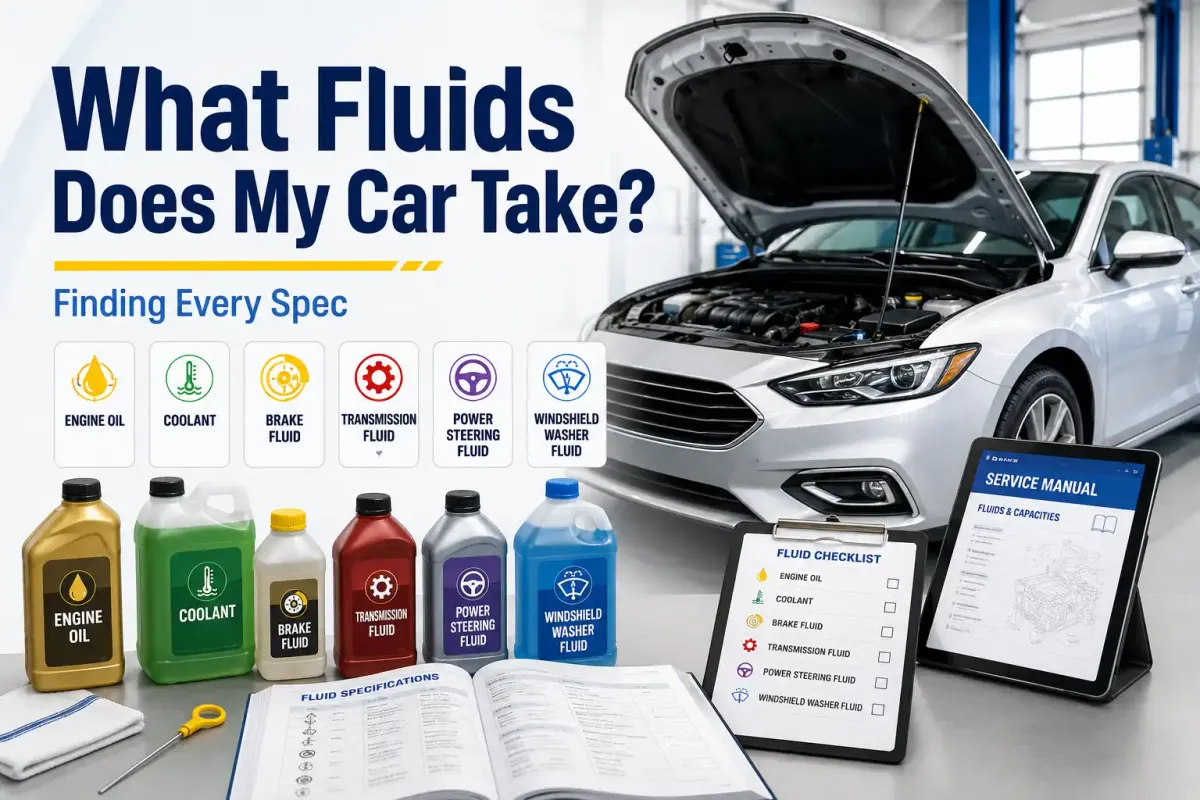
Short answer: your owner's manual has a specifications section that lists all of them together, and most owners have never opened it. Engine oil, coolant, brake fluid, transmission fluid, gear oil and refrigerant each have a specification, and the manual is where the manufacturer states all six for your vehicle. Two of the six are also stated physically on the car.
The reason this page exists is that the search results for fluid questions are written by the people selling the fluid. That is not a conspiracy, it is just who bothers to write about oil, and it means the neutral explanation of what a specification is and where yours lives is genuinely missing.


As an Amazon Associate we earn from qualifying purchases.
The six systems and where each specification lives
| System | Specification looks like | Usually found |
|---|---|---|
| Engine oil | Viscosity grade plus API, ILSAC and any OEM approval | Owner's manual |
| Coolant | A chemistry or a manufacturer specification, never a color | Owner's manual |
| Brake fluid | A DOT rating, sometimes a manufacturer specification | Owner's manual, often the reservoir cap |
| Automatic transmission fluid | A manufacturer specification, often licensed | Owner's manual |
| Gear oil | An API service designation plus viscosity | Owner's manual |
| Air conditioning refrigerant | A refrigerant type | A label under the hood |
Where the list lives in the owner's manual
Look for a section at the back called specifications, technical data, capacities, or something similar. It is one of the last sections, after the operating chapters and the maintenance chapter.
Search a PDF for the word "capacities" or "specifications" rather than for the name of the fluid. The fluid names appear throughout the book; the table appears once.
If you no longer have the manual, most manufacturers host it free, and getting the edition for your market matters more than people expect: where to get your owner's manual free.


As an Amazon Associate we earn from qualifying purchases.
The two specs that are physically on the vehicle
Two of the six do not require the book at all.
Refrigerant type is on a label under the hood on most vehicles, either on the emissions label or on a dedicated label near it. That label is your vehicle's own statement about what its system was charged for, which beats any chart: finding your refrigerant on the under-hood label.
Brake fluid rating is frequently molded or printed on the reservoir cap. It is a summary rather than a full specification, and the manual may name something more specific, but it is a useful immediate check.
The other under-hood labels are worth knowing generally, since they carry engine identification that decides which fluid specification applies: the under-hood emissions control information label and, for the labels on the door, reading the door jamb label line by line.
Why a specification is not one word
This is the idea the whole cluster runs on.
"5W-30" is not an engine oil specification. It is one of four independent things an engine oil specification usually consists of: a viscosity grade, an API service category, an ILSAC specification, and possibly a manufacturer approval. A bottle can match on viscosity and fail on the others.
The same pattern repeats across the six systems. A DOT number is not the whole brake fluid answer on every vehicle. A coolant color is not a specification at all. A transmission fluid that lists your vehicle on the back is making a claim, not carrying a licence.
Reading a bottle properly, marking by marking: reading a motor oil label.


As an Amazon Associate we earn from qualifying purchases.
Approval versus meets-or-exceeds
The single most useful distinction in this whole subject, and it applies well beyond engine oil.
An approval is granted by the vehicle manufacturer to a specific product after testing, and approved products carry an identifier that can be checked against the manufacturer's own list.
A meets-or-exceeds claim is the seller's own assertion that their product performs to a standard. It may be entirely true. Nobody independent has confirmed it.
Where your vehicle requires an approval rather than a performance level, those are not equivalent: OEM oil approvals and what they mean.
Why capacity is a different kind of number from specification
Specification is what to put in. Capacity is how much. They live in the same table and behave very differently.
A specification is a requirement the fluid either meets or does not. A published capacity is an estimate for a nominal condition, and the actual amount your engine takes depends on how much drained out, whether the filter was changed, and whether the vehicle was level.
That is why the correct procedure is always to fill toward the manufacturer's measurement method rather than to the number: why the capacity chart and your dipstick disagree.


As an Amazon Associate we earn from qualifying purchases.
Where to go when the manual is not enough
The owner's manual is authoritative for fluid specifications and it is usually sufficient. Where it is not, the tier above is manufacturer service information, which resolves to your VIN and carries the specifications that did not make the owner's book: owner's manual vs service manual vs repair database.
Beyond that, a dealer parts department can confirm a fluid specification for your VIN in a minute or two, which is faster than an hour of searching and considerably more reliable.
Individual walkthroughs for the systems where getting it wrong is expensive or dangerous: coolant by color is a myth, brake fluid DOT ratings and automatic transmission fluid specs.
What we will not tell you, and why
Two things, stated up front so you are not waiting for them.
We do not publish a fluid specification or a capacity for any vehicle. We cannot verify them across the thousands of model year, trim, engine and market combinations on the road, and the wrong coolant chemistry or the wrong transmission fluid destroys a component quietly over months rather than announcing itself.
We do not publish change intervals for anything, ever. When to change a fluid is a different question from what fluid it takes. It depends on your vehicle, its use and its condition, and it is a maintenance question rather than a specification question. This site covers specifications. Your manual's maintenance schedule and a qualified technician cover the other one.


As an Amazon Associate we earn from qualifying purchases.
Frequently asked questions
Where is the list of fluids my car takes?
In the specifications or capacities section of your owner's manual, usually near the back. Search a PDF for "specifications" or "capacities" rather than for the fluid name.
Which fluid specs are written on the car itself?
Refrigerant type, on a label under the hood on most vehicles, and often the brake fluid rating on the reservoir cap. The rest are in the manual.
Is 5W-30 a complete oil specification?
No. It is the viscosity grade, which is one of usually four parts alongside the API category, the ILSAC specification and any manufacturer approval.
What is the difference between an approval and meets-or-exceeds?
An approval is granted by the vehicle manufacturer after testing and is verifiable against their list. A meets-or-exceeds claim is the seller's own assertion.
How often should I change these fluids?
That is a maintenance question rather than a specification question, and this site does not cover intervals. Your manual's maintenance schedule and a qualified technician are the sources.