The Under-Hood Emissions Label: What It Actually Tells You
The Vehicle Emission Control Information label is a regulatory sticker that is also one of the most useful references on your car. How to read it.

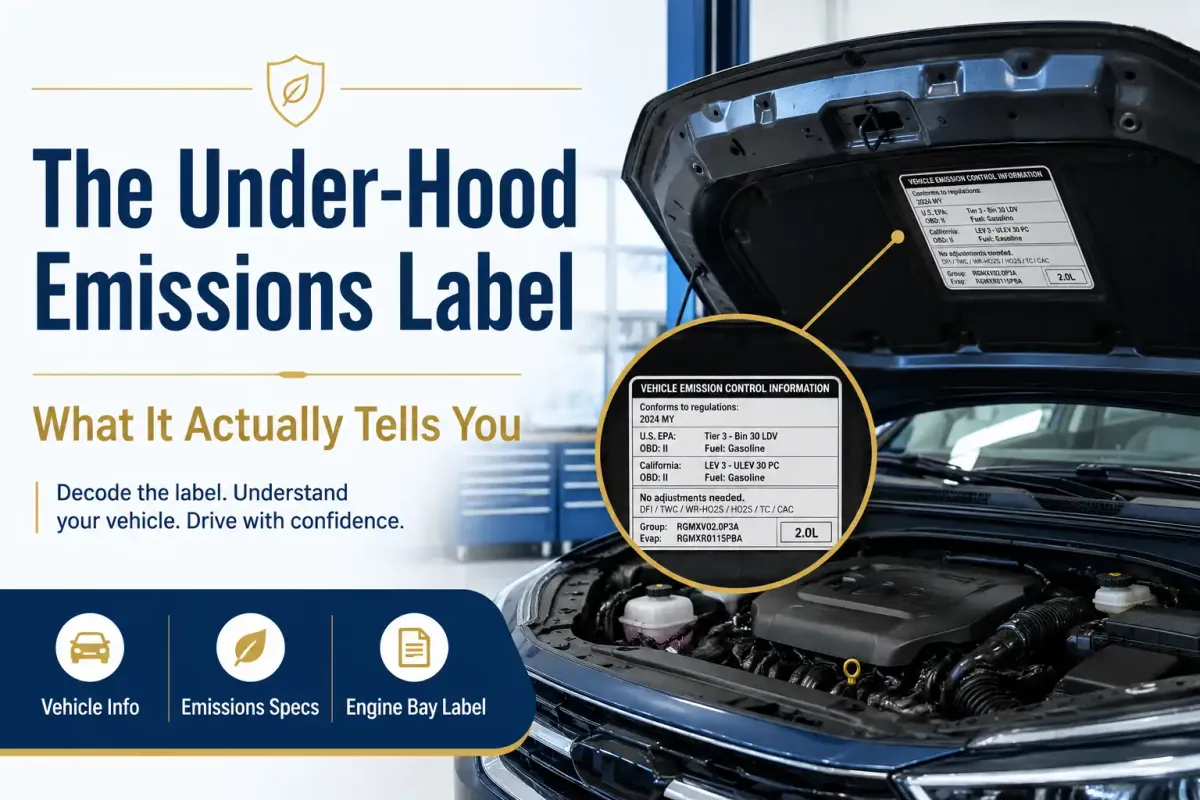
Short answer: it is a regulatory label that happens to be one of the most useful spec references on your vehicle. This article describes the Vehicle Emission Control Information label as required in the United States, under Environmental Protection Agency rules and, for vehicles certified to California standards, California Air Resources Board rules. Other markets require their own labels with different content, and nothing here should be read as universal.
Most drivers have never read this label because it looks like paperwork glued to a car. It is worth thirty seconds, because it commonly carries the engine family identification and, on many vehicles, the air conditioning refrigerant specification, which is a question people otherwise search the internet for and get wrong.
Which jurisdiction requires it, and why that matters to what is on it
The label exists because a regulator requires the manufacturer to state which emissions standards the vehicle was certified to.
In the United States that is a federal EPA requirement, with an additional layer for vehicles certified to California standards. A vehicle may be certified federally, to California standards, or to both, and the label says which. That is not trivia. It affects which emissions-related components the vehicle was built with, and therefore which parts are correct for it.
Because the label's content is set by the regulator, a vehicle built for a different market carries a different label with different information, or none at all in this form. If your vehicle was imported, do not assume the label described here is the one you are looking at.
Where the label is fitted, and why it moves around
Open the hood and look at the underside of the hood itself first. After that, the radiator support across the front, the strut towers, the underside of the hood latch panel, and occasionally the inner fender.
The regulation requires the label to be readily visible with the hood open, not to be in a specific place, which is why it moves between manufacturers and between model years on the same manufacturer.
On some vehicles it is combined with, or fitted next to, other under-hood labels such as a belt routing diagram. Those are separate labels serving separate purposes.
The engine family code and what it identifies
The most useful single field on the label is the engine family identification.
This is a code assigned for certification purposes that identifies the specific engine and emissions configuration the vehicle was certified as. Two vehicles that look identical, with the same displacement and the same badge, can carry different engine family codes if they were certified differently, and where that is true it is frequently the reason two parts are listed for what appears to be one vehicle.
You do not need to interpret the code yourself. Its value is that it is a precise identifier you can hand to a parts department, which is more useful than describing the vehicle.
Displacement, engine code and emissions family: three different identifiers
These get conflated constantly, so it is worth separating them.
Displacement is the engine's size. It is the coarsest identifier and it is shared across many variants.
Engine code is the manufacturer's identifier for the engine itself, and it usually appears in the VIN descriptor section and on the engine. See reading your engine code off the block and off the VIN.
Emissions family is the certification identifier on this label. It can distinguish vehicles that share an engine code but were certified differently.
When a parts catalogue lists two options for what you thought was one engine, one of these three is usually the distinguishing factor, and it is often the third.
The refrigerant line, where the label carries one
Many vehicles carry the air conditioning refrigerant type on an under-hood label, either on the emissions label itself or on a separate dedicated label nearby.
This is the correct answer to the question "which refrigerant does my car use." It is the vehicle's own statement about what the system was designed and charged for, and it beats any chart, because the transition between refrigerant types happened at different points for different vehicles and even for the same nameplate across model years.
Getting this wrong is not a small mistake. The full treatment: finding your refrigerant on the under-hood label.
The vacuum routing diagram, where one is present
Older vehicles frequently carry a vacuum hose routing diagram on or near this label, and some newer ones still do.
Where it exists it is genuinely authoritative for that vehicle, which distinguishes it from a diagram found online for the same model. It is one of the clearest cases on the whole vehicle of the label beating the internet.
What this label proves about the vehicle, and what it does not
It proves what the vehicle was certified as when built. That is its entire job.
It does not prove the vehicle is currently in that configuration. On a used vehicle with an unknown history, the label describes the original build and the car may have been changed. When the label and the vehicle disagree, both facts are useful: the label tells you what it should be, and the vehicle tells you what it is.
It also does not tell you whether anything is wrong. This label is a reference document, not a diagnostic one, and questions about a fault or a warning light are a different subject that this site does not cover.
For the wider picture of which document holds what: where every number on your car actually lives. And for the other regulated label, on the door: reading the door jamb label line by line.
Frequently asked questions
What is the label under my hood with all the codes on it?
On a vehicle sold in the United States it is most likely the Vehicle Emission Control Information label, which states the emissions standards the vehicle was certified to and carries the engine family identification.
Where exactly is the emissions label?
Most commonly the underside of the hood, the radiator support or a strut tower. The requirement is that it be readily visible with the hood open, not that it be in a fixed location.
Does the emissions label tell me my refrigerant type?
On many vehicles, yes, either on this label or on a dedicated label nearby. That is the authoritative answer for your vehicle and is better than any online chart.
What is an engine family code?
A certification identifier for the engine and emissions configuration. It can distinguish vehicles that share a displacement and even an engine code, which is often why two parts are listed for one apparent vehicle.
My car was imported. Does this apply?
Not necessarily. This describes the label required in the United States. Other markets require different labels with different content, and an imported vehicle may carry something else entirely.