Coolant Color Is Not a Spec: Reading the Actual One
Dye is not chemistry. The same color has covered different chemistries and the same chemistry has come in different colors. Here is what to read instead.

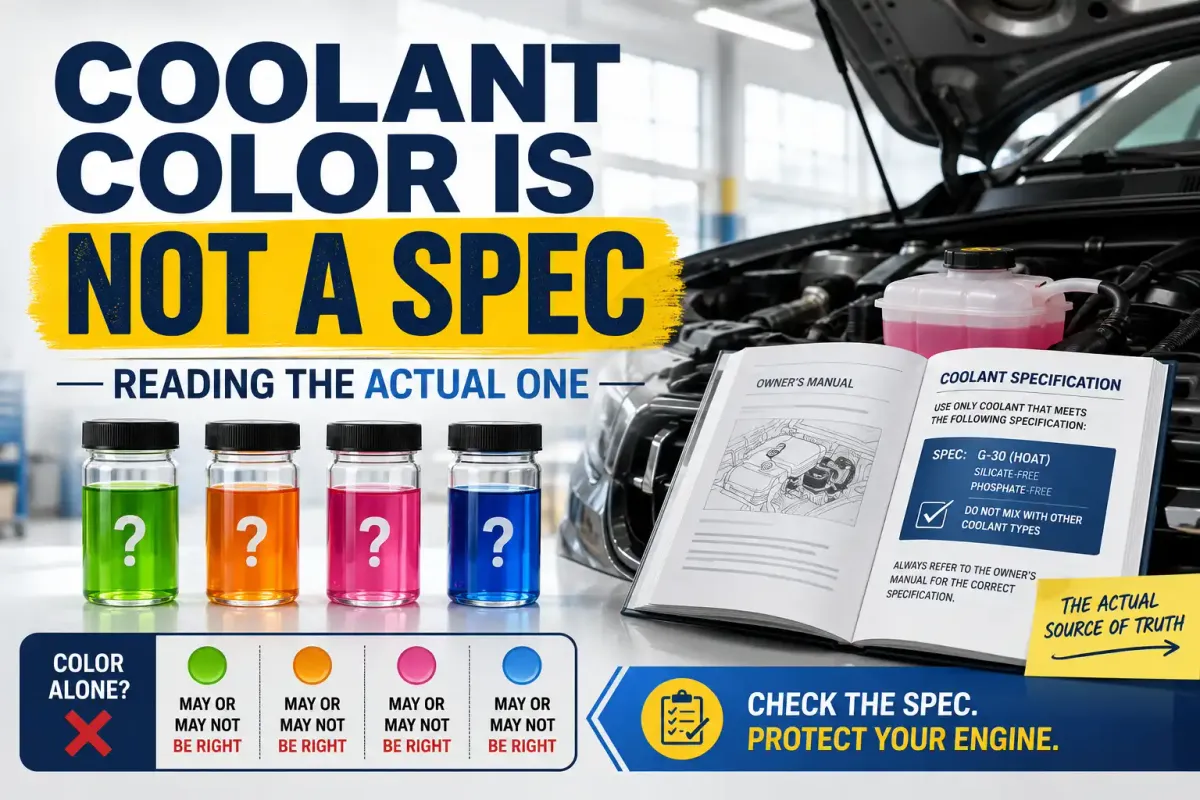
Short answer: no, color is not enough, because color is dye and dye is not a specification. Manufacturers have used the same color for different chemistries and different colors for the same chemistry. Matching orange to orange tells you two liquids look alike. It tells you nothing about whether they are compatible or whether either is correct for your vehicle.
The consequence of getting this wrong is not immediate. Coolant chemistry protects the metals in the cooling system, and the wrong chemistry degrades that protection over months while the vehicle behaves normally. That combination, expensive and quiet, is why this article is written the way it is.


As an Amazon Associate we earn from qualifying purchases.
Why the color-coding belief exists
It was not invented from nothing. For a period, color was a reasonably reliable shorthand: a particular chemistry was widely sold in a particular color, and matching worked often enough to become received wisdom.
That shorthand was always a convention rather than a standard. Nobody was required to use a given dye for a given chemistry, and nothing prevented anyone from choosing differently.
Received wisdom outlives its accuracy. The belief survives because it used to work and because it is easy, not because anyone re-checked it.
Why it broke down
Three things happened.
More chemistries appeared than there were conventional colors to distinguish them.
Manufacturers chose their own colors for their own specified products, without coordinating with anyone.
Aftermarket products adopted colors to match, sometimes matching the appearance of a product they were formulated to replace and sometimes not.
The result is a market in which color and chemistry are only loosely correlated, and where the correlation that does exist is not something you can rely on for a specific bottle.


As an Amazon Associate we earn from qualifying purchases.
What is actually in the system on a used vehicle
This is the argument that should end the discussion.
Suppose you have a used vehicle and the coolant in it is orange. What does that tell you about its chemistry?
It tells you about the last thing somebody put in. Not the factory fill, not the correct specification, and not necessarily a single product. A previous owner topping up with whatever was in the garage produces a color that is a blend of decisions you know nothing about.
So even if color were a reliable indicator of chemistry in a sealed bottle, the color in your expansion tank is not evidence about what should be in there. It is evidence about what happened, by someone you cannot ask.
What the specification looks like instead
A real coolant specification is one of two things.
A chemistry designation, describing the additive technology the coolant uses. What those designations mean and how they differ: OAT, HOAT and IAT coolants.
A manufacturer specification, a named standard the vehicle manufacturer publishes and against which products are formulated or approved. This works the same way manufacturer oil approvals do, and the same approval-versus-claim distinction applies: OEM oil approvals and what they mean.
Either of those is a specification. A color is not.
Where your vehicle's coolant specification is written
In the specifications section of your owner's manual, alongside the other fluids.
Some vehicles also carry information on the expansion tank or its cap, and where present that is a useful immediate check, though it is usually a summary rather than the full specification.
The complete list and where each fluid's specification lives: how to find every fluid spec your vehicle requires.
Where the manual is not enough, manufacturer service information resolves to your VIN: owner's manual vs service manual vs repair database. And a dealer parts department can confirm it in a couple of minutes, which on a used vehicle of unknown history is often the sensible move.


As an Amazon Associate we earn from qualifying purchases.
What goes wrong when the wrong chemistry goes in
Coolant does more than move heat. Its additive package protects the metals and the non-metallic components in the cooling system, and different chemistries protect in different ways and are designed for different material sets.
Put the wrong chemistry in and the protection appropriate to that system is not present. Corrosion proceeds where it was being inhibited, and the components affected are the ones the system depends on.
There is also the possibility of interaction between chemistries, which is the subject of the companion article and is a distinct concern from simply having the wrong one: what mixing coolant types does.
What none of this does is announce itself. There is no immediate symptom, which is precisely why the myth persists: people top up with the wrong color-matched product, nothing happens that week, and they conclude it was fine.
When to have the system looked at rather than topped up
Four situations where the answer is a professional rather than a bottle.
You bought the vehicle used and do not know its history. The fluid in it is an unknown of unknown provenance.
You have already topped up with something and are unsure what. Do not add more of anything.
The coolant looks wrong in a way that is not about color, for example cloudy, containing particles, or oily. That is a condition observation, not a specification question, and it belongs with someone who can inspect the system. The same applies to engine oil; see our dipstick engine oil color chart.
You cannot establish the correct specification. Guessing here is exactly what this article exists to prevent.
We do not tell you which coolant to use, and we do not publish a color-to-chemistry chart, because such a chart would be the fabricated figure this whole site is built to avoid. Your manual names yours.


As an Amazon Associate we earn from qualifying purchases.
Frequently asked questions
Can I match coolant by color?
No. Color is dye and is not a specification. The same color has covered different chemistries and the same chemistry has been sold in different colors.
Why do people think coolant is color-coded?
Because for a period the correlation was strong enough to work as a shorthand. It was a convention rather than a standard, and it broke down as more chemistries appeared.
The coolant in my used car is orange. What does that tell me?
What the last person put in. It is not evidence about the factory fill or the correct specification, and it may be a blend of several products.
Where is my coolant specification written?
In the specifications section of the owner's manual. Some vehicles also carry a summary on the expansion tank or cap.
What happens if I use the wrong coolant?
The additive protection appropriate to your system is not present, so corrosion proceeds where it was being inhibited. It develops quietly over months rather than producing an immediate symptom.