OEM Oil Approval vs Meets or Exceeds: Not the Same
An approval is a licence granted after testing and carries a checkable identifier. Meets-or-exceeds is the seller's own assertion. Here is how to tell.

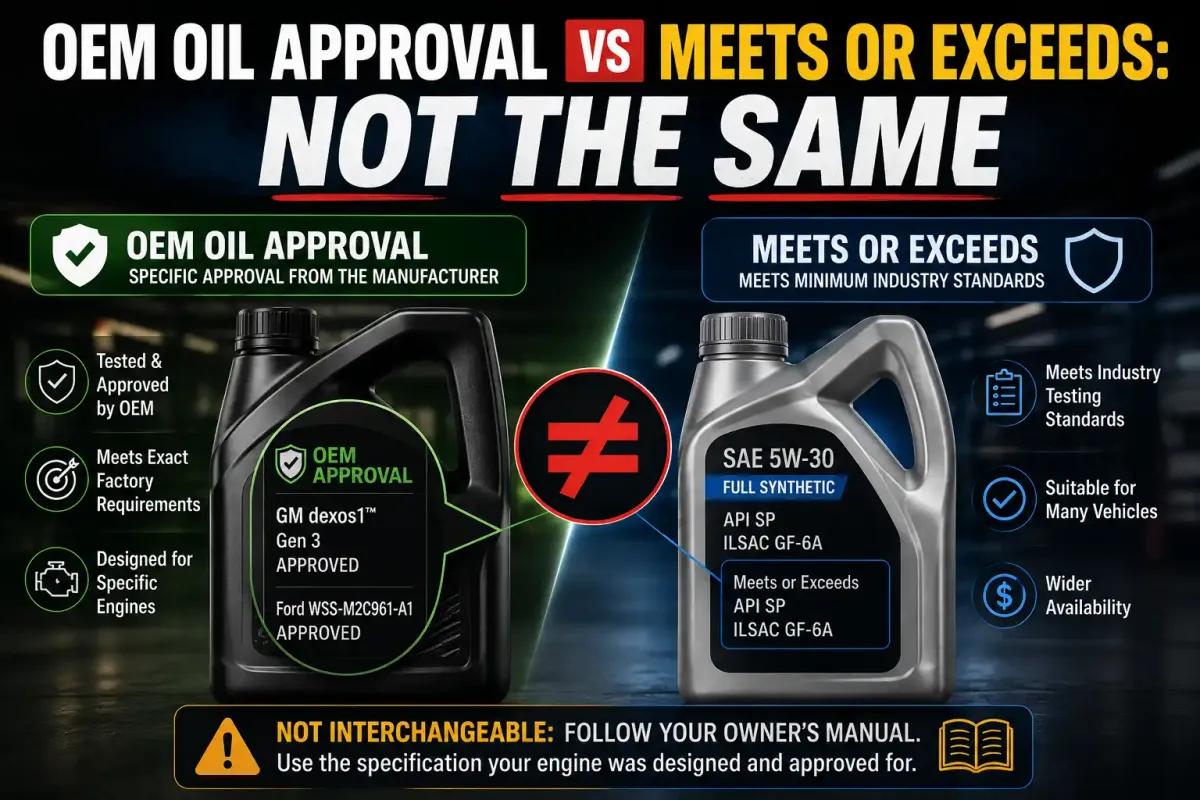
Short answer: no, they are not the same thing, and the difference is who did the testing. An approval is granted by the vehicle manufacturer to a specific product after that product has been tested against their specification, and approved products carry an identifier you can check against the manufacturer's own list. A meets-or-exceeds claim is the seller's assertion about their own product. It may be entirely true. Nobody independent confirmed it.
Written and verified 2026-09-13. Manufacturer specifications and approval lists change; check the current position for your vehicle rather than relying on any list, including this description of the system.


As an Amazon Associate we earn from qualifying purchases.
What an OEM approval actually is
A vehicle manufacturer that runs its own oil specification defines the performance requirements, tests candidate products against them, and grants approval to those that qualify.
Approval is granted to a specific product, not to a brand and not to a formulation family. Two products from the same manufacturer can differ in whether they carry a given approval, and a product can carry an approval in one viscosity grade and not in another.
The approval is then recorded on a list the vehicle manufacturer maintains and publishes. That is the part that makes it verifiable rather than assertable.
The names in the title of this article are used as examples of the system rather than as recommendations. We are not endorsing a specification, a manufacturer or a product.
What a meets-or-exceeds claim actually is
A statement by the oil's seller that their product performs to the level a named specification requires.
It is not necessarily false. A competent formulator can produce an oil that genuinely performs to a specification without seeking approval, and there are legitimate commercial reasons not to seek one, including the cost of the testing and licensing programme.
What it is not is verified by the party whose specification is being named. There is no list to check it against, because the vehicle manufacturer was not involved.
The distinction is the same one that runs through this whole site: a claim with a checkable source behind it and a claim without one are different kinds of statement, even when both happen to be true.


As an Amazon Associate we earn from qualifying purchases.
The licence number, and how to check one
This is the actionable part.
Approval programmes generally issue an identifier to each approved product, and that identifier is printed on the bottle. It exists so that anyone can look it up on the manufacturer's list and confirm that this specific product holds this specific approval.
Two practical points. The identifier is usually on the back label rather than in the marketing text on the front. And a bottle naming a specification without an identifier is worth a second look, because the identifier is the evidence and its absence is informative.
The manufacturer's own published list is the place to check. Not a retailer's product page, and not a comparison site: why two websites give your car two different numbers.
Why manufacturers run their own specifications at all
A reasonable question given that API and ILSAC specifications already exist.
The industry-wide specifications are consensus documents covering a wide range of engines. A manufacturer with particular design characteristics, particular emissions equipment or particular service expectations may need requirements the consensus specification does not address.
So the OEM specification sits on top of the industry ones rather than replacing them. A product can carry an API category, an ILSAC specification and an OEM approval simultaneously, and each is saying something different: reading a motor oil label.
Where your vehicle names an approval, it is the strictest requirement on the list, and satisfying API or ILSAC does not satisfy it: API service categories and ILSAC GF-6A vs GF-6B.
Approvals are specific, including to viscosity
Worth its own section because it is the most common way people get this wrong while trying to get it right.
An approval attaches to a product in a viscosity grade. Buying the same product name in a different grade does not carry the approval across, and neither does buying a different product from the same brand.
Check the actual bottle in your hand, in the grade you are buying, for the identifier. Not the brand, not the product family, not what you bought last time.


As an Amazon Associate we earn from qualifying purchases.
The warranty question
Whether using a non-approved oil affects a manufacturer's warranty position is a real question and it is not one this site can answer for you.
It depends on the manufacturer, the jurisdiction, the terms of the specific warranty and the nature of any claim. Those are legal and commercial matters that vary considerably, and we are not going to characterize them.
What we can say is that it is a fair question to ask directly, of the dealer or the manufacturer, before making a decision on a vehicle still under warranty. Asking costs nothing and gets you an answer specific to your situation rather than a general one.
What to do when you cannot find an approved product
Three steps.
Check the back label rather than the front. Products often carry more approvals than their marketing mentions.
Ask a dealer parts department. They sell a product that carries the approval for your VIN, and that is the shortest path to a correct answer.
Ask the manufacturer whether an alternative is acceptable, rather than deciding yourself. On a vehicle where the manual names an approval, substituting on the basis of a meets-or-exceeds claim is a judgement you are making about testing you have not seen.
Where the full list of your vehicle's requirements lives: how to find every fluid spec your vehicle requires. And on the word on the front of the bottle, which is a separate matter again: full synthetic, blend and conventional.


As an Amazon Associate we earn from qualifying purchases.
Frequently asked questions
Is "meets or exceeds dexos" the same as being dexos approved?
No. An approval is granted by the vehicle manufacturer after testing and carries a checkable identifier. A meets-or-exceeds claim is the seller's own assertion with no list to verify it against.
How do I check whether an oil is genuinely approved?
Find the approval identifier on the bottle, usually on the back label, and look it up on the vehicle manufacturer's published list.
Does an approval cover a whole brand?
No. It attaches to a specific product in a specific viscosity grade. The same product name in a different grade does not automatically carry it.
Does using non-approved oil void my warranty?
That depends on the manufacturer, the jurisdiction and the warranty terms, and this site does not give legal advice. Ask the dealer or manufacturer directly if the vehicle is under warranty.
Why do manufacturers have their own oil specs?
Because industry-wide specifications are consensus documents covering many engines, and a manufacturer may have requirements those documents do not address.