Oil Capacity vs Dipstick: Which One Is Actually Right?
A published capacity is an estimate for a nominal condition. The dipstick measures the engine in front of you, and the dipstick wins every time.

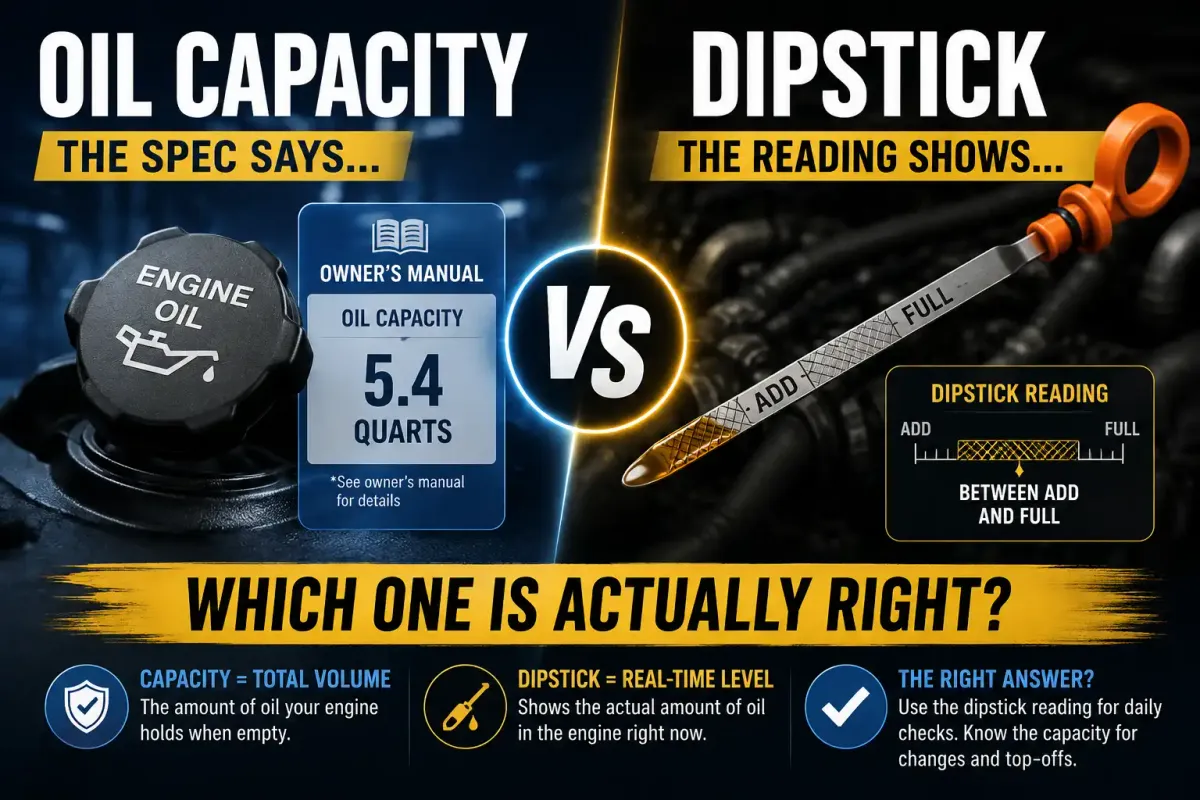
Short answer: the dipstick is the measurement and the published capacity is an estimate, so the dipstick wins. A capacity figure describes a nominal condition that your particular oil change almost certainly did not reproduce. The dipstick is measuring the engine actually in front of you, right now, with whatever is actually in it.
If you have put in the chart amount and the level reads above the mark, do not add more and do not assume the chart was wrong about your engine. Work through the four reasons below, then fill to the dipstick.


As an Amazon Associate we earn from qualifying purchases.
What a published capacity figure actually is
A capacity figure is the amount of oil the system holds under a defined condition, and the defining condition is the part that gets dropped when the number is copied.
Some published figures are dry-fill amounts, describing a completely empty system. Some are service-fill amounts, describing a routine change. Some include the filter and some do not, and many sources do not say which.
None of them describe your specific oil change, because your specific oil change depends on things a published figure cannot know.
Reason one: not everything drained out
An engine does not fully empty when you pull the drain plug.
Oil remains in galleries, in the cylinder head, on internal surfaces and in components that do not drain to the sump. How much remains varies with the engine's design, how long it was left to drain, and whether it was warm.
That residual oil is already in the engine when you start refilling, so the amount you add to reach the correct level is less than the amount the system holds. A figure derived from a dry system will always over-fill an engine that was merely drained.


As an Amazon Associate we earn from qualifying purchases.
Reason two: whether the figure includes the filter
An oil filter holds a meaningful volume, and whether the published figure accounts for it changes the number. Small engines are no exception: our Briggs and Stratton oil filter chart shows a manual listing about 44 oz without a filter and 48 oz with one.
Three cases produce three different correct amounts: you changed the filter and the figure includes it, you changed the filter and the figure does not, or you did not change the filter at all and it is still holding oil from before.
A figure that does not state its assumption about the filter is a figure you cannot use with confidence, and many published ones do not state it.
Reason three: the vehicle was not level
A dipstick reads the depth of oil in the sump, and depth depends on the vehicle's attitude. (For what the oil's color on the stick means, see our dipstick engine oil color chart.)
A vehicle on a sloped driveway, on ramps, or with one side jacked will read differently from the same vehicle on level ground with the same oil in it. This is one of the most common reasons a level appears wrong immediately after a change.
The other timing factor is drain-back. Oil that is still up in the engine after running has not yet returned to the sump, so a reading taken too soon shows low. Your vehicle's manual specifies how it wants the level checked, including whether warm or cold and how long after running, and that procedure is part of the measurement rather than a nicety.
Reason four: the wrong engine variant
Manufacturers commonly offered several engines under one model name, and capacities differ between them.
A chart keyed to year and model has silently picked one. If your vehicle has a different engine from the one it assumed, the figure is for a different engine and there is nothing wrong with either the chart or your car.
Establishing which engine you actually have, from three independent sources: reading your engine code off the block and off the VIN.
This is a general pattern rather than an oil-specific one: why two websites give your car two different numbers.


As an Amazon Associate we earn from qualifying purchases.
How to fill correctly regardless of the chart
The procedure that works whatever the published figure says.
Add clearly less than you expect to need. Deliberately under-fill on the first pour.
Run the engine briefly, then stop it and wait for drain-back as your manual specifies. This fills the new filter and settles the level.
Check the level following your manual's stated method, on level ground, at the stated temperature, after the stated wait.
Add small amounts and re-check. Adding is easy. Removing is not.
Stop within the marked range. The marks are the specification. The chart was an estimate, useful for working out how much oil to pick up at the store and nothing more.
This is the same principle as everywhere on this site: the vehicle in front of you outranks a published figure about vehicles in general. Where the vehicle's own documentation lives, including its measurement procedure: how to find every fluid spec your vehicle requires and owner's manual vs service manual vs repair database.
We do not publish capacity figures for any vehicle, and this article is the clearest illustration of why: even a correct figure is an estimate about a condition your oil change did not reproduce.
Why overfilling is not harmless
Worth stating because the instinct is that a bit extra cannot hurt.
The crankshaft rotates near the surface of the oil in the sump, and a level above the designed range brings it into contact with oil it was not meant to be churning. That aerates the oil, and aerated oil does not behave the way the lubrication system was designed around.
Overfilling also raises pressure in the crankcase and can push oil into places it does not belong.
None of that is a reason to panic over a small amount above the upper mark, and none of it is something to diagnose from a description. It is a reason to correct the level rather than leave it, and if the overfill is substantial, to have someone look at it rather than driving on it. What that means for your vehicle specifically is a question for a qualified technician, not for us: reading a bottle correctly is our subject, and reading a motor oil label is where that starts.


As an Amazon Associate we earn from qualifying purchases.
Frequently asked questions
Should I trust the oil capacity chart or the dipstick?
The dipstick. It measures the engine in front of you. A published capacity describes a nominal condition your oil change almost certainly did not reproduce.
Why is my oil over the mark after adding the stated capacity?
Most likely because oil remained in the engine after draining, or the figure assumed a different filter situation, or the vehicle was not level when you checked.
Does the capacity figure include the oil filter?
Often it is not stated, which is exactly the problem. A figure that does not state its filter assumption cannot be used with confidence.
How do I check the level correctly?
Follow your manual's stated method: level ground, at the stated temperature, after the stated wait for drain-back. That procedure is part of the measurement.
Is a little too much oil a problem?
It is worth correcting rather than leaving. A level above the designed range can aerate the oil and raise crankcase pressure. A substantial overfill is worth having looked at rather than driven on.