DOT 3 vs DOT 4 vs DOT 5: The Numbers Are Not a Ladder
DOT 5 is silicone based and not compatible with the glycol fluids either side of it. DOT 5.1 is glycol based despite the number. That is the whole trap.

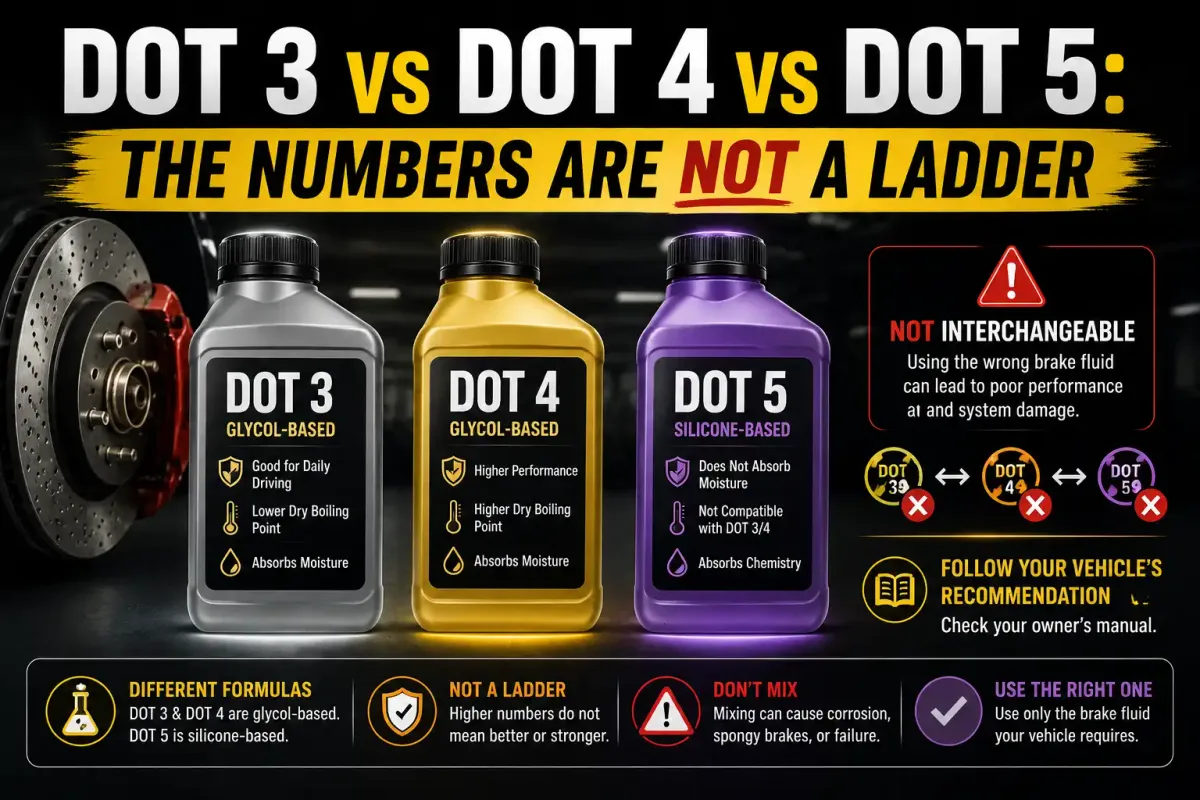
Short answer: the numbers look like a ladder and they are not one. DOT 3, DOT 4 and DOT 5.1 are glycol-based fluids. DOT 5 is silicone based, sitting in the middle of that sequence while being a fundamentally different chemistry that is not compatible with the fluids either side of it. A numbering scheme that puts a chemically incompatible product between two compatible ones is a genuine hazard created by naming, and it is the most important thing on this page.
Note also that DOT 5.1 is glycol based despite being numbered above DOT 5. If you take one thing away, take that the number is not telling you what you think it is.


As an Amazon Associate we earn from qualifying purchases.
What a DOT rating certifies
DOT ratings are performance specifications for brake fluid, defining minimum requirements including boiling point behavior for fluid both new and after it has absorbed moisture in service.
That last part is why brake fluid has a specification at all. Brakes generate heat, that heat reaches the fluid, and a fluid that boils in the system produces vapor. Vapor is compressible in a way liquid is not, and a compressible element in a hydraulic system means pedal travel that does not translate into braking.
We do not publish the boiling point figures. They are published by the specification and by fluid manufacturers, who name the exact fluid they apply to, and that is where they should be read.
DOT 3 and DOT 4, both glycol based
These are the two most commonly specified fluids for passenger vehicles, and they share a base chemistry.
Because they share a chemistry, they are broadly compatible with each other as materials, which is the source of the general belief that you can move up the numbers freely.
Compatibility is not the same as suitability. Whether a fluid meeting a higher specification is appropriate in a system specified for a lower one depends on the vehicle, and it is a question for the manufacturer's documentation rather than an inference from the numbering.


As an Amazon Associate we earn from qualifying purchases.
DOT 5, which is silicone based
This is the trap.
DOT 5 is a silicone-based fluid, a different chemistry from the glycol fluids around it in the numbering. It was developed for particular applications, and it has properties that suit those applications.
It is not a higher grade of DOT 4. It is a different product that happens to have been given the next number.
Because it is a different chemistry, it is not compatible with the glycol fluids, and a system designed for one is not a system you put the other into on the basis of the number being larger.
DOT 5.1, which is glycol based despite the number
And here the naming gets worse.
DOT 5.1 is a glycol-based fluid, in the same chemistry family as DOT 3 and DOT 4, carrying a specification with higher performance requirements than DOT 4.
So the sequence runs glycol, glycol, silicone, glycol. Reading down the numbers, the chemistry changes at DOT 5 and changes back at DOT 5.1.
Nobody would design a naming scheme this way on purpose. It happened, and the consequence is that the numbers cannot be used to reason about compatibility at all. Read the chemistry, not the number.
Why mixing silicone and glycol fluids is not an option
They do not mix in the sense of forming a working fluid.
Beyond the fluid itself, a hydraulic system contains seals and components selected for compatibility with the fluid the system was designed for. Introducing a different chemistry means those components are in contact with something they were not selected against.
This is the same class of problem as coolant chemistry, and it fails the same way: not immediately, and not visibly: OAT, HOAT and IAT coolants and what mixing them does.
The difference is what the system does. A cooling system that degrades over months is expensive. A braking system that degrades is a braking system.


As an Amazon Associate we earn from qualifying purchases.
Why glycol fluids absorb water, and what follows from that
Glycol-based brake fluids are hygroscopic, meaning they absorb moisture from the atmosphere over time.
Two practical consequences follow, and both are about handling rather than selection.
An opened container has begun absorbing moisture. A part-used bottle that has been sitting in a garage is not the same fluid it was when sealed.
The fluid in a vehicle absorbs moisture in service, which is why the specification defines a wet boiling point as well as a dry one.
What follows from the second is a service interval, which is a maintenance question rather than a specification question, and this site does not cover intervals. Your manual's maintenance schedule and a qualified technician are the sources.
One further handling note that is a specification matter: glycol brake fluid can damage paint. That is a property of the fluid, not a warning we invented, and it is worth knowing before a bottle is opened over a fender.
What your vehicle specifies, and why substituting upward is still a question for a professional
Your vehicle's brake fluid specification is in the owner's manual, and it is frequently also molded or printed on the reservoir cap.
The cap is a useful immediate check and is usually a summary. The manual may name something more specific, including a manufacturer specification beyond the DOT rating, which works the same way manufacturer specifications do elsewhere: OEM oil approvals and what they mean.
Where the complete list lives: how to find every fluid spec your vehicle requires.
On whether to use a higher-specification glycol fluid than your vehicle names: that is a real question with a real answer, and the answer is specific to your vehicle. Ask a qualified technician or the manufacturer. We are not going to give you a general rule about a braking system, for the same reason we do not publish brake fastener torque figures: brake caliper and bracket torque.
And if brake work is in prospect, note that this site covers the specification and not the job. Whether your brakes need attention is a different question, and it belongs with someone who can inspect the vehicle. If you already have a pad measurement, our brake pad wear chart in mm shows what the published thresholds say about it. For the vehicle's own documentation: owner's manual vs service manual vs repair database.


As an Amazon Associate we earn from qualifying purchases.
Frequently asked questions
Can I use DOT 4 where DOT 3 is specified?
They share a base chemistry, so they are broadly compatible as materials, but compatibility is not suitability. Whether it is appropriate for your vehicle is a question for the manufacturer's documentation or a qualified technician.
Is DOT 5 better than DOT 4?
No, it is different. DOT 5 is silicone based while DOT 3, DOT 4 and DOT 5.1 are glycol based. It is not a higher grade of the same thing and is not interchangeable with them.
Is DOT 5.1 the same as DOT 5?
No. Despite the number, DOT 5.1 is glycol based and in the same family as DOT 3 and DOT 4. DOT 5 is silicone based. The numbering is genuinely misleading here.
Why does brake fluid absorb water?
Glycol-based fluids are hygroscopic, taking up moisture from the atmosphere. That is why the specification defines a wet boiling point as well as a dry one, and why an opened bottle is not the fluid it was when sealed.
Where is my brake fluid specification written?
In the owner's manual, and frequently molded or printed on the reservoir cap as a summary.