What Refrigerant Does My Car Use? Check the Label
Your vehicle states it on a label under the hood. A chart cannot answer this reliably: the transition happened at different points for different cars.

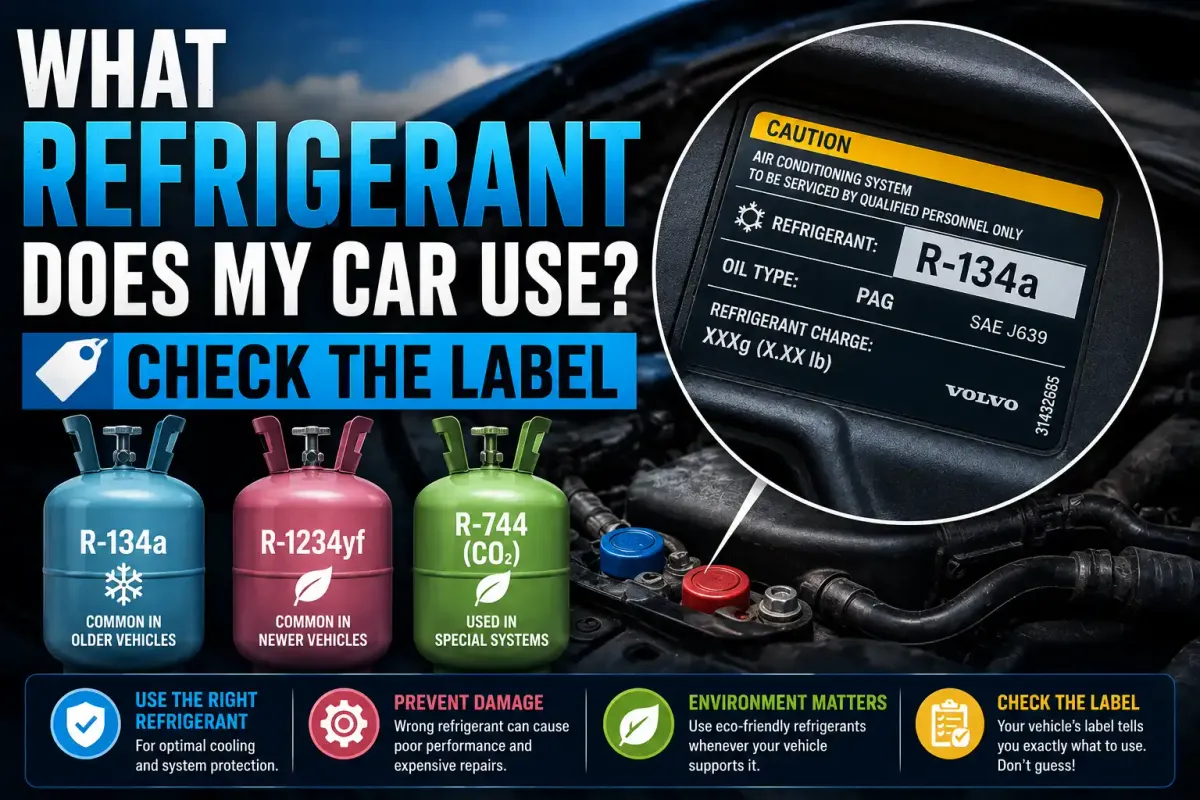
Short answer: your vehicle states it on a label under the hood, and that label is a better source than any chart. This article describes the situation in the United States, where refrigerant handling and vehicle service are subject to federal rules; other jurisdictions have their own requirements and nothing here should be read as describing them.
Written and verified 2026-09-21. Refrigerant transitions and the rules around handling change over time; re-check before relying on this.
The label matters more here than almost anywhere else on this site, because the transition between refrigerant types did not happen on a single date. It happened at different points for different manufacturers, different models and even different model years of the same nameplate, which is exactly the situation a chart handles badly and a label handles perfectly.


As an Amazon Associate we earn from qualifying purchases.
Which jurisdiction this describes
The United States. Refrigerant production, sale and handling are regulated federally, and vehicle air conditioning service is affected by those rules.
That regulatory context is why the label exists and why it says what it says. A vehicle built for another market may carry different labelling or none in this form, and the rules around who may service the system differ elsewhere too.
Where the label is
Open the hood and look in the same places you would look for the emissions label: the underside of the hood, the radiator support across the front, or a strut tower.
On many vehicles the refrigerant type appears on a dedicated air conditioning label. On others it appears on or beside the Vehicle Emission Control Information label. Both are under-hood labels and they frequently sit near each other: the under-hood emissions control information label.
Photograph it while you are there. The print is small and you will want it again.


As an Amazon Associate we earn from qualifying purchases.
Why a chart cannot answer this reliably
Because the transition was staggered in a way no year-and-model table represents well.
Manufacturers moved from one refrigerant to the other on their own schedules, model by model, and the changeover point for one nameplate is not the changeover point for another from the same manufacturer. Vehicles built either side of a changeover within one model year carry different systems.
A chart keyed to year and model has to pick one answer for a row where two are true. That is not sloppiness on the chart's part; it is a limitation of the format.
This is the same structural problem that makes published vehicle specifications disagree generally, and it is why the vehicle's own label outranks every chart: why two websites give your car two different numbers.
The two refrigerants you are most likely to meet
R-134a was the widely used automotive refrigerant for a long period after the previous generation was phased out.
R-1234yf is the more recent refrigerant, adopted in response to environmental requirements around global warming potential.
They are different substances with different properties, and a system designed for one is not a system you charge with the other. The lubricant circulating with the refrigerant is also matched to the system, which is a further reason these are not interchangeable at the level of "it is all air conditioning gas."
We are not going to tell you which one your vehicle has, by year or by model. The label does that, and it is right about your specific car in a way we cannot be.
Why the fittings differ, and what that does and does not prove
Service fittings differ between the two refrigerants, which is a deliberate design choice intended to prevent the wrong refrigerant being introduced.
What that means practically: a can or a service coupler for one refrigerant does not connect to a system designed for the other, which is a useful physical check and part of the answer to the question in the micro-intent.
What it does not mean: that a fitting match proves anything about the system's condition, its charge, or whether it has been correctly serviced in the past. Adapters exist, and a system that has been worked on may not be in the state its label describes.
The label tells you what the vehicle was designed and charged for. The fittings tell you what will physically connect today. Where those disagree, something has been done to the vehicle, and that is worth knowing about before anything else happens.


As an Amazon Associate we earn from qualifying purchases.
What the label tells you besides the type
Air conditioning labels commonly carry more than the refrigerant name.
They typically also state the charge amount and the lubricant type the system requires. Both are genuine specifications and both are on the vehicle rather than in a chart, which is the point of the label.
We do not publish charge amounts, lubricant specifications or pressures for any vehicle. The label states yours, and where it is missing or unreadable, manufacturer service information for your VIN is the source: owner's manual vs service manual vs repair database.
Where the rest of your vehicle's fluid specifications live: how to find every fluid spec your vehicle requires.
Where this stops being a specification question
The boundary of this article, stated plainly.
Identifying which refrigerant your vehicle uses is a lookup, and lookups are what this site does. Servicing an air conditioning system is not, for two reasons.
It is regulated. In the United States there are federal rules covering refrigerant handling, including requirements around recovery rather than release and around who may purchase and handle certain refrigerants. Those rules exist for environmental reasons and they are not optional.
It is a system where a wrong answer costs real money. Charge amount, lubricant type and system condition interact, and none of them can be assessed from a description.
So: read your label, know your refrigerant, and take anything beyond that to a qualified air conditioning technician. This article will not tell you how to charge a system, and any page that does while skipping the regulatory position is a page worth being careful with.



As an Amazon Associate we earn from qualifying purchases.
Frequently asked questions
How do I find out which refrigerant my car uses?
From a label under the hood, either a dedicated air conditioning label or one on or beside the emissions label. That label is your vehicle's own statement and is better than any chart.
What is the difference between R-134a and R-1234yf?
They are different substances with different properties, the second adopted in response to environmental requirements around global warming potential. Systems are designed for one or the other and they are not interchangeable.
Why can a chart not tell me?
Because the transition was staggered by manufacturer, model and model year, so a chart keyed to year and model has to pick one answer where two can be true.
Do the service fittings differ?
Yes, deliberately, to prevent the wrong refrigerant being introduced. That is a useful physical check, but adapters exist and a fitting match proves nothing about the system's condition.
Can I service the system myself?
Refrigerant handling in the United States is subject to federal rules, and charge amount, lubricant and system condition interact in ways that cannot be assessed from a description. Take it to a qualified technician.