How to Read a Motor Oil Label: Which Marks Matter
Four independent systems plus marketing. Here is which markings are requirements your vehicle sets and which are words the seller chose.

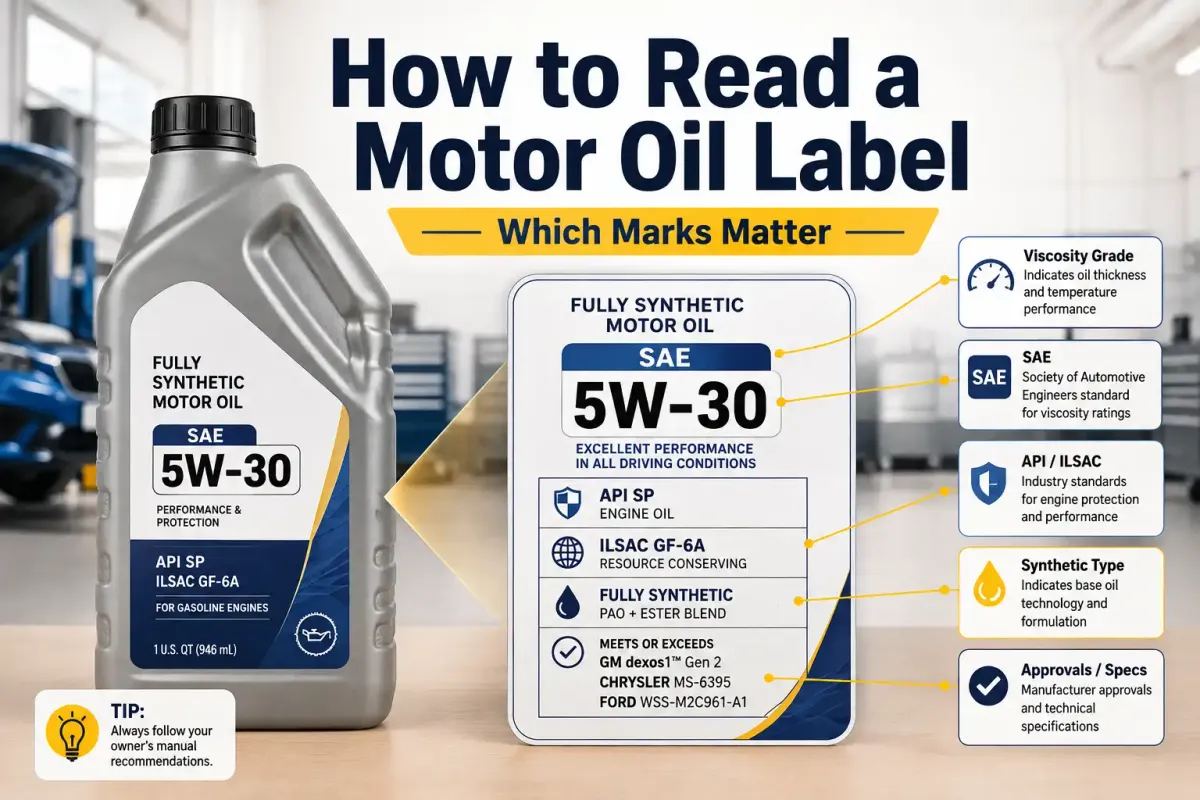
Short answer: there are four independent specification systems on a bottle of engine oil, plus a layer of marketing, and only some of them are requirements your vehicle sets. Viscosity grade, API service category, ILSAC specification and OEM approval are four different things assessed by four different bodies. The words on the front of the bottle are chosen by whoever is selling it.
Learning to separate those is the whole skill. Once you can, a shelf of forty bottles becomes a shelf where three or four are candidates and the rest are not.


As an Amazon Associate we earn from qualifying purchases.
The four systems, and where each is printed
| System | Assessed by | Where it appears |
|---|---|---|
| Viscosity grade | An SAE classification | Front label, large |
| API service category | The American Petroleum Institute | The donut on the back |
| ILSAC specification | The International Lubricant Standardization and Approval Committee | The starburst or shield mark |
| OEM approval | The vehicle manufacturer | Back label, usually as a specification name |
The viscosity grade
The most prominent marking on the bottle, and the one people treat as the whole answer.
It is two grades from two separate tests, not two ends of one scale, and neither is a measurement in a unit of anything. The details, kept short because it is a narrow subject: what 5W-30 actually describes.
The important thing here is that matching viscosity is necessary and not sufficient. A bottle with the right grade can fail on any of the other three systems below.


As an Amazon Associate we earn from qualifying purchases.
The API service category and the donut
The API service category is printed inside a circular mark on the back of the bottle, commonly called the donut.
The donut carries three pieces of information: the viscosity grade, the API service category, and whether the oil meets energy-conserving or resource-conserving criteria. It is a certification mark, which means a licensed product is entitled to display it and an unlicensed one is not.
Categories for spark-ignition engines run in an S series, and the letters progress as the specifications are updated. What to do when your manual names an older letter than the shelf has: API service categories, SP, SN Plus and the older letters.
The ILSAC specification and the starburst
ILSAC specifications are marked with a starburst symbol on the front of the bottle, and more recent specifications also use a shield mark.
ILSAC is a separate body from API with a separate specification series, which is why a bottle can carry both marks and they are not saying the same thing. ILSAC specifications tend to be more demanding in specific areas that vehicle manufacturers care about.
The current series has an unusual property: two of its specifications are deliberately not interchangeable, which trips up readers who assume a lettering suffix indicates a grade. That is worth its own explanation: ILSAC GF-6A vs GF-6B.


As an Amazon Associate we earn from qualifying purchases.
OEM approvals, which are the strictest
The fourth system is the vehicle manufacturer's own.
Several manufacturers run their own oil specifications and grant approvals to specific products that have been tested against them. Where your vehicle requires an approval, that is the strictest requirement on the bottle, and it is not satisfied by the API or ILSAC marks.
The critical distinction, and the most useful thing on this page: an approval is granted after testing and carries a verifiable identifier. A meets-or-exceeds claim is the seller's own assertion. They are not the same thing and one of them can be checked: OEM oil approvals and why they are not optional.
What is marketing and can be ignored
Everything else on the front of the bottle.
Words describing performance, longevity, protection and cleanliness are the seller's own language. They may be describing something real about the product. They are not specifications, nobody independent assessed them, and they cannot be checked against a list.
The word "synthetic" sits in an awkward middle position: it means something technically, but it is far less tightly defined than buyers assume: full synthetic, blend and conventional.
The rule that keeps you out of trouble: if a claim is not a mark or a named specification, it is not a requirement you can verify. Read the back of the bottle.


As an Amazon Associate we earn from qualifying purchases.
Which markings must match your vehicle's requirement
Your vehicle sets the requirement, and it is in the specifications section of the owner's manual.
What it will name is some combination of a viscosity grade, an API category, an ILSAC specification and possibly an OEM approval. Whichever of those it names are the ones that must match. What it does not name, you do not need to satisfy.
That last point matters practically. A vehicle whose manual names only a viscosity grade and an API category is not requiring an OEM approval, and buying one anyway is a preference rather than a compliance step.
Where the full list of your vehicle's fluid specifications lives: how to find every fluid spec your vehicle requires.
What to do when the shelf has nothing matching
Three things, in order.
Check whether a newer specification supersedes what your manual names. This is common on older vehicles and is usually the explanation.
Check the back label rather than the front. Products often carry more specifications than their marketing mentions, and the specification you need may be listed among several.
Ask, rather than substitute. A dealer parts department can confirm what your VIN requires, and they sell a product that carries it. That is a two-minute question with a definite answer.
What we will not do is tell you which grade or which product to use. We cannot verify manufacturer specifications across every model year, trim, engine and market, and the wrong oil is a slow expensive failure rather than an obvious one. Your manual names yours.


As an Amazon Associate we earn from qualifying purchases.
Frequently asked questions
What do the markings on an oil bottle mean?
There are four independent systems: the SAE viscosity grade, the API service category in the donut, the ILSAC specification shown by the starburst, and any vehicle manufacturer approval. Everything else on the front is marketing.
Is matching the viscosity enough?
No. Viscosity is necessary but not sufficient. A bottle with the correct grade can still fail the API, ILSAC or OEM requirement your vehicle sets.
What is the donut on the back of the bottle?
The API certification mark, carrying the viscosity grade, the API service category, and whether the oil meets energy-conserving criteria.
Does my car need an OEM approved oil?
Only if your owner's manual names an approval. Where it names only a viscosity grade and an API category, an approval is a preference rather than a requirement.
Which markings should I check first?
Whichever ones your owner's manual names. What it does not name is not a requirement for your vehicle.