Wheel Offset (ET) Explained and What Changing It Does
Offset is where the mounting face sits relative to the wheel's centerline. What moving it does to track, clearance and the load path through the hub.

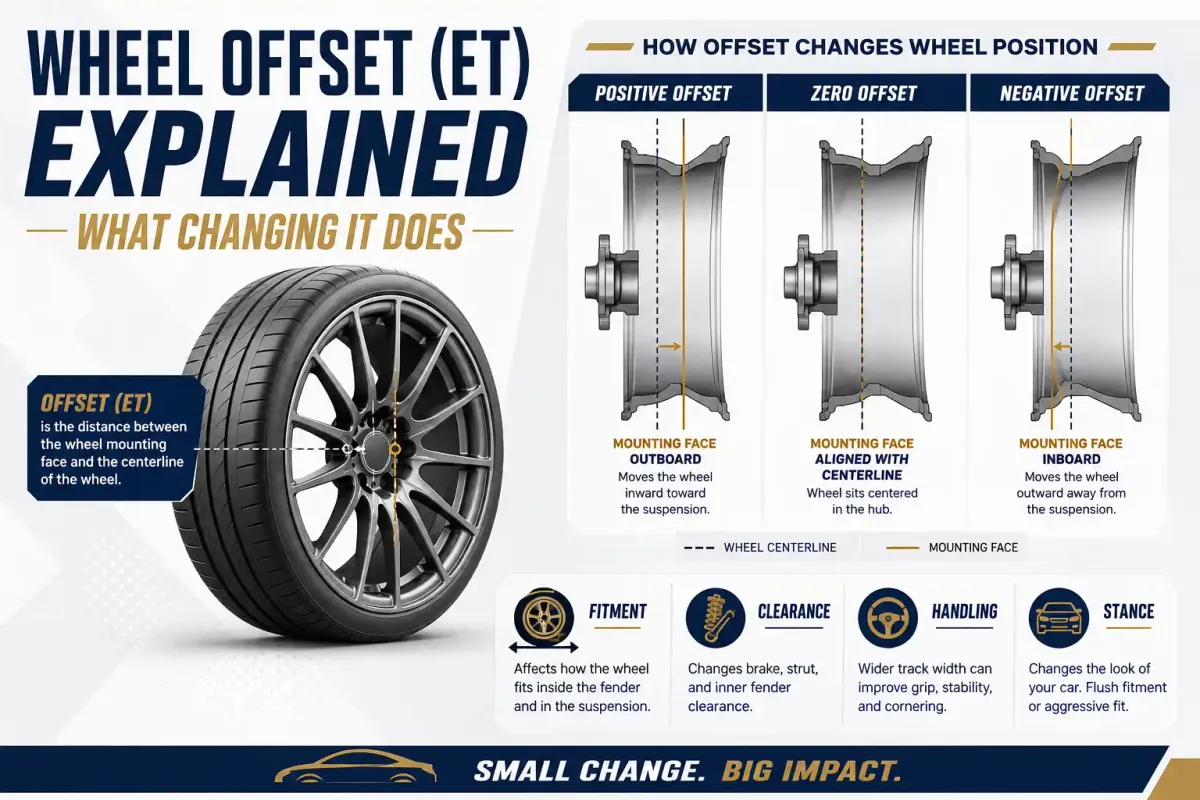
Short answer: offset is the distance between the wheel's mounting face and its centerline, and changing it moves the entire wheel and tire inboard or outboard. That single change has four consequences, not one: track width changes, clearance to suspension and bodywork changes, the steering geometry the vehicle was designed around changes, and the load path through the wheel bearing changes.
The last one is why this matters beyond appearance, and it is usually a footnote elsewhere. This page gives it a section.
Where ET comes from and what the sign means
ET is the marking you will see on the wheel, from the German Einpresstiefe, meaning insertion depth. It is stamped or cast on the wheel, usually on the back of a spoke or on the inner barrel, and it is normally given in millimeters.
Offset describes where the mounting face, the flat surface that meets the hub, sits relative to the wheel's centerline. The centerline is the midpoint of the wheel's overall width.
The sign is the part people misremember. Positive offset means the mounting face is outboard of the centerline, toward the street side of the wheel. Negative means it is inboard. Zero means the mounting face is exactly on the centerline.
Positive, zero and negative offset
| Offset | Mounting face position | Effect relative to a higher offset |
|---|---|---|
| Positive | Outboard of centerline | Wheel sits further in |
| Zero | On the centerline | Between the two |
| Negative | Inboard of centerline | Wheel sits further out |
The relationship that trips people up: higher positive offset moves the wheel inward, not outward. The mounting face moving toward the street pulls the rest of the wheel in behind it.
If you remember the direction wrong, every decision downstream is backwards, so it is worth fixing in your head before you go shopping.
What decreasing offset does to the vehicle
Decreasing offset, whether from a high positive number to a low one or from positive to negative, moves the wheel outward.
Track width increases. The wheels sit further apart than the vehicle was designed with.
Outer clearance decreases. The tire moves toward the fender, and whether it still clears at full steering lock and full suspension travel is a question your driveway cannot answer.
Inner clearance increases, which is occasionally the actual reason for a change, to clear a brake or suspension component.
The load path changes. This is the important one, and it gets its own section below.
What increasing offset does to the vehicle
Increasing offset moves the wheel inward, and the effects mirror the above.
Track width decreases. Inner clearance decreases, which puts the tire and wheel closer to suspension components, brake calipers and, on driven or steered axles, moving parts. Outer clearance increases.
The inner clearance case is the one that fails quietly. A wheel that clears when parked and straight may not clear under steering lock, under suspension compression, or both together. Contact under those conditions is a serious matter and it happens exactly when the vehicle is being asked to do something.
The load path through the hub and bearing
Here is why offset is a safety-relevant specification rather than a styling number.
The wheel bearing was designed around a particular position of the wheel relative to the hub. Moving the wheel outboard increases the leverage the wheel exerts on the bearing, because the load from the tire is now acting at a greater distance from the bearing's support.
That is a change in the loading the bearing sees in normal use, and it does not announce itself. There is no warning light for a bearing carrying more moment than it was designed for. The consequence, when there is one, is a bearing that does not last as it should.
This is the reason a wheel that clears everything and looks correct can still be the wrong wheel for the vehicle. The clearance question and the loading question are separate, and only one of them is visible.
Clearance: suspension, brakes and bodywork
Clearance has to be assessed through the full range of movement, not in the parked position.
Three ranges matter, and they combine: full steering lock in both directions, full suspension compression, and full suspension extension. A wheel can clear in each individually and foul in a combination.
There is also the tire to account for. The wheel is not what contacts the fender; the tire is, and the tire's actual dimensions depend on which tire is fitted rather than on its nominal size: what tire size calculators cannot know.
This is not something to establish from a website, ours included. It is something to establish on the vehicle, ideally with someone who does it regularly.
Where your vehicle's original offset is recorded
The original wheel usually tells you. Look for the ET marking cast or stamped on the back of the wheel.
Where the original wheels are gone, the vehicle's specification lives in manufacturer service information rather than in the owner's manual, which generally does not carry it: owner's manual vs service manual vs repair database.
We do not publish offset figures for any vehicle. We cannot verify them across every model, year, trim and market, and offset is a specification where being wrong loads a bearing incorrectly.
If the seller of a used wheel quotes backspacing rather than offset, those are two measuring conventions for the same geometry and converting between them needs a third measurement: backspacing vs offset.
And if the plan is to correct an offset problem with a spacer, that changes four specifications rather than solving one: wheel spacers and adapters.
The other five things that have to be right: will these used wheels fit. And what centers the wheel once it is on: hub-centric vs lug-centric.
Frequently asked questions
Does higher offset push the wheel out or in?
In. Higher positive offset moves the mounting face outboard, which pulls the rest of the wheel inward behind it. This is the most commonly reversed fact about offset.
What does ET mean on a wheel?
It is from the German Einpresstiefe, meaning insertion depth, and it is the offset in millimeters. It is usually cast or stamped on the back of the wheel.
Is a small offset change safe?
It depends on the vehicle, and the clearance question is separate from the bearing loading question. Both need answering, and neither is answerable from a website.
Why does offset affect wheel bearings?
Moving the wheel outboard increases the leverage the tire's load exerts on the bearing. The bearing then sees loading it was not designed around, with no outward sign that anything has changed.
Where do I find my car's original offset?
Usually cast or stamped on the original wheel. If those are gone, it is in manufacturer service information rather than the owner's manual.