Wheel Spacers: The Four Specifications They Change
A spacer changes effective offset, thread engagement, what centers the wheel and the load path through the hub. Each one, without a product in sight.

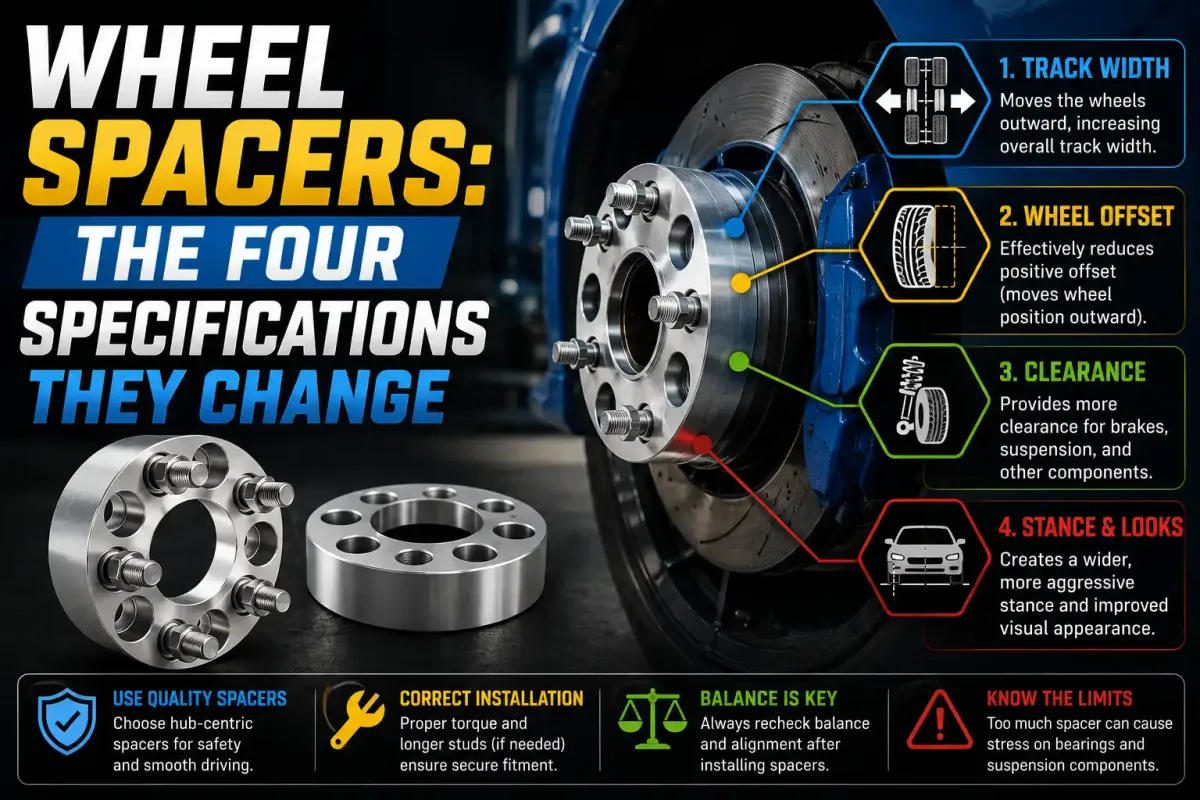
Short answer: a spacer changes four specifications at once, and the one you were trying to change is only the first. Effective offset moves. Thread engagement changes. Whatever was centering the wheel may stop centering it. And the load path through the hub and bearing lengthens. Solving a clearance problem with a spacer means accepting all four changes, not one.
This article is about what changes on paper. It does not recommend, rank or price any spacer or adapter, and it does not give a fitting procedure, because this is a safety-critical assembly and a procedure written for a general audience cannot account for the specific parts in front of you.
Spacer versus adapter: two different parts
The words get used interchangeably and they are different components.
A spacer moves the wheel outboard while keeping the same bolt pattern. It is a plate between hub and wheel, and the vehicle's own studs pass through it.
An adapter changes the bolt pattern as well as adding thickness. It bolts to the vehicle's hub with one pattern and presents a different pattern on its outer face, with its own studs.
The distinction matters because an adapter introduces a second bolted joint into the assembly, with its own fasteners, its own torque requirement and its own seats. That is a structurally different situation from a spacer, and lumping them together under one word hides it.
Change one: effective offset
A spacer moves the wheel outboard by its thickness, which is arithmetically identical to reducing the wheel's offset by that amount.
Everything that follows from a reduced offset now applies: track width increases, outer clearance to the fender decreases, inner clearance increases, and the vehicle is operating with a wheel position other than the one it was designed around.
That is usually the intended effect, and it is worth being clear that the intended effect is the offset change. The spacer is a way of achieving it, not a separate thing. Full consequences: wheel offset explained.
If offset is what you actually want to change, a wheel with the correct offset achieves it without the other three changes below. That is worth weighing.
Change two: thread engagement
This is the change most often overlooked and the one with the least forgiving failure mode.
On a spacer that the vehicle's studs pass through, the studs now have to reach through the spacer's thickness before they begin engaging the nut. The stud did not get longer. The available engagement did get shorter.
Thread engagement is what develops clamping force, and reduced engagement means the joint cannot develop what it was designed to. There is no warning: the nuts still tighten, a torque wrench still clicks, and the number of threads actually engaged is not visible once the wheel is on.
How much engagement is required is a specification, and it is not one we will supply, because it depends on the studs, the fasteners and the assembly in front of you. It is a question for the spacer manufacturer and a professional, and it is the question to ask first rather than last.
Related, because it fails the same silent way: wheel stud thread pitch.
Change three: what centers the wheel
A spacer sits between the hub and the wheel, which means it sits exactly where the hub's centering feature used to meet the wheel's center bore.
Some spacers reproduce that feature, presenting a pilot on their outer face that matches the wheel's bore while their inner bore matches the hub. Others do not, and where they do not, the hub-centering the vehicle relied on has been removed from the assembly.
If the wheel is then centered by the fasteners instead, the studs are doing a job they were not doing before, on top of a joint that already has reduced thread engagement. Those two changes compound. The mechanism: hub-centric vs lug-centric.
Change four: the load path through the hub
The wheel bearing was designed around a particular distance between the tire's load and the bearing's support.
Moving the wheel outboard increases that distance, which increases the moment the bearing sees in normal use. This is the same effect as fitting a lower-offset wheel, and it is real whether the change comes from the wheel or from a plate behind it.
It does not announce itself. There is no light, no noise at first, and no way to observe it. What it affects is how hard the bearing is working over the life of the vehicle.
Why "it fits now" is not the completed check
Clearance was the problem you set out to solve, and a spacer solves it visibly. That visibility is the trap: the one change you can see is complete, and the three you cannot see are not.
A complete check answers all four: what the effective offset is now, whether thread engagement remains adequate, what is centering the wheel, and whether the bearing loading is acceptable. Three of those four cannot be assessed by looking at the car.
The wheel bolting on and the fender clearing tells you about clearance and nothing else. That is the same lesson as everywhere in this cluster: will these used wheels fit.
Where this stops being a specification question
This site's job is to tell you what the specifications are and where to find yours. It stops at the point the question becomes whether to do it and how.
Whether a spacer is appropriate on your vehicle depends on the vehicle, the wheels, the studs and the intended use, and it is a judgement someone needs to make with the vehicle in front of them. In some jurisdictions there are also legal considerations attached to changes of this kind, which vary by location and which we are not going to characterize for you.
Take it to a tire and wheel professional. Bring the wheel specifications, the vehicle's specifications from manufacturer service information, and the spacer manufacturer's requirements. For where the vehicle's own data lives: owner's manual vs service manual vs repair database.
Frequently asked questions
Are wheel spacers safe?
That depends entirely on the specific assembly, and it turns on four things rather than one: effective offset, thread engagement, what centers the wheel, and bearing loading. Three of those cannot be assessed by looking at the fitted car.
What is the difference between a spacer and an adapter?
A spacer keeps the same bolt pattern and the vehicle's studs pass through it. An adapter changes the pattern and introduces a second bolted joint with its own fasteners and torque requirement.
Do spacers affect wheel bearings?
Yes. Moving the wheel outboard increases the moment the bearing sees in normal use, the same effect as fitting a lower-offset wheel. It gives no outward sign.
How much thread engagement do I need with a spacer?
That is a specification determined by the studs, the fasteners and the assembly, and it should come from the spacer manufacturer and a professional rather than from a general figure.
Is a lower-offset wheel better than a spacer?
It achieves the offset change without altering thread engagement or removing the hub centering feature. Whether it is the right answer for your vehicle is still a question for a professional.