Hub-Centric vs Lug-Centric: Center Bore and Vibration
Something has to center the wheel, and the two systems use different things. Here is what changes for the studs when the wrong one is doing the job.

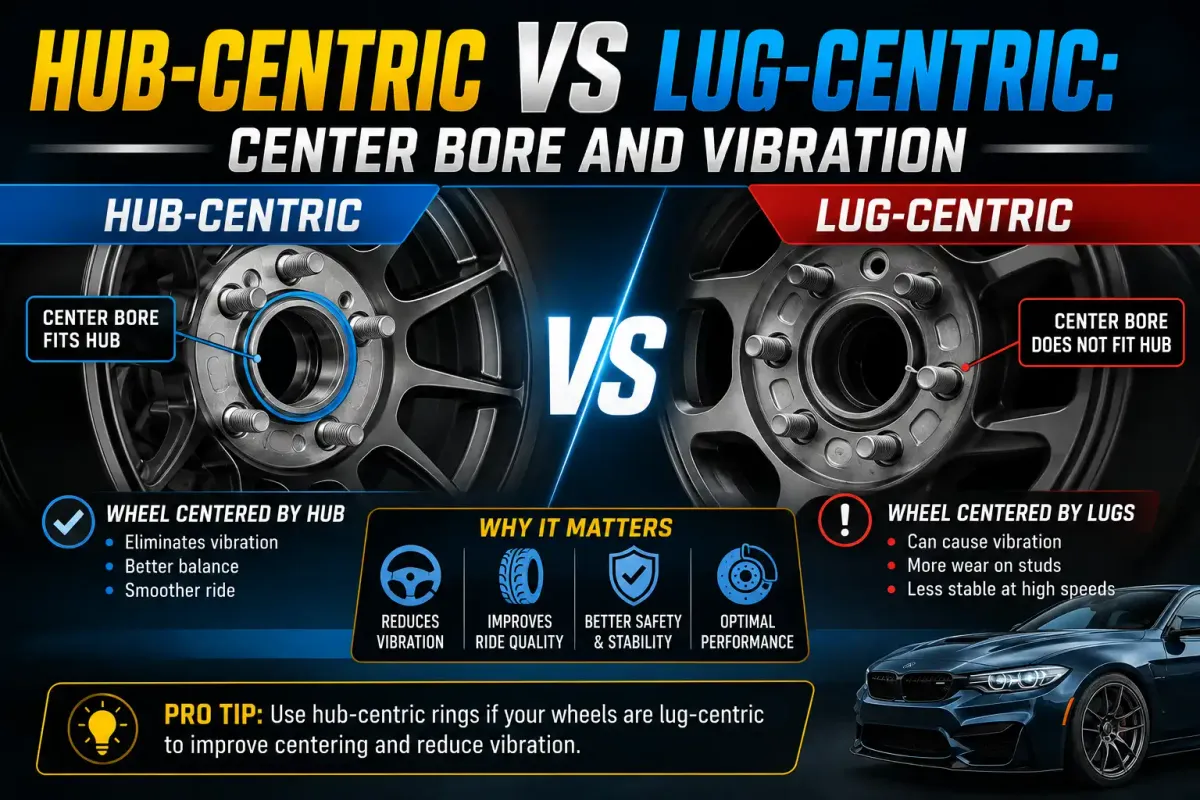
Short answer: something has to hold the wheel centered on the axle, and the two systems use different things to do it. A hub-centric wheel is centered by the hub itself, through a machined fit between the hub's flange and the wheel's center bore. A lug-centric wheel is centered by the fasteners, through the geometry of the lug seats. Both are legitimate designs. Problems arise when a wheel designed for one is fitted in a way that leaves the other doing the job.
This page explains the mechanism so you can reason about your own situation. It does not diagnose your vibration, because a vibration has several possible causes and none of them can be established from a description. If your wheels have been changed and something is now wrong, that is a conversation with a tire and wheel professional.
What the center bore is
The center bore is the large hole in the middle of the wheel, the one the bolt holes sit around.
On the vehicle side, the hub has a raised machined section, sometimes called the hub flange or the pilot, that this hole fits over. Where the two are matched, the fit between them is close, and that closeness is the point.
The center bore is also useful as a measuring reference when identifying a bolt pattern, because measuring from its center to a bolt hole gives you the pitch circle radius: how to measure bolt pattern.
Hub-centric: the hub carries the centering
In a hub-centric design, the machined fit between the hub pilot and the wheel's center bore positions the wheel.
The wheel drops onto the hub and is located by that fit before a single fastener is touched. The fasteners then clamp it in place. Centering and clamping are two different jobs done by two different features, which is the design's whole virtue.
It is also why the fit matters: a center bore larger than the hub pilot cannot center anything, because there is clearance between them. The wheel will still go on, and it will still bolt up, and nothing will be centering it.
Lug-centric: the fasteners carry the centering
In a lug-centric design, the wheel is centered by the interaction between the lug seats in the wheel and the tapered or radiused fasteners as they are tightened.
As each fastener is drawn down, the geometry of its seat pulls the wheel toward concentricity. Done correctly, with the fasteners tightened progressively in the right sequence, this centers the wheel accurately.
The dependency is the sequence. Lug-centric centering relies on the fasteners being brought down evenly, which is exactly what a proper tightening sequence exists to achieve: lug nut torque sequence.
Why the distinction changes what the studs are doing
Here is the part that makes this a safety subject rather than a comfort one.
In a properly hub-centric assembly, the hub pilot carries the wheel's radial position, and the studs are principally in tension, clamping the wheel against the hub. That is the loading studs are designed for.
When a wheel intended to be hub-centric is fitted without an effective hub fit, the studs end up carrying the wheel's position as well as clamping it. That is a different kind of loading, applied to a component sized for the first kind.
The immediate symptom is often vibration, because the wheel is not accurately concentric. The longer-term concern is the loading itself. Neither is something to live with.
Centering rings: what they do and what they do not
Aftermarket wheels are frequently made with a center bore larger than any particular vehicle's hub, so that one wheel can suit several vehicles. Centering rings, sometimes called hub rings, fill that gap.
What they do: restore a close fit between hub and wheel, so the assembly can be centered by the hub as intended.
What they do not do: carry load. A centering ring locates. The clamping force still comes from the fasteners, and the ring is not a structural component.
Two practical consequences. A ring has to actually match both the hub and the bore; a ring that is loose in either direction is not doing the job. And a ring is not a substitute for the wheel being correct in other respects, because the other five fitment specifications are unaffected by it: will these used wheels fit.
Why a wheel can bolt on and still be wrong
This is the general lesson of the whole cluster and it applies here as sharply as anywhere.
A wheel bolting on tells you the bolt holes cleared the studs and the threads engaged. It does not tell you the pattern is exactly right, that the seats are bearing correctly, that the bore is centering anything, or that the offset suits the vehicle.
Each of those is a separate check, and none of them is confirmed by the assembly going together. The seat question in particular fails in the same silent way: lug seat types, and why the wrong nut fails.
What to check, and when to stop and see a professional
Two things you can check yourself: whether your wheel's center bore closely matches your hub, and whether centering rings are fitted and correctly sized if the bore is larger.
Beyond that, stop. A vibration after a wheel change has several possible causes, several of which are not centering at all, and distinguishing between them needs the vehicle on a machine and someone who does this daily.
Take it to a tire and wheel professional, and tell them the wheels were changed and when the vibration started. That is the useful information. If the wheels are aftermarket, tell them that too, along with whether rings were supplied.
For the vehicle's own specifications, the tier above the owner's manual is where wheel data lives: owner's manual vs service manual vs repair database. And offset, which is a separate specification affecting a different aspect of the same assembly: wheel offset explained.
Frequently asked questions
What is the difference between hub-centric and lug-centric?
Hub-centric wheels are positioned by a machined fit between the hub and the wheel's center bore. Lug-centric wheels are positioned by the geometry of the lug seats as the fasteners are tightened.
Do I need hub centric rings?
If your wheel's center bore is larger than the hub and the design relies on hub centering, rings restore the fit. They locate the wheel; they do not carry load and are not a structural part.
Can the wrong center bore cause vibration?
It can, because the wheel may not be running concentric. It is one of several possible causes, which is why a vibration after a wheel change should be looked at rather than diagnosed from a description.
Is lug-centric less safe than hub-centric?
Not inherently. Both are legitimate designs. The problem is a wheel designed for one being fitted so that neither feature is centering it properly.
My wheels bolted on fine. Is centering still an issue?
Possibly. Bolting on confirms the holes cleared the studs and the threads engaged. It confirms nothing about centering, seat bearing or offset.