Backspacing vs Offset: Converting Between Two Systems
They measure the same geometry from different reference points. Converting needs a third number, overall width, and stated width is not overall width.

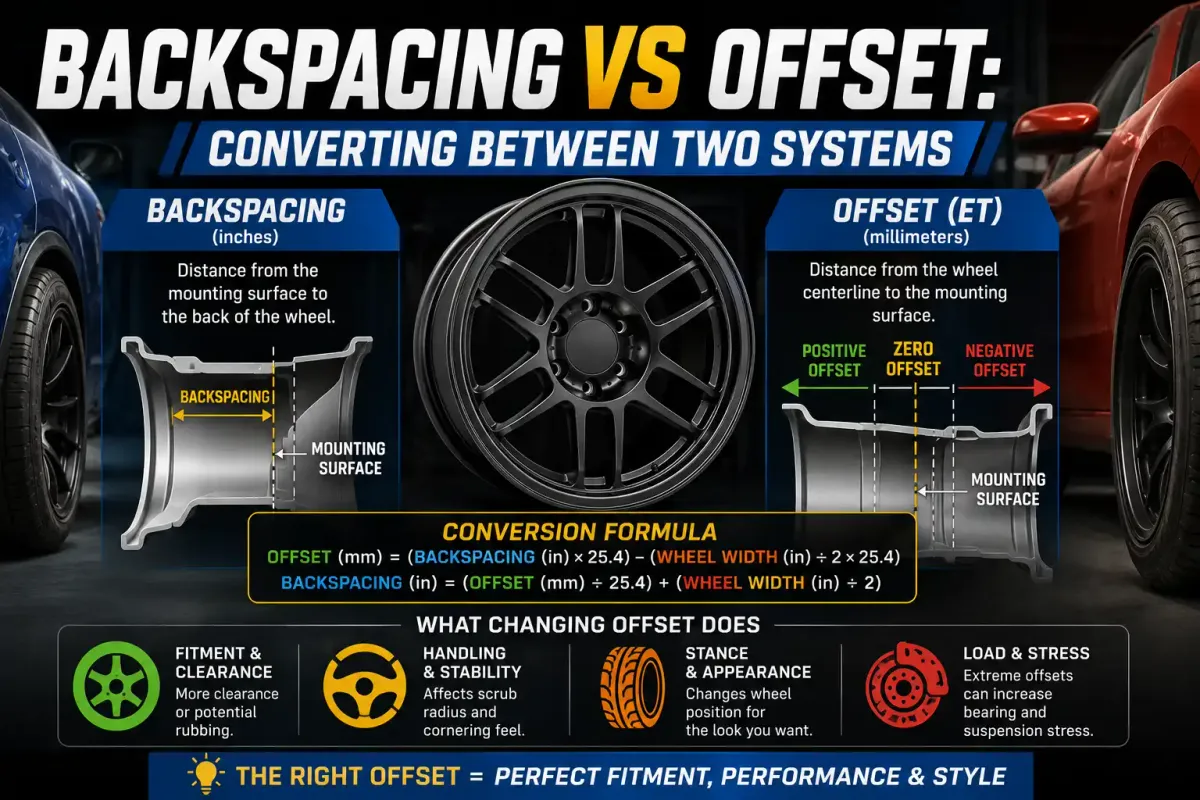
Short answer: they describe the same geometry from different reference points, and converting between them requires a third measurement that people routinely get wrong. Offset is measured from the wheel's centerline. Backspacing is measured from the wheel's inner flange. To convert, you need the wheel's overall width, and overall width is not the same as the stated width printed on the wheel.
That last sentence is where most conversions fail. Everything else here is arithmetic; that is the trap.
What backspacing measures
Backspacing is the distance from the mounting face, the surface that meets the hub, to the inner edge of the wheel.
It answers a physical question directly: how much of the wheel sits behind the mounting face, and therefore how much room it needs on the inboard side. That is why it is the traditional convention in applications where inner clearance to suspension and chassis is the binding constraint.
It is normally quoted in inches.
What offset measures
Offset is the distance from the mounting face to the wheel's centerline, where the centerline is the midpoint of the wheel's overall width.
It answers a different question: how far the wheel sits in or out relative to where a wheel of that width would sit if it were centered on the hub. That makes it the more useful convention for reasoning about track width and how the wheel relates to the vehicle.
It is normally quoted in millimeters, and marked ET on the wheel. What it does to the vehicle: wheel offset explained.
The third number you need to convert: overall width
The two measurements share a reference, the mounting face, and differ in what they measure to. Backspacing measures to the inner flange; offset measures to the centerline.
The distance between those two destinations is half the wheel's overall width. So converting between the systems requires knowing the overall width, and no conversion is possible without it.
This is why a seller quoting backspacing alone has not given you enough information to compare against an offset specification. Backspacing plus width converts. Backspacing alone does not.
Why stated width is not overall width
Here is the part that produces wrong answers.
The width printed on a wheel is the distance between the bead seats, the surfaces the tire actually sits on. It is not the wheel's overall physical width, which includes the flanges on both sides.
The flanges add real width, and that additional width is what separates stated width from overall width. Using the stated width in a conversion that calls for overall width gives you an answer that is wrong by half the flange allowance.
The practical consequence is a converted figure that looks precise and is off by a small but meaningful amount, in a specification where small amounts decide clearance. It is a textbook case of a number that has been through a conversion looking more trustworthy than it should: why two websites give your car two different numbers.
Doing the conversion in the right order
The sequence that avoids the trap:
Establish the overall width, not the stated width. That means either a physical measurement of the wheel from flange to flange, or the manufacturer's stated overall width where they publish one.
Note the unit systems. Backspacing is usually inches, offset usually millimeters. Convert units once, at the end, rather than partway through, so rounding does not compound.
Convert, then verify. Treat the result as a working figure to be checked, not as a specification.
Check the sign. The two systems run in opposite intuitive directions, and it is easy to produce a number of the right magnitude with the wrong sign. A negative offset should correspond to a large backspacing relative to the wheel's width, and vice versa. If your answer fails that sanity check, you have made an error.
Why a converted number should be verified rather than trusted
A converted figure inherits every uncertainty in its inputs.
If the width you used was the stated width rather than the overall width, the answer is wrong. If you rounded a unit conversion partway through, the answer drifts. If the seller's backspacing was measured casually with a straightedge across the flange, which is how it is usually done, the input had error in it before you started.
None of that is a reason to avoid converting. It is a reason to treat the result as approximate and to confirm the actual specification with the wheel manufacturer before buying, particularly where the wheel carries a marking that states offset directly.
Which convention to ask a seller for
Ask for the marking on the wheel, whatever it is, plus a photograph of it.
Most wheels carry cast or stamped markings on the back giving size and offset. That is the wheel stating its own specification, which is stronger than any measurement a seller takes and stronger than any conversion you perform.
If the wheel has no marking, ask for backspacing and overall width, measured flange to flange, rather than backspacing alone. That combination converts. And ask for a photograph of the back of the wheel, which will show you the seat type and the center bore as well, both of which have to be right independently: lug seat types and hub-centric vs lug-centric.
Offset is one of six things to establish before buying used wheels, and the others are here: will these used wheels fit.
Frequently asked questions
How do I convert backspacing to offset?
You need the wheel's overall width as well. The two measurements share the mounting face as a reference and differ by half the overall width, so no conversion is possible from backspacing alone.
Is the width stamped on a wheel its overall width?
No. The stated width is measured between the bead seats. Overall width includes the flanges on both sides, and using the stated width in a conversion produces a wrong answer.
Which is the better specification to work in?
Offset for reasoning about track width and how the wheel relates to the vehicle. Backspacing for inner clearance questions. Neither is more correct; they answer different questions.
Why do sellers quote backspacing?
It is the traditional convention where inboard clearance is the binding constraint, and it is easy to measure with a straightedge and a ruler.
Should I trust a converted offset figure?
Treat it as approximate. Confirm against a marking on the wheel or with the wheel manufacturer before buying, because clearance decisions turn on small amounts.