How to Measure Bolt Pattern on 4, 5, 6 and 8-Lug Wheels
Even lug counts measure straight across. Odd counts do not, which is why five-lug confuses people. Here is the method, plus the two-convention trap.

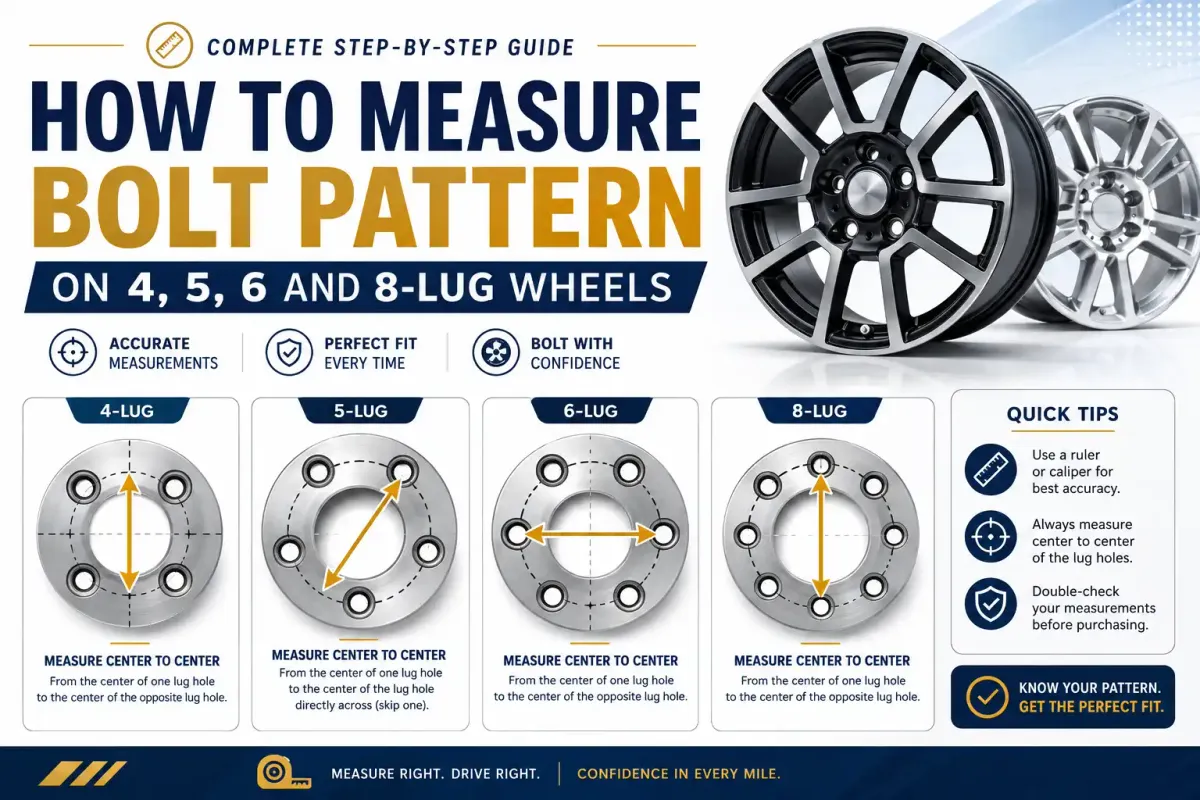
Short answer: for even lug counts you measure center to center across the hub, and for odd counts you cannot, which is why five-lug wheels confuse everybody. The pattern is a circle, and with an even number of holes two of them sit opposite each other on that circle, giving you the diameter directly. With an odd number, no two holes are opposite, so the straight-across measurement does not exist.
This page is for the reader who has a wheel in their hands and no idea what it fits. Fitment databases work the other way round, from a vehicle to a wheel, and they cannot help you here.
Bolt pattern is one of six things that have to be right, and a wheel bolting on is not evidence any of them are. The full checklist: will these used wheels fit.
What PCD is actually describing
PCD stands for pitch circle diameter. It describes an imaginary circle passing through the center of every bolt hole, and it is stated as the number of holes followed by the diameter of that circle.
Two components, both of which must match: the count and the diameter. A wheel with the right hole count and the wrong circle diameter does not fit, and neither does the reverse.
The circle is imaginary, which is the source of the difficulty. You are measuring a thing that is not physically drawn on the wheel, using the holes as your only evidence of where it runs.
Even lug counts: measuring center to center across the hub
With 4, 6 or 8 holes, two of them are diametrically opposite, and that pair sits on the circle you want.
Measure from the center of one hole to the center of the hole directly opposite. That distance is the pitch circle diameter.
The practical difficulty is finding the center of a hole rather than its edge. Two approaches help. Measure from the same edge of both holes, for example the outer edge of one to the outer edge of the other, which cancels the hole diameter out of the measurement. Or measure edge to edge both ways and take the midpoint.
Take the measurement more than once and from more than one opposite pair. Patterns that differ by small amounts are the ones that cause trouble, and a single sloppy measurement will not distinguish them.
Odd lug counts, which is why five-lug is different
With 5 or 7 holes, no two are opposite each other, so there is nothing to measure straight across.
The standard workaround is to measure from the center of one hole to the far edge of the hole two positions away, skipping one. That distance approximates the pitch circle diameter closely enough to identify a pattern, and it is the method most commonly described.
It is an approximation, and that is the honest part. It is good enough to tell you which pattern you are probably looking at from a shortlist. It is not good enough to distinguish two patterns that differ by a small amount, and several such near-pairs exist in common use.
For a five-lug wheel of unknown origin, treat your measurement as a hypothesis to be confirmed rather than as an answer.
Measuring from the center bore as a cross-check
There is a second route that works for any lug count and is worth doing as a check.
Measure from the center of the center bore to the center of any one bolt hole. That gives you the radius of the pitch circle, and doubling it gives the diameter.
This is useful because it uses a different set of features and therefore fails differently. If your across-the-hub measurement and your center-bore measurement disagree, you have made an error in one of them, and you would not have known that from either measurement alone.
The center bore has its own significance beyond being a measuring reference: center bore, and why hub-centric vs lug-centric matters.
Millimeters and inches: the same pattern, two conventions
Bolt patterns are expressed in both millimeters and inches, and the same physical pattern therefore has two written forms.
This produces two distinct problems. A reader comparing a metric-stated pattern against an imperial-stated one has to convert before comparing, and conversion introduces rounding. And some patterns that are exactly round in one system are awkward in the other, which is why published values sometimes look inconsistent between sources.
The rule that keeps you out of trouble: convert once, at the end, and compare against a stated pattern from the wheel or vehicle manufacturer rather than against a value copied between websites. Rounded values propagating between sources is a general problem in this subject: why two websites give your car two different numbers.
Patterns that are close but not identical, and why close does not fit
Several patterns in common use differ from one another by a small amount, and this is where measurement error becomes dangerous rather than merely annoying.
A wheel with a nearly-correct pattern can be pulled onto the studs and the nuts will thread. What has happened is that the studs are being loaded off-axis and the seats are not bearing correctly. The assembly looks finished. It is not.
That is why "it bolted on" is never the test. What generates and holds clamping force is the seat, and a seat bearing incorrectly does not clamp properly at any torque: lug seat types, and why the wrong nut fails.
Verifying before you buy
For a wheel of unknown origin, three steps in order:
Measure, using both methods above. Get a hypothesis and a cross-check.
Find a marking. Many wheels carry casting marks on the back giving size, offset and sometimes the pattern. That is the wheel telling you what it is, which beats your tape measure.
Confirm with the wheel manufacturer or a tire and wheel professional before fitting anything. This is a safety-relevant assembly and the cost of confirming is a phone call.
And confirm what your vehicle requires from the vehicle's own documentation rather than from a database entry: owner's manual vs service manual vs repair database.
We do not publish bolt pattern tables by vehicle. We cannot verify them across every model, year and market, and a wrong pattern is a wheel that comes off.
Frequently asked questions
How do I measure a 5-lug bolt pattern?
Measure from the center of one hole to the far edge of the hole two positions away, skipping one. It is an approximation, so treat the result as a hypothesis and confirm it before buying.
Why can I not measure five-lug straight across?
Because with an odd number of holes no two are diametrically opposite, so there is no pair sitting on the diameter of the pitch circle.
What does PCD mean?
Pitch circle diameter, the diameter of the imaginary circle passing through the center of every bolt hole. A pattern is the hole count plus that diameter.
The wheel bolted on, so does it fit?
No. A nearly-correct pattern will thread on while loading the studs off-axis and preventing the seats bearing correctly. Bolting on is not the test.
Is a bolt pattern in inches the same as one in millimeters?
It can be the same physical pattern written two ways. Convert once at the end and compare against a manufacturer-stated value rather than a figure copied between websites.