Briggs and Stratton Spark Plug Chart 2026: Official Gaps
Briggs & Stratton's official spark plug part numbers and gaps for flathead and OHV engines, plus the Quantum .020 in exception decoded.

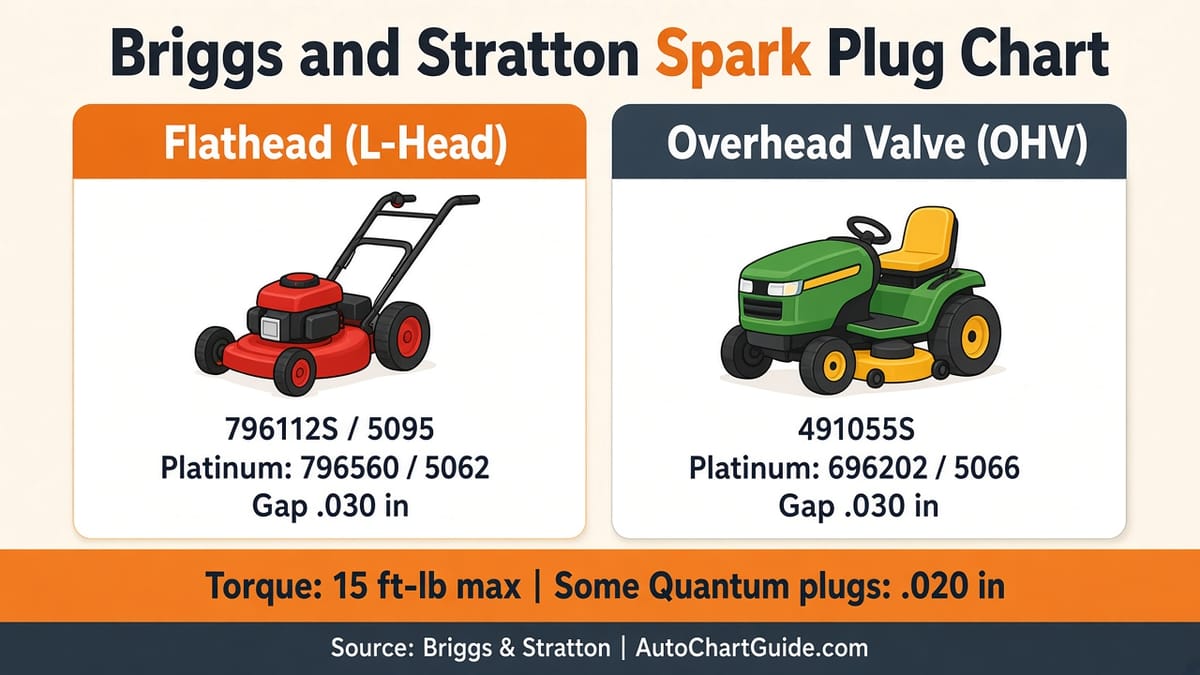
Short answer: Most Briggs & Stratton engines take a .030 in (0.76 mm) spark plug gap. For flathead (L-head) engines, Briggs & Stratton's own chart lists part numbers 796112S, 802592S or 5095 (standard resistor) and 796560 / 5062 (platinum). For overhead valve (OHV) engines, they are 491055S (resistor, replaces Champion RC12YC) and 696202 / 5066 (platinum). The exceptions are some Quantum engines, which use plugs 591868 or 799876 at .020 in depending on build date, and one 692051 listing at .020 in. Tighten the plug to 15 ft-lb (180 in-lb, 20.3 N·m) maximum. Don't regap platinum, iridium or twin-tip plugs.
Every part number and gap below comes from Briggs & Stratton's own spark plug FAQ (updated April 6, 2026) and its service pages, read on October 26, 2026. Briggs & Stratton says to check your engine manual before doing any maintenance, and so do we. The chart tells you what each plug is for, but your engine's model, type and code numbers decide which one is right.
Briggs and Stratton Spark Plug Chart: Flathead (L-Head) Engines
Briggs & Stratton says flathead engines, also called L-head or side-valve engines, are "commonly used for walk behind lawn mowers and pressure washers."
| Plug type / application | Briggs & Stratton part number(s) | Gap |
|---|---|---|
| Standard resistor | 796112S, 802592S, 5095 | .030 in |
| Electromagnetic suppression (EMS) | 697451 | .030 in |
| Extended Life Series L-head platinum | 796560, 5062 (5062D, 5062H) | .030 in |
| Replaces Champion CJ8, RCJ8, RJ19HX, J19LM, RJ19LM | 796560, 5062 (5062D, 5062H) | .030 in |
| Replaces Champion RJ19LMC (Quantum engines) | 591868 | .020 in after code date 110630; .030 in before 110701 |
| Replaces Champion RJ2YLE (Quantum 625, 675, 725 built after code 110701xx) | 799876 | .020 in |
| "Surefire" RJ2YXLE (Craftsman Smooth Start MRS mower) | 591040 | .030 in |
Briggs and Stratton Spark Plug Chart: OHV Engines
Overhead valve engines are used across riding mowers, generators, pressure washers and other equipment. Briggs & Stratton's OHV table lists these replacements:
| Plug type / application | Briggs & Stratton part number(s) | Gap |
|---|---|---|
| Resistor, Vanguard models 050032 and 086400 only (replaces Champion RC12YC) | 692051 | .030 in |
| Resistor (replaces Champion RC12YC) | 491055S | .030 in |
| EMS (replaces Champion QC12YC) | 691043, 792015 | .030 in |
| Extended Life Series OHV platinum (replaces Champion RC12YC) | 696202, 5066 (5066D, 5066H) | .030 in |
| Resistor, hotter spark (replaces Champion RC14YC) | 496018S, 5092 | .030 in |
| Resistor | 692051 | .020 in |
| EMS (if not Champion QC12YC model; check Illustrated Parts List) | 692720 | .030 in |
What the Chart Tells You at a Glance
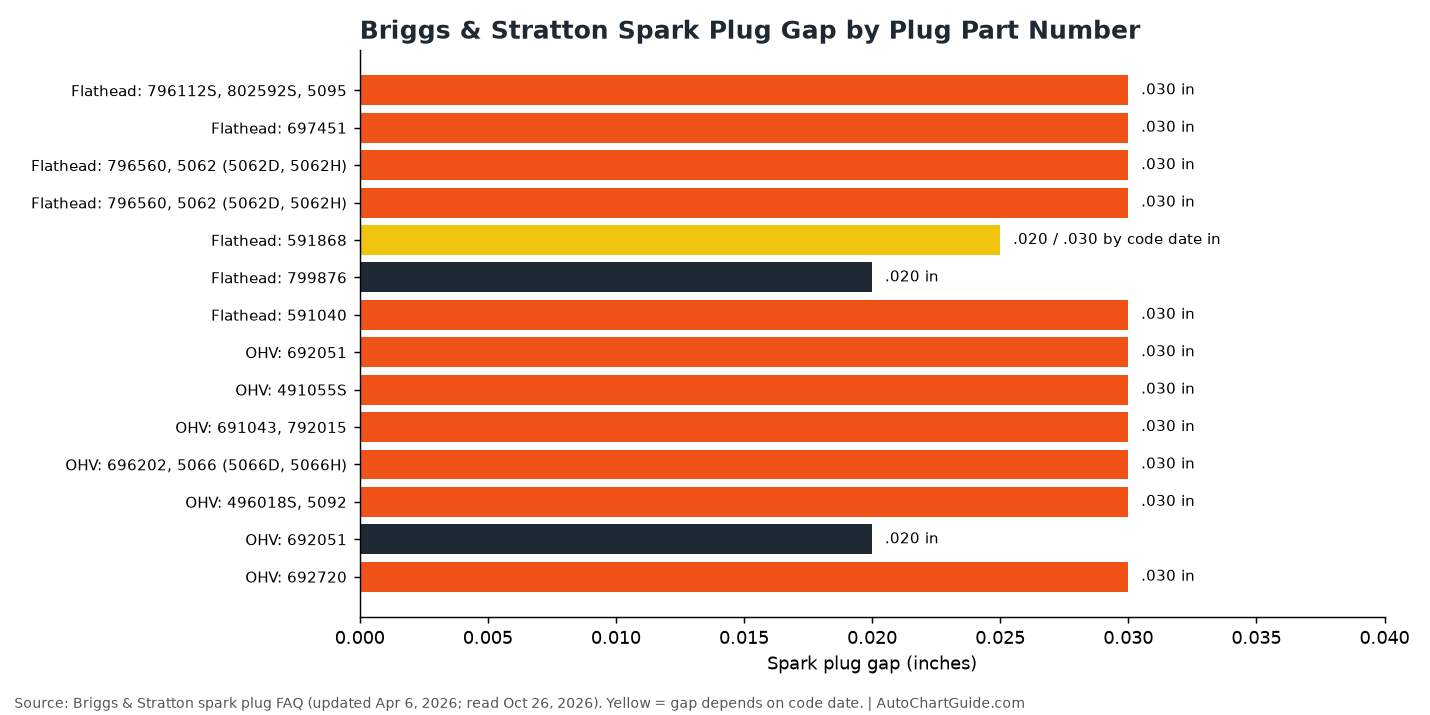
We counted every row in Briggs & Stratton's two tables. Of 14 plug listings, 11 specify .030 in, 2 specify .020 in (799876 for later Quantum engines, and a 692051 resistor listing), and 1 depends on the engine's code date (591868 for Quantum engines). So .030 in is the default, but you can't assume it, especially on a Quantum.
The gap figures convert exactly to metric: .030 in = 0.762 mm and .020 in = 0.508 mm. These are usually rounded to 0.76 mm and 0.51 mm, and Briggs & Stratton's own manuals print .030 in as 0.76 mm.
The chart also includes Champion cross-references, because many original plugs were Champion. When an old plug says RC12YC, the OHV table points you to 491055S, the 696202 / 5066 platinum, or (for Vanguard models 050032 and 086400 only) 692051. A Champion RC14YC maps to the hotter 496018S / 5092. Briggs & Stratton's shop page for 491055S says it replaces older Briggs numbers 491055, 805015, 594056, 72347GS and 72347.
Two Entries That Need Extra Care
Quantum engines and the code date
The Quantum row reads as if it contradicts itself. Briggs & Stratton lists plug 591868 (replaces Champion RJ19LMC) at ".020" for engines built after Code Date 110630x" and ".030" – built before Code Date 110701xx." The code system explains it. Briggs & Stratton's manufacture-date FAQ says the code number is read as year, month, day, then plant and line. So 110630 is June 30, 2011 and 110701 is July 1, 2011. In plain terms:
- Quantum built on or before about June 30, 2011: .030 in with 591868.
- Quantum built from July 1, 2011: .020 in with 591868, or the 799876 plug (replaces Champion RJ2YLE) for Quantum Series 625, 675 and 725 engines, also at .020 in.
The two dates in Briggs & Stratton's wording overlap by a day, so if your code date falls right on the boundary, confirm with the manual or a Briggs & Stratton dealer. Briggs & Stratton also notes that the 799876 plug is "not for Quantum engines built before Date Code 110701xx or other L Head engines."
The 692051 plug appears twice
Part number 692051 appears in the OHV table twice. It's listed at .030 in as a resistor plug "used on Vanguard models 050032 and 086400 only," and separately as a plain resistor at .020 in. The chart doesn't say which engines the .020 in listing applies to. If your parts list calls for 692051, take the gap from your engine's manual, not from the chart.
How to Tell a Flathead From an OHV Engine
You need to know the engine type before you can use the right table. Briggs & Stratton's model number system answers this. Its "Your Key to the World's Finest Engines" chart explains that in a post-1965 model number:
- The first one or two digits are the approximate cubic-inch displacement.
- The next digit is the basic design series, which relates to cylinder construction, ignition and general configuration.
- The next digit is the crankshaft orientation (0 to 4 or A to G horizontal; 5 to 9 or H to Z vertical).
- The next digit is the bearing type and whether there's a reduction gear or auxiliary drive.
- The last digit is the starter type.
Briggs & Stratton's own example is model 303447: 30 cubic inches, design series 3, horizontal shaft, ball bearing with pressure lubrication, and electric starter with alternator. The model number doesn't simply say "flathead" or "OHV," but it does lead you to the right engine in Briggs & Stratton's parts lookup and manuals.
A practical check: on an OHV engine, the valves sit in the cylinder head under a rocker cover, and the spark plug is in the head. On a flathead, the valves are in the block beside the cylinder and there's no rocker cover. If you're unsure, the model number is the reliable route. The same split decides which row you use in our Briggs & Stratton valve clearance chart, where flathead and OHV engines need very different gaps.
Where to Find Your Engine's Model, Type and Code
Briggs & Stratton says the model, type and code numbers are stamped directly into the engine. The same numbers also pick the right filter in our Briggs and Stratton oil filter chart. On lawn mower engines, they're usually on the blower housing, the muffler heat shield, or a few inches above the spark plug, and may also be on the fuel tank and the base of the block. On many horizontal-shaft OHV engines, they're on the rocker cover. Some shrouds cover the numbers and have to be removed.
One warning from Briggs & Stratton: the numbers on the engine emissions label can be confused with the model, type and code, but they can't be used to identify the engine. If you work on cars too, this is the same problem covered in our guide to how to find your engine code: the identifying number is in a specific place, and nearby labels are easy to mistake for it.
The type number identifies the engine's mechanical parts, paint, decals, governed speed and original equipment manufacturer. Two engines with the same model number can need different parts because of the type. The code number is the build date, which is exactly what you need for the Quantum gap question above.
How to Gap and Install a Briggs & Stratton Spark Plug
Briggs & Stratton's own steps, condensed:
- Disconnect the spark plug lead and clean around the plug so debris can't fall into the combustion chamber.
- Remove the plug with a spark plug socket.
- Inspect it. Replace it if it has stubborn deposits, cracked porcelain or burned-away electrodes. Light deposits can be cleaned with a wire brush and spray-on plug cleaner. Briggs & Stratton says never to clean a plug with a shot blaster or abrasives.
- Check the gap with a spark plug gauge. "When the gap is correct, the gauge will drag slightly as you pull it through the gap." Adjust by gently bending the curved (side) electrode.
- Don't regap platinum, iridium or twin-tip plugs. Briggs & Stratton warns that their fine electrodes may be damaged. This includes the 5062 and 5066 Extended Life Series platinum plugs in the chart.
- Install without over-tightening: 15 ft-lb maximum, which Briggs & Stratton also gives as 180 in-lb (20.3 N·m). Then reconnect the lead.
A small torque wrench reading in inch-pounds is the easiest way to stay under the limit. If you need to convert units, 180 in-lb ÷ 12 = 15 ft-lb, and our ft-lb to N·m conversion guide shows the full method. If you don't use a torque wrench often, our guide to how to read a torque wrench covers the scales.
How Often to Check or Replace a Briggs & Stratton Spark Plug
Briggs & Stratton gives two intervals on two pages. Its spark plug servicing FAQ says to check and/or replace plugs "once a season," "every 25 hours of use," or "if your lawn mower or outdoor power equipment won't start." Its "How to Change a Spark Plug" page recommends changing plugs "every 100 hours or every season." Read together: inspect every 25 hours or each season, and replace at least every 100 hours or each season, or sooner if the plug fails inspection. Your engine manual's schedule takes priority over both.
Troubleshooting: When a New Plug Doesn't Fix It
Briggs & Stratton offers a simple test. After fitting the plug, try starting the engine. "If the engine tries to turn over (even for a second) and dies, then you have spark," so the problem probably lies elsewhere: fuel, carburetor or valves. If the engine doesn't fire at all, the ignition system may be at fault, and Briggs & Stratton suggests checking it with a spark tester (coil, switch, flywheel).
Worn or dirty plugs need more voltage to fire, and on a pull-start engine that means a harder pull. Briggs & Stratton links them to hard starting, higher fuel use, cylinder-head deposits and oil dilution. A plug costs little compared with the time spent chasing those symptoms, so replacing it is a sensible first step.
Also check you have the right plug, not just one that fits. Briggs & Stratton warns that "although several different spark plugs may screw into the engine, using the incorrect one will result in performance problems and possible internal engine damage." Reach and heat range matter as much as thread size. Heat range numbers do not carry across brands; see how heat range numbers compare across brands.
Manual, Parts List or Chart: Which Wins?
Use them in this order. First, the engine's operator or repair manual for your model and type. Second, Briggs & Stratton's Illustrated Parts List, which the chart itself points to for the 692720 EMS plug. Third, the general chart above. A good Briggs & Stratton dealer can confirm from your model, type and code. The difference between a general guide and engine-specific documentation is the same one we explain in owner's manual vs service manual.
Frequently Asked Questions
What spark plug does a Briggs and Stratton lawn mower take?
It depends on the engine. Many walk-behind mowers have flathead engines, which Briggs & Stratton covers with 796112S, 802592S or 5095 (standard resistor) and 796560 / 5062 (platinum). OHV engines commonly use 491055S or the 696202 / 5066 platinum. Check your engine model, type and code to confirm.
What is the spark plug gap for a Briggs and Stratton engine?
.030 in (0.76 mm) for most plugs in Briggs & Stratton's chart. The exceptions are .020 in (0.51 mm) for Quantum engines built from July 2011 with 591868 or 799876, and the .020 in 692051 listing.
What does 491055S replace?
Briggs & Stratton says 491055S replaces Champion RC12YC and older Briggs numbers 491055, 805015, 594056, 72347GS and 72347.
How tight should a Briggs and Stratton spark plug be?
No more than 15 ft-lb (180 in-lb, 20.3 N·m), according to Briggs & Stratton.
Can I gap a platinum Briggs & Stratton plug?
Briggs & Stratton says not to change the gap on platinum, iridium or twin-tip plugs, because the fine electrodes may be damaged.
Is 5062 the same as 796560?
Briggs & Stratton lists them together as Extended Life Series L-head platinum plug options in the flathead table, with 5062D and 5062H variants.
How do I know if my Quantum engine needs .020 or .030?
Read the code number. The first six digits are year, month and day. Briggs & Stratton's chart gives .020 in for engines built after code date 110630 (June 30, 2011) and .030 in for engines built before 110701 (July 1, 2011).
Can I use a Champion plug instead?
Briggs & Stratton's chart lists the Champion numbers each of its plugs replaces, such as RC12YC for 491055S. The chart is about Briggs & Stratton replacements, so for any other brand, confirm the equivalent with that plug maker's cross-reference and your engine manual. Our spark plug cross reference chart shows what NGK and DENSO each list for a Champion RC12YC.
Sources
- Briggs & Stratton, "What is the right spark plug and gap for my small engine?": both spark plug tables, gaps and cautions (updated Apr 6, 2026; read Oct 26, 2026).
- Briggs & Stratton, "How do I check, clean and change small engine spark plugs?": inspection intervals, cleaning, 15 ft-lb / 180 in-lb / 20.3 N·m torque.
- Briggs & Stratton, "How to Change a Spark Plug": 100-hour/season replacement, gauge and gap-adjust method.
- Briggs & Stratton, "Your Key to the World's Finest Engines" (model number key, PDF): model numbering system and example 303447.
- Briggs & Stratton, "How Can I Find the Engine Serial / Model Number, Type & Trim?": where model, type and code numbers are stamped; emissions label warning.
- Briggs & Stratton, "What year was my small engine manufactured?": reading the code number as a build date.
- Briggs & Stratton Online Store, 491055S Spark Plug: 491055S supersessions.