How to Read a Torque Wrench: Click, Beam and Digital
Each type tells you it reached the figure differently, and each can be misread. Here are the technique errors that matter more than the tool you own.

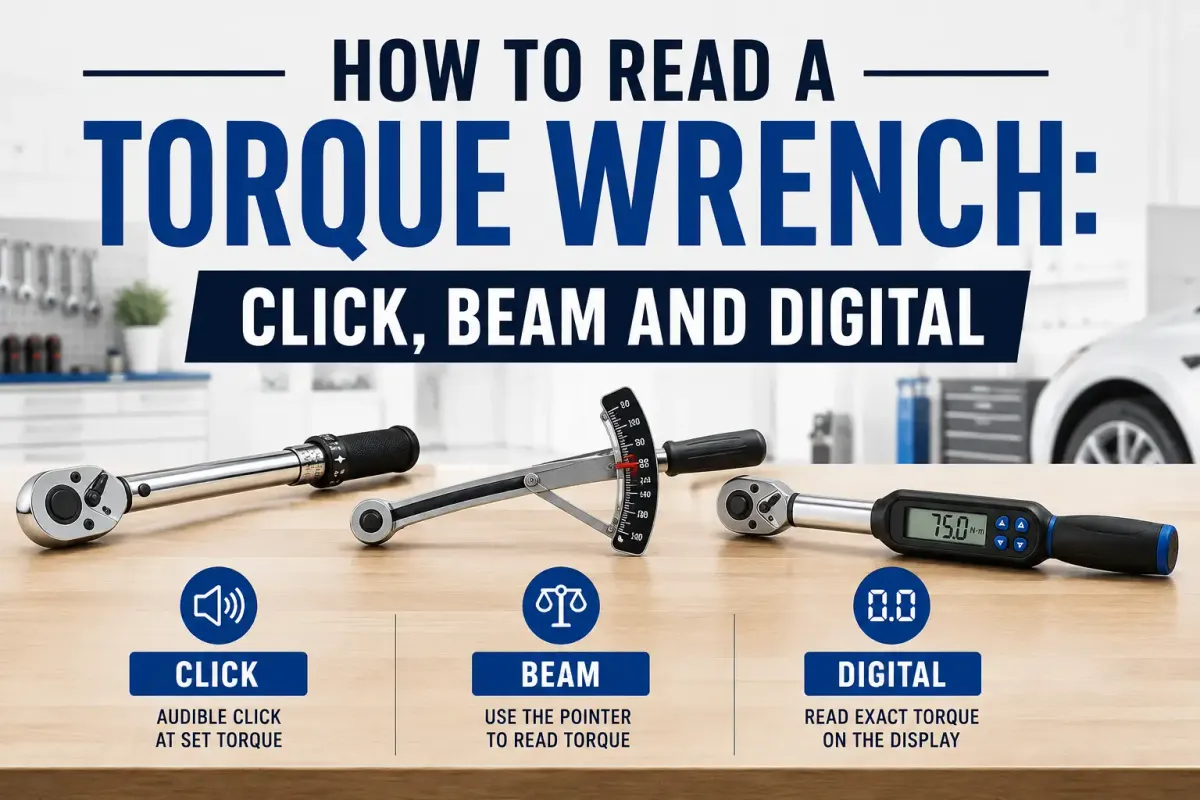
Short answer: each type signals that it reached the figure in a different way, and each can be misread by someone doing everything else right. A click wrench tells you once and then stops helping. A beam wrench tells you continuously and requires you to be looking from the right place. A digital wrench tells you numerically and can still be defeated by how you pull it.
This page is about technique, not about which wrench to own. It covers how each type is read correctly and the specific errors that produce a wrong result while the tool is working perfectly.


As an Amazon Associate we earn from qualifying purchases.
The beam wrench and reading it square
A beam wrench has a pointer that stays still while the beam bends under load, and you read the pointer against a scale.
Its virtue is that it is showing you the torque continuously, so you can see it rising and stop exactly where you want. It also has no mechanism to go out of adjustment, which is why it is often used as a reference.
Its error mode is parallax. The pointer sits above the scale, so reading it from an angle gives a value that is wrong in the direction you are leaning. In a wheel well, under a car, or anywhere you cannot get your eye directly over the scale, that error is easy to introduce and impossible to notice.
Get square to the scale, or use a mirror, or use a different tool for that fastener.
The click wrench and what the click means
A click wrench is set to a value and releases with an audible and tactile click when the mechanism reaches it.
The click is a single event. It tells you the tool reached the setting at that instant. It does not tell you anything afterward, and this is the whole difficulty with the type: a click wrench is silent about everything except one moment.
The click can also be missed. In a noisy workshop, wearing gloves, at an awkward angle, or on a large wrench where the release is less pronounced, an operator can go past it. That is why the next section is the most important one on this page.


As an Amazon Associate we earn from qualifying purchases.
The most common click wrench error: continuing past it
Once the wrench has clicked, the fastener is at the setting, and any further movement takes it beyond.
A click wrench does not stop. It releases, and then, if you keep pulling, it re-engages and continues tightening. Nothing prevents you from clicking the same fastener three or four times, each time adding more, and the tool will click obligingly every time.
The discipline is to stop at the first click and take the tool off the fastener. Not to check it clicks again. Not to give it a little more to be sure. The click was the answer.
The related habit that causes trouble: going around the wheel a second time after everything has been torqued, hearing no clicks, and concluding all is well. Depending on the joint and the tool, re-checking a correctly torqued fastener can move it slightly further. If a re-check is part of the specification, that is the specification. Doing it out of anxiety is not.
Where re-checking genuinely is called for after a wheel service: re-torquing after a wheel service.
Digital and electronic wrenches
Digital wrenches display torque as you apply it and generally alert by sound, light or vibration at the setting.
They combine the beam wrench's continuous reading with the click wrench's alert, and many will also measure angle, which matters for staged specifications: torque plus angle explained.
The error modes are ordinary electronics problems. They depend on a battery, and behavior at low battery is a question for the manufacturer's documentation rather than an assumption. They can be set to a mode or unit other than the one you think, which is exactly the failure that turns foot-pounds into inch-pounds: ft-lb, Nm and kg-m conversion.
Check the unit on the display before every use, not just the number.
Where you hold the wrench, and why it changes the reading
Torque wrenches are calibrated for force applied at a particular point, and gripping somewhere else changes the effective leverage.
Most wrenches are designed to be held at the middle of the handle, and many carry a mark or a shaped grip indicating where. Holding further out increases the leverage you are applying relative to what the mechanism is measuring, which on some designs means the fastener ends up beyond the setting.
Two related habits. Do not extend a torque wrench with a pipe, which changes the geometry the tool was calibrated for entirely. And be aware that an extension between the wrench and the socket can change the relationship on some designs, particularly a crow's foot or an offset adapter, which is a case to look up rather than assume. Start with a socket that fits the head properly, too. Our socket size chart, metric and standard lists the exact sizes.


As an Amazon Associate we earn from qualifying purchases.
Smooth pull versus jerk
Apply force smoothly and continuously, and let the tool arrive at the setting.
A jerked or snatched pull applies a dynamic load the mechanism was not designed to measure, and the result can be past the setting before the tool releases. It is the same reason an impact wrench cannot set torque: pulses and measurement do not go together: why an impact wrench is not a torque setting.
Slow down as you approach the setting rather than pulling at a constant rate through it. On a click wrench in particular, arriving fast means you have already moved past the release before your hand reacts.
Setting, resetting and storing a click wrench
The single most useful habit with a click wrench: return it to its lowest setting before putting it away.
The mechanism is a spring held under compression at the set value. Storing a wrench at a high setting leaves that spring loaded indefinitely, which is not what it was designed for and can affect the tool over time.
Two related points on setting. Approach the setting from below rather than winding down to it, because the mechanism's behavior on the way down is not necessarily the same as on the way up. And be certain which scale you are setting on a dual-scale wrench, since the secondary scale often has coarser graduation.
None of this tells you whether the tool is still accurate, which is a separate question with its own answer: torque wrench calibration, how often.
And the correct technique on the wrong figure is still the wrong outcome. Where yours actually comes from: how to find the torque spec for any fastener. The sequence it has to be applied in: torque sequence and why order matters.


As an Amazon Associate we earn from qualifying purchases.
Frequently asked questions
What does the click on a torque wrench mean?
That the mechanism reached the setting at that instant. It is a single event and tells you nothing afterward, which is why continuing to pull past it adds more torque.
Should I click a fastener more than once?
No. Stop at the first click and take the tool off. Re-checking out of caution can move the fastener further, unless a re-check is part of the specification.
Where should I hold a torque wrench?
At the point the tool was designed for, usually the middle of the handle, often marked. Holding further out changes the effective leverage and can take the fastener past the setting.
Should I store a click wrench at its lowest setting?
Yes. The mechanism is a spring held compressed at the set value, and leaving it loaded indefinitely is not what it was designed for.
Which type of torque wrench is most accurate?
That depends on the individual tool and its condition rather than the type, and accuracy is a calibration question. This site does not recommend or rank tools.