Spark Plug Heat Range Chart 2026: Official Maker Scales
DENSO's published heat range conversion table for NGK, DENSO, Champion and Bosch, each maker's own scale, and what the makers say about going hotter or colder.

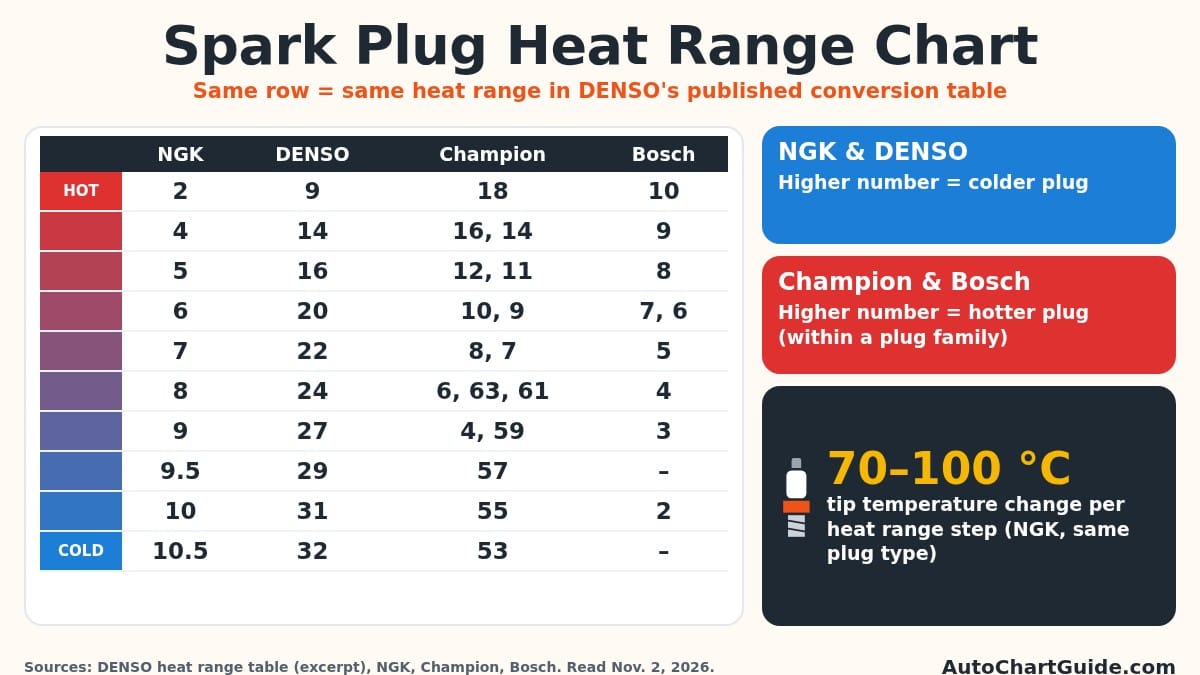
Short answer: A spark plug heat range chart lines up each brand's heat number for the same thermal behavior. In DENSO's published conversion table, NGK 6 = DENSO 20 = Champion 10 or 9 = Bosch 7 or 6, and NGK 5 = DENSO 16 = Champion 12 or 11 = Bosch 8. The numbers run in opposite directions: for NGK and DENSO a higher number is a colder plug, while for Champion and Bosch a higher number is a hotter plug. NGK says one heat range step moves tip temperature by about 70°C to 100°C, so stay with the heat range your engine maker lists unless you have a reason to change it.
The chart and the rules on this page come only from the plug makers' own documents, read on November 2, 2026: DENSO's Identifying DENSO Plugs heat range table and Heat Range page, NGK Spark Plugs USA's Spark Plug Basics and Understanding Spark Plug Heat Range, Champion's heat range tech tip, Bosch's spark plug catalogue, and Autolite's heat range guide. We have not tested any plug. Every equivalence below is a maker's published claim, and we say whose claim it is.
Spark Plug Heat Range Chart: NGK, DENSO, Champion and Bosch
DENSO is the only maker in our sources that publishes one table lining up four brands' heat numbers. Here it is in full, all 13 rows, hottest at the top.
| NGK | DENSO | Champion | Bosch |
|---|---|---|---|
| – | 4 | – | – |
| 2 | 9 | 18 | 10 |
| 4 | 14 | 16, 14 | 9 |
| 5 | 16 | 12, 11 | 8 |
| 6 | 20 | 10, 9 | 7, 6 |
| 7 | 22 | 8, 7 | 5 |
| 8 | 24 | 6, 63, 61 | 4 |
| 9 | 27 | 4, 59 | 3 |
| 9.5 | 29 | 57 | – |
| 10 | 31 | 55 | 2 |
| 10.5 | 32 | 53 | – |
| 11 | 34 | – | – |
| 11.5 | 35 | – | – |
Source: DENSO, "Identifying DENSO Plugs," heat range table, read November 2, 2026. Hottest at the top, coldest at the bottom. Read across one row. A dash means DENSO lists no number for that brand on that row. DENSO lists its own number 4 with no equivalents. Autolite is not in the table.
Read it one row at a time. If your old plug is a Champion with a 9 in the middle, its row also holds NGK 6, DENSO 20 and Bosch 7 or 6. That is where to start when you look for an equivalent in another brand. It is not a finished answer, because heat range is only one of the properties that must match. Thread, reach, seat, resistor and electrode design matter too, as our guide to reading a spark plug part number explains.
Three details in the table are easy to miss:
- DENSO's numbers are labels, not a scale. The steps between DENSO numbers are uneven: 9 to 14 is a jump of five, 20 to 22 a jump of two, and 31 to 32 a jump of one. A DENSO 24 is not colder than a 22 by any fixed amount. It is simply one row colder.
- Two Champion or Bosch numbers can share a row. Champion 10 and 9 both sit beside NGK 6, and so do Bosch 7 and 6. That means DENSO treats those numbers as close enough to the same NGK step, not that the two plugs are interchangeable in every other way.
- The cold end is mostly NGK and DENSO. Bosch's last entry is 2, on the NGK 10 row. From NGK 9.5 down, Champion's only entries are its high-performance numbers 57, 55 and 53, and NGK 11 and 11.5 have only DENSO equivalents. NGK's half steps (9.5, 10.5, 11.5) appear only at this end.
Which Way Each Brand's Heat Numbers Run
This is the single most common source of mistakes. Two of the big brands count one way and two count the other, so the same number means opposite things.
| Brand | Where the heat number sits | Higher number means | What the maker says |
|---|---|---|---|
| NGK | Middle of the code (BKR6E); after the hyphen on R-type racing plugs (R5671A-11) | Colder | "lower numbers indicate a hotter type, higher numbers indicate a colder type" |
| DENSO | Number after the shell letters (K20PR-U) | Colder | Calls a cold plug "high heat range (cold type)" |
| Champion | Middle number (RC9YC) | Hotter, within a plug family | "The higher the number, the hotter the plug" |
| Bosch | Number after the resistor letter (FR7DC) | Hotter (11 is hottest, 05 coldest) | "A hot spark plug (high heat value) dissipates heat more slowly" |
| Autolite | Within the part number, per family | Hotter (Autolite: "HIGHER Heat Range," "HOT PLUG") | Not in DENSO's table; no cross-brand heat chart in the Autolite documents we read |
Sources: NGK Spark Plug Basics and Decoding Spark Plug Part and Stock Numbers; DENSO Heat Range and Identifying DENSO Plugs; Champion Decoding Champion Spark Plugs; Bosch Spark Plug Catalogue (2025); Autolite Understanding Heat Range. Example codes are plugs that appear in those makers' published lists.
The wording is as confusing as the numbers. DENSO calls a cold plug "high heat range (cold type)" and a hot plug "low heat range (hot type)," because a cold plug moves more heat. Autolite's sheet uses the opposite words: its short-insulator, fast-cooling plug is a "LOWER Heat Range" and a "COLD PLUG," and its long-insulator plug is a "HIGHER Heat Range" and a "HOT PLUG." Bosch also calls its hot plug a "high heat value" plug. So when DENSO's catalogue says a tuned engine needs the heat range "increased," it means a colder plug. If you read the same words from Autolite or Bosch, you would assume a hotter one. When in doubt, ignore "high" and "low" and look for the words hot and cold.
NGK Heat Range Numbers
On a standard NGK plug the heat range is the number in the middle of the code. In BKR6E it is the 6. NGK says lower numbers are hotter and higher numbers are colder, so an NGK 5 is one step hotter than an NGK 6 and an NGK 7 is one step colder. DENSO's table shows NGK numbers from 2 (hottest listed) to 11.5 (coldest listed), with no NGK 3 row.
NGK's racing plugs are the exception. NGK's part number guide uses the R5671A-11 as its example: "R5671A represents the plug type and -11 represents the heat range." On those plugs, read the number after the hyphen, not the digits in the type number. The same guide warns about a different number that looks meaningful: the stock number printed on the box "has no relation to heat range or plug type."
NGK also explains what physically sets the number. The main factor is the length of the insulator nose. A hotter plug has a longer nose, so heat has further to travel to the metal shell and the firing end stays hotter. NGK also lists the insulator's surface area, thermal conductivity, a copper core in the center electrode, and how far the insulator tip projects. That is why two plugs can look almost the same and still be one heat range apart.
DENSO Heat Range Numbers
On a DENSO plug the heat range is the two-digit number after the shell letters. In K20PR-U the 20 is the heat range, and in K16PR-U it is 16. Higher DENSO numbers are colder, the same direction as NGK, which is why DENSO 20 sits beside NGK 6 and DENSO 16 beside NGK 5.
DENSO's spark plug catalogue adds a short selection guide. For a normal vehicle it says to use the standard heat range plug. If you often drive at low speeds or short distances and carbon fouling keeps coming back, it says a low heat range (hotter) plug might help. Its own chart runs from 20, for preventing carbon and oil fouling, to 31, for preventing plug overheating. For tuned engines it says the heat range "must be increased according to the level of tuning," meaning colder in DENSO's terms, and that choosing it is "at your own discretion and responsibility."
Champion Spark Plug Heat Range Chart
Champion's part number guide says the middle number is the heat range and "the higher the number the hotter the heat range." Champion also says its numbers "don't indicate degrees; they're product codes." Champion publishes its own chart, split into three plug families.
| Automotive & small engine | General & industrial | High performance |
|---|---|---|
| 23 | – | – |
| 21 | – | – |
| 20 | – | – |
| 19 | 95 | – |
| – | 92 | – |
| 18 | 91 | – |
| 17 | 90 | – |
| 16 | – | – |
| 15 | – | – |
| 14 | – | – |
| 13 | – | – |
| 12 | 86 | – |
| 11 | – | – |
| 10 | – | – |
| 9 | – | – |
| 8 | – | – |
| 7 | – | – |
| 6 | 85 | 63 |
| 5 | 82 | 61 |
| 4 | 81 | 59 |
| – | 79 | – |
| – | 78 | – |
| 3 | 77 | 57 |
| – | 76 | – |
| – | 75 | – |
| 2 | – | 55 |
| 1 | – | 54 |
| – | – | 53 |
Source: Champion, part numbering structure brochure (2021), heat range chart, which matches the chart on Champion's US "Choosing the Right Spark Plug Heat Range" page. Hottest at the top. Each row is one position on Champion's chart; Champion does not say the rows are equal temperature steps.
The family matters as much as the number. Champion's guide groups the numbers like this: 1 to 20 for automotive and small engine plugs, 20 to 49 for historical aviation, 50 to 65 for high-performance racing, and 65 to 100 for industrial and small engine plugs. It adds that "the Racing and Industrial plug families run colder than the automotive plug family even though they have higher numbers." So a Champion 63 is not hotter than a Champion 12. On Champion's chart it sits on the same row as an automotive 6. Small engines use their own plug lists too: our Briggs and Stratton spark plug chart shows the plugs Briggs & Stratton itself lists, with Champion numbers alongside.
Champion's chart and DENSO's table mostly agree, with one small difference we found. DENSO groups Champion 6, 63 and 61 together on the NGK 8 row. Champion's own chart puts 63 on the row of its automotive 6, but puts 61 one row lower, beside its automotive 5. DENSO's table also leaves out Champion's automotive 5, 3, 2 and 1. We have not filled those gaps. If your plug is one of them, use a cross reference published by the maker of the plug you are buying.
Bosch Heat Range Numbers
Bosch calls it the heat value. In its 2025 catalogue the number comes after the resistor letter, so in a code with R7 the 7 is the heat value. Bosch prints the scale from hot to cold like this:
| Bosch heat value | Where it sits |
|---|---|
| 11 | Hottest on the scale |
| 10 | |
| 9 | |
| 8 | |
| 7 | |
| 6 | |
| 5 | |
| 4 | |
| 3 | |
| 2 | |
| 09 | Two-digit code, colder than 2 |
| 08 | Two-digit code, colder than 2 |
| 07 | Two-digit code, colder than 2 |
| 06 | Two-digit code, colder than 2 |
| 05 | Coldest on the scale |
Source: Bosch Spark Plug Catalogue (India, 2025 PDF), "Resistor and heat value," page 13. Order as printed, hot to cold.
Bosch's explanation is clear: "A hot spark plug (high heat value) dissipates heat more slowly. It reaches high temperatures more quickly, which avoids soot deposits on the spark plug. Such spark plugs are more commonly used in engines with lower power." A cold plug, with a low heat value, "dissipates heat more quickly and therefore stays cooler," and Bosch says these "are usually used in powerful engines with high compression or turbocharging." Bosch's US heat range sheet says the same: a high heat-range code number is a "hot plug." Watch the two-digit codes at the cold end. On Bosch's scale 09 to 05 come after 2, so they are colder than any single-digit number. DENSO's table only covers Bosch 10 to 2.
Autolite Heat Range: Why It Is Missing From the Chart
Autolite does not appear in DENSO's table, and the Autolite documents we read do not include a cross-brand heat chart. Autolite's Understanding Heat Range sheet does give the direction: a short insulator tip means fast heat transfer, a "LOWER Heat Range" and a "COLD PLUG," and a long tip means a "HIGHER Heat Range" and a "HOT PLUG." It says plugs range "from COLD through MEDIUM; and HOT to EXTREMELY HOT" and that the rule for choosing is to "follow manufacturer's specifications."
The same Autolite sheet contains a racing cross reference, and two rows are a useful check on DENSO's table. Autolite pairs its AR3923 with Champion RC9YC and NGK BKR6E, and its AR3924 with Champion RC12YC and NGK FR5. In DENSO's table, Champion 9 sits beside NGK 6 and Champion 12 beside NGK 5. So on those two rows, three makers' documents point the same way. For any other Autolite plug, look it up in Autolite's own application finder rather than guessing from the digits.
What Heat Range Actually Measures
Heat range is not about spark strength. NGK says it "has no relationship to the electrical energy transferred through the spark plug" and "only indicates the rate that the spark plug dissipates its firing end heat to the engine." A plug has to stay hot enough to burn off carbon (self-cleaning) and cool enough not to become a glowing ignition source. The heat range is how the plug maker places the firing end inside that window for a given engine.
The makers describe that window differently. NGK, DENSO and Bosch each publish a range, but they measure slightly different things.
| Maker | Range it publishes | What the range describes |
|---|---|---|
| NGK | About 500°C (932°F) to 800°C (1472°F) | "Optimal firing end temperature"; carbon fouling below about 450°C (842°F); overheating above 800°C |
| DENSO | About 500°C to 950°C | Center electrode temperature where the plug "only functions completely"; 500°C self-cleaning, 950°C pre-ignition |
| Bosch | 450°C to 900°C | "Electrode temperature" in the technical data for its two-wheeler spark plugs |
Sources: NGK Spark Plug Basics; DENSO Heat Range (basic knowledge); Bosch Mobility spark plug page. Read November 2, 2026.
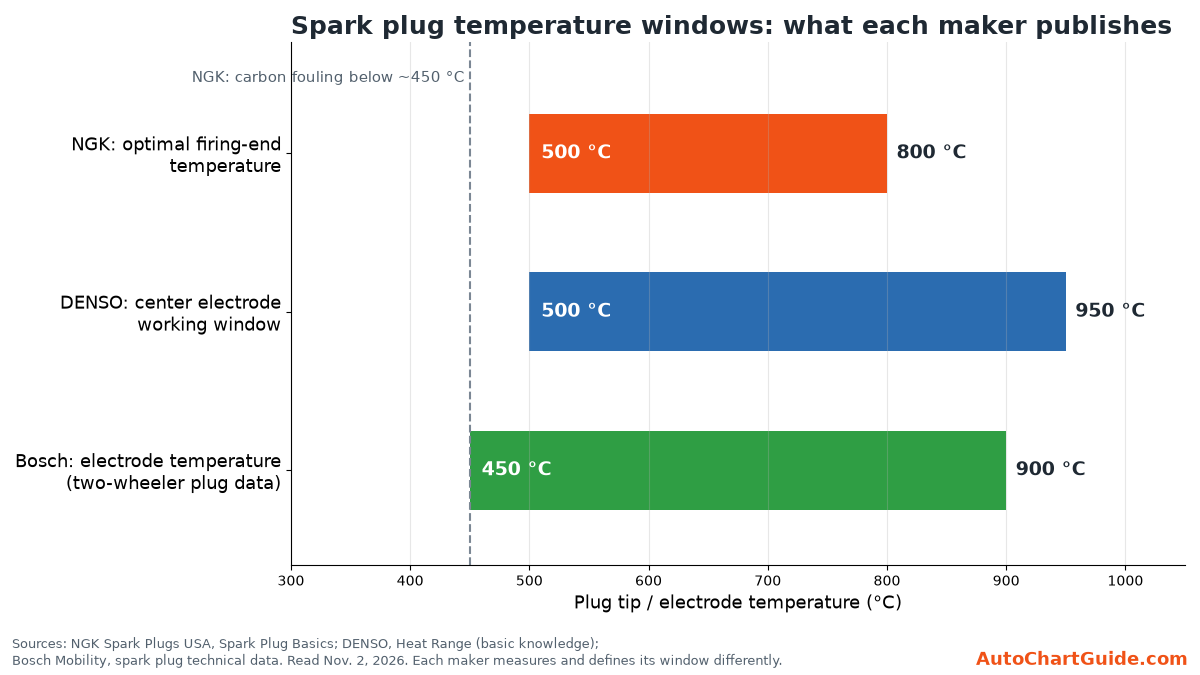
The lower ends broadly agree, around 450°C to 500°C, which is where carbon stops burning off. The upper ends differ by 150°C. NGK says pre-ignition "originating from the overheated insulator ceramic can occur" above 800°C, while DENSO puts its pre-ignition temperature for the center electrode at 950°C. Treat the numbers as each maker's own guide, not as one shared standard. The practical point is the same in all three: too cold fouls, too hot can damage the engine.
How Much One Heat Range Step Changes
NGK gives the most specific figure: "among identical spark plug types, the difference in tip temperature from one heat range to the next is approximately 70°C to 100°C." Autolite says a switch in heat range changes the tip temperature "by 50 to 150 degrees depending on design," but its page does not say whether that is Celsius or Fahrenheit, so we do not convert it.
To put NGK's figure in context, NGK also says that advancing ignition timing by 10° raises the plug tip temperature by about 70°C to 100°C. One step of heat range and 10° of timing advance can therefore move the tip by a similar amount. That is why NGK warns that a colder plug "may be necessary if the ignition timing has been advanced to near the knock level."
It also explains why one step is the normal unit of change. NGK's rule for modified engines is "for every 75-100 hp you add, you should use a one (1) step colder heat range to be safe and avoid pre-ignition." NGK frames its advice in single steps, so change one step at a time and read the plugs before going further.
When to Use a Hotter or Colder Spark Plug
For a stock engine, all of the makers start in the same place. NGK says "for most vehicles, the factory recommended heat range is sufficient." Champion says "for most vehicles, the manufacturer-recommended spark plug and heat range is the best option" and points you to the owner's manual. If you do not have the manual, our list of free owner's manuals by manufacturer shows where each carmaker publishes them, and our guide to finding your engine code helps when one model came with several engines.
NGK's basics page lists the conditions that push a plug toward one side or the other:
- A colder plug may be needed for long periods of high RPM, heavy load or high temperatures; ignition timing advanced near the knock level; a significantly higher compression ratio; turbocharging or supercharging; and high-ethanol fuel in high-performance use, where NGK says a colder heat range "may be necessary."
- A hotter plug might be needed if the engine is run at low speeds or low temperatures for long periods, to prevent fouling.
- Altitude lowers tip temperature. NGK says plug tip temperature falls as altitude rises, and fouling can occur more easily if the mixture is not adjusted.
The makers do not agree on everything, and it helps to know where they differ:
- Exhaust and bolt-on parts. NGK's modified engine guide says an air filter, headers, mufflers and rear-end gears will not require different plugs, because they do not change the compression ratio. DENSO's catalogue lists an aftermarket muffler, ignition coil, plug cord, turbo, electronic ignition and nitrous among the changes after which the heat range "must be increased according to the level of tuning."
- When you are unsure. Autolite says "always start with a colder spark plug," because a plug that is too cold will foul and misfire but "will not hurt the engine," while one that is too hot can cause pre-ignition and detonation. NGK's advice is to keep the factory heat range and fix the underlying problem.
- Hotter plugs as a fix. NGK says "often hotter heat ranges have been used to address a fuel delivery or oil consumption problem," but that a hotter plug "will reduce the pre-ignition safety margin, so it is better to correct the mechanical or tuning issue instead." DENSO allows a hotter plug for recurring carbon fouling on low-speed, short-trip use.
Two further cautions from NGK. Its modified engine guide says the plug gap "may also need to be adjusted smaller to avoid misfire" when power goes up. Our guide on where to find the spark plug gap spec explains where to look first. And its basics page lists "insufficient tightening torque and/or no gasket" among the causes of overheating, because a loose plug cannot pass its heat to the head. A plug of the correct heat range can still run too hot if it is not installed to the plug maker's torque.
Worked Examples: Checking a Cross With the Heat Range Chart
The heat chart is most useful as a check on a cross reference. Our spark plug cross reference chart lists what NGK and DENSO each publish for common plugs. Here are three of those crosses, each checked against DENSO's heat range table.
| Plug you have | Its number on DENSO's row | NGK guide lists | DENSO list gives | What the heat chart tells you |
|---|---|---|---|---|
| Champion RC9YC | Champion 9 = NGK 6 = DENSO 20 | BKR6E | K20PR-U | Both makers' picks sit on the same row |
| Bosch FR7DC | Bosch 7 = NGK 6 = DENSO 20 | BKR6E or FR5 | K20PR-U | BKR6E and K20PR-U are on that row; FR5 carries NGK's 5, one row hotter |
| Bosch FR8DC | Bosch 8 = NGK 5 = DENSO 16 | FR4 or BKR5E | K16PR-U | BKR5E and K16PR-U are on that row; FR4 carries NGK's 4, one row hotter |
Sources: NGK Spark Plugs USA automotive cross reference (2019 edition PDF); DENSO Global cross-reference lists for Champion and Bosch; DENSO heat range table. Read November 2, 2026. NGK lists several plugs for some competitor numbers; we show all of them.
In all three cases both makers have a pick on the matching row. The Bosch rows show why the check is worth doing, though. For an FR7DC, NGK's guide offers BKR6E or FR5, and the FR5 carries NGK's 5, one row hotter on DENSO's table than the Bosch 7. NGK may list FR5 for reasons beyond the heat number. FR and BKR are different NGK designs, and NGK's guide does not say why it lists both. But you should notice the difference before you buy, and settle it with the application listing for your engine.
Here is how to do the same check yourself, step by step:
- Read the heat number on your old plug using its maker's key. For Champion and NGK that is the middle number. For NGK racing plugs it is after the hyphen.
- Find that number in the right column of DENSO's table. Note the other brands' numbers on the same row.
- Look up the cross in the new brand's own list. Do not build a part number from the heat number. A code that follows the pattern may not exist, or may be a different plug.
- Compare the cross with the row. If the listed plug carries a heat number from a different row, find out why before you fit it.
- Check the rest of the code. Thread, reach, seat, resistor and gap must also suit your engine.
How to Read Your Old Plugs
A used plug can tell you whether the heat range suits the way the engine is driven. Bosch's catalogue has a fault diagnosis page. Here are its descriptions that bear on heat range, with the cause Bosch gives for each.
| What the plug looks like (Bosch description) | Cause Bosch gives | Heat range link |
|---|---|---|
| Insulator nose gray-white/gray-yellow to fawn brown | Engine OK, mixture and timing OK | "Heat range correctly selected" |
| Velvet-like dull black soot on nose, electrodes and shell (carbon-fouled) | Mixture too rich, dirty air cleaner, choke, mostly short trips, plug too cold | "heat range code number too low" |
| Shiny soot or carbon (oil-fouled) | Too much oil in the chamber: worn rings, cylinders or valve guides | Not a heat range problem: overhaul the engine |
| Center electrode partly melted, blistered, spongy nose tip | Thermal overload from auto-ignition: timing too advanced, deposits, bad valves, poor fuel | Remedy: check engine, ignition and mixture, then fit "new spark plugs with correct heat range" |
| Center electrode melted, ground electrode badly corroded | Same thermal overload causes | Check engine, ignition and mixture first |
| Thick ash coating from oil and fuel additives | Additives in oil or fuel | Not a heat range problem: new plugs, possibly different oil |
Source: Bosch Spark Plug Catalogue (India, 2025 PDF), "Fault diagnosis at a glance," pages 21 to 22. Bosch uses its own numbering: a low Bosch number is a cold plug.
Notice how often Bosch points somewhere other than the plug. Oil fouling and ash are engine or oil problems, and melted electrodes come with a list of engine causes before the heat range. NGK says the same about overheating: its causes include over-advanced timing, fuel octane too low, an excessively lean mixture, heavy carbon deposits, insufficient cooling and a plug that is not torqued properly. Changing heat range to hide one of those leaves the real fault in place.
Common Mistakes With Spark Plug Heat Range Charts
- Carrying a number across brands. An NGK 9 is on the cold side of DENSO's table. A Champion 9 sits beside an NGK 6, three rows hotter than NGK 9.
- Reading "higher heat range" as "hotter." In DENSO's wording, a higher heat range is a colder plug. In Autolite's and Bosch's, it is a hotter one.
- Comparing Champion numbers across families. A Champion racing 63 is not hotter than an automotive 12. Champion says racing and industrial families run colder despite higher numbers.
- Missing the Bosch leading zero. Bosch 05 to 09 are colder than Bosch 2, not hotter than Bosch 5.
- Reading the box number. NGK's stock number on the box has nothing to do with heat range.
- Using heat range to hide a fault. NGK says it is better to correct the mechanical or tuning issue than to change heat range.
- Making several changes at once. If you change plugs, timing and fuel together, you will not know which change caused the result. Change one thing and read the plugs again.
Frequently Asked Questions
Is a higher heat range number hotter or colder?
It depends on the brand. NGK says "lower numbers indicate a hotter type, higher numbers indicate a colder type," and DENSO numbers run the same way. Champion says the higher the number, the hotter the plug, and Bosch calls a hot plug a "high heat value" plug. Always read the number inside the scale of the maker who printed it.
What NGK heat range equals a Champion 9?
In DENSO's published conversion table, Champion 10 and 9 sit on the same row as NGK 6, DENSO 20 and Bosch 7 or 6. NGK's own cross reference agrees for one common plug: it lists BKR6E for a Champion RC9YC.
What does one heat range step change?
NGK says that among identical plug types, the tip temperature difference from one heat range to the next is about 70°C to 100°C. Autolite says a heat range switch changes the tip temperature by 50 to 150 degrees depending on design, without naming the unit.
Should I use a colder spark plug for a turbo or supercharger?
Possibly. NGK lists forced induction among the reasons a colder plug may be necessary, and for added power its rule of thumb is one step colder for every 75 to 100 hp. DENSO says tuning means choosing a colder plug in line with the level of tuning, at your own discretion and responsibility. Both say a stock engine should use the factory heat range.
Will a hotter spark plug fix oil fouling?
NGK says hotter plugs have often been used to cover a fuel delivery or oil consumption problem, but that a hotter plug reduces the pre-ignition safety margin, so it is better to fix the mechanical or tuning issue. Bosch says an oil-fouled plug points to worn rings, cylinders or valve guides and calls for an engine overhaul.
Where is Autolite on the heat range chart?
Autolite is not in DENSO's conversion table. Autolite's own documents say a higher Autolite heat range is a hotter plug, but we did not find an Autolite-published chart lining its numbers up with other brands. Use Autolite's application lookup, or a cross reference published by the maker of the plug you are buying.
If I am unsure, should I go hotter or colder?
The makers do not say quite the same thing. Autolite says that if you are unsure, start with a colder plug, because a plug that is too cold fouls but a plug that is too hot can cause pre-ignition and engine damage. NGK and Champion say the factory recommended heat range is right for most vehicles. Start from the factory plug.
Does heat range affect spark strength?
No. NGK says the heat range "has no relationship to the electrical energy transferred through the spark plug." It describes how fast the plug moves heat from its firing end into the cylinder head.
Sources
- DENSO, Identifying DENSO Plugs (part number key and heat range table), read November 2, 2026.
- DENSO, Heat Range (basic knowledge), read November 2, 2026.
- DENSO, Spark Plug Catalogue 2024 (PDF; data as of October 2022), selection know-how, read November 2, 2026.
- DENSO Global cross-reference lists for Champion and Bosch plugs, read November 2, 2026.
- NGK Spark Plugs USA, Spark Plug Basics (updated May 17, 2019), read November 2, 2026.
- NGK Spark Plugs USA, Understanding Spark Plug Heat Range (updated April 30, 2025), read November 2, 2026.
- NGK Spark Plugs USA, Are Special Plugs Necessary on a Modified Engine? (updated September 1, 2020), read November 2, 2026.
- NGK Spark Plugs USA, Decoding Spark Plug Part and Stock Numbers (updated August 11, 2021), read November 2, 2026.
- NGK Spark Plugs USA, Spark Plug Cross Reference, automotive (2019 edition PDF), read November 2, 2026.
- Champion, Choosing the Right Spark Plug Heat Range, read November 2, 2026.
- Champion, Decoding Champion Spark Plugs, read November 2, 2026.
- Champion, Our Part Number Structure brochure (PDF, 2021), heat range chart, read November 2, 2026.
- Autolite, Spark Plug Heat Range (updated May 13, 2024), read November 2, 2026.
- Autolite, Understanding Heat Range (PDF, 2024), read November 2, 2026.
- Bosch, Spark Plug Catalogue (India, PDF, 2025), heat value and fault diagnosis pages, read November 2, 2026.
- Bosch, Spark Plug Heat Range temperature curves (PDF, 2019), read November 2, 2026.
- Bosch Mobility, Spark plug (two-wheeler technical data), read November 2, 2026.