
Ft-lb to Nm: Converting Torque Without Getting It Wrong
The conversion is a defined constant, not a vehicle spec. The real risk is inch-pounds, which is an order-of-magnitude error on a safety-critical fastener.

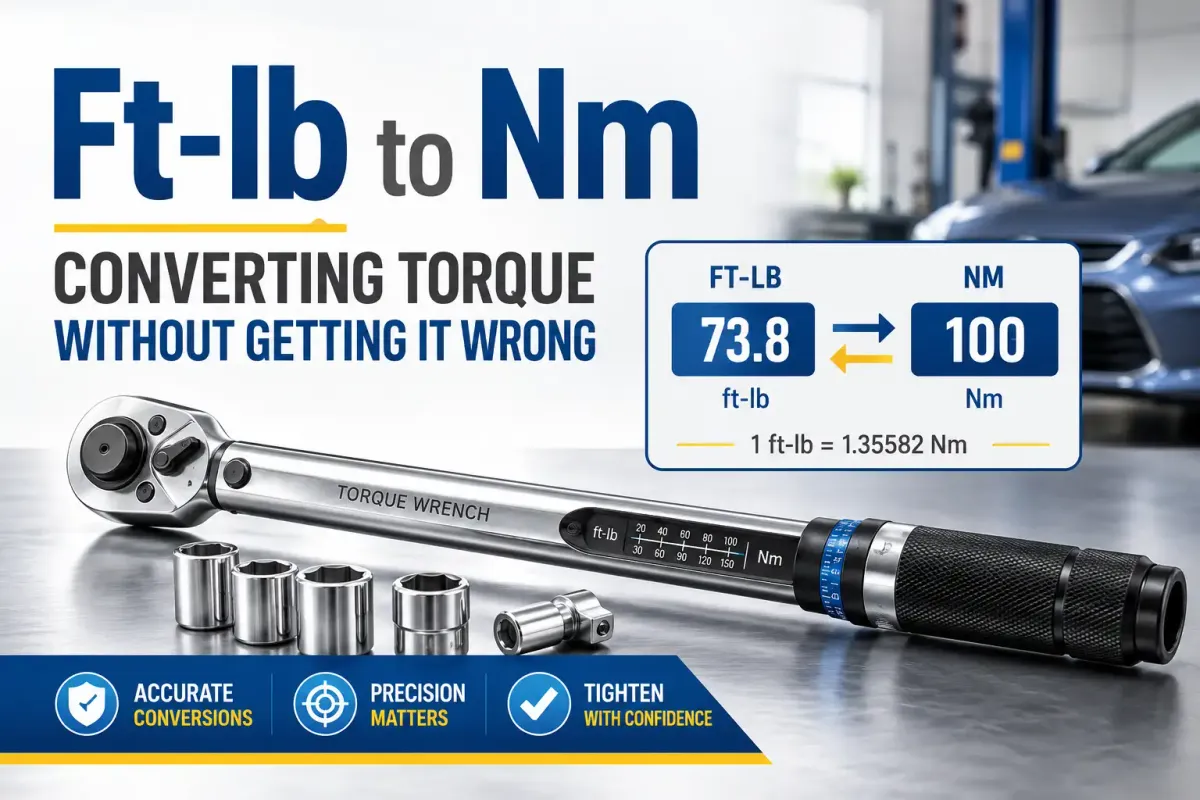
Short answer: the conversion between these units is a fixed mathematical relationship between defined quantities, so unlike a vehicle specification it can be stated exactly. One foot-pound is 1.35581794833 newton metres, from the definitions of the foot and the pound-force. One kilogram-force metre is exactly 9.80665 newton metres, from the definition of standard gravity. And one foot-pound is exactly 12 inch-pounds.
That last one is where people actually get hurt. Everything else on this page is about not making that mistake.
This is one of the few pages on this site that gives you a number, and it is worth being explicit about why: these are definitional constants, not a specification for any vehicle. We are not telling you what to torque anything to.
The three units you will meet
| Unit | Written as | Where you meet it |
|---|---|---|
| Newton metre | Nm or N·m | The SI unit; most modern service information |
| Foot-pound | ft-lb or lb-ft | Common in United States specifications and tools |
| Inch-pound | in-lb or lb-in | Smaller fasteners, and the source of the worst errors |
| Kilogram-force metre | kg-m or kgf·m | Older documentation, particularly Japanese |
The dangerous confusion: foot-pounds versus inch-pounds
This deserves the top of the page rather than a footnote.
A foot-pound is twelve inch-pounds. That means treating an inch-pound figure as foot-pounds over-tightens by a factor of twelve, and treating a foot-pound figure as inch-pounds under-tightens by the same factor.
Neither of those is a small error. On a fastener that matters, one direction shears or stretches it and the other leaves a joint that was never clamped.
Two things make this more likely than it sounds. The abbreviations are similar and are written inconsistently, sometimes as ft-lb and sometimes as lb-ft, sometimes in-lb and sometimes lb-in, with no universal convention about the order. And torque wrenches exist in both, so a reader with an inch-pound wrench and a foot-pound specification can set a number that looks right on the dial.
The habit that prevents it: read the unit out loud, every time, before setting the wrench. Not the number. The unit.
kg-m and why it is a third thing
Kilogram-force metre appears in older documentation and is a genuinely different unit from the newton metre, despite both being metric.
It is based on kilogram-force, the force exerted by one kilogram under standard gravity, rather than on the newton. The conversion is exact by definition: one kilogram-force metre is 9.80665 newton metres.
The practical risk is smaller than the inch-pound trap because the numbers are far apart, but it is worth recognizing the unit rather than assuming any metric figure is in newton metres.
Converting without introducing error
Four rules.
Identify the unit before you touch the arithmetic. Most conversion errors are unit identification errors rather than mathematical ones.
Convert once, at the end. Every conversion is an opportunity to round, and rounding twice compounds. If a figure has already been converted before it reached you, you are working from a rounded number and converting it again makes it worse.
Keep more precision than you need through the calculation, and round only at the point you set the tool.
Sanity-check the magnitude. If your converted figure is roughly a third of the original, you converted newton metres to foot-pounds. If it is roughly triple, you went the other way. If it is twelve times different, you have crossed the foot-pound and inch-pound boundary and should stop.
Why you convert once and at the end
A figure that has been through two conversions is not the figure that went in.
This is a general problem with published vehicle data and not only with your own arithmetic. A specification originally stated in newton metres, converted to foot-pounds by one source, rounded, then converted back by another, arrives at a value that differs from the original. Both look authoritative.
The signal to watch for is tidiness. A figure that is round in one unit and awkward in the other was probably specified in the first. A figure that is awkward in both has usually been converted twice, and it is telling you that you are looking at a copy rather than a source: why two websites give your car two different numbers.
The fix is to get the specification in the unit the manufacturer stated it in, which means going to manufacturer service information rather than to an aggregator: how to find the torque spec for any fastener.
Reading a dual-scale wrench correctly
Many torque wrenches carry two scales, and this introduces its own error mode.
On a click wrench with dual scales, one scale is usually the primary graduation and the other is a secondary reference, and they do not necessarily have the same resolution. Setting to a value on the secondary scale can involve interpolating between marks in a way the primary scale does not.
Read which scale you are setting, deliberately, and prefer the scale that matches the unit your specification is in so that you are not converting at all. Not converting is always more reliable than converting well.
How each wrench type is read correctly, and the technique errors that matter more than the arithmetic: click, beam and digital torque wrenches.
And a correctly converted figure applied with a wrench you cannot trust is still not a correct outcome: torque wrench calibration, how often.
When the specification itself is ambiguous about units
Occasionally a source gives a figure with an ambiguous or missing unit.
Treat that as a source that has failed rather than as a puzzle to solve. A torque figure without an unambiguous unit is not a specification, and inferring the unit from the magnitude is guessing about a safety-critical fastener.
Go to a source that states its units clearly. Manufacturer service information does.
Frequently asked questions
What is the conversion from ft-lb to Nm?
One foot-pound is 1.35581794833 newton metres, which follows from the definitions of the foot and the pound-force. It is a defined constant rather than an approximation.
Are foot-pounds and inch-pounds the same thing?
No, and confusing them is a factor-of-twelve error. One foot-pound is exactly twelve inch-pounds, which over-tightens or under-tightens dramatically depending on the direction of the mistake.
What is kg-m in Nm?
One kilogram-force metre is exactly 9.80665 newton metres, from the definition of standard gravity. It appears in older documentation and is a different unit from the newton metre.
Should I convert a spec or find it in my unit?
Find it in your unit if you can. Not converting is more reliable than converting well, and manufacturer service information states the manufacturer's own unit.
Why does a converted figure look odd?
Because rounding accumulates. A figure that is awkward in both units has usually been converted twice, which is a sign you are reading a copy rather than a source.