How to Find Your Engine Code: Three Sources That Should Agree
Your VIN, the under-hood label and the engine itself each identify the engine. Here is how to read all three, and what it means when they disagree.

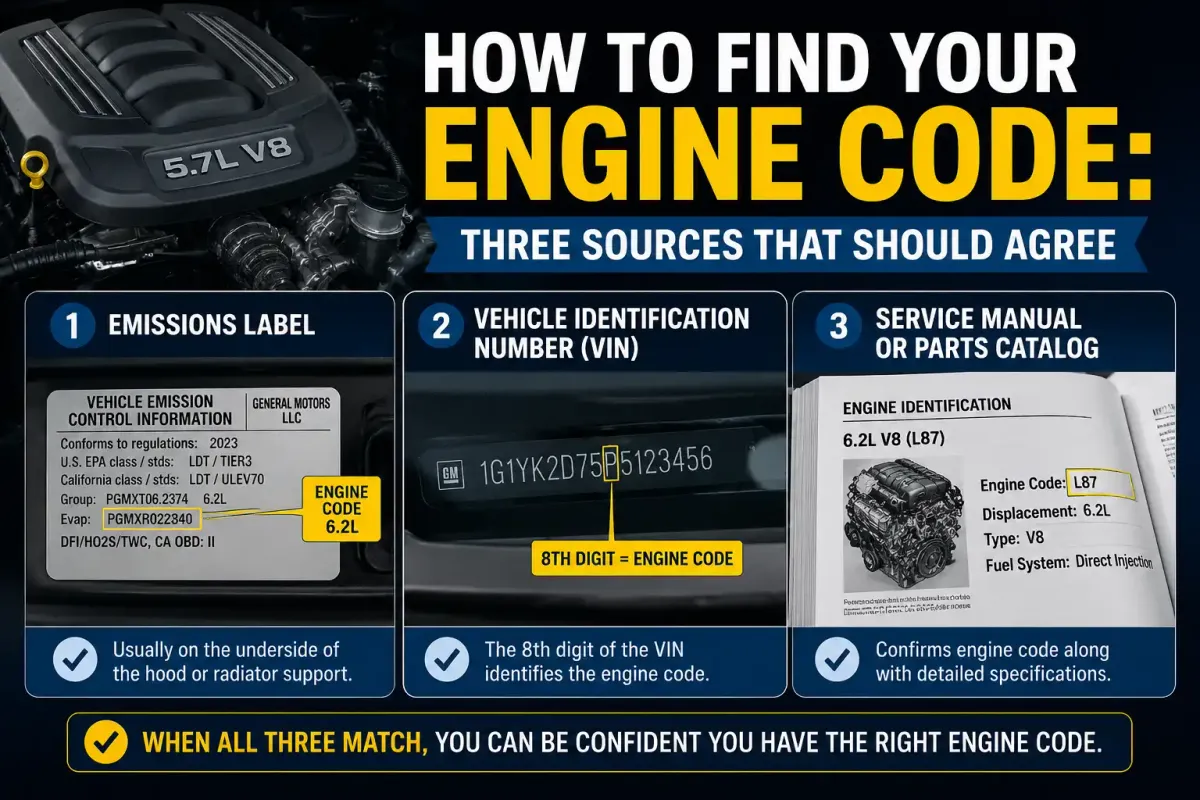
Short answer: there are three independent places your vehicle identifies its engine, and the right approach is to read all three and check they agree. The VIN descriptor section, the under-hood emissions label, and identifiers cast or stamped into the engine itself. On an original vehicle they will agree. On a used vehicle with an unknown history, a disagreement is the most useful thing you will find all day.
Search results for engine codes explain what a given code means. That is the second question. The first one, how do I find mine, is what this page covers.
Why this matters before you order anything
Manufacturers routinely offered two or more engines in the same model year, and the parts that follow from that choice are not interchangeable. Filters, plugs, belts, sensors and fluids can all differ between engines that sit under identical bodywork.
Establishing the engine first is the step that prevents a return. It is also the step most commonly skipped, because the model name feels like enough information and is not.
Source one: the VIN descriptor section
Most manufacturers encode the engine somewhere in positions 4 through 8 of the VIN, the block known as the vehicle descriptor section.
The catch is that the coding within that block is the manufacturer's own. There is no universal rule that says a particular position identifies the engine across all manufacturers, which is why generic VIN decoders disagree with each other on exactly this field. See what each VIN character encodes for the full structure and its limits.
The most reliable free route into it is the NHTSA decoder at vpic.nhtsa.dot.gov, which returns what the manufacturer reported for that VIN rather than a third party's interpretation.
Remember what the VIN describes: the vehicle as built. If the engine has been replaced, the VIN is confidently wrong.
Source two: the under-hood emissions label
The Vehicle Emission Control Information label under the hood carries an engine family identification and commonly the displacement.
This is a strong cross-check on the VIN, and it is stronger than the VIN in one specific way: it identifies the certified emissions configuration, which can distinguish two vehicles that share an engine code. That distinction is frequently the reason a catalogue lists two parts for what looks like one engine.
Where the label is and what its fields mean: the under-hood emissions control information label.
Like the VIN, this label describes the vehicle as built.
Source three: the engine itself
This is the only source that describes the engine actually in the vehicle, which makes it the tie-breaker.
Engines carry identifiers cast into the block or stamped onto a machined pad, and many also carry a label or a data tag. Location varies enormously by manufacturer and engine family, and there is no general instruction that covers every vehicle, which is why we are not going to give you one.
What is general is the approach. Look for a flat machined surface with stamped characters, or raised cast numbers on the block. Photograph what you find rather than transcribing it, since these are frequently dirty, upside down and easy to misread. Then verify what it identifies through the manufacturer or a dealer parts department rather than a general chart, for the same reason we do not republish code tables anywhere on this site.
What to do when the three sources disagree
Disagreement is information, not a dead end. Work through it in order:
Did you misread one? By far the most likely explanation. Cast and stamped numbers are hard to read, and a VIN transcribed from a document rather than the vehicle can be wrong. Re-check before concluding anything.
Are you comparing the same kind of identifier? Displacement, engine code and emissions family are three different things, and finding that they are not identical is not a disagreement. It is three different labels for three different levels of detail.
Has the engine been replaced? This is the real case. A replaced engine makes the VIN and the emissions label describe a vehicle that no longer exists, and every parts lookup keyed to the VIN will be wrong. Trust the engine.
Swapped and replaced engines: when the VIN is wrong about your car
On a used vehicle this deserves its own thought, because the failure mode is quiet.
If the engine was replaced with a different variant, everything downstream of a VIN lookup is subtly wrong: filters, plugs, sensors, fluid specifications. Nothing about the vehicle announces it. The parts you order will often physically fit and be incorrect anyway.
Two signals worth noticing: identifiers on the engine that do not match what the VIN implies, and service history that mentions an engine replacement. Neither is conclusive alone, and the way to settle it is the physical identifier on the engine plus a dealer parts department that can tell you what it corresponds to.
This is a specific case of a general problem worth understanding: why two websites give your car two different numbers.
Using the engine code to get to the right specification
Once the engine is established, the code becomes the key that unlocks everything else. Hand it to a parts department instead of describing your vehicle, and give the VIN alongside it so they can see both the vehicle as built and the engine as fitted.
For specifications rather than parts, the engine identification is what selects the right section of the service information: owner's manual vs service manual vs repair database.
Frequently asked questions
Where is the engine code on my car?
In three places: the VIN descriptor section, the under-hood emissions label, and cast or stamped identifiers on the engine itself. Location on the engine varies by manufacturer, so photograph what you find and verify it through the manufacturer.
Can I get my engine from the VIN alone?
Often, but not always reliably, because the descriptor coding is manufacturer-specific. The NHTSA decoder at vpic.nhtsa.dot.gov is the best free route since it returns manufacturer-reported data.
My VIN and my engine give different answers. Which is right?
The engine, if the numbers really do conflict and you have not misread one. The VIN describes the vehicle as built and cannot know about a replacement.
What is the difference between engine code and engine family?
The engine code is the manufacturer's identifier for the engine. The engine family is a certification identifier on the emissions label, and it can separate vehicles that share an engine code but were certified differently.
Does it really matter which engine I have?
Yes. Manufacturers commonly offered several engines in one model year, and filters, plugs, belts, sensors and fluid specifications can all differ between them.