Do I Need to Re-Torque Lug Nuts? Yes, and Here's Why
The shop asking you to come back is not an upsell. Here is the physical reason a fresh wheel joint loses clamping force in its first miles.

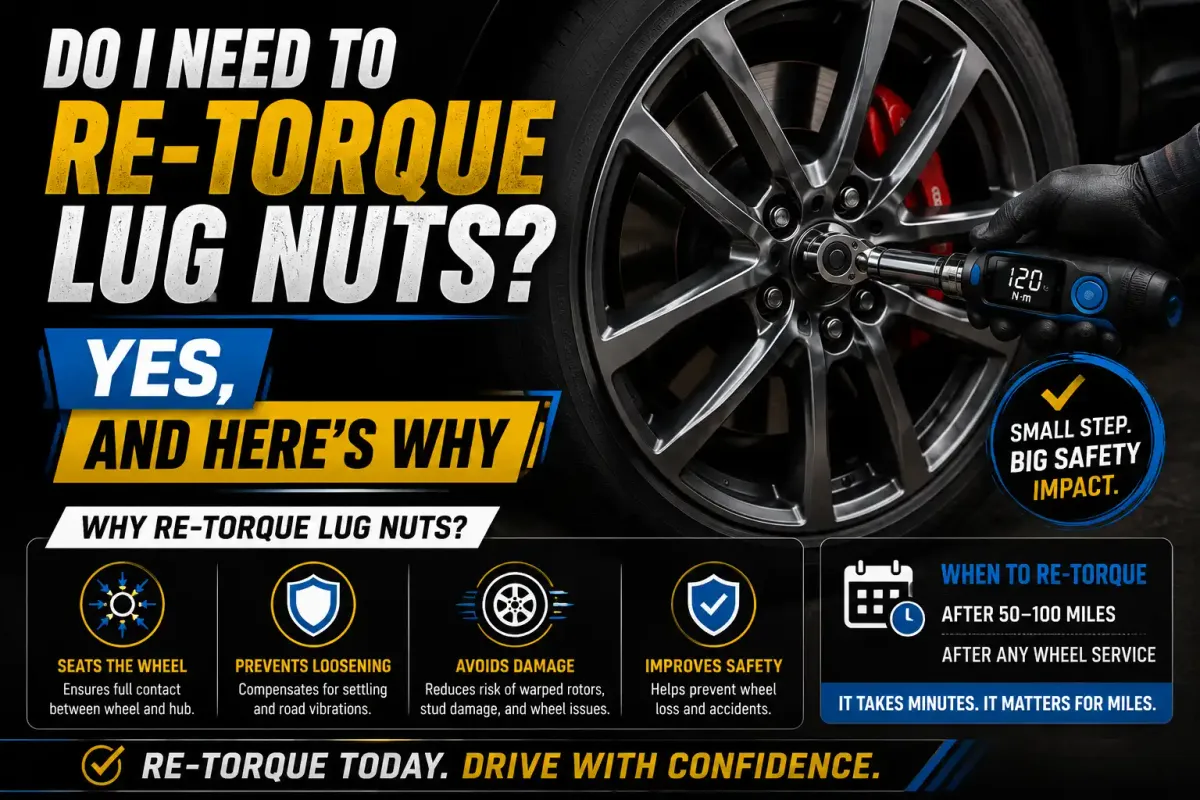
Short answer: it is a real, long-established practice with a physical mechanism behind it, not an upsell. A freshly assembled wheel joint settles in its first miles, and settling means the clamping force drops slightly below what was set. Re-torquing restores it. The shop asking you to come back is doing the job properly, and a shop that says nothing is not necessarily doing it better.
What we will not do is tell you after how many miles. That figure comes from the shop that did the work and from your vehicle's own documentation, and the reasons are in the middle of this page.
What happens to a joint in its first miles
When fasteners are tightened, the surfaces in the joint are not perfectly flat and perfectly mated at a microscopic level. High points on the mating faces carry more load than the areas around them.
Under the loads of driving, heating and cooling, those high points deform and bed in. The surfaces come into fuller contact, and as they do the total thickness of the stack reduces very slightly.
The fastener does not compensate. It was stretched a set amount when it was tightened, and a small reduction in stack thickness means a small reduction in that stretch, which is a reduction in clamping force. Nothing has loosened in the sense of anything unscrewing. The joint has settled.
Why alloy wheels are particularly associated with this
The practice is most often mentioned with alloy wheels, and the association is real rather than folklore.
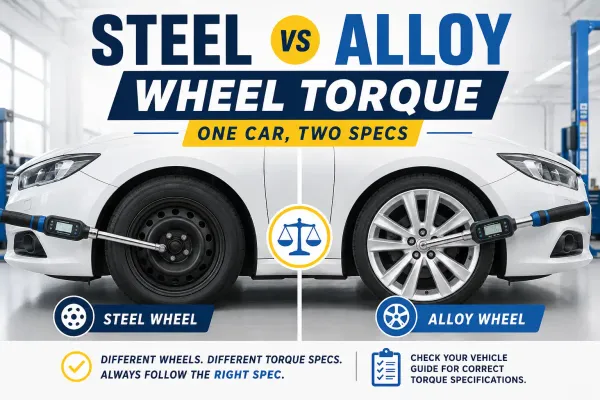
Bedding-in depends on the materials in the joint and how they behave under load, and steel and cast aluminium alloy do not behave identically. That is the same underlying reason a vehicle can carry two different wheel torque figures: steel vs alloy wheel torque.
It does not mean steel wheels never need it. It means the practice is emphasized where the effect is most pronounced.
What re-torquing actually involves
It is not tightening everything a bit more.
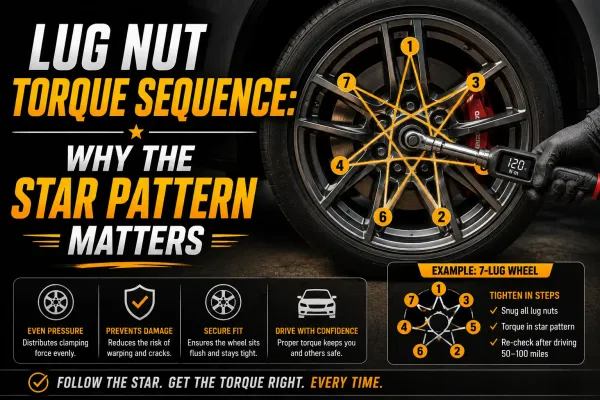
The correct process is to check each fastener against the specification, in the specified sequence, with a torque wrench. Some will already be at the figure and will not move. Some will take a small amount of further rotation before the wrench reaches the setting.
It is a check, and the outcome is that every fastener is confirmed at specification. That is why doing it with an impact wrench, or by feel, is not doing it: why an impact wrench is not a torque setting.
The sequence matters here as much as it did at assembly: torque sequence and why order matters.
Why we will not tell you the distance or the interval
You will find a distance quoted on plenty of websites. We are not going to add to them, and the reason is worth stating.
The figure varies by vehicle manufacturer, by wheel type and by shop policy, and it is exactly the kind of number that gets copied between sites until nobody knows where it came from. Publishing one here would give you a figure with no source and no named vehicle behind it, which is the class of number this site exists to avoid.
Two sources apply to you and neither is a website. The instruction the shop that fitted your wheels gave you, and your vehicle's own documentation. Where the second one hides: where your wheel torque spec actually lives.
If the shop gave you a distance, use theirs. They fitted the wheels and they know what they fitted.
What to do if you cannot get back to the shop
The check can be done anywhere with the correct figure and a torque wrench you can read.
That means any tire shop, not only the one that did the work, and many will do a re-torque check quickly. It also means you, if you have the specification, the correct tool and the confidence to use it: click, beam and digital torque wrenches.
What it does not mean is skipping it because the original shop is inconvenient. The check exists because the joint changes in its first miles, and that happens whether or not you go back.
Signs that should take you straight back rather than waiting
Do not wait for the appointment if any of the following appear after a wheel service:
A noise from a wheel that was not there before, particularly a clicking or knocking that changes with speed.
A vibration that has appeared since the work.
Anything visible around a lug seat, on the wheel or the fasteners, that looks bright, polished or deformed. That appearance can indicate a joint that has been moving.
A fastener that is visibly not sitting the same as the others.
These are not things to diagnose from a description, ours included. They are reasons to stop driving the vehicle and have it looked at, because the failure mode at the end of this particular road is a wheel leaving the vehicle.
The wider structure of what a torque specification consists of, and why the conditions matter as much as the number: how to find the torque spec for any fastener.
Frequently asked questions
Is re-torquing lug nuts really necessary?
It is a real practice with a physical basis. A fresh joint beds in during its first miles, which slightly reduces the stretch in the fasteners and therefore the clamping force. Re-torquing restores it.
Is the shop upselling me?
No. Asking you back for a re-torque check is doing the job properly, and it is normally a quick check rather than chargeable work.
After how many miles should I re-torque?
Use the figure the shop that fitted your wheels gave you, or your vehicle's own documentation. We do not publish a general distance, because it varies and an unsourced figure is worse than none.
Can I re-torque them myself?
Yes, if you have the correct specification, a torque wrench you can read, and the sequence. It is a check against the figure, not a general tightening.
Does this apply to steel wheels too?
The practice is emphasized with alloy wheels because the effect is more pronounced, but bedding-in is a property of the joint rather than of one material. Follow your vehicle's and your shop's guidance.