Torque Wrench Calibration: How Often, and How to Check
Intervals come from the wrench manufacturer and are often set in cycles as well as time. Here is how to sanity-check a wrench without a calibration lab.

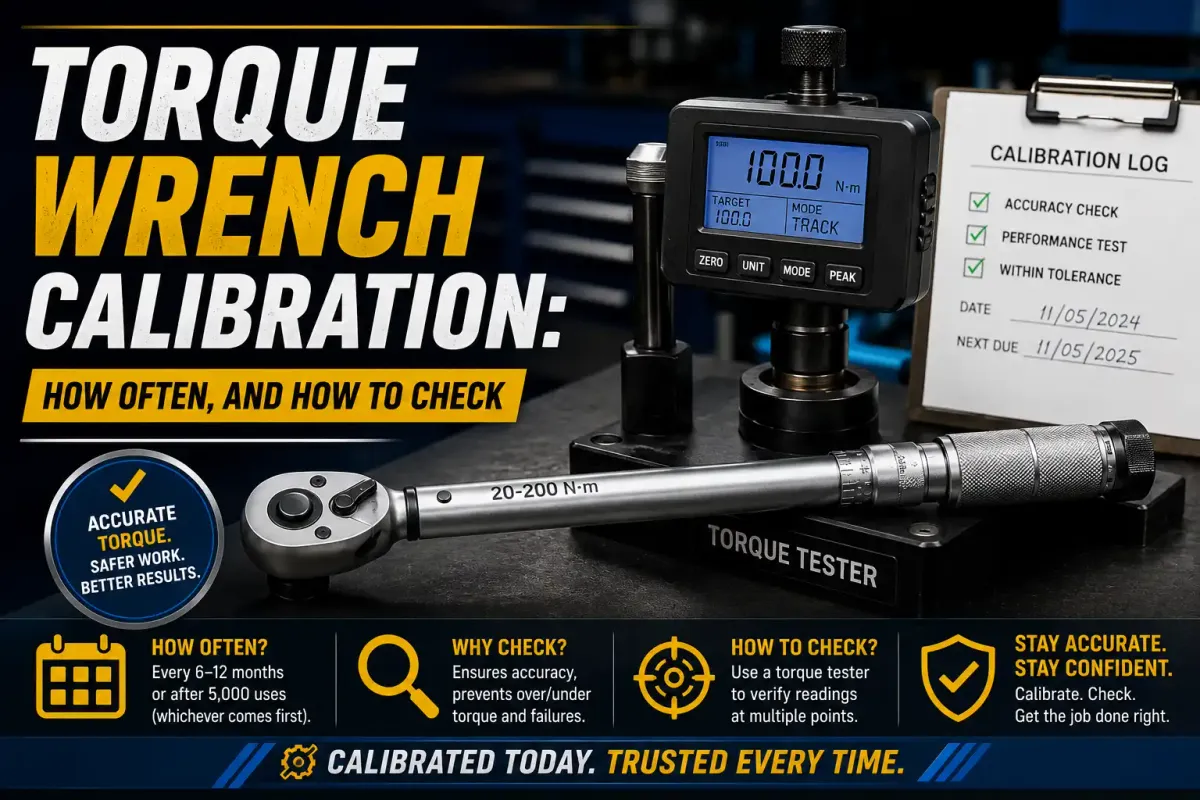
Short answer: the interval comes from the wrench manufacturer, not from a website, and it is usually expressed in use as well as in time. A wrench that has done a great deal of work in two years may be further out than one that has sat unused for six. Time alone is a poor proxy, which is why a general calendar figure published on a blog is not something to rely on.
What this page can give you is the reasoning, the things that actually affect a wrench, and a way to detect a grossly wrong one without sending it anywhere.


As an Amazon Associate we earn from qualifying purchases.
What calibration actually means for a torque wrench
Calibration is checking the tool against a reference and, where it is out, adjusting it so its indication matches reality.
The two halves matter. A calibration check tells you whether the tool is reading correctly. A calibration adjustment brings it back if it is not. A service returning a certificate is telling you what the tool was reading and, usually, what it reads now.
That distinction is worth knowing because a check is often cheaper than a full service, and a check is what answers the question you actually have.
Why intervals are expressed in cycles as well as in time
Manufacturers commonly specify calibration intervals as a number of uses or a period of time, whichever comes first.
The reason is that wear is caused by use. A click wrench's mechanism operates every time it releases, and the components doing that work have a service life measured in operations. A shop wrench used continuously reaches that count far sooner than a home wrench used twice a year.
So "how often" is genuinely two questions, and the answer for your wrench is on your wrench's documentation or on its manufacturer's site. Both are more specific to your tool than any figure we could publish.


As an Amazon Associate we earn from qualifying purchases.
What storage does and does not do to a wrench
Six years in a drawer is the situation in the question, so it is worth being precise.
Storage does not wear the mechanism, because it is not operating. A wrench that has sat unused has not accumulated cycles.
Storage can matter for a click wrench left at a high setting, since the mechanism is a spring held compressed at whatever value it was left on, and leaving it loaded indefinitely is not what it was designed for.
Storage conditions matter. Damp, temperature extremes and knocking around in a toolbox affect a precision instrument, and a wrench that has been dropped is a different question again. A drop is a reason to have a wrench checked regardless of when it was last calibrated.
The stored-at-setting question for click wrenches
The habit worth adopting: return a click wrench to its lowest setting before storing it, and set it fresh each time you use it.
Approach the setting from below rather than winding down to it, since the mechanism's behavior in each direction is not necessarily identical. Full technique: click, beam and digital torque wrenches.
If a wrench has been stored at a high setting for years, that is a specific reason to have it checked rather than assumed.
Sanity-checking a wrench without a lab
You cannot calibrate a wrench at home, and you should not try. You can detect a grossly wrong one, which is a different and useful thing.
The principle is comparison against something independent. A second torque wrench, particularly a beam type, which has no adjustment mechanism to drift. If two wrenches disagree substantially at the same setting, at least one is wrong and you have learned something important.
The other principle is consistency. A wrench that gives noticeably different behavior on repeated applications at the same setting is telling you about its own condition. Inconsistency is a red flag even when you have nothing to compare against.
Neither of these is calibration. Neither produces a number you can trust. What they do is separate "probably about right" from "definitely wrong," and the second category is the one that matters.


As an Amazon Associate we earn from qualifying purchases.
What a sanity check can and cannot tell you
It can tell you: that a wrench is grossly out, that two tools disagree, that a wrench is behaving inconsistently, or that something has changed since last time.
It cannot tell you: that a wrench is within its accuracy specification. That requires a reference traceable to a standard, which is what a calibration service provides and what a comparison between two uncertain tools does not.
The practical position: use a sanity check to catch the obvious failures, and use the manufacturer's interval and a calibration service for the actual question.
When to have it calibrated or replaced rather than trusted
Some situations do not need an interval to decide.
The wrench has been dropped. Have it checked.
It has been used as a breaker bar, to loosen fasteners or with a pipe over the handle. That is loading it far beyond what it measures and it is a common way to ruin one.
It is inconsistent on repeated applications.
Its history is unknown. A wrench bought used, or one that has been in a shared toolbox, has no history you can rely on.
You are about to use it on something where being wrong matters. This is the honest one. If the fastener is safety-critical and the wrench is of uncertain condition, the cost of a calibration check is small against the alternative, and the alternative is a joint that is not clamped as specified.
A perfectly calibrated wrench applied to the wrong figure is still the wrong outcome, so it is worth confirming both: how to find the torque spec for any fastener. And check that you are working in the unit you think you are, which is the error that dwarfs calibration drift: ft-lb, Nm and kg-m conversion.
For context on why an unmeasured tool is a category apart from an imperfectly calibrated one: why an impact wrench is not a torque setting.


As an Amazon Associate we earn from qualifying purchases.
Frequently asked questions
How often should a torque wrench be calibrated?
The interval comes from the wrench manufacturer and is commonly expressed as a number of uses or a period of time, whichever comes first. Use is what causes wear, so a calendar figure alone is a poor guide.
Does a torque wrench go out of calibration sitting in a drawer?
Storage does not wear the mechanism, but a click wrench left at a high setting holds its spring compressed indefinitely, and storage conditions and any drops matter regardless.
Can I calibrate a torque wrench myself?
No. You can sanity-check one against an independent tool to catch a grossly wrong wrench, which is useful but is not calibration and does not confirm accuracy.
Should I store a click wrench at zero?
Return it to its lowest setting rather than forcing it below the scale, and set it fresh each time you use it.
My wrench was dropped. Is it still good?
Have it checked. A drop is a reason to verify a precision instrument regardless of when it was last calibrated.