Socket Size Chart Metric and Standard 2026: Complete Guide
Exact SAE-to-metric socket sizes, the few pairs that really swap (3/4 in vs 19 mm), and which socket fits each metric and inch bolt head.

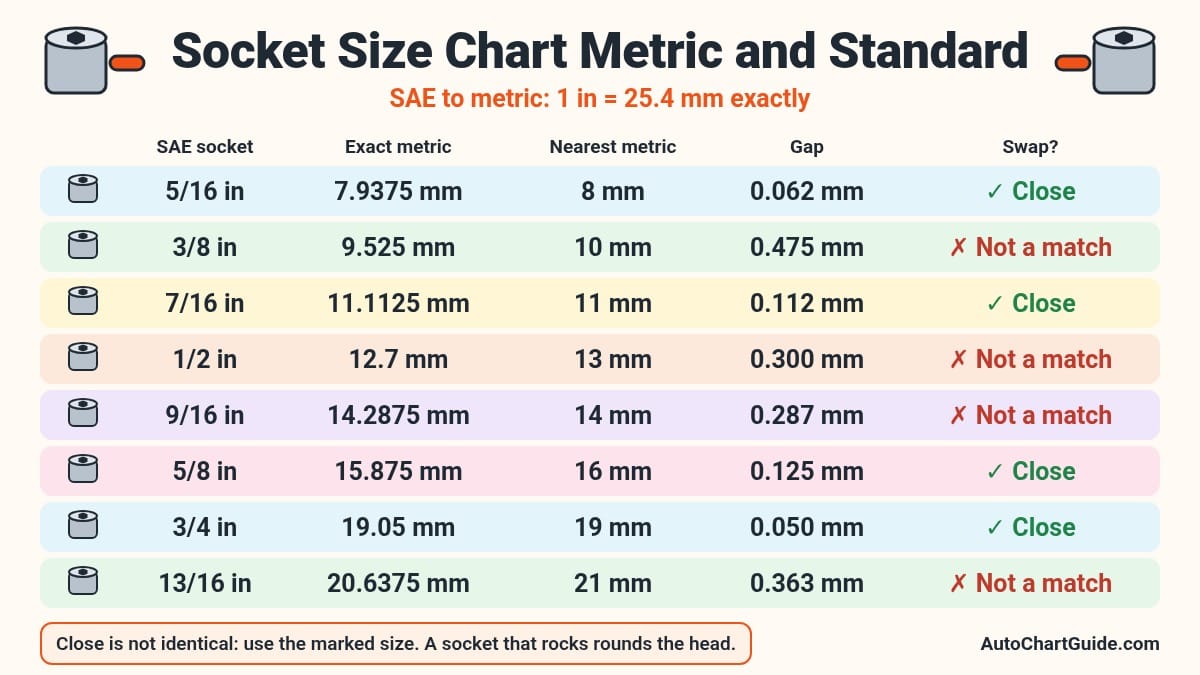
Short answer: To convert any standard (SAE) socket to metric, multiply the inch size by 25.4. That conversion is exact, so 1/2 in = 12.7 mm, 9/16 in = 14.2875 mm, 5/8 in = 15.875 mm and 3/4 in = 19.05 mm. Among the common 1/16 in sizes, only a few land close to a whole millimetre: 5/16 in ≈ 8 mm (0.062 mm apart), 7/16 in ≈ 11 mm (0.112 mm), 5/8 in ≈ 16 mm (0.125 mm), 3/4 in ≈ 19 mm (0.050 mm) and 1-1/16 in ≈ 27 mm (0.013 mm). Others that look like pairs aren't. A 1/2 in socket is 0.3 mm smaller than a 13 mm nut, and 3/8 in is almost half a millimetre short of 10 mm. Use the socket size marked for the fastener. Treat cross-system swaps as a last resort, and don't use one if the socket rocks.
We checked this chart on October 26, 2026. The conversion factor comes from NIST. The bolt and nut head sizes come from the hex nut standard ISO 4032:2023 and the inch hex cap screw standard ASME B18.2.1, and the socket types come from the ASME B107.110 socket wrench standard. The safety notes quote OSHA and Snap-on. We didn't test any tools. Every gap below was calculated from those published numbers, and the method is explained under each table.
Socket size chart: standard (SAE) to metric
NIST states that the inch "is exactly equivalent to 25.4 mm," a definition in force since July 1, 1959. Because the factor is exact, the "Exact metric size" column below involves no rounding. The last column shows how far the nearest whole-millimetre socket is from the SAE size. A plus sign means the metric socket is bigger, and a minus sign means it's smaller.
| SAE (standard) socket | Decimal inch | Exact metric size | Nearest metric socket | Metric minus SAE |
|---|---|---|---|---|
| 1/8 in | 0.125 | 3.175 mm | 3 mm | −0.175 mm |
| 5/32 in | 0.15625 | 3.96875 mm | 4 mm | +0.031 mm |
| 3/16 in | 0.1875 | 4.7625 mm | 5 mm | +0.238 mm |
| 7/32 in | 0.21875 | 5.55625 mm | 6 mm | +0.444 mm |
| 1/4 in | 0.25 | 6.35 mm | 6 mm | −0.350 mm |
| 9/32 in | 0.28125 | 7.14375 mm | 7 mm | −0.144 mm |
| 5/16 in | 0.3125 | 7.9375 mm | 8 mm | +0.062 mm |
| 11/32 in | 0.34375 | 8.73125 mm | 9 mm | +0.269 mm |
| 3/8 in | 0.375 | 9.525 mm | 10 mm | +0.475 mm |
| 7/16 in | 0.4375 | 11.1125 mm | 11 mm | −0.112 mm |
| 15/32 in | 0.46875 | 11.90625 mm | 12 mm | +0.094 mm |
| 1/2 in | 0.5 | 12.7 mm | 13 mm | +0.300 mm |
| 9/16 in | 0.5625 | 14.2875 mm | 14 mm | −0.287 mm |
| 19/32 in | 0.59375 | 15.08125 mm | 15 mm | −0.081 mm |
| 5/8 in | 0.625 | 15.875 mm | 16 mm | +0.125 mm |
| 11/16 in | 0.6875 | 17.4625 mm | 17 mm | −0.462 mm |
| 3/4 in | 0.75 | 19.05 mm | 19 mm | −0.050 mm |
| 13/16 in | 0.8125 | 20.6375 mm | 21 mm | +0.363 mm |
| 7/8 in | 0.875 | 22.225 mm | 22 mm | −0.225 mm |
| 15/16 in | 0.9375 | 23.8125 mm | 24 mm | +0.188 mm |
| 1 in | 1 | 25.4 mm | 25 mm | −0.400 mm |
| 1-1/16 in | 1.0625 | 26.9875 mm | 27 mm | +0.013 mm |
| 1-1/8 in | 1.125 | 28.575 mm | 29 mm | +0.425 mm |
| 1-3/16 in | 1.1875 | 30.1625 mm | 30 mm | −0.162 mm |
| 1-1/4 in | 1.25 | 31.75 mm | 32 mm | +0.250 mm |
| 1-5/16 in | 1.3125 | 33.3375 mm | 33 mm | −0.337 mm |
| 1-3/8 in | 1.375 | 34.925 mm | 35 mm | +0.075 mm |
| 1-7/16 in | 1.4375 | 36.5125 mm | 37 mm | +0.488 mm |
| 1-1/2 in | 1.5 | 38.1 mm | 38 mm | −0.100 mm |
The inch series is built on fractions of an inch (1/16 in and 1/32 in steps), and the metric series is built on whole millimetres. One 1/16 in step is 1.5875 mm, so the two grids drift in and out of alignment. Most sizes never line up, which is why a mixed set can look like it has twins when it really doesn't.
Metric to standard: every socket from 6 mm to 32 mm
The table below goes the other way. It shows each metric socket's size in inches (to four decimals) and the nearest SAE size on a 1/32 in grid. Many of those nearest sizes are 1/32 in fractions like 13/32 or 21/32, which aren't in a typical starter set. So the "nearest SAE" for 10 mm is 13/32 in, not the 3/8 in that some charts list.
| Metric socket | Inch size (4 decimals) | Nearest 1/32-in SAE size | SAE minus metric |
|---|---|---|---|
| 6 mm | 0.2362 in | 1/4 in | +0.350 mm |
| 7 mm | 0.2756 in | 9/32 in | +0.144 mm |
| 8 mm | 0.3150 in | 5/16 in | −0.062 mm |
| 9 mm | 0.3543 in | 11/32 in | −0.269 mm |
| 10 mm | 0.3937 in | 13/32 in | +0.319 mm |
| 11 mm | 0.4331 in | 7/16 in | +0.112 mm |
| 12 mm | 0.4724 in | 15/32 in | −0.094 mm |
| 13 mm | 0.5118 in | 1/2 in | −0.300 mm |
| 14 mm | 0.5512 in | 9/16 in | +0.287 mm |
| 15 mm | 0.5906 in | 19/32 in | +0.081 mm |
| 16 mm | 0.6299 in | 5/8 in | −0.125 mm |
| 17 mm | 0.6693 in | 21/32 in | −0.331 mm |
| 18 mm | 0.7087 in | 23/32 in | +0.256 mm |
| 19 mm | 0.7480 in | 3/4 in | +0.050 mm |
| 20 mm | 0.7874 in | 25/32 in | −0.156 mm |
| 21 mm | 0.8268 in | 13/16 in | −0.363 mm |
| 22 mm | 0.8661 in | 7/8 in | +0.225 mm |
| 23 mm | 0.9055 in | 29/32 in | +0.019 mm |
| 24 mm | 0.9449 in | 15/16 in | −0.188 mm |
| 25 mm | 0.9843 in | 31/32 in | −0.394 mm |
| 26 mm | 1.0236 in | 1-1/32 in | +0.194 mm |
| 27 mm | 1.0630 in | 1-1/16 in | −0.013 mm |
| 28 mm | 1.1024 in | 1-3/32 in | −0.219 mm |
| 29 mm | 1.1417 in | 1-5/32 in | +0.369 mm |
| 30 mm | 1.1811 in | 1-3/16 in | +0.162 mm |
| 31 mm | 1.2205 in | 1-7/32 in | −0.044 mm |
| 32 mm | 1.2598 in | 1-1/4 in | −0.250 mm |
This is where many online charts disagree. Some list 3/8 in as the match for 10 mm. The arithmetic shows 3/8 in is 9.525 mm, 0.475 mm smaller than 10 mm. A socket that much smaller won't go onto a 10 mm hex at all. The nearest bigger SAE size, 13/32 in, is 0.319 mm oversize. It will go on, but it's loose.
Which metric and SAE sockets are close enough to swap?
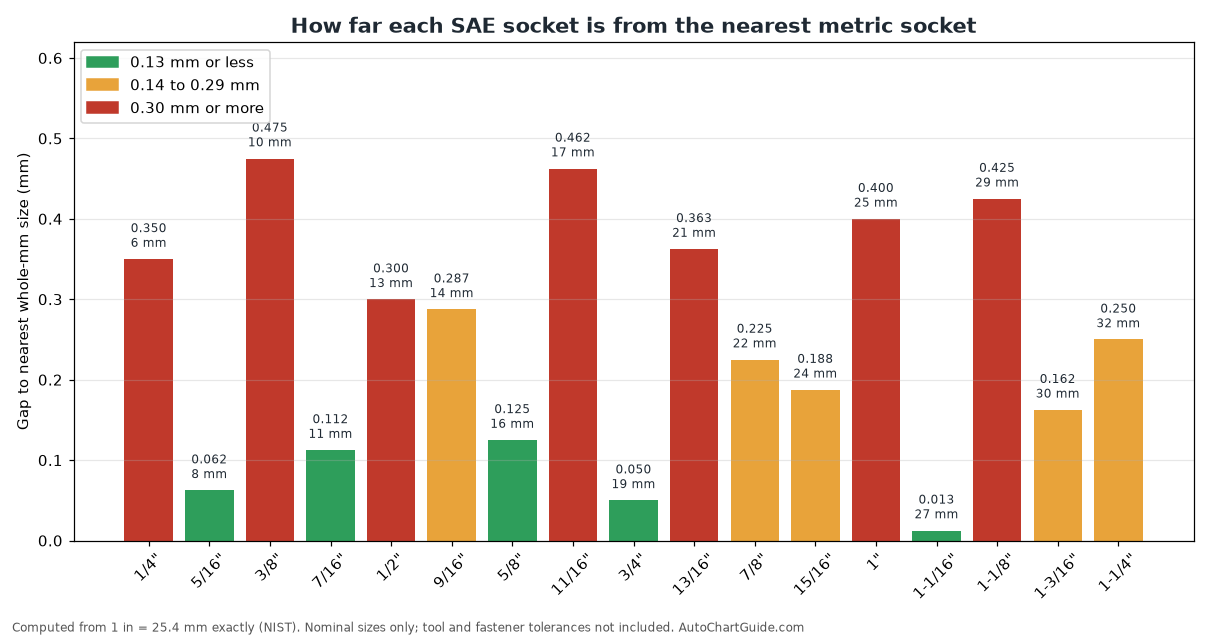
Ranked by gap size, the closest pairs among the 1/16 in sizes from 1/4 in to 1-1/4 in (the sizes in the chart) are:
- 1-1/16 in and 27 mm: 26.9875 mm vs 27 mm, a 0.013 mm gap
- 3/4 in and 19 mm: 19.05 mm vs 19 mm, 0.050 mm (the metric socket is the smaller one)
- 5/16 in and 8 mm: 7.9375 mm vs 8 mm, 0.062 mm
- 7/16 in and 11 mm: 11.1125 mm vs 11 mm, 0.112 mm (the metric socket is smaller)
- 5/8 in and 16 mm: 15.875 mm vs 16 mm, 0.125 mm
A few 1/32 in sizes also land close: 15/32 in ≈ 12 mm (0.094 mm), 19/32 in ≈ 15 mm (0.081 mm), 29/32 in ≈ 23 mm (0.019 mm) and 1-7/32 in ≈ 31 mm (0.044 mm). Those sizes are less common in sets, so check before you count on them.
Pairs that look like matches but aren't include 1/2 in and 13 mm (0.300 mm), 9/16 in and 14 mm (0.287 mm), 13/16 in and 21 mm (0.363 mm), 11/16 in and 17 mm (0.462 mm) and 3/8 in and 10 mm (0.475 mm). The color bands in the chart (0.13 mm or less, 0.14 to 0.29 mm, 0.30 mm or more) are our grouping to make the chart easy to read. They aren't from any standard.
Direction matters more than the size of the gap. A socket smaller than the fastener head won't go on. A larger one goes on but has play, so it turns a little before it grips. Socket makers try to keep contact off the corners: Snap-on says its Flank Drive design moves "the contact away from the corners." A loose socket works against that. OSHA's construction hand tool rule (29 CFR 1926.301) puts it bluntly: "Wrenches, including adjustable, pipe, end, and socket wrenches shall not be used when jaws are sprung to the point that slippage occurs." A loose cross-system socket slips the same way a worn one does.
Original finding: why "close" can still be too small
Charts that compare only nominal sizes leave out the fastener's own tolerance. Fastener heads aren't made at exactly their nominal size. Each standard allows a range, and the nominal number is the maximum. ISO 4032:2023 lets a "13 mm" M8 nut measure anywhere from 12.73 to 13.00 mm across the flats. A "16 mm" M10 nut can measure 15.73 to 16.00 mm. We compared each ISO nut's allowed range with the nearest smaller inch socket:
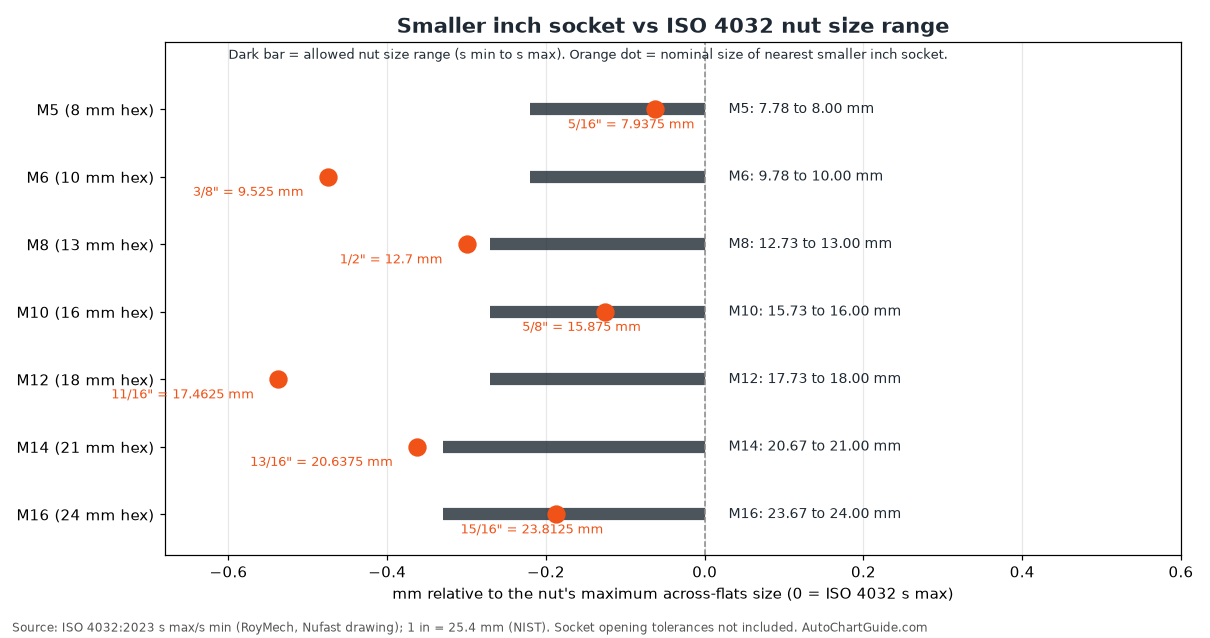
- 1/2 in on a 13 mm (M8) nut: 12.70 mm is below the 12.73 mm minimum. Even the smallest nut the standard allows is bigger than a nominal 1/2 in opening, so the swap only works if the socket's actual opening is oversize.
- 3/8 in on a 10 mm (M6) nut: 9.525 mm is far below the 9.78 mm minimum. It won't go on.
- 5/8 in on a 16 mm (M10) nut: 15.875 mm falls inside the 15.73 to 16.00 mm range. It may slip onto a nut at the small end of the range and not onto one at the large end.
- 5/16 in on an 8 mm (M5) nut: 7.9375 mm is inside the 7.78 to 8.00 mm range, so it's the same story as 5/8 in.
Inch fasteners work the same way. Under ASME B18.2.1, the head of a 1/2 in hex cap screw (a 3/4 in socket size) may measure 0.736 to 0.750 in, or 18.69 to 19.05 mm. That's a 0.36 mm spread. The 0.05 mm difference between a 19 mm and a 3/4 in socket is about a seventh of that spread, one of the smallest mismatches in the cap screw table relative to the head's tolerance (only 38 mm vs a 1-1/2 in head is similar, at 0.10 mm of a 0.79 mm spread). That makes it one of the most forgiving swaps. Even so, a head at the very top of its range (19.05 mm) is nominally larger than a 19 mm opening. Compare a 3/8 in cap screw: its 9/16 in head may measure 14.00 to 14.27 mm, so a nominal 14 mm socket matches only the smallest head the standard allows.
One limit on this analysis: socket openings also have tolerances. ASME B107.110 sets them in dimension tables we didn't have access to, so the figures above compare nominal socket sizes with allowed fastener sizes. They show which swaps are marginal. They don't predict how a particular socket will fit.
What socket fits which bolt? Metric fasteners
The "M" number on a metric bolt is the thread diameter, not the head size. An M10 bolt doesn't take a 10 mm socket. Under the current ISO standards it takes a 16 mm socket. The table lists the socket size for each regular hex bolt or nut (ISO 4014/4017 bolts and ISO 4032 nuts use the same head sizes), the range the nut standard allows, and the older DIN size where it differs.
| Thread size | Socket (ISO 4032 / 4014 / 4017) | Allowed nut width across flats | Older DIN 931/933/934 size |
|---|---|---|---|
| M5 | 8 mm | 7.78 to 8.00 mm | same |
| M6 | 10 mm | 9.78 to 10.00 mm | same |
| M8 | 13 mm | 12.73 to 13.00 mm | same |
| M10 | 16 mm | 15.73 to 16.00 mm | 17 mm |
| M12 | 18 mm | 17.73 to 18.00 mm | 19 mm |
| M14 | 21 mm | 20.67 to 21.00 mm | 22 mm |
| M16 | 24 mm | 23.67 to 24.00 mm | same |
| M18 | 27 mm | 26.16 to 27.00 mm | same |
| M20 | 30 mm | 29.16 to 30.00 mm | same |
| M22 | 34 mm | 33.00 to 34.00 mm | 32 mm |
| M24 | 36 mm | 35.00 to 36.00 mm | same |
These tables cover regular hex bolts and nuts. Flange bolts and fasteners made to a carmaker's own drawings aren't covered by them. If a service manual or parts catalog gives a socket size, use it. If you need the tightening value as well, see how to find the torque spec for any fastener on your car.
Why an M10 bolt needs a 16 mm socket on one machine and a 17 mm on another
The older German DIN standards (DIN 931 and 933 bolts, DIN 934 nuts) used different head sizes at four thread sizes. A data sheet from fastener supplier Milsons and a comparison by distributor Eurolink list them: M10 is 17 mm under DIN and 16 mm under ISO, M12 is 19 mm vs 18 mm, M14 is 22 mm vs 21 mm, and M22 is 32 mm vs 34 mm. Every other size listed is the same in both.
So if a 16 mm socket is loose on an "M10" bolt, the bolt may simply be an older DIN part with a 17 mm head. You can't fix that by forcing a smaller socket on. Measure the head, then use the socket that matches it. Keep both 16 and 17 mm, and both 18 and 19 mm, in a metric set for the same reason.
What socket fits which bolt? Inch (SAE) fasteners
Inch fasteners follow a similar pattern. The bolt's thread diameter and its head size are different numbers. ASME B18.2.1 lists these head sizes for hex cap screws:
| Bolt diameter | Socket (head size) | Allowed head width across flats |
|---|---|---|
| 1/4 in | 7/16 in | 0.428 to 0.438 in (10.87 to 11.13 mm) |
| 5/16 in | 1/2 in | 0.489 to 0.500 in (12.42 to 12.70 mm) |
| 3/8 in | 9/16 in | 0.551 to 0.562 in (14.00 to 14.27 mm) |
| 7/16 in | 5/8 in | 0.612 to 0.625 in (15.54 to 15.88 mm) |
| 1/2 in | 3/4 in | 0.736 to 0.750 in (18.69 to 19.05 mm) |
| 9/16 in | 13/16 in | 0.798 to 0.812 in (20.27 to 20.62 mm) |
| 5/8 in | 15/16 in | 0.922 to 0.938 in (23.42 to 23.83 mm) |
| 3/4 in | 1-1/8 in | 1.100 to 1.125 in (27.94 to 28.57 mm) |
| 7/8 in | 1-5/16 in | 1.285 to 1.312 in (32.64 to 33.32 mm) |
| 1 in | 1-1/2 in | 1.469 to 1.500 in (37.31 to 38.10 mm) |
A 1/2 in bolt takes a 3/4 in socket, and a 3/8 in bolt takes a 9/16 in socket. Thread pitch is a separate measurement with its own near-miss traps. Our guide to wheel stud thread pitch explains why a thread that "nearly fits" is worse than one that plainly doesn't. Australian standard AS 2465 nut data in the Milsons sheet also gives an 11/16 in nut size for 7/16 in, which differs from the 5/8 in cap screw head above. Check the nut separately from the bolt.
Socket drive sizes and what the standard covers
The drive size is the square hole the ratchet fits into. It's separate from the socket's opening size. ASME B107.110-2019 has separate tables for hand sockets in 1/4, 3/8, 1/2, 3/4 and 1 in drive, with both inch-sized and metric ("M" table) openings. Its impact-socket category goes up to 1-1/2 in and 2-1/2 in drives, plus a #5 spline drive. Snap-on says it makes sockets "in nine drive sizes."
The standard also notes that its dimension tables aren't a list of what's for sale: "Inclusion of dimensional data in this Standard is not intended to imply that all of the products described herein are stock production sizes." Which sizes come in which drive depends on the manufacturer. Check the set's contents list rather than assuming 19 mm comes in 1/4 in drive.
In practice, the drive has to match the ratchet or wrench, and the opening has to match the fastener. An adapter changes the drive, not the opening. An extension or adapter between a torque wrench and the socket can affect the reading on some designs. Our guide on how to read a torque wrench covers that.
6-point vs 12-point, and hand vs impact sockets
ASME B107.110 defines standard 6-point and 12-point openings "for fitting with commercial hexagon fasteners," plus a modified design "that does not contact on the fastener's corners." Snap-on describes the trade-off: "A 6-point (or single hex) Flank Drive socket is generally chosen to get a more secure fit on the fastener with less chance of rounding the fastener." A 12-point socket "is used primarily for 12-point fasteners" and is easier to engage "since there is less rotation to initially engage the fastener as the socket has a corner every 30 degrees instead of 60 degrees."
That makes 6-point the better choice for a fastener that's tight, corroded or already slightly rounded. It's also the better choice for any cross-system swap where the fit is marginal. On Flank Drive, Snap-on says its sockets "move the contact away from the corners."
Hand and impact sockets aren't interchangeable either. Snap-on's guidance: "Technicians should avoid using hand sockets on impact guns because thin-wall hand sockets are optimized for high-strength and could fracture during impact use. Impact sockets have thicker walls and are heat treated to optimize strength and toughness." Also, using an impact wrench doesn't set the final torque. See impact wrench vs torque wrench.
Spark plug socket sizes
Spark plugs have their own hex sizes, and ASME B107.110 has a separate spark plug socket category. NGK.com states: "While 5/8" (16mm) and 13/16" are the two most common plug hex sizes, plugs can have a hex as small as 8mm or larger than 1"." Our chart shows the reason 5/8 in and 16 mm are named together: they're only 0.125 mm apart. The 13/16 in size is 20.6375 mm, which isn't close to any whole millimetre. Look up your plug part number for its hex size instead of guessing.
How to find the right socket for an unknown fastener
- Check the documentation first. A service manual, parts diagram or fastener packaging often gives the head size or the standard.
- Measure across the flats. Use a caliper on two opposite flat sides, not the corners. Compare the reading with the "Allowed width across flats" ranges in the tables above. A reading of 19.0 mm, for example, fits a 3/4 in head (18.69 to 19.05 mm). Some readings fit both systems. 15.8 mm is inside the ISO M10 range (15.73 to 16.00 mm) and also the 5/8 in head range (15.54 to 15.88 mm), so check the thread as well before you decide.
- Test the fit by hand. The right socket slides fully onto the head and doesn't rotate noticeably before it grips. If it rocks, try the next size down or the other system.
- Use a 6-point socket for anything tight. Save 12-point sockets for 12-point fasteners and light work.
- Then torque to the spec in its own unit. If the spec and your wrench use different units, our ft-lb to Nm conversion guide explains how to convert without stacking rounding errors.
Troubleshooting socket fit
- The socket won't go on: it's smaller than the head. A 1/2 in socket on a 13 mm head and a 3/8 in socket on a 10 mm head both fit this case. Don't hammer it on. Go one size up or switch systems.
- The socket goes on but turns before it grips: it's too big. Examples are 13 mm on a 1/2 in head (0.30 mm oversize), 21 mm on 13/16 in (0.363 mm), or 17 mm on an ISO M10 (16 mm) head. Stop before the corners round.
- A 16 mm socket is loose on an M10 bolt: it may be an older DIN 17 mm head. The same happens with M12 (19 mm DIN vs 18 mm ISO) and M14 (22 mm vs 21 mm).
- The corners are already rounded: switch to a 6-point socket of the exact size. Snap-on notes that a 6-point socket gives "less chance of rounding the fastener." Don't keep going with a loose socket.
- A hand socket cracked on an impact gun: replace it with an impact socket. Snap-on warns that hand sockets "could fracture during impact use."
FAQ
Is a 13 mm socket the same as 1/2 inch?
No. A 1/2 in socket is 12.7 mm, 0.3 mm smaller than 13 mm. A 1/2 in socket is also smaller than the 12.73 mm minimum ISO 4032 allows for a 13 mm nut, and a 13 mm socket is loose on a 1/2 in head.
Is 19 mm the same as 3/4 inch?
Very nearly. 3/4 in is 19.05 mm, so the gap is 0.05 mm. That's much smaller than the 0.36 mm spread ASME B18.2.1 allows for a 3/4 in hex head, which makes it one of the most forgiving cross-system swaps. Use the marked size when you have it.
What SAE socket is closest to 10 mm?
13/32 in (10.31875 mm) is the nearest on a 1/32 in grid, 0.319 mm oversize. 3/8 in is 9.525 mm, which is too small for a 10 mm hex.
What size socket fits an M10 bolt?
16 mm for an ISO 4014/4017 bolt or ISO 4032 nut. Older DIN 931/933/934 parts use 17 mm.
What size socket fits a 1/2 inch bolt?
A standard 1/2 in hex cap screw has a 3/4 in head under ASME B18.2.1, so it takes a 3/4 in socket. A 19 mm socket is the closest metric substitute (0.05 mm smaller).
What is the formula to convert socket sizes?
Millimetres = inches × 25.4, and inches = millimetres ÷ 25.4. NIST defines the inch as exactly 25.4 mm, so the result is exact before you round.
Should I use a 6-point or 12-point socket?
Use a 6-point for most hex fasteners, especially tight or corroded ones. Snap-on says it gives "less chance of rounding the fastener." Use a 12-point for 12-point fasteners or where it's easier to engage.
Can I use regular sockets on an impact wrench?
No. Snap-on warns that thin-wall hand sockets "could fracture during impact use." Use impact-rated sockets.
Sources
- NIST, SI Units - Length
- NIST copy of Federal Register Notice 59-5442 (1959), refinement of values for the yard and the pound
- ASME B107.110-2019, Socket Wrenches, Handles, and Attachments (product page and preview)
- ISO 4032:2023 hexagon nut dimensions (RoyMech table)
- Nufast production drawing, hexagon nuts to ISO 4032
- ASME B18.2.1 hex cap screw dimensions (BBI technical guide)
- Milsons, hex bolt, nut and set screw across-flats sizes, DIN vs ISO (Oct 2023)
- Snap-on Industrial, Sockets
- Snap-on socket selection guidance, Trucks, Parts, Service (2019, updated 2020)
- OSHA 29 CFR 1926.301, Hand tools
- Eurolink, DIN 933 vs ISO 4017 and DIN 931 vs ISO 4014
- NGK.com, Does a spark plug's hex size matter?