Torque Plus Angle Explained: Ninety Degrees of What?
Ninety degrees of further rotation of the fastener, measured from where the first stage ended. Here is why angle beats torque as a proxy for stretch.

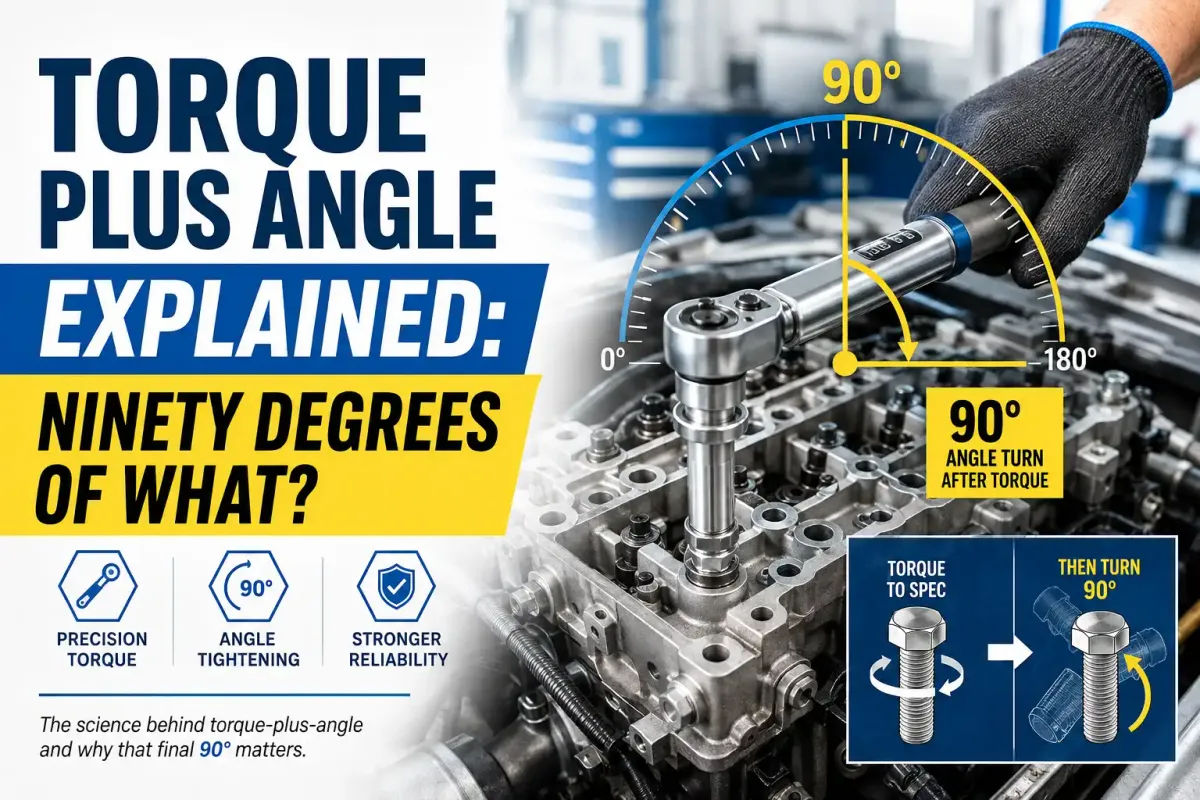
Short answer: ninety degrees of further rotation of the fastener itself, measured from the exact point the first stage ended. Not ninety degrees of wrench swing from wherever you happened to start. Not ninety degrees from the fastener's original position. From the moment the first-stage torque was reached, the fastener turns a further quarter turn.
That reference point is where people go wrong, and it is worth getting right before anything else on this page.


As an Amazon Associate we earn from qualifying purchases.
Why torque alone is an unreliable proxy
Start with what a torque specification is trying to achieve.
The goal is clamping force. Torque is a way of getting there, but most of the torque you apply to a fastener is consumed by friction: friction in the threads and friction under the head or nut face. Only what is left goes into stretching the fastener, which is what actually produces clamping force.
The share consumed by friction is not constant. It varies with thread condition, surface finish, any lubricant present, and manufacturing variation between fasteners. Two bolts torqued identically in the same joint can end up at meaningfully different clamping forces because they had different friction.
That is the limitation torque-plus-angle is designed around.
What the first stage is for
The first stage is a torque, and its job is to establish a known starting point.
It brings the joint together, seats all the mating surfaces, and takes up any gaps, so that every fastener in the joint begins the angle stage from a comparable condition. It is a preload step, not the specification's main event.
This is why the first-stage figure is often modest relative to what the joint ends up at. It is not trying to clamp anything fully. It is trying to get everything to the same place.


As an Amazon Associate we earn from qualifying purchases.
What the angle stage is measuring
Rotation is a proxy for stretch.
Once the joint is seated, further rotation of the fastener translates fairly directly into further elongation, because the threads are advancing the fastener into a joint that is no longer taking up slack. A given angle of rotation stretches the fastener by an amount determined by the thread pitch, and thread pitch is a fixed geometric property rather than a variable one.
That is the elegance of it: angle bypasses friction entirely. It does not matter how much torque was needed to achieve the rotation, because you are measuring the rotation.
The result is far more consistent clamping force across a set of fasteners. Which is exactly why angle tightening is strongly associated with fasteners designed to be taken into permanent stretch: torque-to-yield and stretch bolts.
The reference point, which is where people go wrong
Restating it because it is the practical failure.
The angle is measured from the point the previous stage ended. If the specification is a torque then ninety degrees, you tighten to the torque, note where the fastener is at that instant, and rotate ninety degrees further from there.
Three ways people get this wrong:
Measuring from where they started tightening, which includes all the rotation of running the fastener down and produces far too little final rotation.
Losing the reference during a repositioning. If you have to reset the wrench mid-rotation, you must not lose track of the fastener's position. Mark it before you start the angle stage.
Measuring the wrench rather than the fastener. If the wrench slips on the fastener, or an adapter flexes, the wrench has moved further than the fastener has. The fastener's rotation is the specification.
Marking the fastener, or the socket, with a paint pen or a piece of tape at the end of the first stage removes most of this. It is a five-second habit and it makes the angle stage visually verifiable.
Multi-stage specifications with more than two steps
Two stages is the simple case. Real specifications frequently have more.
You may meet a torque followed by two separate angle stages, a torque then an angle then a further torque check, or a sequence where the whole joint is taken through stage one before anything goes to stage two.
That last point matters and is easy to miss: on a multi-fastener joint, the stages usually apply to the joint rather than to each fastener individually. Every fastener completes stage one, in sequence, before any fastener begins stage two. Doing one fastener all the way through and then moving to the next defeats the purpose, for the same reason a circular tightening order does: torque sequence and why order matters.
Read the whole procedure before you start. The staging and the sequence together are the specification.


As an Amazon Associate we earn from qualifying purchases.
How the angle is measured in practice
Three approaches, in rough order of reliability.
An electronic wrench with an angle function, which measures rotation directly and alerts at the target.
A dedicated angle gauge, which mounts between the drive and the socket and reads rotation against a fixed reference arm.
Marking and eyeballing, which is what most people do at home. It is workable for large angles like ninety degrees, where a quarter turn is visually obvious, and progressively less reliable as angles get smaller or less round.
Whatever the method, the fastener's position at the end of the previous stage is the datum, and marking it is what makes any of these verifiable afterward.
Why the sequence and the stages interact
Both exist for the same underlying reason: fasteners in a joint affect each other.
Tightening one fastener changes the load distribution through the clamped parts, which changes the condition its neighbors are working in. The sequence spreads that effect out spatially. The staging spreads it out in magnitude, so that no fastener reaches its final state while its neighbors are still loose.
Take either away and the joint ends up unevenly clamped even though every individual fastener received the correct treatment.
Where your vehicle's actual procedure lives, with its staging and sequence intact: how to find the torque spec for any fastener and owner's manual vs service manual vs repair database.
And the tool has to be read correctly for the torque stage before the angle stage means anything: click, beam and digital torque wrenches.


As an Amazon Associate we earn from qualifying purchases.
Frequently asked questions
Ninety degrees of what, exactly?
Ninety degrees of further rotation of the fastener, measured from the point at which the first-stage torque was reached. Not from where you started tightening.
Why do manufacturers specify angle instead of just torque?
Because most applied torque is consumed by variable friction, so torque is an unreliable proxy for clamping force. Rotation translates directly into stretch via the thread pitch, which bypasses friction.
How do I measure the angle at home?
Mark the fastener or socket at the end of the torque stage and rotate to the target. A dedicated angle gauge or an electronic wrench with an angle function is more reliable, especially for smaller angles.
Do I do all stages on one fastener before moving on?
Usually not. On a multi-fastener joint the stages generally apply to the whole joint, so every fastener completes stage one in sequence before any begins stage two. Read the full procedure first.
Does a torque-plus-angle spec mean the bolt is single use?
Often, because angle tightening is strongly associated with fasteners taken into permanent stretch. The specification will say. Do not assume reusability from the bolt's appearance.