Impact Wrench vs Torque Wrench: Was the Shop Wrong?
It depends entirely on whether the gun was the last tool used. Here is the legitimate use, the illegitimate one, and what torque sticks really do.

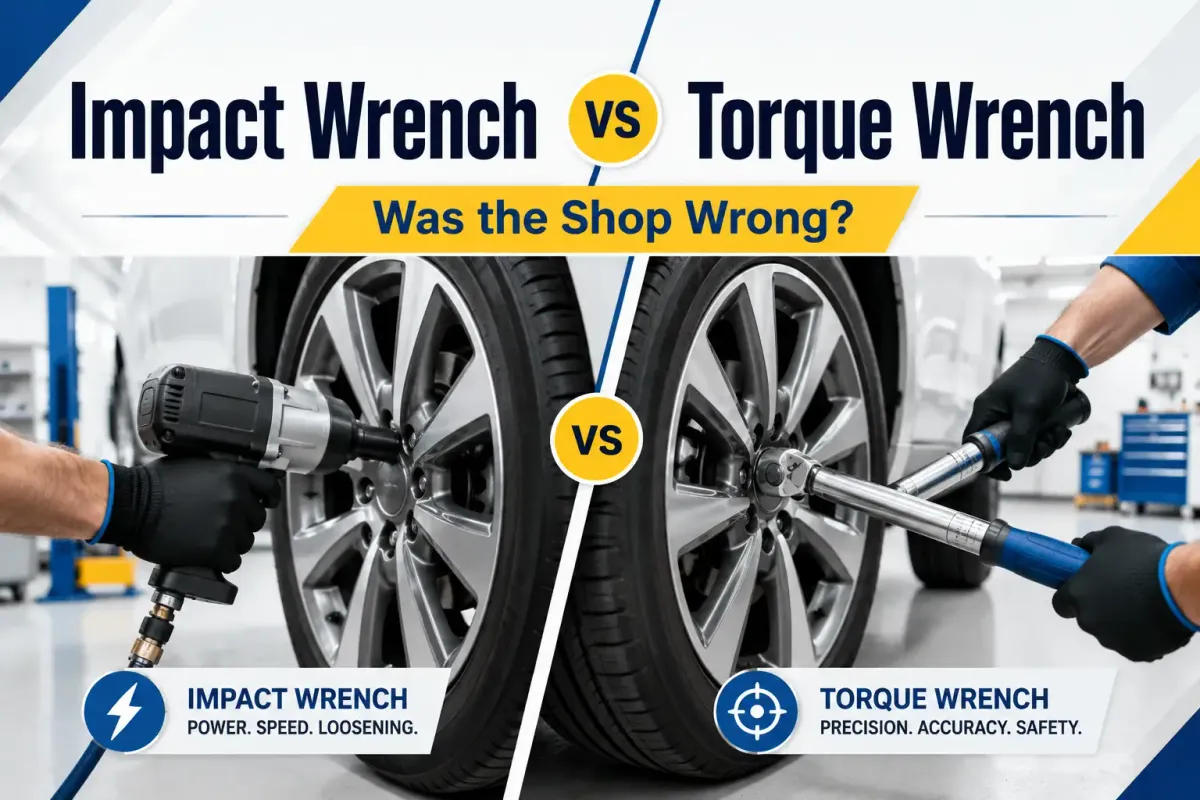
Short answer: it depends entirely on whether the impact wrench was the last tool that touched the fasteners. Running nuts down with an impact wrench and then finishing with a torque wrench is normal, correct practice in a busy shop. Using the impact wrench to do the final tightening is not. From the waiting room both sound identical, which is the honest difficulty with your question.
This page explains the difference so you can ask a precise question rather than a suspicious one. It does not recommend, rank or price any tool, because which tool to own is a different subject from whether your car was serviced correctly.


As an Amazon Associate we earn from qualifying purchases.
What an impact wrench actually does
An impact wrench delivers rotation in rapid hammer blows rather than as steady turning force.
That mechanism is why it is so effective at loosening fasteners that steady force cannot move: each blow delivers a short, high-intensity pulse that breaks static friction where a continuous pull would just load the tool up.
It is also very fast at running a fastener down its thread, which is most of the time spent on a wheel change and none of the precision.
Why it does not deliver a controlled clamping force
The problem is that the tool has no way of knowing when to stop.
Torque, correctly applied, is a proxy for clamping force, and achieving a specified clamping force means applying a specified torque and then stopping. An impact wrench applies pulses until the operator releases the trigger. What the fastener ends up at depends on how many blows it received, the air pressure or battery state, the tool's condition, the socket, the extension, and the operator's judgement.
None of those are the specification. The result is a fastener at some torque that nobody measured.
There is no dial to read afterward either. The wheel looks the same whether it is under-tightened or dramatically over-tightened, which is why this is worth caring about.
What a torque specification actually consists of: how to find the torque spec for any fastener.


As an Amazon Associate we earn from qualifying purchases.
The legitimate use: running nuts down before final tightening
Used correctly, an impact wrench does the boring part.
The fasteners are run down until they are seated but not tight, and then a torque wrench takes each one to specification, in the correct sequence, in more than one pass. The impact wrench has saved time on the threads and has had no influence on the final clamping force.
This is standard practice and there is nothing wrong with it. A shop doing this is not cutting corners; it is spending its time where the precision matters.
The sequence part is not optional and is easy to skip when working fast: torque sequence and why order matters.
The illegitimate use: final tightening
Using the impact wrench for the last step means nobody knows what the fasteners are at.
The usual outcome is over-tightening, because operators err toward tight and the tool makes it effortless. Over-tightening can stretch studs beyond where they should be, deform the seat area of the wheel, and make the fasteners very difficult to remove later, which is the symptom most owners eventually notice at the roadside.
Under-tightening happens too, particularly with a tool that is low on air or battery, and it is the more dangerous of the two because there is no warning at all.
The tell that the job was done properly is simple: you saw or heard a torque wrench after the gun. If the gun was the last thing you heard, the fasteners are at an unmeasured value.
Torque sticks, and what they are and are not
Torque sticks are the interesting middle case and they are widely misunderstood.
A torque stick is a torsion bar extension used between an impact wrench and the socket. It is sized so that it flexes and absorbs the tool's blows above a certain level, which limits the torque that can be transmitted through it. The socket on the end should be an impact socket of the exact size. See which socket sizes match across metric and standard.
What they do: provide a practical ceiling that stops an impact wrench running a fastener up to whatever it is capable of. That is a genuine safety improvement over an unrestricted gun, and it is why shops use them.
What they do not do: turn an impact wrench into a torque wrench. The limiting behavior depends on the tool driving them, the speed, and the condition of the stick, so what a stick delivers is an approximation of a ceiling rather than a measured value.
The correct role is the same as the impact wrench itself: a fast intermediate step, with a torque wrench doing the final tightening. A shop using torque sticks and then a torque wrench is doing it properly. A shop using torque sticks instead of a torque wrench is treating a ceiling as a specification.


As an Amazon Associate we earn from qualifying purchases.
What over-tightening does that you will not notice until later
The consequences are delayed, which is why this argument is hard to win in the moment.
Studs stretched beyond their intended range do not return to where they were, and a stud that has yielded does not develop the clamping force it should on the next assembly. Deformed seat areas in the wheel lose clamping force too, which allows movement.
There is also the practical consequence: fasteners tightened by an unrestricted impact wrench can be extremely difficult to remove with a hand tool, which is a genuine problem at the roadside with a flat tire and the wrench that came with the car.
Some fasteners cannot be reused at all once taken past their intended stretch, which is a related principle worth knowing: torque-to-yield and stretch bolts.
What to ask the shop, and what to do if you are unsure
Ask one question: "Were the wheel fasteners final-torqued with a torque wrench?"
It is a precise question, it has a yes or no answer, and any competent shop will answer it without difficulty. A shop that becomes evasive has told you something.
If you are not satisfied, the remedy is straightforward and cheap. Have the fasteners checked against the specification with a torque wrench, at the same shop or another one. That is a few minutes of work and it resolves the question completely.
If you want to check them yourself, you need the correct figure and a wrench you can read: where your wheel torque spec actually lives and click, beam and digital torque wrenches.


As an Amazon Associate we earn from qualifying purchases.
Frequently asked questions
Is it wrong for a tire shop to use an impact wrench?
Not by itself. Running fasteners down with an impact wrench and final-tightening with a torque wrench is normal, correct practice. Using the impact wrench for the final step is not.
Why can an impact wrench not set torque?
Because it applies pulses until the trigger is released, and the result depends on the number of blows, the tool's power state and condition, and the operator. Nothing measures the outcome.
Do torque sticks make an impact wrench accurate?
No. They impose an approximate ceiling, which is a real safety improvement over an unrestricted gun, but the ceiling is not a measured value and should be followed by a torque wrench.
How do I know if my wheels were over-tightened?
You generally cannot tell by looking. The practical remedy is to have them checked against the specification with a torque wrench, which takes a few minutes.
What should I ask the shop?
Whether the wheel fasteners were final-torqued with a torque wrench. It is a yes or no question and a competent shop answers it easily.