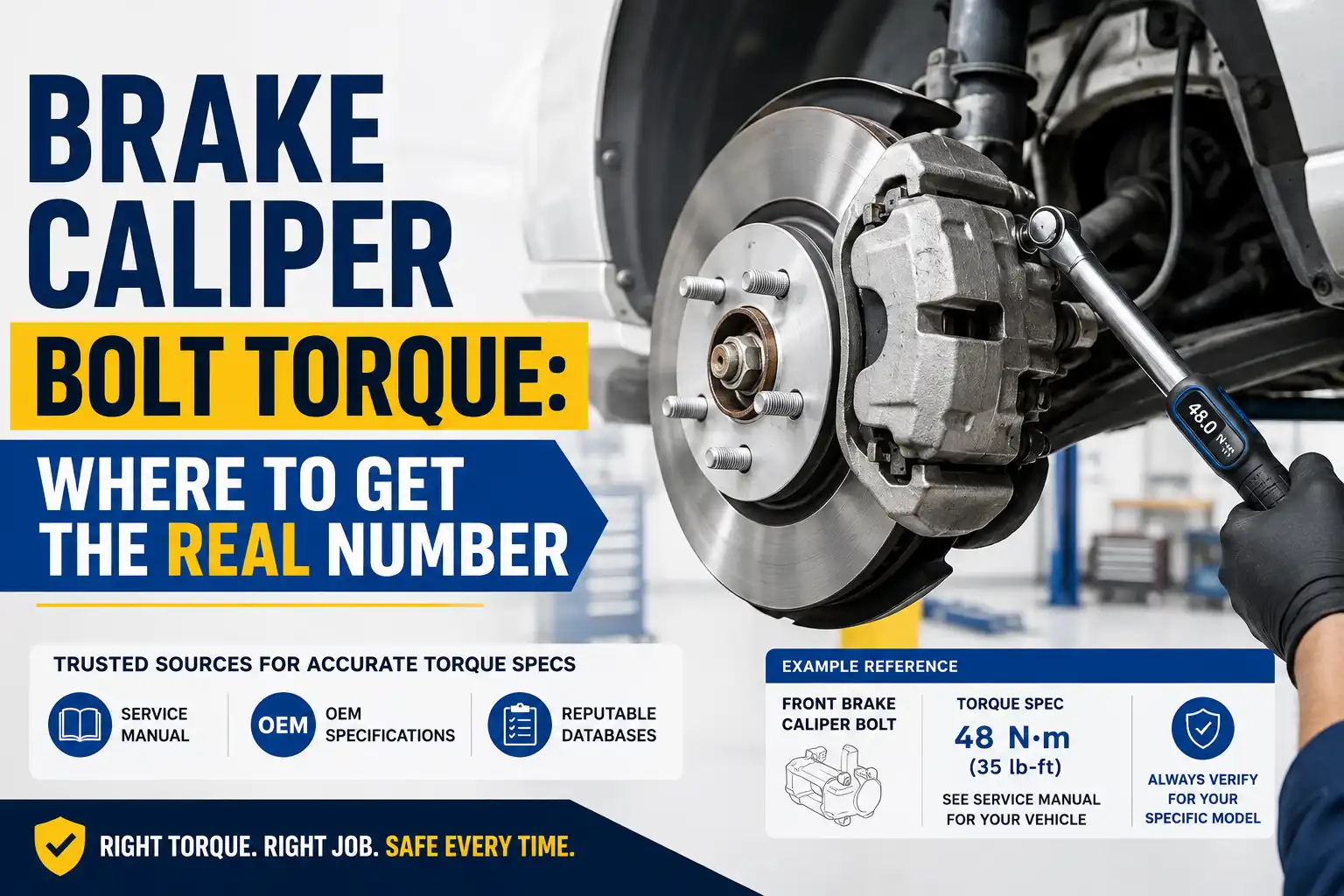
Brake Caliper Bolt Torque: Where to Get the Real Number
Braking is a system where a professional is the right answer for most readers. Why a general torque chart is especially dangerous on these fasteners.

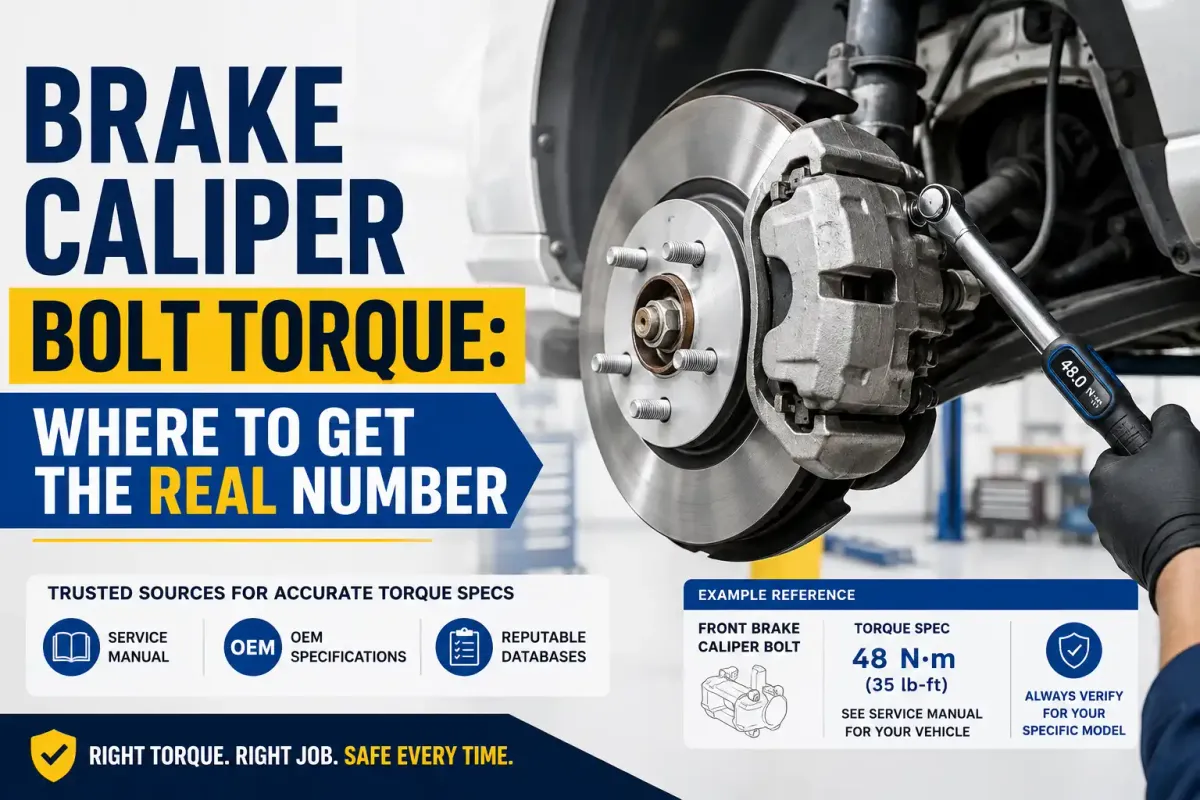
Short answer: braking is a system where a qualified professional is the correct answer for most readers, and the torque figure is not ours to give. If you are reading this because you are part way into a brake job and need a number, the honest thing we can tell you is where the number lives and why the charts offering it to you right now should not be trusted. We will not publish one, and by the end of this page we hope you will agree that is the right call.
This is not a brake job guide and it will not become one. We have done no hands-on work on any vehicle, and nothing here is written from experience of doing this job.


As an Amazon Associate we earn from qualifying purchases.
Why brake fasteners are not one specification
The phrase "caliper bolt torque" describes several different fasteners as though they were one.
A typical arrangement has fasteners holding the caliper bracket to the steering knuckle or hub carrier, and separate fasteners or guide pins holding the caliper to that bracket. Those are different fasteners doing different jobs in different materials, and they carry different specifications.
Add to that the banjo bolt or fitting at the hydraulic connection, which is a different specification again and has a sealing function rather than only a clamping one.
So a single number labeled "caliper bolt torque" is already suspect before you ask which vehicle it came from. It is answering a question that has at least three answers.
Guide pins, bracket bolts and caliper bolts
Worth separating properly, because the naming is inconsistent across manufacturers and across the internet.
Bracket fasteners hold the caliper carrier to the suspension upright. These carry the braking loads into the vehicle's structure and are usually the highest specification of the group.
Guide pins, on floating caliper designs, allow the caliper to slide as the pads wear. They are threaded fasteners with a sliding function, and their specification reflects that they are not simply clamping something. Sliding parts that seize can make the pads wear unevenly; our brake pad wear chart covers how to read uneven pad wear in millimeters.
Caliper fasteners on fixed caliper designs hold the caliper body to its mounting.
A chart that does not distinguish these has collapsed several specifications into one row. Applying a bracket figure to a guide pin, or the reverse, is not a small error.


As an Amazon Associate we earn from qualifying purchases.
Fasteners that may be single use
Brake hardware is one of the places single-use fasteners are common.
A fastener designed to be tightened past its elastic limit cannot be reused, and it looks identical to a reusable one after removal. The specification is the only thing that tells you: torque-to-yield and stretch bolts.
Some of these fasteners also carry a thread-locking compound applied at manufacture, which is consumed on removal. That is a condition of the specification too, and a fastener refitted without it is not in the state the figure assumes: dry vs lubricated threads.
A chart cannot tell you any of this. It has one column for a number.
Why a general torque chart is especially dangerous here
Every general torque chart on the internet includes brake fasteners, and this is precisely the entry that should worry you.
Those charts are aggregated from other charts. They collapse several distinct fasteners into one row, drop the sequence, drop the staging, drop the single-use instruction and drop the thread condition. What survives is a number, and a number is the least important part of a brake fastener specification.
They also inherit the ordinary problems of copied vehicle data: wrong configuration, wrong market, wrong side of a mid-year change, and rounded conversions: why two websites give your car two different numbers.
On most fasteners a wrong figure is a repair that fails later. On braking, a wrong figure is a system that may not do what the driver asks of it at the moment they ask.
Where the real specification lives
Manufacturer service information for your model year and market, or a factory service manual.
That is the only form in which you get the figure together with the things that make it a specification: which fastener, in what sequence, in how many stages, in what thread condition, with what replacement instruction.
An individual can generally buy access to manufacturer service information, often as a short subscription measured in days. For a job like this, that is the cheapest correct answer available, and it is a genuinely different quality of information from anything a search returns: owner's manual vs service manual vs repair database.
The general structure of what a torque specification consists of, and why the conditions are not optional: how to find the torque spec for any fastener. And if the specification you find is expressed in stages: torque plus angle explained.


As an Amazon Associate we earn from qualifying purchases.
What we have not done, stated plainly
We have not performed this job on any vehicle. We have not tested any fastener, measured any torque, or verified any figure against a physical car.
Everything on this site is written from documented sources, and where a source cannot be named for a specific vehicle we say so rather than filling the gap. That is the whole editorial position, and this article is where it matters most.
If a site is giving you a brake torque figure without telling you which fastener, which vehicle configuration, which model year, which market and where the figure came from, it has not done more work than us. It has done less and shown you a number anyway.
How to decide whether this job is yours
Not a judgement about your competence. A set of questions with factual answers.
Do you have manufacturer service information for your exact vehicle? If not, you do not have the specification, and the job cannot be done to specification.
Do you have a torque wrench you can trust and read? Torque wrench calibration covers what "trust" means here.
Do you have the replacement hardware the procedure calls for, if it calls for any?
Can you complete the whole procedure, including anything the specification requires after assembly?
Is there anyone to check it? On a braking system, a second pair of eyes is worth a great deal.
If the answer to any of the first four is no, the job is not currently yours, and that is a factual statement rather than a discouragement. A qualified technician has the information, the tools and the hardware, and on this system that combination is what the work requires.


As an Amazon Associate we earn from qualifying purchases.
Frequently asked questions
What is the torque spec for brake caliper bolts?
We do not publish one, and neither should the charts offering you one. Bracket fasteners, guide pins and caliper fasteners are different specifications, and your vehicle's figure comes from manufacturer service information.
Why will this site not give me a brake torque figure?
Because we cannot verify manufacturer specifications across every model year, trim and market, and on braking a wrong figure is a system that may not perform when the driver needs it.
Are brake caliper bolts single use?
Some are. Single-use fasteners are common in brake hardware and look identical to reusable ones after removal. Only the specification tells you.
Can I use a torque chart for brake bolts?
No. Charts collapse several distinct fasteners into one row and drop the sequence, staging, thread condition and replacement instructions, which is most of what the specification is.
How do I get the real specification?
Manufacturer service information for your model year and market. Individuals can generally buy short-term access, which for a job like this is the cheapest correct answer available.