Anti-Seize on Lug Nuts: What the Physics Actually Says
Most applied torque fights friction. Reduce it and the same wrench reading produces more clamping force, which is over-tightening that looks correct.

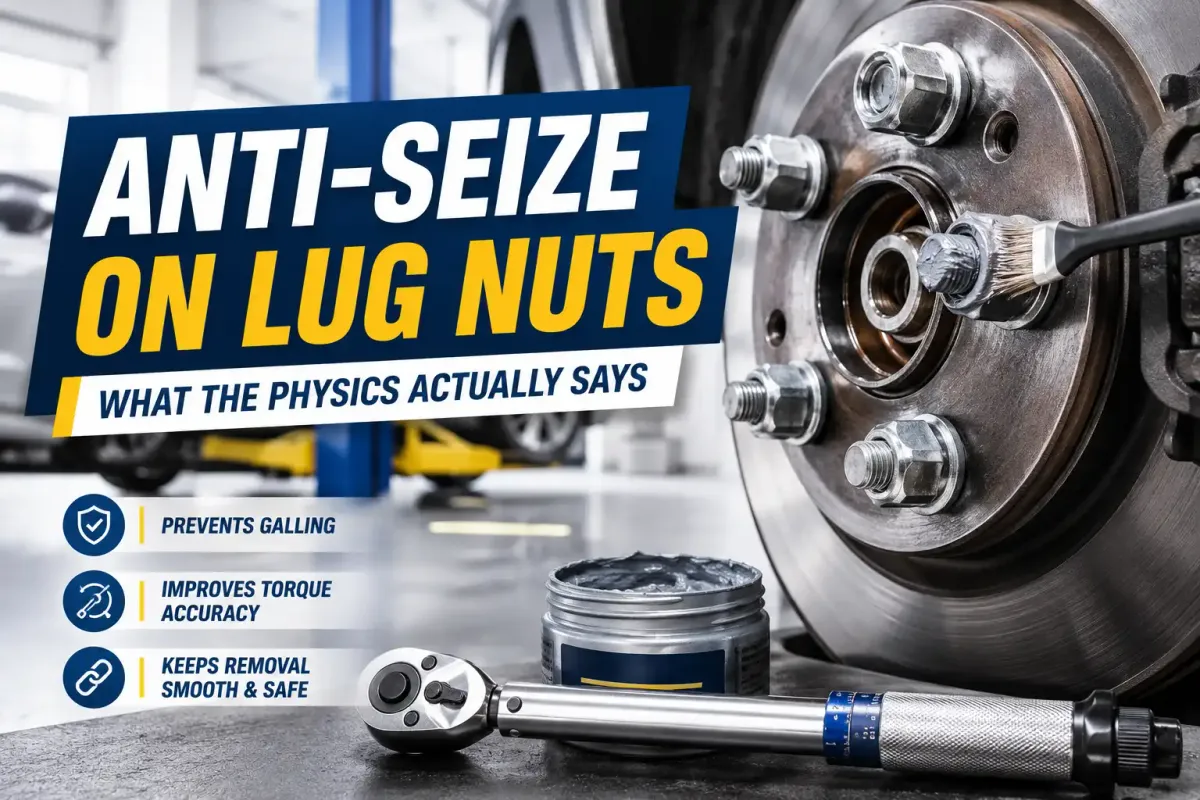
Short answer: most of the torque you apply to a fastener is spent overcoming friction, so reducing the friction sends more of it into stretching the bolt. The same reading on the same wrench then produces a higher clamping force than the specification intended. That is over-tightening, and it happens while the wrench is telling you that you did everything correctly.
The forums argue about this endlessly because both sides are describing something real. One side is describing the physics above. The other is describing corrosion, seizing and the roadside flat that cannot be undone. Both are true, and neither settles it, which is why the answer has to come from your manufacturer rather than from an argument.


As an Amazon Associate we earn from qualifying purchases.
Where the torque you apply actually goes
When you tighten a fastener, the effort divides three ways.
A large share goes into overcoming friction in the threads. Another substantial share goes into overcoming friction between the turning face and the surface it bears on. What is left, the smallest share of the three, goes into actually stretching the fastener.
That last part is the one doing the work. Stretch produces clamping force, and clamping force is what holds the joint. Everything else is overhead.
The proportions vary with the joint, which is precisely the problem: a specification is derived for one set of conditions and applies to those conditions.
What happens when friction drops
Reduce the friction and the overhead shrinks, so more of the same applied torque reaches the fastener.
The clamping force goes up. Not by a little, because the friction share is large, and the portion going into stretch is small enough that a reduction in overhead is proportionally significant to it.
This is why the effect is not a rounding error. Changing thread condition changes the outcome of a torque specification meaningfully, and the direction is always toward more clamping force than intended.


As an Amazon Associate we earn from qualifying purchases.
Why this is over-tightening even though the wrench reads correctly
The wrench measures torque. It does not measure clamping force, and it has no way to know what the friction in your joint is.
So a wrench clicking at the specified value on a lubricated thread is doing exactly what it is designed to do while the joint ends up beyond specification. There is no feedback, no warning and no way to detect it afterward by inspection.
That is what makes this a genuine hazard rather than a debating point. The failure is invisible at the moment it happens, which is the profile of most of the failures on this site.
The consequences of over-tightening are the same here as anywhere: studs loaded beyond their intended range, seat areas deformed, and fasteners that may not develop correct clamping force next time. Some fasteners cannot survive it at all: torque-to-yield and stretch bolts.
What a specification assumes about thread condition
Every torque specification assumes a thread condition, whether or not it says so.
Well-written service information states it: clean and dry, lightly oiled, with a specified compound, or as-supplied. Where it is stated, that is part of the specification and not a footnote.
Where it is not stated, the safe reading is that the specification assumes the condition the fastener is normally in for that assembly, which for most wheel fasteners means clean and dry.
The general principle, which extends well beyond lug nuts: changing the thread condition invalidates a torque figure unless the manufacturer has specified that condition. A number derived under one set of conditions is not a number that applies under another: how to find the torque spec for any fastener.
The corrosion argument on the other side
The case for anti-seize is not silly and it deserves stating properly.
Fasteners corrode. Dissimilar metals in contact corrode faster. A wheel fastener that has seized is a fastener that cannot be removed with the tools in the car, at the roadside, in the dark, with a flat tire. That is a real failure mode with real consequences, and people who have experienced it are not being irrational.
There is also a case about consistency: a corroded thread has more friction than a clean one, so it produces less clamping force at the same torque, which is the mirror image of the problem above.
What makes this hard is that both arguments are correct and they point in opposite directions. Neither is a knock-down case, which is why the resolution is not an argument at all.


As an Amazon Associate we earn from qualifying purchases.
What manufacturers actually say, and why you must check yours
Manufacturers do address this, and what they say varies.
Some specify clean and dry threads explicitly and prohibit compounds. Some specify a particular compound or a particular condition and give a figure for that condition. Some address corrosion through the fastener's own coating and expect nothing to be added.
We are not going to characterize what any manufacturer says, because that varies by manufacturer, by model and by era, and an unsourced generalization is exactly the kind of claim this site refuses to make.
What we will say clearly: we do not publish a correction factor. You will find percentages quoted online for how much to reduce torque on a lubricated thread. A correction factor without a named source and a named joint is a fabricated figure, and applying one to a safety-critical fastener on the basis of a website is not better than not applying one.
Your vehicle's own documentation is where this is answered: where your wheel torque spec actually lives and owner's manual vs service manual vs repair database.
Where this leaves you in practice
Three positions that are all defensible.
Follow your manufacturer's stated condition. If they say clean and dry, clean and dry. If they specify a compound and a figure for it, use both together. This is the only position that is unambiguously correct.
Where nothing is stated, default to clean and dry, because that is what most wheel fastener specifications assume and it is the condition under which a published figure is most likely to mean what it says.
If corrosion is a genuine problem where you are, take it to a dealer or a professional and ask what the manufacturer recommends for your vehicle. That is a better question than any general answer, and it may have an answer that is neither of the above.
What is not defensible is applying a compound and then applying the dry-thread figure unchanged, which is the most common thing people actually do.
Whatever you do, the reading has to be right for any of it to matter: click, beam and digital torque wrenches.


As an Amazon Associate we earn from qualifying purchases.
Frequently asked questions
Should I put anti-seize on lug nuts?
Follow your vehicle manufacturer's stated thread condition. Where nothing is stated, clean and dry is the condition most wheel fastener specifications assume.
Why does lubricant change the torque required?
Most applied torque is consumed by friction. Reducing friction sends more of the same torque into stretching the fastener, producing a higher clamping force than the specification intended.
How much should I reduce torque if I use anti-seize?
We do not publish a correction factor. A percentage without a named source and a named joint is a fabricated figure, and applying one to a wheel fastener on the basis of a website is not safe practice.
Is over-tightening from lubricant really a problem?
Yes, and it is invisible. The wrench reads correctly while the joint goes beyond specification, and there is no way to detect it afterward by inspection.
What about corroded threads?
Corrosion increases friction, so it produces less clamping force at the same torque, which is the mirror problem. Seized fasteners are also a real roadside hazard. Ask a professional what your manufacturer recommends.