Torque-to-Yield Bolts: Why You Really Cannot Reuse Them
A TTY bolt is deliberately stretched past its elastic limit, which is exactly why it is single use. And a used one looks identical to a new one.

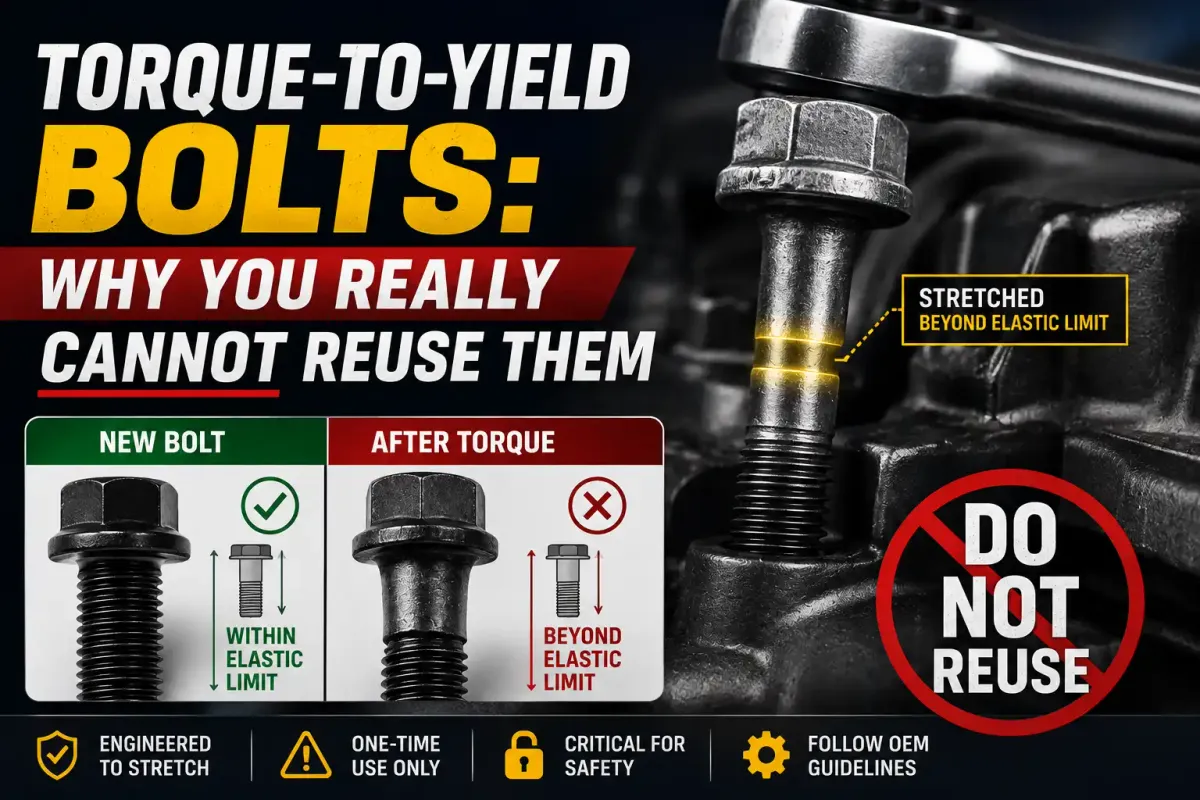
Short answer: no, and the reason is that the bolt was designed to be stretched permanently, which is the whole point of it. A torque-to-yield bolt is deliberately tightened past its elastic limit so that it holds a very consistent clamping force. That same design is exactly why it cannot go back a second time. The manual telling you to replace them is not selling you bolts.
The dangerous part is that a used one looks completely normal.


As an Amazon Associate we earn from qualifying purchases.
Elastic versus plastic deformation, in plain terms
Every bolt stretches when you tighten it. That stretch is what produces clamping force, in the same way a stretched spring pulls.
Up to a point, the stretch is elastic: release the load and the bolt returns to its original length. Beyond that point, called the yield point, the stretch becomes plastic: the material has permanently deformed and will not return.
An ordinary bolt is designed to be used well inside its elastic range, so it can be tightened, loosened and tightened again, returning to the same length each time.
A torque-to-yield bolt is designed to be taken to or just past its yield point.
Why a manufacturer would want a bolt that yields
This seems perverse until you look at what happens at yield.
In the elastic range, small differences in applied torque produce proportional differences in clamping force. Since a large and variable share of applied torque is consumed by friction, that means real-world clamping force in an elastic joint varies considerably between fasteners, even when every one is torqued identically.
At yield, the material's behavior flattens out. Once you are in that region, further rotation produces relatively little additional tension. So a fastener taken into yield ends up at a clamping force determined largely by the material's own properties rather than by how much friction happened to be in that particular thread.
The result is a set of fasteners clamping far more consistently than the elastic equivalent. On a joint where even clamping matters a great deal, that consistency is worth designing for.


As an Amazon Associate we earn from qualifying purchases.
What happens to a reused torque-to-yield bolt
The bolt has already been permanently stretched, so it starts its second life longer and thinner than it started its first.
Tightening it again continues from where it left off, further into plastic deformation, with less material cross-section to work with. It reaches a given clamping force at a different point, and it is closer to failure than it was.
Repeat that and the bolt eventually necks and breaks, either during tightening or, worse, in service. On a joint where these fasteners are used, a failure in service is usually a serious matter, because these bolts are specified where consistent clamping is critical.
There is also a subtler failure: the reused bolt may reach the specified rotation without achieving the clamping force the specification assumes, so the joint is assembled looking correct and clamped incorrectly.
Why you cannot tell by looking
A torque-to-yield bolt that has been used once shows no obvious external sign.
The permanent stretch is distributed along the shank and amounts to a small change in overall length. Threads look normal. There is no discoloration, no visible necking in most cases, and nothing that distinguishes a used one from a new one in a parts tray.
Measuring length can identify a badly stretched bolt where the manufacturer publishes a maximum, and where a length limit is specified that is a real check. But absence of obvious stretch is not evidence the bolt is reusable, because reusability is determined by the specification rather than by inspection.
The practical consequence: once these bolts are out of the vehicle and off the bench, you cannot sort the used from the new by eye. Keep them separated as you work.


As an Amazon Associate we earn from qualifying purchases.
How the specification tells you a bolt is torque-to-yield
Three signals in service information, and any one of them should stop you.
An explicit instruction to replace. The clearest and most common.
A tightening procedure expressed as torque followed by angle. Angle tightening is strongly associated with taking a fastener into yield, because rotation is a better proxy for stretch than torque once you are past the elastic range: torque plus angle explained.
A maximum length or a stretch check. If the manufacturer tells you to measure the bolt, they are telling you it stretches permanently.
None of these appear on a general torque chart, which is a large part of why this site does not publish one. A chart entry giving one number for a fastener with a multi-stage single-use specification has not simplified it; it has replaced it with something wrong: how to find the torque spec for any fastener.
Where the real specification for your vehicle lives
Manufacturer service information for your model year and market, or a factory service manual. That is where the tightening procedure, the staging, the sequence and the replacement instruction all live together, which is the only form in which they are a specification.
How the tiers differ and how an individual gets access: owner's manual vs service manual vs repair database.
Two related principles that come from the same underlying physics. Anything that changes thread friction changes what a torque figure achieves, which matters especially on fasteners specified with an angle stage: dry vs lubricated threads.
And on brake fasteners in particular, where single-use hardware is common and the consequences are severe, this site's position is that the number is not ours to give: brake caliper and bracket torque.


As an Amazon Associate we earn from qualifying purchases.
Frequently asked questions
Can I reuse a torque-to-yield bolt?
No. It was designed to be stretched permanently past its elastic limit, so a second use continues that permanent deformation with less material to work with and does not achieve the specified clamping force reliably.
What does torque-to-yield mean?
The bolt is tightened to or just past the point where its material deforms permanently. In that region, clamping force is governed largely by the material rather than by thread friction, which makes it far more consistent.
How can I tell if a bolt is torque-to-yield?
From the specification, not from the bolt. Look for an explicit replace instruction, a torque-plus-angle procedure, or a maximum length check. A used one looks identical to a new one.
What happens if I reuse one?
It continues further into permanent deformation and may reach the specified rotation without achieving the intended clamping force, or eventually neck and fail. Either way the joint is not what the specification assumed.
Are stretch bolts and torque-to-yield bolts the same?
The terms are used for the same idea: a fastener deliberately taken into permanent stretch so it clamps consistently, and therefore single use.