Brake Pad Wear Chart mm 2026: Complete Thickness Guide
New pads are about 10 mm. Brake makers say plan a replacement at 4 mm and replace by 2 mm; U.S. legal floors are 0.8 to 1.6 mm. Every threshold sourced.

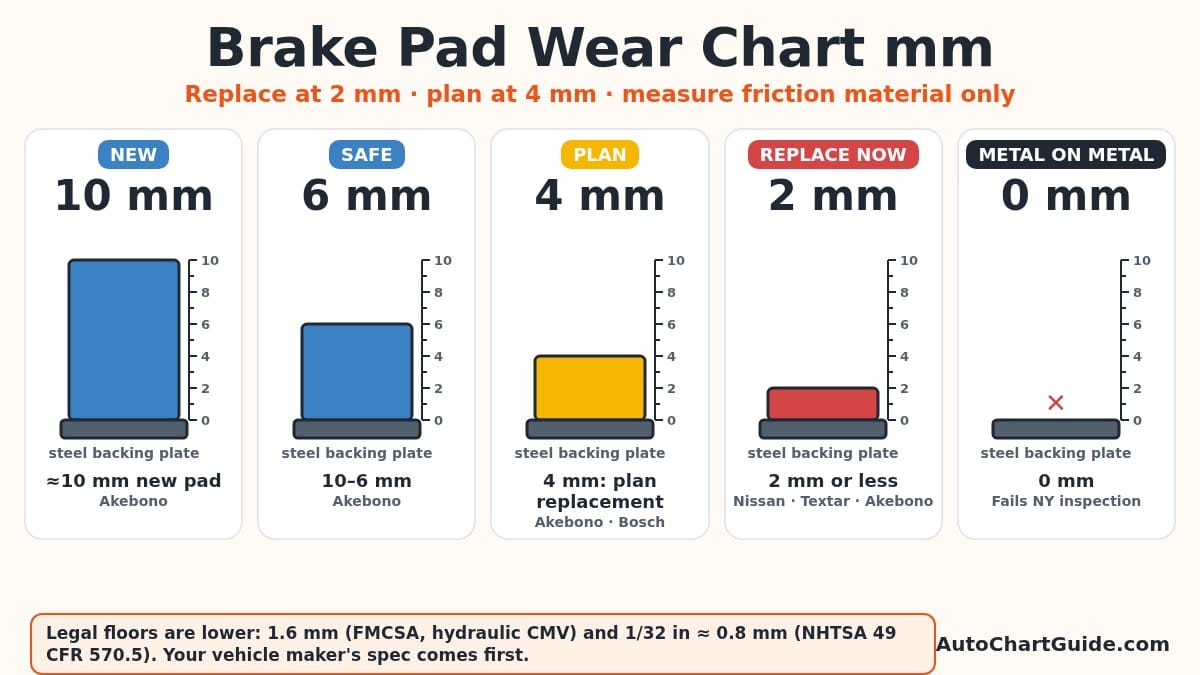
Short answer: a new passenger-car brake pad has about 10 mm of friction material, brake makers start telling you to plan a replacement at 4 mm, and they put the "replace now" line at 2 to 3 mm. Akebono calls 4 mm or less "time for replacement" and 2 mm or less "replace immediately," Bosch sets its workshop wear limit at 4 mm, and Nissan and Textar say pads should be replaced by 2 mm at the latest. The legal minimums in U.S. inspection rules are far lower, around 0.8 to 1.6 mm, and they mark the point where a vehicle fails inspection or may not be operated, not a target. Measure the friction material only, never the steel backing plate, and treat your vehicle maker's own figure as the one that decides.
Every number in this brake pad wear chart comes from a document we read on October 31, 2026: Akebono's customer guidance, Bosch's disc brake workshop guide and brake brochure, TMD Friction's Textar technical manual, Nissan USA's brake service page, NAPA's brake pad warranty statement, and the inspection rules in 49 CFR 570.5 (NHTSA), 49 CFR 393.47 (FMCSA), Pennsylvania's 67 Pa. Code § 175.80 and New York's 15 NYCRR 79.21. Where a rule is written in inches, we show the millimeter conversion and label it as converted. Links to each source are in the text and in the list at the end.
Brake Pad Wear Chart in mm
Read the chart top to bottom as a pad wears. The left column is the thickness of the friction material you would measure on the pad, with the steel backing plate left out. The middle column is what the published sources say about that thickness, and the right column is what that means in practice.
| Friction material left | What the sources say | What to do |
|---|---|---|
| About 10 mm | Typical new pad thickness (Akebono: "about 10 mm (1 cm)") | Nothing; note the reading as your baseline |
| 10 to 6 mm | Akebono blue band: "Safe" | Check at normal service visits |
| 5 mm | No band in any source we read | Keep checking; you are approaching the planning line |
| 4 mm | Akebono yellow band: "Caution (time for replacement)," replacement recommended at 4 mm or less; Bosch workshop wear limit 4 mm; NAPA: riveted pads worn out below 4 mm | Plan a replacement soon |
| 3 mm | NAPA: integral molded pads worn out below 3 mm (warranty definition) | Replace soon |
| 2 mm | Akebono red band: "Danger (replace immediately)"; Nissan and Textar: replace at or before 2 mm; wear indicators set to about 2 mm | Replace now |
| 1.6 mm (1/16 in) | FMCSA legal minimum for hydraulic-brake commercial vehicles; Pennsylvania rejects bonded linings under 2/32 in (converted: about 1.6 mm) | Fails inspection where these rules apply |
| 0.8 mm (1/32 in, converted) | NHTSA 49 CFR 570.5 inspection criterion: not less than 1/32 in over rivet heads or the shoe | Fails inspection; well past every maker line |
| 0 mm | Backing plate on rotor; New York rejects "metal-to-metal contact" | Stop driving and repair |
Friction material only, excluding the steel backing plate. Sources: Akebono, Bosch, Textar (TMD Friction), Nissan USA, NAPA, 49 CFR 570.5, 49 CFR 393.47, 67 Pa. Code § 175.80, 15 NYCRR 79.21. Inch figures converted at 1 in = 25.4 mm where the rule gives inches only. Your vehicle maker's specification takes precedence.
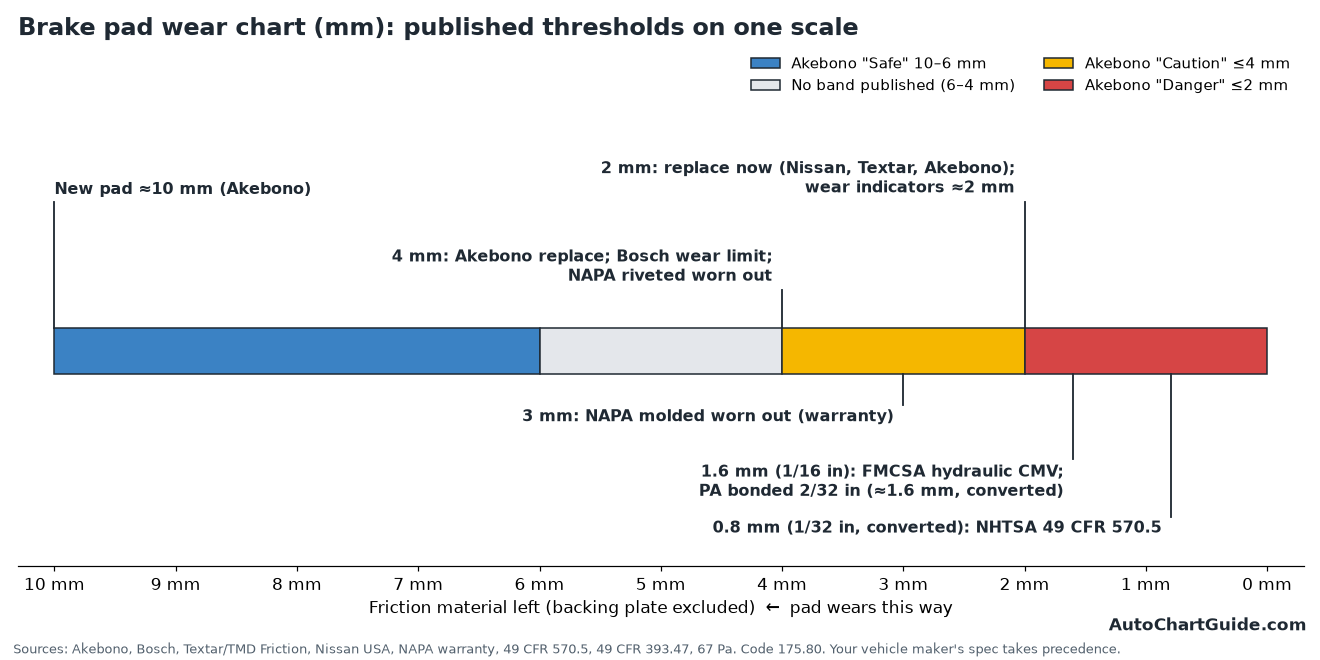
Two gaps in the chart are deliberate. Akebono's color scale labels 10 to 6 mm as safe and 4 mm or less as caution, and it does not put a color on the 5 mm range in between, so we haven't invented one. None of the sources gives a mileage figure for how long a millimeter of pad lasts, either. TMD Friction's Textar manual explains why: for passenger cars, pad life is "a statistical factor," with a "statistical mileage range of between 10,000 and 150,000 km," and it says "it is mainly the driving style that decisively influences the service life of a brake friction product." That's why this chart is organized by thickness, not by miles.
What Each Thickness Means, Band by Band
About 10 mm: a new pad
Akebono, which supplies original-equipment brakes to carmakers as well as the aftermarket, says in its customer advice that "the thickness of the new pad is about 10 mm (1 cm)." That is an approximate figure, not a specification for every pad, and Akebono itself calls its numbers "only guidelines." If you want to know how much pad your car started with, the dimension is in the factory service information or on the pad maker's catalog page for your exact part, not in a generic chart.
10 to 6 mm: normal wear
Akebono's chart colors this range blue and labels it "Safe." A pad in this range has used less than half of its friction material if it started near 10 mm. There's nothing to do except keep an eye on it at your normal service visits.
4 mm: start planning a replacement
This is where the two brake makers' guidance meets. Akebono writes that "when residual thickness is 4 mm or less, we recommend pad replacement for safety's sake," and colors the band yellow for "Caution (time for replacement)." Bosch's workshop checklist for disc brakes puts the "wear limit at 4 mm pad thickness, measured without pad backing plate." A 4 mm reading isn't an emergency, but it is the point where most of the usable material is gone. If your next service is months away, it's sensible to book the pads now rather than wait for the squeal.
3 mm: the warranty line for molded pads
NAPA's SilentGUARD warranty treats a disc brake pad as worn out, "beyond the life of the product," once the friction material is "less than 3 mm for integral molded disc brake pads." That's a warranty definition, not a safety instruction, but it tells you where at least one pad seller considers the useful life of a molded pad to end.
2 mm: replace now
At 2 mm several sources agree that the pad is done. Nissan USA says "pads should be replaced at or before 2 mm thickness is reached." TMD Friction's Textar manual says friction products "must be replaced at the latest, when the friction material has reached the minimum thickness of 2 mm." Akebono's chart colors 2 mm or less red: "Danger (replace immediately)." This is also roughly where wear indicators are designed to go off, which is covered in its own section below.
1.6 mm and 0.8 mm: legal floors, not targets
Below 2 mm you are into the numbers written into inspection law. FMCSA's rule for commercial vehicles with hydraulic brakes is 1.6 mm (1/16 inch). Pennsylvania rejects bonded linings under 2/32 inch, which converts to about 1.6 mm. NHTSA's model inspection standard for vehicles of 10,000 lb GVWR or less allows 1/32 inch, about 0.8 mm. A pad that thin is well past every manufacturer's replace-now line, so passing inspection at that thickness only means the car isn't illegal yet.
0 mm: metal on metal
Once the friction material is gone, the steel backing plate presses on the rotor. New York's inspection rule rejects a vehicle for "metal-to-metal contact," and at that point the rotor can be damaged as well. Akebono's guidance makes the same point from the other direction: pads that wear too thin "might cause damage to the disk rotors and could lead to replacement of the entire brake."
Who Says What: The Thresholds by Source
The table below puts every published number side by side, so you can see which source is behind each line of the chart and how each one measures the pad.
| Source | Type of number | Threshold | How it is measured |
|---|---|---|---|
| Akebono (brake maker) | Customer guidance | New about 10 mm; safe 10 to 6 mm; replace at 4 mm or less; replace immediately at 2 mm or less | "Residual thickness" of the pad |
| Bosch (workshop guide) | Workshop inspection limit | Wear limit 4 mm | "Measured without pad backing plate" |
| Textar / TMD Friction | Technical manual | Replace at the latest at 2 mm; indicators at approx. 2 mm | Friction material thickness |
| Nissan USA | Vehicle maker service FAQ | Replace at or before 2 mm; indicator noise at around 2 mm | Friction material thickness |
| NAPA SilentGUARD warranty | Warranty definition of "worn out" | Below 3 mm (integral molded); below 4 mm (riveted); or wear sensor engaged | Friction material thickness |
| NHTSA, 49 CFR 570.5(g) | Model state inspection criterion | Not less than 1/32 in (about 0.8 mm, converted) | Over rivet heads, or over the shoe at the thinnest point for bonded pads |
| FMCSA, 49 CFR 393.47(d) | Federal rule, commercial vehicles | Hydraulic brakes 1.6 mm (1/16 in); air disc 3.2 mm (1/8 in) | At the shoe center |
| Pennsylvania, 67 Pa. Code § 175.80 | State inspection rule | Bonded under 2/32 in fails; riveted under 1/32 in above rivet fails | At the thinnest point |
| New York, 15 NYCRR 79.21 | State inspection rule | No disc pad number; fails if wear sensor activated or metal-to-metal contact | Visual and sensor check |
All documents read October 31, 2026. Converted values are labeled; FMCSA prints both mm and inches.
Laid out like this, the sources fall into four groups, and that explains most of the apparent disagreement between "replace at 4 mm," "replace at 3 mm" and "replace at 2 mm":
- Planning thresholds (4 mm). Akebono and Bosch give a number at which you should arrange a replacement while some material remains. They are written for people deciding whether a pad will last until the next inspection.
- Replace-now thresholds (2 mm). Nissan, Textar and Akebono's red band mark the minimum a pad should ever reach in service. Wear indicators are set to this point.
- Warranty definitions (3 and 4 mm). NAPA's figures define when a pad counts as worn out for a warranty claim. They match the planning range, but they are not safety advice.
- Legal floors (about 0.8 to 1.6 mm). Inspection rules define the thickness at which a vehicle fails. They are deliberately low because they are written to catch dangerous vehicles, not to tell owners when to service theirs.
So the honest summary is that there isn't one universal brake pad replacement thickness. There's a planning number, a replace-now number and a legal floor, and your vehicle maker may publish its own figure that overrides all three. The owner's manual usually tells you how and when to have the brakes inspected; the exact minimum is normally in the factory service information. Our guide to which spec is in the owner's manual and which is in the service manual explains where to look.
Legal Minimum Brake Pad Thickness in the U.S. (Inches and mm)
There is no single national minimum pad thickness for private cars. NHTSA's 49 CFR 570.5 sets inspection criteria that, in the words of the regulation's purpose section, are meant for "the inspection of motor vehicles by State inspection systems." Each state that inspects cars writes its own rule, so the figure that applies to you depends on where the car is registered. Commercial vehicles are different: FMCSA's 49 CFR 393.47 applies directly to commercial motor vehicles.
| Rule | Applies to | Disc pad / lining minimum | In mm |
|---|---|---|---|
| NHTSA 49 CFR 570.5(g) | Inspection criteria for vehicles 10,000 lb GVWR or less | 1/32 in over rivet heads or over the shoe (bonded) | About 0.8 (converted) |
| Pennsylvania 67 Pa. Code § 175.80(7) | Passenger cars and light trucks | Bonded: 2/32 in at thinnest point; riveted: 1/32 in above rivet head | About 1.6 / 0.8 (converted) |
| New York 15 NYCRR 79.21 | Most passenger vehicles and light trucks | No number for disc pads: reject if wear sensor activated, material broken, loose or contaminated, or metal-to-metal | Not stated |
| FMCSA 49 CFR 393.47(d) | Commercial vehicles, hydraulic or electric brakes | 1/16 in | 1.6 (printed) |
| FMCSA 49 CFR 393.47(d) | Commercial vehicles, air disc brakes | 1/8 in | 3.2 (printed) |
Sources: eCFR (current), Pennsylvania Code (current through 56 Pa.B. 5370, August 8, 2026), Cornell LII copy of 15 NYCRR 79.21. Converted values use 1 in = 25.4 mm.
Two details in these rules are easy to miss. First, the federal and Pennsylvania rules measure riveted linings above the rivet heads, not above the backing plate, because the rivet heads are the first metal that would reach the rotor. Second, New York's rule for passenger vehicles doesn't give a number for disc pads at all. Instead, it rejects a car if a disc brake wear sensor is activated, if the friction material is broken, cracked, loose or contaminated with oil or grease, or if there is metal-to-metal contact. The 1/16 inch and 1/32 inch figures in New York's rule apply to drum brake linings.
The same rules also cover rotors and drums. NHTSA's standard says that if a rotor "is embossed with a minimum safety thickness dimension," the rotor must be within it, and Pennsylvania rejects a car when "the disc thickness is less than minimum stamped on assembly or less than manufacturer's specifications," or when drums or rotors are scored deeper than 0.015 inch.
How to Measure Brake Pad Thickness in mm
Every source that gives a number measures the same thing: the friction material on its own. Bosch states its 4 mm limit as "measured without pad backing plate," NAPA and Textar both refer to "friction material thickness," and NHTSA's inspection procedure says to "measure bonded lining thickness over shoe surface at the thinnest point on the lining or pad." Including the steel backing plate is the most common way to misread a pad, because the plate alone can make a nearly finished pad look healthy.
- Find a view of both pads, or remove the wheel. On some wheels you can see the outer pad through the spokes. The inspection rules don't rely on that view: NHTSA's procedure says to remove at least one front wheel and one rear wheel, and Pennsylvania's says to remove at least one front and one opposite rear wheel. If you are not comfortable lifting and supporting a car safely, have a shop measure the pads.
- Identify the friction material. It's the darker block that touches the rotor. The steel plate behind it, and any thin shim behind the plate, are not counted.
- Measure at the thinnest point. Pads don't always wear flat. NHTSA and Pennsylvania both specify the thinnest point, so look at both ends of the pad and both the inner and outer pad, and use the lowest reading.
- Use a gauge that reads in millimeters. A brake pad gauge set or a small ruler with a millimeter scale works. If your gauge reads in 32nds of an inch, 1/32 inch is about 0.8 mm, 2/32 inch about 1.6 mm, 4/32 inch about 3.2 mm and 5/32 inch about 4.0 mm (all converted, 1 inch = 25.4 mm).
- Compare against the chart and your manual. If your vehicle maker publishes a minimum, that figure wins. Otherwise use the planning and replace-now lines above.
Measuring in 32nds of an inch is familiar if you have checked tire tread. Our penny tire tread depth chart uses the same 2/32 inch figure for tires, though the tire rule and the brake rules come from different regulations.
Worked Examples: Reading Your Measurement
The examples below use the published thresholds above and assume a pad that started near Akebono's typical 10 mm. Your pad may have started thicker or thinner, so the percentages are illustrations of the method, not predictions.
| Your reading | Share of usable material left* | Where it falls | Action |
|---|---|---|---|
| 7 mm | 63% | Akebono "Safe" band (10 to 6 mm) | Nothing yet; recheck at the next service |
| 5 mm | 38% | Between Akebono's safe and caution bands; above Bosch's 4 mm limit | Recheck soon; budget for pads |
| 4 mm | 25% | Akebono caution, Bosch wear limit, NAPA riveted worn-out line | Plan replacement |
| 3 mm | 13% | Below the 4 mm planning line; NAPA molded worn-out line | Replace soon |
| 2 mm | 0% | Akebono "replace immediately"; Nissan and Textar replace-now line | Replace now |
*Illustration only: assumes a 10 mm new pad (Akebono's typical figure) and counts usable material down to a 2 mm replace-now line, so 8 mm is usable. Formula: (reading − 2) ÷ 8. Your pad's starting thickness may differ.
The "share of usable material left" column measures the pad against a 2 mm replace-now line, because that is the lowest figure any of the brake makers here recommends running to. A 10 mm pad therefore has about 8 mm of usable material. If you have two readings taken some months or miles apart, you can use the same arithmetic to estimate your own wear rate, but none of the sources publishes a wear rate, and we don't give one.
Brake Pad Wear Indicators: The Squeal and the Dash Light
Many pads carry a way to warn you before they reach the end, and it is set to roughly the same 2 mm line that the brake makers give for replacement.
Mechanical indicators are small metal parts riveted or push-fitted onto the backing plate. Textar's manual says they "are positioned so that the wear indicator makes contact with the brake disc when the remaining thickness of the friction material reaches approx. 2 mm," and that the contact "triggers a warning in the form of an audible vibration." Nissan describes the same thing in plain terms: the indicators "produce a squeaking noise when the brakes are almost worn out," the noise "may be present with or without the brake pedal applied," and it is set to start "when there is around 2 mm of brake pad friction material thickness remaining." When you hear it, Nissan says the pads "should be replaced as soon as possible."
Electronic indicators are contacts embedded in the friction material that make or break a circuit when they touch the rotor. Textar says they indicate the wear limit, again "approx. 2 mm," by "a warning lamp." Bosch's brake brochure adds a useful caveat: the lamp "also lights up if the braking system gets too hot, if the contact melts, or if the indicator has been incorrectly installed." A lit pad-wear lamp therefore always deserves an inspection, even on pads that were changed recently.
Two practical points follow from the sources. First, a wear indicator is a last warning, not a schedule; by the time it sounds you are already at the replace-now line. Second, in New York an activated disc brake wear sensor is enough by itself to fail inspection, regardless of what the pad measures. Some pads, wear sensors and clips differ between brake packages on the same model, which is one reason the pad listing for your exact car matters; see why one car can show two different brake pad fitments.
Uneven Brake Pad Wear: When the Two Pads Don't Match
A pad chart assumes even wear. In practice the inner and outer pads on one wheel, or the left and right wheels on one axle, can wear at different rates, and that difference is information. Bosch's disc brake troubleshooting table links specific wear patterns to causes:
| Wear pattern | Causes listed by Bosch | Effects listed by Bosch | Bosch recommendation |
|---|---|---|---|
| Wear on one side only | Brake caliper and/or caliper piston blocked | Vehicle pulls to one side when braking; faster and/or uneven pad wear | Check the caliper and replace if necessary; replace the pads |
| Conical (tapered) wear, vertical or horizontal | Worn caliper seals and/or spring; excessive operating clearance of the caliper | Premature pad wear; braking noise | Check the caliper and replace if necessary; replace the pads |
| Grooves and scoring in the friction material | Dust or metal particles on the contact surface; scratches on the disc | Braking noise; vibration; affected braking efficiency | Check the disc and replace if necessary; replace the pads |
| Cracks or broken edges in the friction material | Extreme heat from constant pad-disc contact; bent backing plate; blocked caliper or piston | Noise; pulling; overheating on one wheel; uneven pad wear | Check the caliper and replace if necessary; replace the pads |
Source: Bosch Automotive Aftermarket, "Disc brake: tips, tests and repair" troubleshooting table.
The practical rule from the inspection procedures is to judge the whole axle by its thinnest point, not its best pad. Pads are also replaced by the axle. Textar's manual says friction products "are always replaced axle-wise," left and right together, because otherwise "there is a risk that the vehicle will not brake uniformly (e.g. brake pull)." Bosch's guide adds that when changing the brake discs you should "always change the brake pads as well." Textar also warns that "seized or sluggishly moving parts can have a highly adverse effect" on the brake and on pad wear. If one pad on an axle is far thinner than the others, that is a reason to have the caliper checked rather than just fitting new pads. On floating calipers, the guide pins that let the caliper slide are part of that check; our article on brake caliper bolt and guide pin torque explains why those fasteners need the factory specification.
Riveted vs Bonded Pads: Why the Measuring Point Changes
Disc brake pads are built in two ways: bonded or integral molded, with the friction material attached directly to the backing plate, or riveted, with rivets holding it on. The difference matters for measurement. On a riveted pad the rivet heads sit inside the friction material, so the material above them, not above the backing plate, is what's left before metal touches the rotor.
The rules reflect this. NHTSA's standard measures 1/32 inch "over the rivet heads" on riveted pads and over the shoe on bonded ones. Pennsylvania uses 1/32 inch above the rivet head for riveted linings but 2/32 inch for bonded linings. NAPA's warranty sets a higher worn-out point for riveted pads (less than 4 mm) than for integral molded pads (less than 3 mm). If your pads are riveted, measure from the rivet heads and expect to replace earlier than the bonded-pad figures in the chart.
Check the Rotors at the Same Time
Pads and rotors wear together, and the rotor has its own limit. Nissan explains that rotors "are marked with a 'minimum thickness' on the casting (usually 2 mm to 3 mm less than the new rotor thickness)," and that they "should be replaced before they reach this minimum thickness and should not be 'turned' (machine refinished) below this." NHTSA's inspection standard and Pennsylvania's rule both use the stamped minimum as the pass-fail line, falling back on the manufacturer's specification if the rotor isn't marked.
The rotor minimum is printed on the part, so it is one of the few brake numbers you can read directly. Bosch's guide lists scoring or grooves, uneven wear, blue discoloration from overheating and corrosion as rotor conditions to look for alongside thickness. If the pads ran down to the backing plate, assume the rotor needs measuring or replacement as well.
Commercial Trucks and Buses Use Different Numbers
If you drive a commercial vehicle, the federal rule sets the minimum directly. Under 49 CFR 393.47, a hydraulic-braked commercial motor vehicle may not be operated with a lining or pad thinner than 1.6 mm (1/16 inch), measured at the shoe center. Air disc brakes need at least 3.2 mm (1/8 inch). Air drum brakes on non-steering axles need 6.4 mm (1/4 inch) or the wear indicator mark, and steering-axle drum shoes need 4.8 mm (3/16 inch) for a continuous strip or 6.4 mm for a shoe with two pads. Those figures are printed in both millimeters and inches in the regulation, so no conversion is involved.
The truck or brake maker's own wear limit can be stricter than the regulation, and where it is, it is the one to work to. The heavy-truck numbers shouldn't be applied to passenger cars, and the passenger-car planning figures above don't replace a fleet's inspection schedule.
How Often to Check Brake Pad Thickness
The sources here give few fixed intervals, and the ones they give are general. Textar's manual says disc brake pads "should be checked for wear every 10,000 kilometers," which is about 6,200 miles (converted). Nissan says its dealers check pad thickness during the multi-point inspection at routine maintenance visits. Akebono notes that its thickness figures "are only guidelines" and recommends having residual thickness checked "at a car maintenance facility."
In practice, the vehicle maker's maintenance schedule is the interval to follow. Textar lists the conditions that wear pads fastest: "driving style (braking frequency, speed ranges), traffic conditions and topographical and climatic conditions," and it notes that "wear greatly increases at higher temperature ranges." If your driving matches that description, with frequent braking, hilly roads or dense traffic, check more often than the schedule's minimum. Brake fluid is a separate maintenance item with its own interval in the manual; see DOT 3 vs DOT 4 brake fluid for what the ratings mean.
Signs Your Pads Need Attention Before You Measure
A thickness reading is the definitive check, but several signs from the sources tell you to look sooner:
- A squeaking noise that, as Nissan describes it, "may be present with or without the brake pedal applied." That is how a mechanical wear indicator sounds.
- A pad-wear or brake warning lamp on the dash. Bosch notes it can also mean overheating or a wiring fault, so it always needs checking.
- The car pulling to one side when braking, which Bosch's troubleshooting guide links to a blocked caliper or piston and to uneven pad wear.
- Brake noise or a rubbing feel when braking, which Bosch's guide associates with scoring, dirt particles or corrosion on the disc and pad.
- Vibration through the steering wheel or a pulsing pedal, which Bosch lists as effects of uneven disc wear or run-out.
Any of these is a reason for a brake inspection rather than a reason to keep driving until the next service. Brakes are a safety system, and this chart is a guide to reading a measurement, not a substitute for a qualified inspection or your vehicle maker's specification.
Frequently Asked Questions
What mm should brake pads be replaced at?
Brake makers put the replace-now line at 2 mm of friction material (Nissan, Textar, Akebono) and recommend planning a replacement at about 4 mm (Akebono, Bosch). Your vehicle maker's own figure takes precedence.
Is 3 mm brake pad thickness OK?
It is below the 4 mm planning line used by Akebono and Bosch, and NAPA's warranty treats a molded pad under 3 mm as worn out. It is not yet at the 2 mm replace-now line, so replace the pads soon rather than waiting for the next service.
Is 4 mm on brake pads good?
4 mm still works, but it is where Akebono recommends replacement and where Bosch sets its workshop wear limit. Plan a replacement soon.
How thick are new brake pads in mm?
Akebono gives about 10 mm of friction material for a new pad. That is a typical figure; the dimension for your exact pad is in the pad maker's catalog or the factory service information.
What is the legal minimum brake pad thickness?
It depends on the rule. NHTSA's model inspection criterion is 1/32 inch (about 0.8 mm), Pennsylvania rejects bonded linings under 2/32 inch (about 1.6 mm), FMCSA requires 1.6 mm for hydraulic-brake commercial vehicles, and New York uses wear sensors and metal-to-metal contact rather than a number for disc pads.
Do you include the backing plate when measuring brake pads?
No. Bosch states its limit as measured without the backing plate, and NAPA, Textar and Nissan all refer to friction material thickness. Measure only the friction material, at the thinnest point.
At what thickness do brake pad wear indicators squeal?
Nissan says its indicators make noise at around 2 mm of friction material remaining, and Textar says mechanical and electronic indicators work at approximately 2 mm.
How long do brake pads last?
No fixed mileage applies. Textar's manual gives a statistical range of 10,000 to 150,000 km for passenger cars and says driving style is the main factor, so measure thickness instead of counting miles.
Should I replace brake pads on both sides at once?
Yes. Textar says pads are always replaced axle-wise, left and right together, to avoid uneven braking such as brake pull.
Sources
- Akebono Brake Industry, Akebono Report 2018, "Advice to Customers: Criteria for Brake Pad Replacement" (PDF). Read October 31, 2026.
- Bosch Automotive Aftermarket, "Disc brake: tips, tests and repair" (PDF, December 2022). Read October 31, 2026.
- Bosch Automotive Aftermarket, "Driven by Safety" brake brochure, wear sensors section (PDF). Read October 31, 2026.
- TMD Friction, Textar Technical Information "In Detail" (PDF, 2007; distributor-hosted copy). Read October 31, 2026.
- Nissan USA, Brake Service FAQ. Read October 31, 2026.
- NAPA SilentGUARD disc brake pads warranty statement (PDF, 2021). Read October 31, 2026.
- 49 CFR 570.5, Service brake system (NHTSA, eCFR). Read October 31, 2026.
- 49 CFR 393.47, Brake actuators, slack adjusters, linings/pads and drums/rotors (FMCSA, eCFR). Read October 31, 2026.
- 67 Pa. Code § 175.80, Inspection procedure (Pennsylvania Code). Read October 31, 2026.
- 15 NYCRR 79.21, Inspection of motor vehicles (Cornell LII). Read October 31, 2026.